Poetry of S. Heaney: Human Chain
Poetry of S. Heaney: ethical depth?
Poetry of S. Heaney and bullfighting
Click on highlighted text to go to a page or a region of this page
Taking shape, the new page
Shambolic Sheffield: Criticism
of a university, a police force, a political party, union, camp, allotment office,
mayor, and more, a project with dispersed material and action, not a single page.
Includes ,below:
Interlude 1
and Interlude 2.
A United States Patent has been awarded to me for my New growing system: 'dual layer structural units' for growing farm crops, with wide-ranging environmental and other benefits.
Official Patent Document pdf file provides detailed explanations, with an abundance of technical detail. A new patent application is in preparation.
PHD
[Paul Hurt Design and Construction]: more and less recent gardening, building and general projects.
On this page, more water storage ponds and water-collecting surfaces
constructed for drought mitigation. One of the newest projects
includes mitigation of flooding.
Building boats and much, much more has material on a versatile, flexible system which can be used to build container growing units (with protected cropping), water storage / wildlife ponds, very versatile boats, strong tables and workbenches, shelving, storage units and units for presentations, displays and publicity - and more. This page gives further information.
New window-door system
with multiple environmental / other benefits (eg security, fire safety)
and applications: homes,
offices, factories, small / large buildings. It
allows different materials (eg insulating, reflective, single or
multiple) to be easily, quickly installed in windows and doors to
substantially reduce the impact of eg very high/low
temperatures.
New roofing-walling system:
the many applications and
benefits include water collecting and
conservation.
Controversies includes Security, safety, safeguarding, survival; Cambridge University: excellence, stupidity; Israel: defending; animal welfare: activism; bullfighting: arguments against, action against; Ireland and Northern Ireland; Amnesty International discredited; veganism: against; the death penalty; Green Objections; Sheffield pro-Palestinian protest camp; The Culture Industry; Ideology; Oxford University, Royal Holloway; Education: capability and abuses.
Translations and versions includes texts in German, Dutch, Italian, Latin, classical / modern Greek and French, with my own translations and comment and discussion of a text in Polish, notes on Hebrew. Kafka and Rilke is a study in comparative literature and comparative reputations. There are many more literary pages, including Poetry and visual art: word-designs, PHD concrete poetry; Poetry: new ideas, new techniques, a literary glossary; Poems (my own); Aphorisms (my own) with discussion; Metaphor and Metre / Meter are analytical, technical.
Sheffield Dales includes appreciative comment on landscape and buildings, with material on Wentworth Woodhouse. Experiences as cellist, violinist, violist (and as cross-country skier and rower).
The pages on Christianity include Church Survey, Church Crisis; Church Donations: reasons not to give, and the multiple failures of the Church of England; Church Documents: faith and practice, claims and realities; Church Integrity: failures; New Creations: photographing, filming, documenting clergy and congregations; Church Army; Appointment of Bishop at Durham, Ely, Carlisle: problems. See also: Security, Safety, Safeguarding, Survival; In preparation: Liverpool Diocese: alternative realities.
Pseudo-science
Commercial
pressures
Nietzsche
Goya and violence
{completion}
Mathematical proof
Truth tables
Digital electronics
Biological taxonomy
Aristotle's 'telos'
{direction}
Generalized linkage connective
Implication
Material conditional
Teleological arguments
Trends
Vectors and directed lines
Ferromagnetism
Entropy
Tractatus Logico-Philosophicus, 3.144
{distance}
Key system in music
Modulation
in poetry
Unities of drama
Narrative {distance}
'Du' and 'Sie' in German
Edward Bullough's aesthetic {distance}
Wordsworth's boy at Windermere
Subjunctive and optative
in Thucydides
iii, 22
Web design and {distance}
Law
of negligence
The Journey
James Connolly and the Easter Rising
Innovation
Nietzsche
Transformation in Rembrandt and Rilke
Mind,
body and the rest of the world
George Orwell: capital and
corporal punishment
Activism and opposition
{modification} by
{diversification}
The necessary, the impossible and the contingent
The ship of Theseus
Invariance
Variables and pretensions
Corroboration and falsification
Typography and action
Modal
properties
Ethical decision-making
Digital
technology
Military medicine: triage
Priorities in
politics
Dependence
Nietzsche
{ordering} and
{grouping}
The mind and concentration
{restriction}
Limitation and limits
Disappointment
and imperfection
Exemption: slavery
Quantum mechanics
Jokes
Linkage schemata
((surveys))
Framing
Linkage isolation
Isolation and abstraction
Isolation
and 'The Whole Truth'
Isolation and distortion
Poetry
and prose
Kant and the limits to knowledge
Allowing and
disallowing
{reversal}
Thermodynamic reversal
Elastic
deformation
Negation
Undoing
Inversion and
musical intervals
Of people:
Shakespeare
Of people: Auschwitz-Birkenau
Commuters
Between past and present
Vegetables and fruit
Human
characteristics and versatility
Thermodynamic separation
{separation} and application-sphere
{separation} and separability
Causation
Areas of competence
{substitution}
Evaluating the thing itself
Mathematical and scientific {substitution}
2. {themes}:
Some interpretations,
making use of Linkage and theme theory
Commutative operators
Demarcation: science-metaphysics
Endothermic and exothermic
reactions
Foundationalism and coherentism
Implication
Induction
Inertia
Infinitesimals
Interchangeability
Intervals
Inverses of functions
Kantian categories
Mendelian factors
Meta- and para-studies
Newton's first law of motion
Newton's third law of motion
Particle in a box
Polish (prefix) notation
Referents
Regions
Selection: natural and artificial
SI units
Thermodynamic
systems and partitions
Abbreviation
{adjustment} and alignment
Allowing and
disallowing
Assuming a linkage
Atypical linkage
Close linkage and
close contrast
Common interface
Constraints
Context-sensitive term
Contrasts of contrast
Deleted linkage
Distortion
Diversification
Elements
Enclosure
Evaluation
Evaluative linguistics
Exemption
Factors and factorization
Genus and species
Homoiolinkage and heterolinkage
Incommensurable linkage
Indeterminacy
Isolation
Layers
Limitation
Linkage diagrams
Linkage lines
Linkage schemata
Obverse linkages
Opposites linkage
Orwell's Search
Parnassian contrast
Philosophy and linkage
Primary and secondary elements
Prior linkages
Redeeming contrast
Redrawing
Reduction of contrast
Re-scaling
Restatement
Scaling: primary, secondary, tertiary
Separate worlds
Semi-precise linkage
Substitution
((survey))
{theme}
Unification
Volume
Weighting
4. Literature: new ideas and techniques in poetry
Introduction: analysis and adventure
Allomorphs
Axis poetry
Centred rhyme
Consonants and vowels
Contrast and repetition
Directionality
Fragmentation and faulting
Inter-line poetry
'Linguistically
innovative poetry'
Linkage by meaning
Modulation
Pulse poetry
Rearrangement and restoration
Regions
and zoning
Sectional analysis
Semantic force and significance
Strata poetry
Tensile art
Timing
Transept poetry
Unit poetry
Image-lines
The Set
Intra-linkages and intra-contrasts
Inter-linkages and inter-contrasts
Frames
Many pages, including this, use 'Large Page Design,' They are wide as
well as
long and can't be viewed easily on small screens. Setting the
browser to zoom out by pressing Ctrl and - (minus key) together will
make it possible to view
the whole width of the page.
Below, some of the site's many images, showing some of its
range and
variety, quickly and easily seen by scrolling down the page. Clicking on
an image takes you very often to a linked page or to Home Page Images.
t
All pages use an innovation of mine in Web navigation, 'the rail,' the
long, thin band on the left margin. Clicking anywhere on the rail gives a quick, convenient means of reaching the top of the page. Clicking on a link on any page can be viewed as taking a flight: there are 'internal flights' to visit content on the same page and longer distance flights to visit other pages, which include hub-pages. See also Page Travel.
The British Library, the national library of the United Kingdom, has
selected all of this site for (very) long-term preservation, in the
Arts
and Humanities / Literature archive and the Computer Science, Information
Technology and Web Technology archive.

Note: PHD (Paul Hurt Design-construction) has never been a business. It's financed entirely from my own very restricted resources. None of the products, including ones on this page,
have ever been for sale. When an innovation is described below as 'cheap' or 'very cheap,' this relates to the cost to myself, for the materials and equipment used to construct the
product, in prototype or finished form, not
the cost to any buyer.
I've an interest in all the things I design and
construct but some aren't central interests at all, e.g. camper
vans
and pizza ovens. None of
the fruit and vegetables and other produce from the land I rent has ever
been sold to
the public, but I'm happy to give
away surplus.
Below: images (some with text) concerned with design, construction, growing. Some of these are very new. After those images: many, many general but smaller images, with far
less text. Then, much larger images, with passages of text. The images not concerned with my own work are the majority and the principle guiding selection of these is a
guiding principle of the site:
'admiration and criticism.' I prefer to praise rather than criticize.
I only criticize when I think that criticism can be justified. I provide
evidence for my
views. I oppose 'slogan shouting' and
similar simplification. The page About this
site gives information about some of the policies I follow, including
those on published profiles
and removal of profiles from the site.

























 t
t
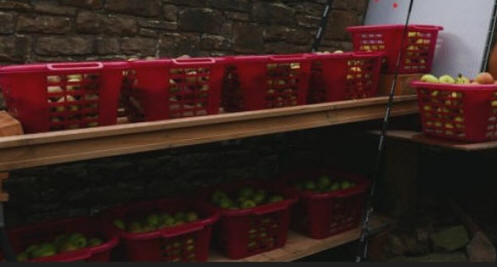
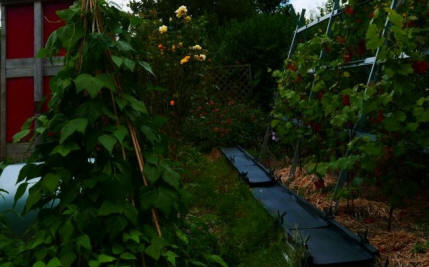
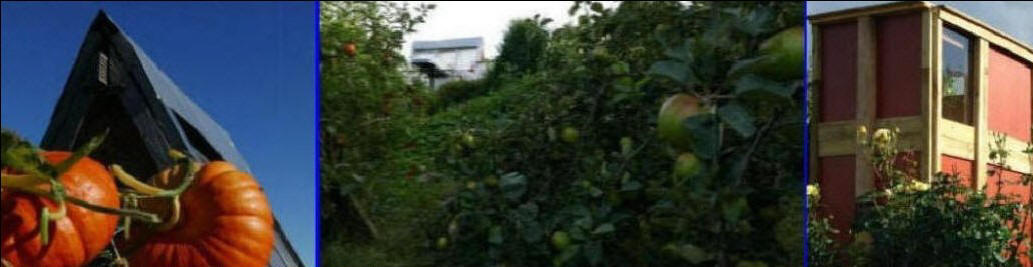
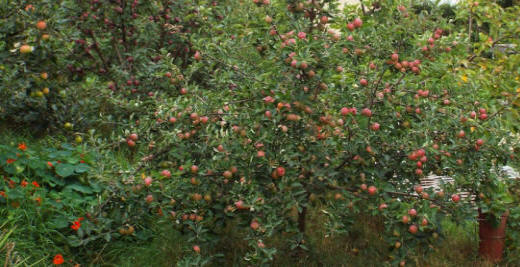
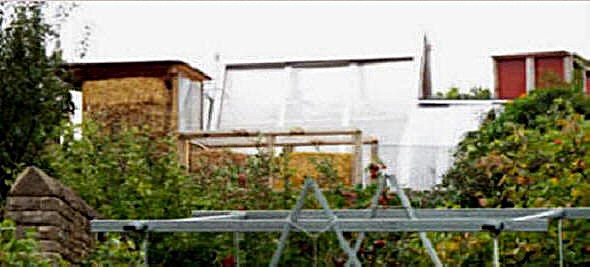
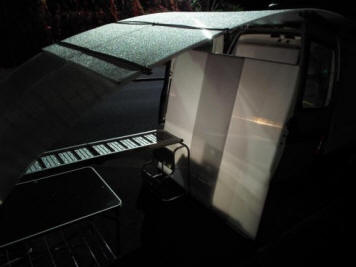
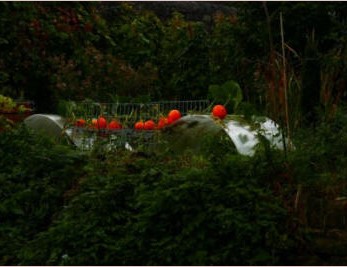
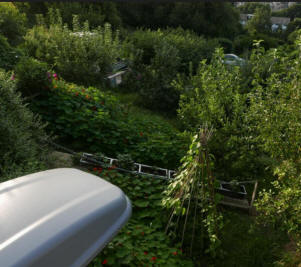
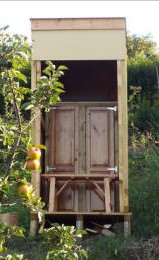
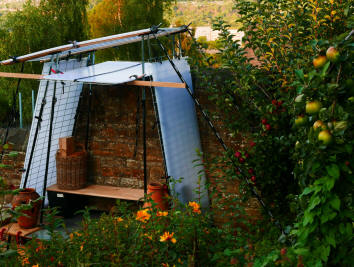
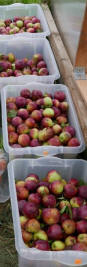
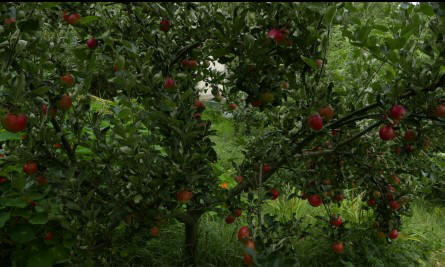
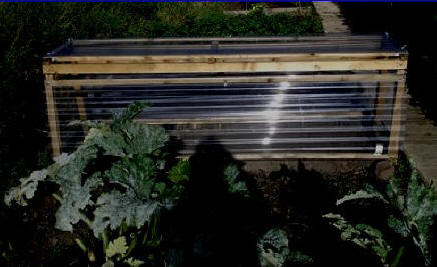
Photograph 2, row above: Not long after this
photograph was taken, intruders, or a single intruder, scattered apples
taken from this store on the ground and threw apples into the wildlife
pond at the bottom of the plot. I've lost count of the number of cases of
vandalism and theft of tools and equipment which have taken place here - but
only one case of threatening behaviour.
This plot is very hard to
secure, for reasons to do with the extensive boundaries, but I've worked to
improve security. There can be no guarantees of complete success, but I
think, or I'd like
tto
think, that the problem is under control. A worrying development has been
visits by thieves obviously equipped with some quite sophisticated tools,
used to break into the smaller upper
plot, which is much easier to secure
than the larger plot shown here. There's an Anderson Shelter in this plot, a
reminder of the Sheffield Blitz. The Anderson Shelter in the
neighbouring plot,
a very heavy structure made with thick corrugated metal, was stolen by thieves. There was a murder in an allotment not far away, many years ago. A garden fork was the murder weapon.


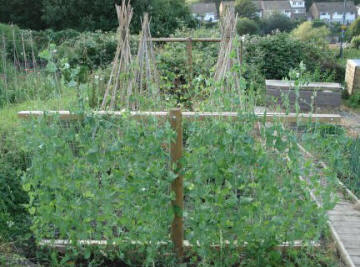
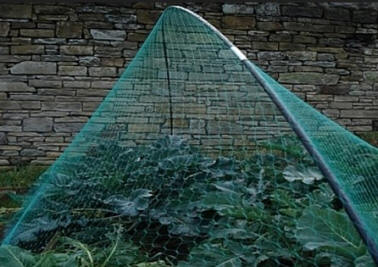
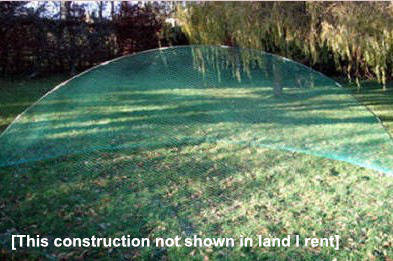
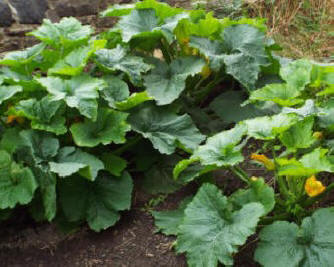


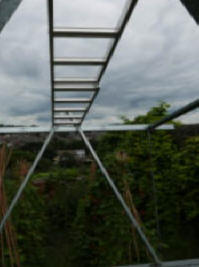

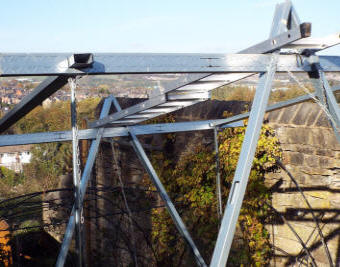






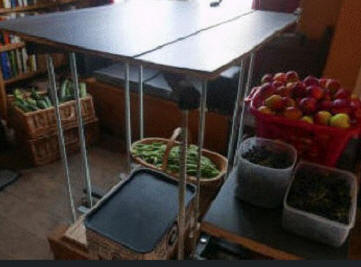

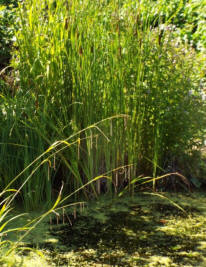
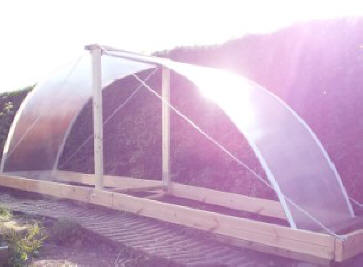

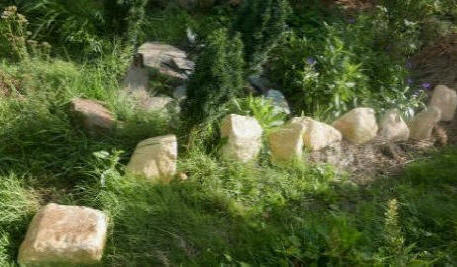



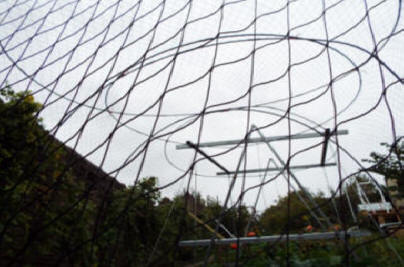
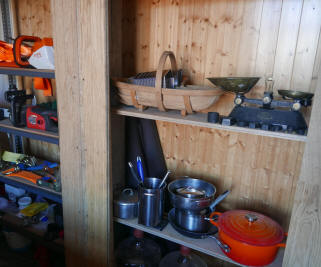
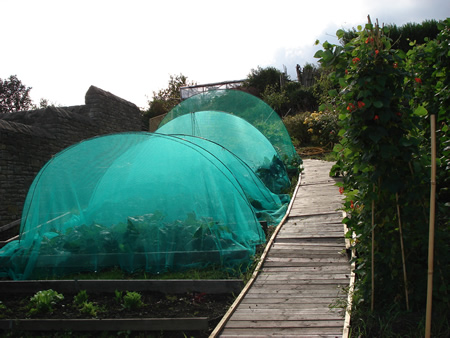
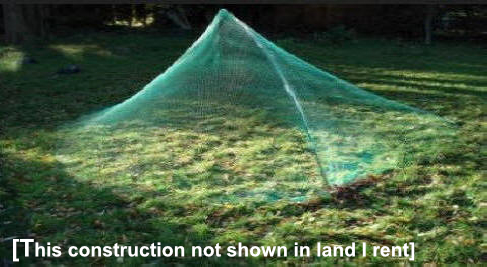
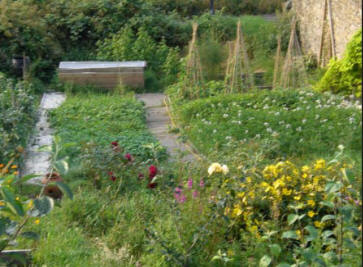
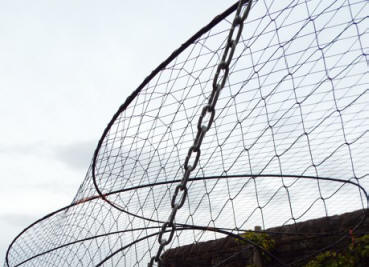
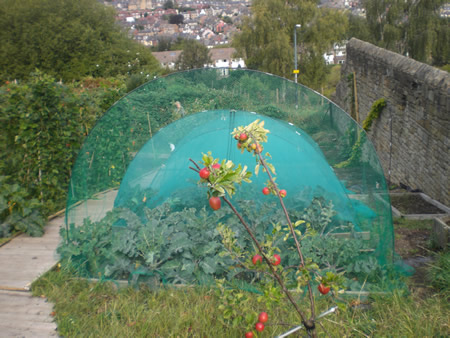
Row above, photograph 1: the large versatile
structure I constructed using lightweight galvanized steel beams, used here
as supports for netting. This netting cage has been
used to protect
quite a wide range of crops over the years from bird damage, including white
and purple sprouting broccoli and Oriental vegetables, Mizuna, Pak Choi and
Komatsuma.



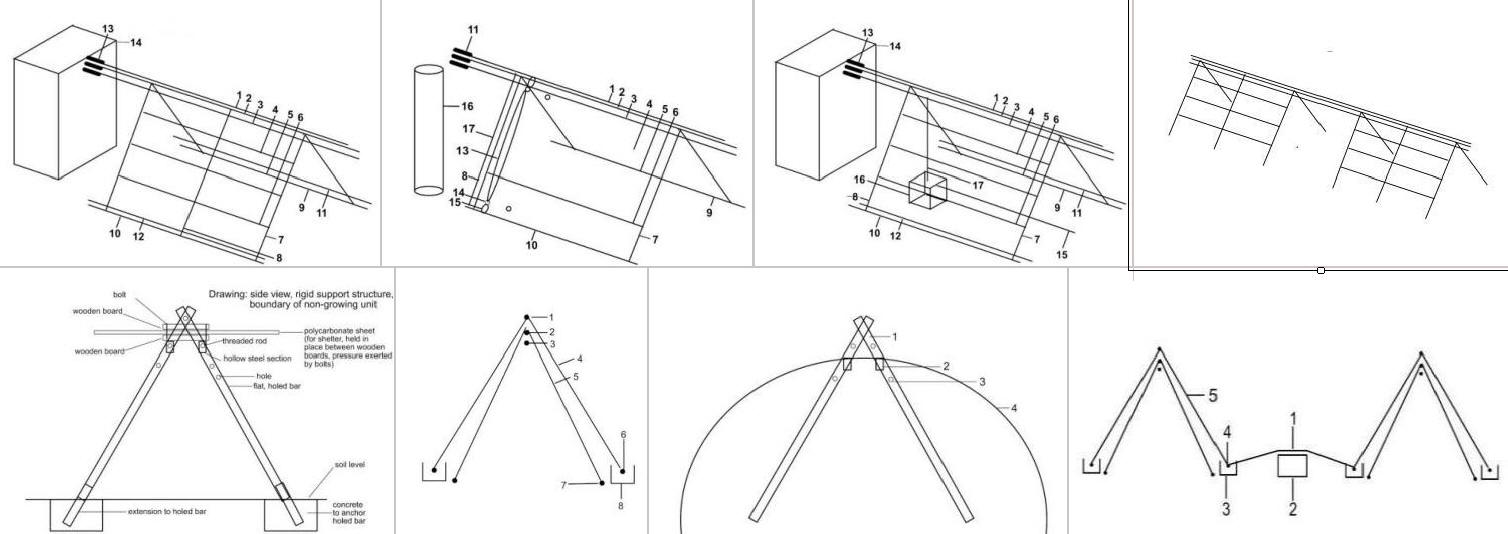
Click on official U.S. patent document
to view the pdf document on this site. Zooming in will be advisable in most cases to
obtain a text size suitable for reading, to a magnification of 150% or more.
To view the patent document on the United States Patent and Trademark Office Website:
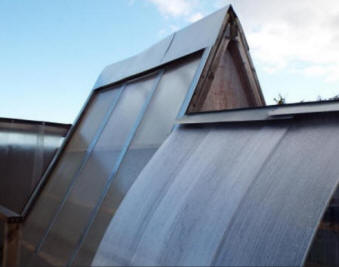

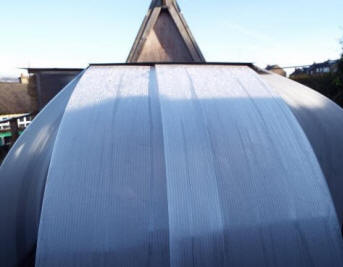
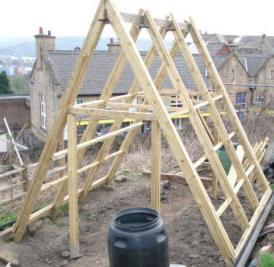


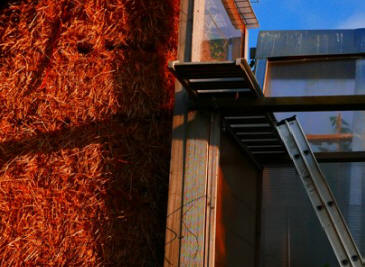
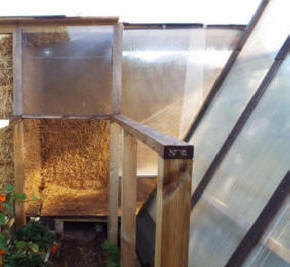
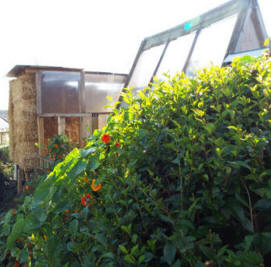
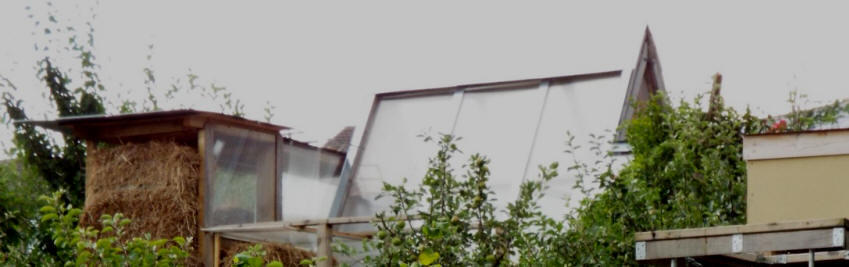
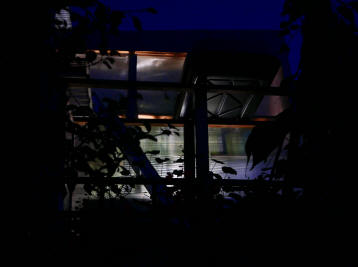
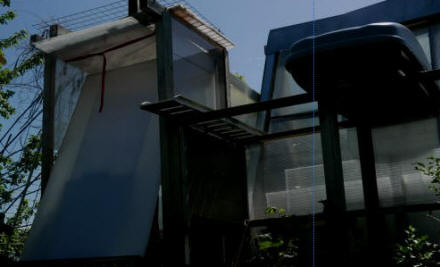
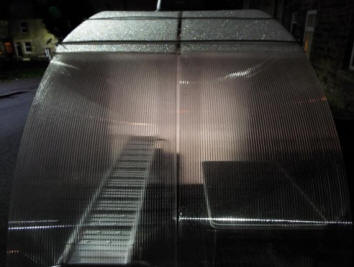
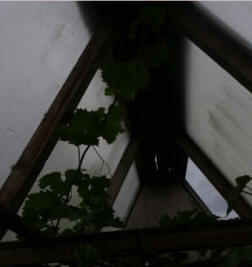
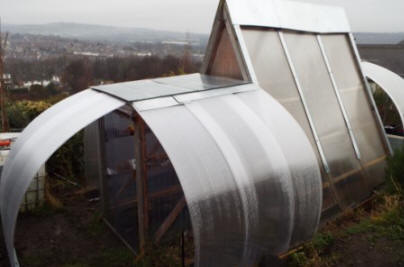
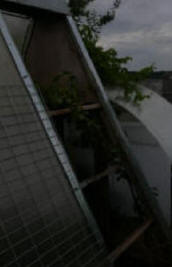
Above, 1st photograph shows New Greenhouse Design. The
core structure takes the form of a triangular prism (a shape with great
structural strength.) Around the core structure are
extensions, here
with curved panels. Three straight panels of the core structure are visible
on this North-facing side. There are 3 panels on the South-facing side. The
system has great
versatility. With all the panels in place, gutters and
pipes at the base can divert water collected from the roof to water storage
containers and ponds (dual-function, for water storage and to
benefit
wildlife). Panels can be removed and put back very easily. When most or all
of the panels are removed, crops inside the greenhouse can be watered with
natural rainfall. The system
has many advantages for water conservation.
It reduces reliance on mains water. It has many other benefits, e.g. for
temperature control. Ventilation is very important, to reduce or
eliminate overheating when external temperatures are high and for other
reasons. One or more panels can be removed and all the panels can be
removed, to give maximum
ventilation. Plastic coverings don't enhance
the appearance of a site, for most people. When polycarbonate sheets aren't
needed, none need be visible. One of the panels on the South-
facing side
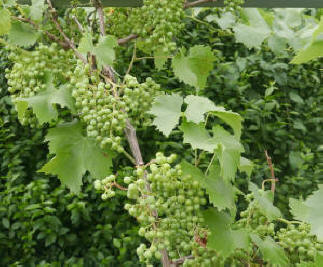
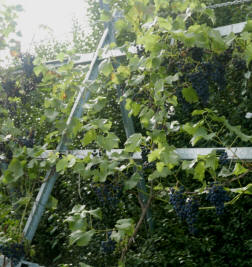
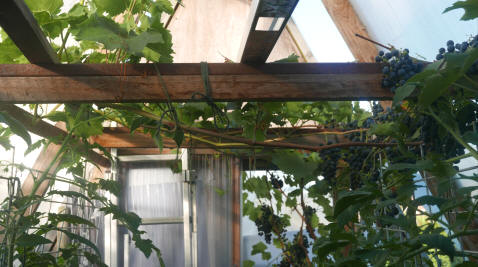
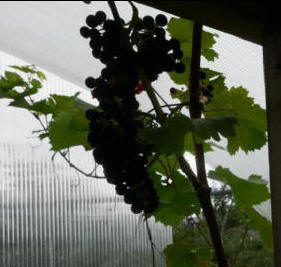
has been removed permanently. A grape vine in the greenhouse grows inside
the greenhouse, at roof level, and outside, higher up, above the roof.
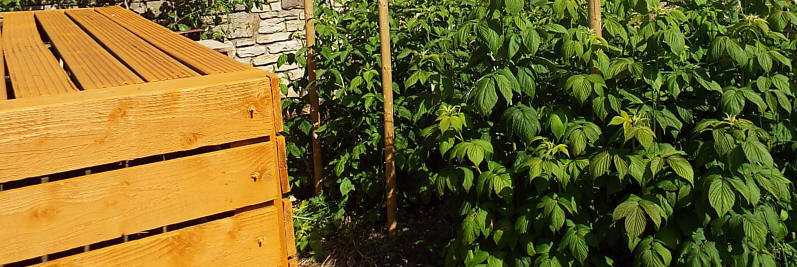
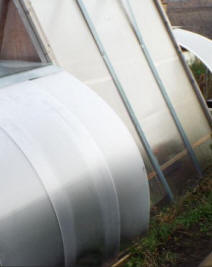
The extensions shown
below, on the West side, include a 'solar
composter,' which speeds up the production of compost by the greenhouse
effect, a wildlife / water storage pond and other growing areas.
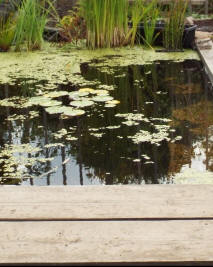
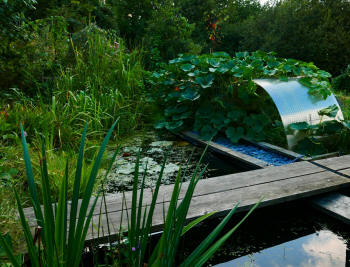
There's a much larger wildlife / water storage pond outside the greenhouse
and other water-collecting surfaces and water storage facilities.
An extension on the East side includes a
storage area for e.g. tools and supplies
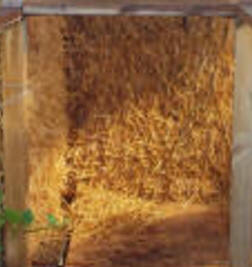
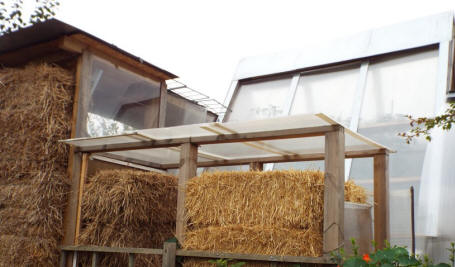
and a working area for e.g. propagation. A straw bale wall has been a
feature of this extension (shown above, also with a straw bale storage
area.)
The greenhouse has
been featured in an article I wrote for the magazine of the National Allotment Society.
My New Growing System for farms has the advantages of the New Greenhouse Design as well as many other features. From the official U.S patent document: ' ... the present invention
is a trellising system with modifiable components and configurations for growing, protected cropping, protected working, materials handling, water collecting and water conservation for
use in vineyards and orchards and as a polytunnel
substitute.' The New System has aesthetic advantages. The plastic sheeting
which forms part of the system is needed to secure
environmental advantages
but is unnecessary when external temperatures are high and no water can
be collected. Unlike the plastic of polytunnels, the plastic used in this
system can
be retracted. The plastic need not be visible when not needed.
The plant growth on the unobtrusive supports will be seen all the more
clearly.
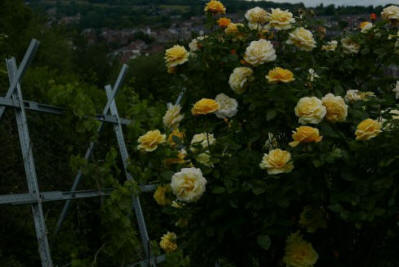
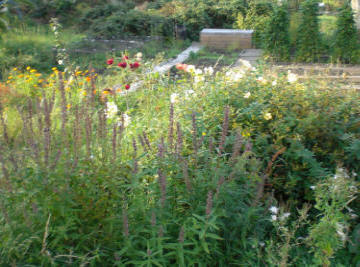
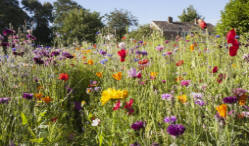
Below, images of
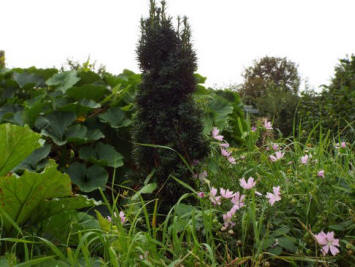
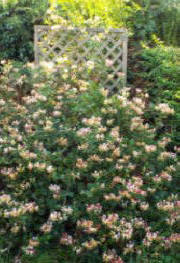
flowers of native British plants in the land I rent, most of
them growing there due to my active encouragement.
There are just two
exceptions. Solanum crispum isn't a British native. Pilosella aurantiaca
isn't a British native but s widely naturalized in this country.
I'm
never in the least danger of neglecting food production in the land I rent
but without neglecting other plants, the 'ornamental plants' - but I'd
rather think of them as the 'sensuous' plants or the
'beautiful' plants,
although many of the edible plants are sensuous, beautiful as well. And
there are so many plain, unobtrusive, even drab plants which interest me so
much, plants which I view
with a degree of affection.









 aaaaaaaaaaaaaaaaaaaaaaaaaaaa


 \
\
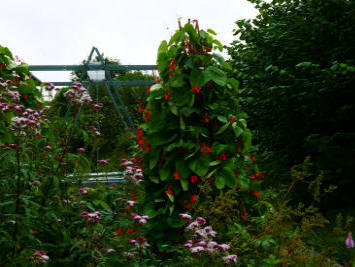
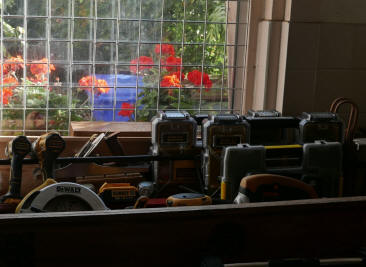
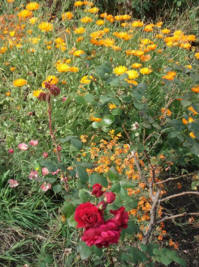
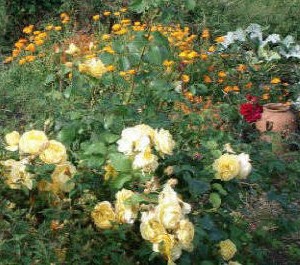
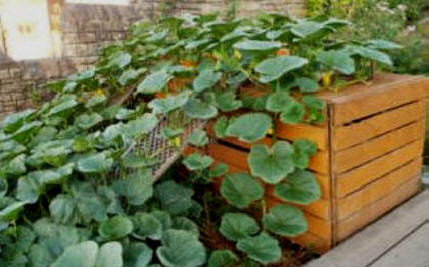
Row of Images above: Image on left, some Geranium
(Pelargonium) flowers in a container on the wall platform high above the
large growing area, some of it shown in the Image. The
crop being grown:
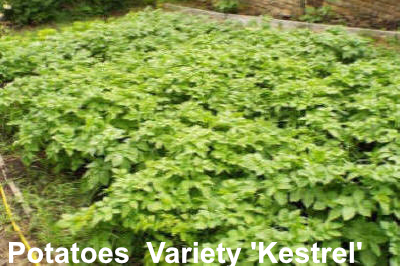
variety Kestrel. The same variety is shown in two images above, with much
more of this growing area to be seen.
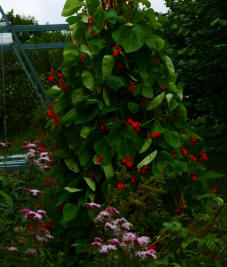
Image in centre and Image on right:
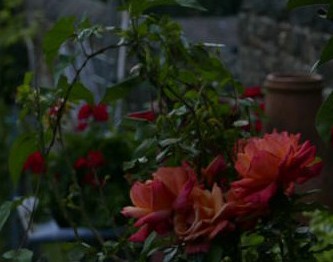
red flowers of climbing rose, variety 'Olympic flame.' This was
planted next to a privet hedge on the lower boundary of the upper growing
area,
Plot 112, which is growing in a very awkward
sloping area, difficult to reach and keep in check by pruning. The rose
plant is very vigorous, competing very well against the privet and
now
suppressing its growth. I planted a climbing perennial sweet
pea, which has been able to suppress growth of a much smaller privet hedge
at the upper end of the lower allotment,
Plot 111. I also planted
hawthorn hedging in front of the privet hedge. This has grown well, allowing
the privet hedge be removed completely. I planted blackthorn hedging on part
of the
boundary with the neighbouring allotment. When I began to
cultivate this land, there was no hedging at all, and nothing to prevent
intruders from walking into the land I rent. I planted
gorse hedging which has grown very well. Its spines
effectively deter intruders. These hedging plants only cover a fraction of
the long boundary between this plot and the neighbouring
plot. I planted
five hazel trees along the boundary. These leave no gaps. The hazel trees
have many advantages, not least for wildlife. They produce hazel nuts in
abundance, support over
250 insect species - the male catkins provide an
early source of pollen for bees and other pollinators in late winter and
early spring - and very good nesting sites and shelter.
The multi-stemmed
growth habit offers the advantages of a hedge, forming an effective
barrier to intruders, with some additions, which are very easy to provide.
I don't coppice the
trees but coppicing provides wood which has many
uses in the garden and for traditional crafts. A short section of privet hedge
by the allotment path leading to the entrance to Plot 112 will
be left
for the time being. I encouraged two beech saplings in front of the hedge to
grow, and they've grown well. I intend to convert these trees into beech
hedging. I like native hedging
plants and have taken a strong dislike to
privet. A long length of privet hedge forms the boundary between Plot 112
and neighbouring allotments. My very small vineyard is next to
this
privet hedge. I've devised a method to partially suppress growth of the
privet without compromising the boundary. Without supplying any detail, I
intend to to construct a long solar
composter with one long, sloping
wall, made using some of the used polycarbonate sheets I have. These are
easily removable, for appearances' sake. Compost
materials will be placed
in the composter. Conditions in the composter willbe favourable for the formation of compost but not favourable for the growth
of the privet plants. Increase in the width of the hedge,
on this side, will
be checked. It's likely that the privethedge has been having an
unfavourable effect on the grape vines. This method is intended to reduce
its competitive advantage.
The polycarbonate sheets are easily
removable.

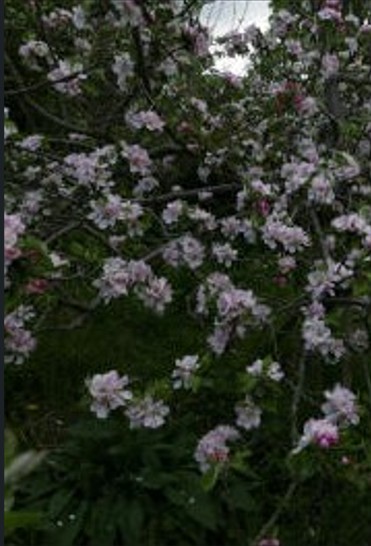
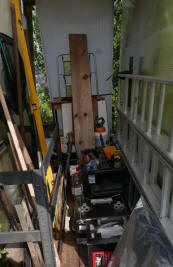
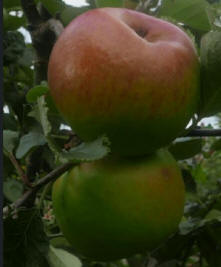


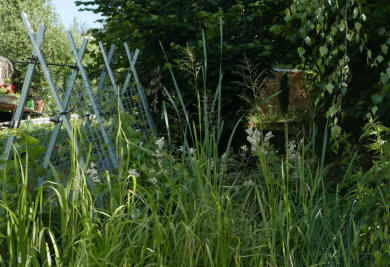

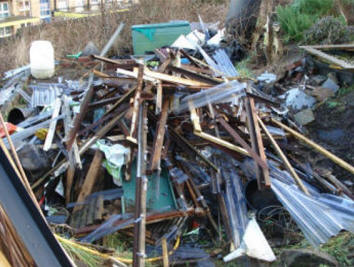
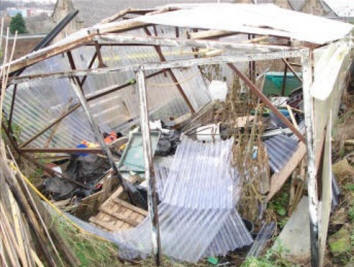
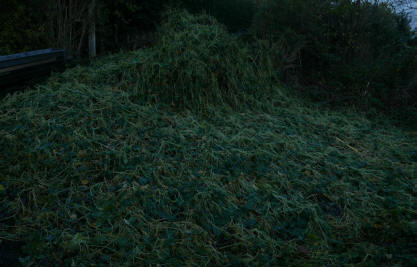
.Images in the row above: Images 1 and 2: the wreckage left after very strong winds destroyed the very old greenhouse which occupied this area for many decades before I took on this land.
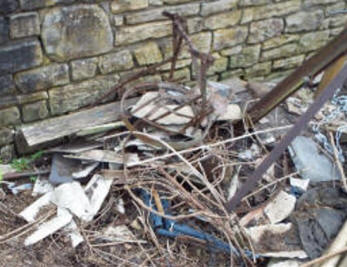
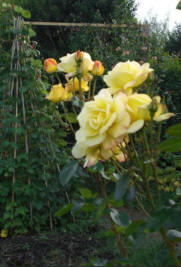
Image 3, the debris to be found in one corner of the same allotment when I took on the land. Image 4, a Floribunda rose, 'Abraham Darby' which I planted in the upper allotment.
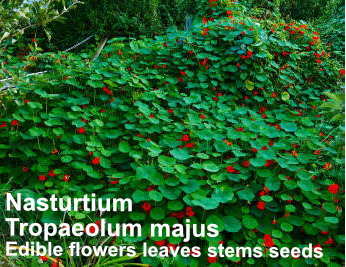
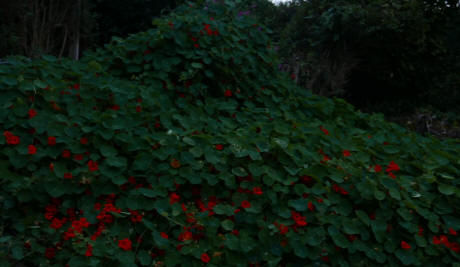
Image 4, the area occupied by Nasturtium, Tropaeolum majus, on a North-facing slope, shown in flower in some other images. The slope was steeper before planting, corrected with earthworks.[]]]]]
I cleared the site where the greenhouse had stood,
precariously, before it fell, and had all the debris removed in a
skip. I designed and constructed a greenhouse of radically new design.
I
ensured that the new greenhouse would withstand winds of any force,
except for exceptionally violent winds, the kind that would cause damage to buildings of brick, stone or concrete.
The main growing area makes use of straight polycarbonate sheets,
similarly one of the two large extensions, but the extension at the
other end makes use of curved polycarbonate
sheets. I've long experience
of using curved (and straight) polycarbonate. Proper use of curved
polycarbonate sheets allows the construction of surfaces with great
structural strength
and remarkable resistance to wind damage. I've
provided quite detailed information on the site about these features, the
flexibility of the system. It allows the removal of one one or
more of the
straight (as well as the curved) panels. All of them can be removed if
necessary - when the external temperature is higher than 30 Celsius, then no
heating by the greenhouse
effect is needed. Removal of panels allows natural rainfall to water the
crops inside the greenhouse, avoiding a great deal of unnecessary work. The
panels can be replaced as easily as
they are removed.
I cleared and removed a great deal
of the debris shown in Image 3 but I found that the debris went down to quite a depth and
that there was a great amount of asbestos sheet. Fragments
of asbestos sheet
can be seen in the photograph. I planted a vigorous
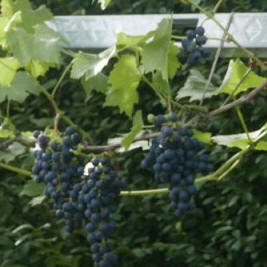
grape vine, Vitis vinifera Brandt near to the area shown, which produced grapes - small grapes in large quantities,
well worth having. The vine
has grown as far as the composter nearby and covers the roof of the
composter, which was the first structure I built after taking on these
plots. I now use the
composter for storage.
Below, some images taken in the summer and autumn of 2025: projects undertaken, land use, miscellaneous images, accompanied in some cases by more than minimal text.












1

2

3

4
5
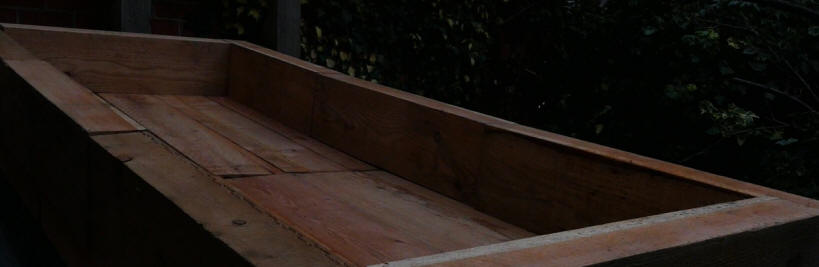
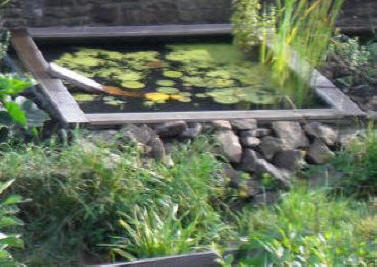
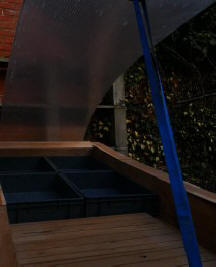
6
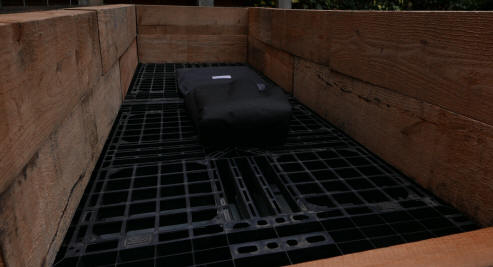


7

The extensive material on flooding and the use of boats of new design to help the victims of flooding is now on a new page Building boats and much more: a versatile, flexible system
Above, some of the images from the page. Row 1: showing flooding scenes, rescue, damage. Rows 2 and 3: prototypes, examples of dual-unit boats with contrasted units. Only one
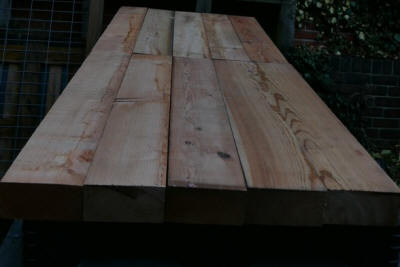
unit is based on larch (or oak) beams. The other unit is structurally very different. Row 4, prototyping on the sloping prototyping bench (the slope has advantages in viewing and
working on prototypes.) The images show Dual-unit bases and dual-unit boats in a very basic, preliminary form, simply larch beams placed on the bases. These are the longer
beams used in this design.
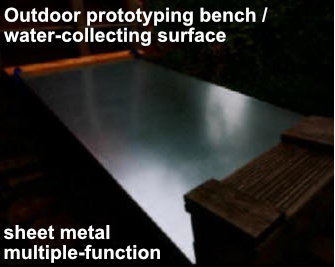
Image shown in Row 5: shorter larch beams and a thin surface material fixed to the longer larch beams have important functions in the design. The
'thin surface material' is galvanised sheet metal, not visible here. This has multiple functions. The functionality can also be achieved by other means. The small larch beams are
clearly visible at the perimeter of the structure. When the structure is used as a boat, this raised section prevents water from entering the boat in water which isn't flat calm.
This is the 1 layer configuration. To deal with rougher waters (but not very rough waters) another layer can be added. Not shown and not yet installed on this prototype, the methods
I've devised to prevent these perimeter components from moving. These methods allow these smaller larch to be quickly removed and quickly replaced, on one side or more than
one side. They will need to be removed on one side when bulky materials are brought on board, to give free access.
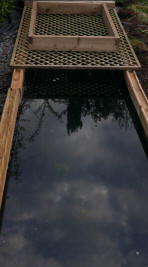
The second image in Row 5
shows the raised
wildlife pond I constructed many years ago, in the area now occupied by a
water-storage pond, as well as a growing area. This was the first
pond I
constructed in the land I rent. The pond which can be constructed according
to this much newer design is larger and much easier to construct than the
older pond. The sloping
board visible in the photograph is to allow
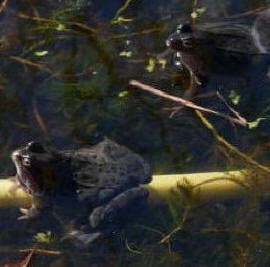
animals, in particular frogs, to get out of the pond. There's a similar
board in the water storage pond inside the greenhouse, which is frequented
by frogs.
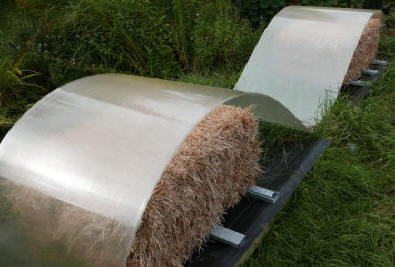
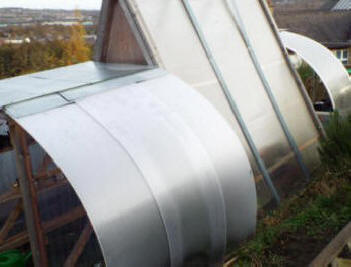
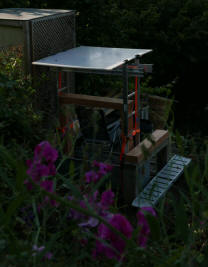
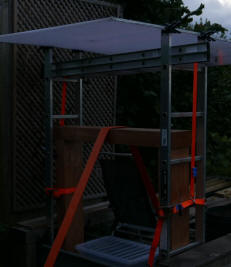
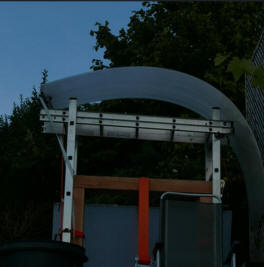
The third image in Row 5 shows some work on the
issue of provision of shelter, for weather protection, of people and also
property. This is a further use for curved polycarbonate
sheets. For this
preparatory work, only one sheet has been used. Two overlapping sheets would
be necessary here. A second sheet was available but one sheet is sufficient
to obtain some
useful findings. This is a demanding application. Previous
experience and previous uses, which include various applications as
greenhouse extensions, have made it possible for me
to build structures which can withstand very strong winds without any damage. If a boat is used in a static or semi-static capacity, as during flooding, then methods are available to
incorporate shelter without too much difficulty. The movement of the boat can be constrained, to prevent lateral motion and allow only upward and downward movement. When the boat is
used as a sailing boat, then the problem is much more challenging. The polycarbonate sheets can act as sails and the effects can be extreme. The situation becomes more manageable
when the boat is carrying a large, heavy load, one which is of appreciable height. This kind of load has great inertia and can provide gives and secure fixings for attachment of straps
or chains which can prevent flexing and other distortions of the sheet. In practice, sheltered or fairly sheltered conditions would be needed and the sheets would be taken down if the
wind is obviously excessive. The sheets could be stored along the sides of the boat. They could be added to polycarbonate sheets which form the bows of the boat., if these are being used.
When the sheets are being used above the deck and in contact with the deck at one end, the curvature of the sheets can easily be adjusted, to give a longer but lower protected area or a
shorter but higher protected surface. However, the length can easily be almost doubled by linking a second sheet to the first sheet, with some overlapping of the sheets. This is a procedure
I've used for other projects.
Other methods prevent movement of any chairs and tables on the deck, fix the rowing seat in position and allow for the installation of oarlocks to take the oars when the boat is propelled
by rowing. The containers, visible also in one of the photographs in row 3 above, can be increased in number or decreased. Oak panels, visible in the photograph in Row 4, can be
increased in number - they can also be varnished. Varnishing of the larch beams, some or all of them, is also easy to carry out, or relatively easy.
When additional components have been added, when
some modifications have been carried out, then this will look more like a
boat, less like a plain box structure, but function
determines structure
to a large extent. This is, after all, a flat-bottomed boat, with the
advantages of a flat-bottomed boat, such as the ability to sail into shallow
- very shallow - water.
This boat is designed to carry heavy loads, not
to win races. The modifications necessary for installing an outboard motor
at the stern (but either end of the boat can become the stern,
or the
bows) would make it clear that this is a boat, and no longer a garden-based
structure. The addition of oarlocks and oars, or a mast and sail, would
similarly remove any doubts.
When the structure in these photographs is used for other purposes, rather than as a boat, then the same components are used, or a selection of these, sometimes with a few more components.
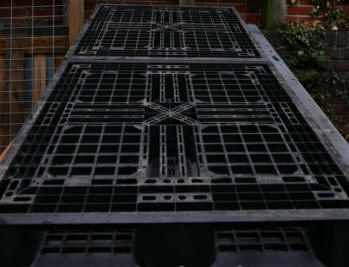
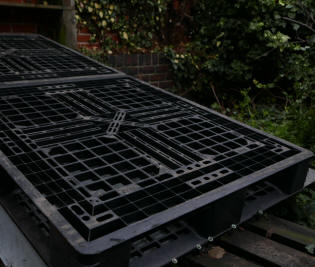
Row 6 Photograph 1. This shows part of the plastic base, with no horizontal larch beams in place. The vertical front of the structure, which is identical to the vertical rear part, clearly visible
at here, has been removed. This allows a better view of the interior of the structure, which now contains, just for display, a PVC pond liner, further back, and underlay, nearer the front. This
shows the configuration for container growing. For this use, the floor beams are unnecessary and can be used for other purposes. When the underlay and pond liner are installed, then this
makes a large raised container bed, suitable for growing a wide range of crops. This large bed is made up of two units, with two bases. More units can be added, to give a bed two, three or four
times as large. Alternatively, a smaller bed made up of one unit, with one base, can be built. Any bed can be divided to give two smaller beds, of varying sizes, by installing one or more divider
beams. Liners and underlay of a different size from the ones shown here are readily available. The liner and underlay can be arranged to cover this divider or a larger number of dividers.
When the liner and underlay have been installed, compost (or soil, or a mixture of the two) is added.
I've already designed an add-on bow structure, installed on the end of the boat acting as the bows, which makes the boat much more streamlined. The bow is of the kind named 'straight-
stem bow and is yet another use for polycarbonate sheets, here with a sharp bend rather than curved. The polycarbonate sheets shown in the second diagram in make up
double layers, for additional rigidity and structural integrity, with the sheets brought to a sharp frontal line. Bows with more than two layers can easily be constructed. There's insufficient
room on the prototyping bench to include an add-on bow to the prototype boat.
A polycarbonate sheet, straight or curved, can be
installed on the container bed. The curved bed can be made resistant to wind
forces more easily than the straight sheet, but the problems
aren't
substantial in the least. The polycarbonate sheets have these main benefits:
they allow for protective
cropping, making use of the
'greenhouse effect' to raise temperatures inside the
structure, extending the growing season, making possible the growing of tender crops. They also achieve shielding of the compost from heavy rain, preventing it from turning into mud.
There are no drainage holes in the liner. It would be easy to make drainage holes, but in most circumstances, unwise - an intact pond liner is needed when the system is converted into a pond.
A further use is as a water collecting surface. This structure is on a slope and water is carried down to a water collecting / storage container outside the structure. For structures which are
non-sloping, a slope is easy to arrange. An additional row of horizontal shorter beams installed at one end, on top of the existing layers. The water collecting surface can be extended, if the
space is available. The space is unavailable in the
case of this prototype, which is installed in my very small backyard, with a
plum tree growing very near. There was no garden when I moved
into the
house. Extended water collecting surfaces can be constructed using more
polycarbonate sheets, or flexible polythene sheet material, generally
requiring a lightweight galvanized
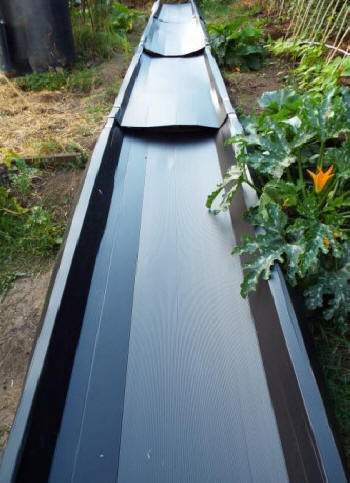
steel support or more than one support, or black surface protection sheets which can be easily opened out or folded back in and which work very well when used for this different purpose,
water collection. There are various examples of this use in the photographs towards the top of this page, most of them laid on what were originally paths, and which can easily become paths
again by removal of the sheets.
The configuration for a wildlife or water storage pond is very similar - the pond liner and the underlay are installed on the base, but in this case, the thin sheet mentioned above is installed
on the plastic base. On this sheet the larch beams, longer and shorter, are installed and the pond liner and the underlay are added. The polycarbonate sheet (or sheets in the case of larger
systems) is unnecessary as a water collecting surface. Rainwater and other forms of precipitation can fall directly on to the water in the pond. However, polycarbonate acting to promote
the greenhouse effect will be useful in the case of more tender water plants, if any are grown. The polycarbonate will obviously not be used as a permanent fixture. It can be removed easily.
When the structure is used for growing plants, vegetables and fruit or non-edible plants, the plants grown can be perennial or annual. Growing perennial plants will need the structure, or
part of the structure in the case of a larger multiple-unit structure, to be available for years in many or most cases. If annual plants are grown, then changes of use are easy. For example,
amongst food plants, courgettes (but not strawberries), bush tomatoes, cordon tomatoes, broad beans, dwarf French beans, climbing French and runner beans, lettuces, cabbages and
potatoes could be cultivated. There are many other possibilities, of course. At the end of the growing season (which can be extended by using the protected cropping facilities), then
the structure can be put to an alternative use, such as water collecting and storage. Rain in late autumn and winter can be collected and stored, available for use in watering the plants
grown in the next season. The compost is easily
removed from the structure. I find a scoop, as used by bakers to transfer
flour, very useful for this and similar purposes. The compost can
be
stored for future use, with additions to restore full soil fertility before
use. A wildlife pond has to be regarded as a permanent fixture, although a
wildlife pond can occupy just part of a
multiple-space structure. A
water-storage pond is different. It can be drained, without wasting the
water, and then used for a different purposes, such as growing crops in
spring, summer and
early autumn.
If the structure is used as a viewing platform, then the pond liner and underlay are unnecessary, but can be kept in position. It will be necessary to move out of the way their topmost part,
to allow for installation of short horizontal beams placed on the vertical beam layers making up the rectangle, and at right angles. The same configuration is used to build a storage box.
As with all the applications of this very versatile and flexible system, smaller and larger structures can be built, from a size corresponding to 1 base, 1 unit to multiple bases, multiple units.
The storage box requires a door, or more than one door in the case of larger boxes. I don't provide the information for inclusion of these.
iIf the 2-unit structure shown above is increased, to give a 4-unit structure, then the water surface area becomes 3.52 square metres, which is more than sufficient for dragonflies as well as
damselflies to visit the pond. However, the depth of the pond is
important.
Dragonflies ideally need water no more than about 30 cm deep
and the pond as shown here is much deeper than
that. Dragonflies do not
need shallow water in all the pond. Larch beams placed on the base over a
proportion of the area before the pond liner and underlay are put in place
will give a
shallow area. If the main use of the pond is for water
storage, then the deeper pond can be constructed. If a larger multiple-unit
pond is built, there can be vertical walls only at the perimeter,
to give a pond with a single undivided space, or the internal space can be made up of two separate spaces, four different spaces, or a different number of spaces. Again, the system has the
flexibility to choose from alternatives. In this case, one space can be used
for water storage and another space, with a lower water level, to attract
wildlife such as dragonflies. Water lilies
can be planted in water
storage ponds as well as wildlife ponds, but these need to be non-native
plants. The native water lily, Nymphaea alba, is very demanding. It needs
water which is at least
1 metre deep and has a spread of approximately
120cm. The much larger ponds needed to accommodate Nymphaea alba can be
constructed according to this system but techniques are
needed which enable the walls of the pond to withstand the varying water pressures, including pressures much greater than the ones which are taken into account in these ponds with lower sides.
Row 7.
The I used the prototyping bench which supports the base and the layers of
this system - some possible configurations of the new system. There were
some problems which required
solutions, not problems to do with the main
system but problems to do with aspects of the system, but important aspects.
I found solutions which satisfy me and which I've tested. The bench is
in my yard. When I took on this terraced house, there was no garden, only the backyard. In the neighbouring backyard are the outside toilets which were used before the luxury of indoor toilets.
I grew up in a terraced house without an inside toilet or a bathroom. This
was no hardship. We brought the metal bath up from the cellar o Friday
night, bath night, and we had a bath one after
the other in the same
water. For use in the outside toilet, there was no toilet paper (or toilet
tissue). We had the use of squares of newspaper. There's a Monty Python
sketch about growing up
in poverty, with more and more exaggerated accounts. I had no interest
in gardening when I moved in, but in time, I began to take in interest. I
used a great many containers and filled them
with a mixture of things:
soil I bought and had delivered (very, very poor, infertile soil, with many,
many stones), compost I made, and leaf mould I made from autumn leaves
collected in the
area. I grew a wide range of vegetables and I planted a
plum tree, variety Opal, in the centre of the new garden. The fruit tree is
still there, still producing fruit, but when I took on my two
allotments, I felt no need to continue container gardening in the yard.
Now, I want to resume container gardening after an interval of so many
years. The main container is the single system container shown above, now
used as a raised bed, with the perimeter
walls constructed from larch
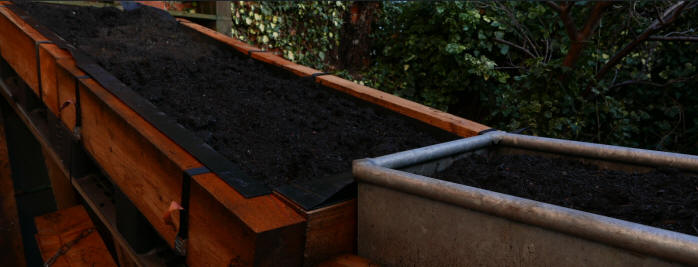
beams resting on the two plastic bases. There are two similar views of the
raised bed in the photographs of Row 7, containing compost which I bought in
bulk.
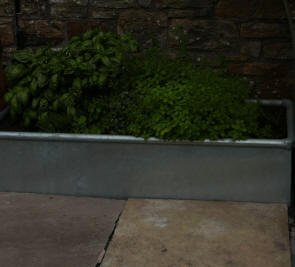
To the right in the photographs is a galvanized metal container, not part of 'the system.' This is filled with some of the compost bought recently. There's another, larger galvanized metal
container not visible in either photograph, at a lower level - resting on
the asphalt surface of the yard. I've chosen the crops I intend to grow in
each of these containers. They include herbs
as well as vegetables. I
intend to recycle the compost in these containers eventually, by adding the
compost to the soil which covers most of the garden. The soil needs
increased depth,
although the plum tree and the hedge on one side of the garden have grown very well in the soil available. I can fit in a vegetable crop (a very vigorous one) in the soil available, on the side
opposite the hedge.
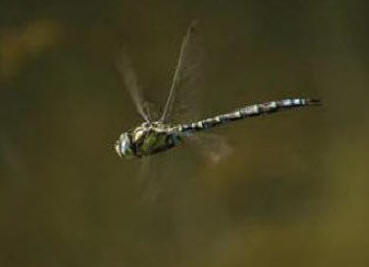
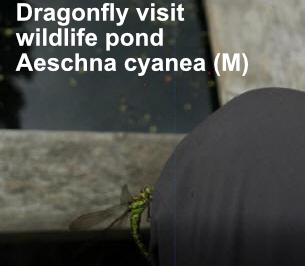
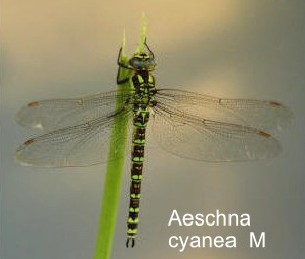
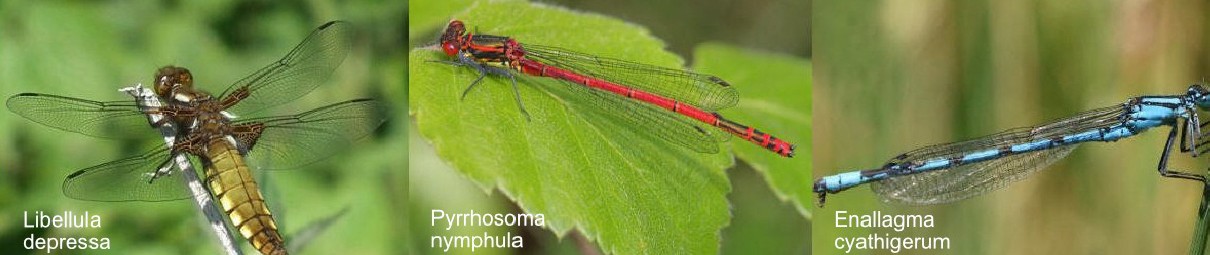
Below, The wildlife pond, some visitors, dragonflies and damselflies. These photographs not taken by me.
to
A wildlife pond can be very useful as a water storage pond. I've found that the biggest difficulty is the fact that there are very large numbers of tadpoles in the water in the spring, after
frogs have mated there. When a watering can is used to collect water from the pond, many tadpoles are unavoidably transferred to the watering can. I designed a simple modification to
prevent this from happening, a mesh filter placed over the opening to the watering can.
Next, some miscellaneous, supplementary information.
Row 6
shows a forklift truck. Range is an important concept
for me. Range includes, of course, the small and the large, the very small
and the very large. I carry out work relevant to small-
scale gardening,
gardening on a larger scale and farming. The system which can be used to
build so many useful structures - a wide range of useful structures - can
accommodate carrying
of components using simply muscle power, by hand, or
by using a trolley or wheelbarrow, but it can also incorporate machine
handling, industrial methods. The units which make up the
boats, the
container growing structures and the rest, can also be moved in bulk, by
forklift truck. I don't own a forklift truck but for commercial operations,
the fact that the design includes
this facility is important.
The plastic bases are essential in these designs. The number of bases determines the number of units. The number of units can be increased to give larger boats, wider and / or longer.
A smaller one-unit boat can be constructed. All the boats shown here are one layer boats, with a single layer of larch (or oak) beams. Multi-layer boats can also be easily constructed, with
two or more larch layers, capable of carrying bigger loads, but one-layer boats can carry a substantial load. Each of the bases shown has a rating of 1 tonne. When used in boat form, when
the boat is floating, then the upthrust from the water changes the rating appreciably, allowing heavier loads to be carried.
u
If the dual structure here were to be launched in a suitable pond, lake or river (not the sea), then obviously, the two units would quickly separate. The beam-superstructures would remain
on the bases only if the water were perfectly calm or very calm. I don't provide information about the 'binding' methods I've devised to ensure that the components of a boat constructed
according to this design stay together. I'll be providing only the most basic information about any of the additional structures and the necessary fittings and equipment added to the
decks. These would differ markedly, depending upon the intended use or uses. I don't provide information about the fixing methods I've devised to ensure that the additional structures,
fittings and equipment stay in place. The page 'Building boats and much more: a versatile, flexible system' does supply some information about these matters in connection with dual-unit
boats with contrasted units, the boats illustrated in rows 2 and 3.
in
The boats which can do something to mitigate some of the effects of flooding can also be used in very different ways and propelled in different ways., including propulsion by punting.
One of the various uses for the boats is maintenance of ponds and smaller lakes. These doneed maintenance - for example, correction of plant overgrowth. Water lilies, despite their
beauty, can become too much of a good thing. They need taking up and periodic division. This work needs a boat but the boat won't be used very often for this purpose, although a
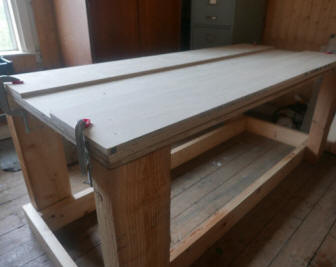
boat would be very useful for other purposes. This design allows the components to be used for other gardening work as well as non-gardening work. A large and sturdy table which
lasts a very long time and can withstand any weather conditions can easily be constructed using some of these components. The table can be quickly built using the larch beams
which are smaller in length (but with other dimensions the same as the longer beams). These beams are used as uprights, supporting one or more of the bases, which now act as the
table top, with the thin surfacing material fixed to the table top. This arrangement gives a table with a convenient height for very many purposes. Instead of acting as a table, this makes
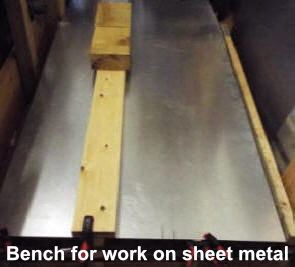
a very strong and useful workbench, again, at a convenient height for very many purposes. (The workbenches illustrated on this page were constructed years ago, before this system.)
Other configurations make it easy to construct platforms. I find that viewing platforms and sitting platforms in a garden enhance the experience so much. So much more can be gained
by viewing the garden from above. The fact that the increase in height is very modest doesn't impair the experience. The components can also be used to construct the basic framework
of garden sheds. The plastic bases used in this system make very good bases for sheds.
The page
Building boats and
much more: a versatile, flexible system will
contain much fuller information about the structures which can be built using the
components bases
and beams, together
with other components, generally few in number. I
don't give information on this page about use of this system to build -
quickly and easily - storage units and shelving units. The shelving
system referred to in an image on this page is an earlier system, making use of different components, oak panels and straps - nothing else. No screws, nails or other fixings are used and
there are no woodworking joints. This is a radical design. Facilities for presentations, displays and publicity are described in quite a detailed way on this page, below, but don't embody this
design system - but these different systems can be integrated.
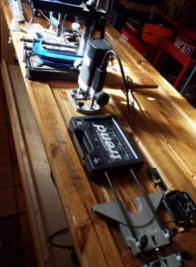
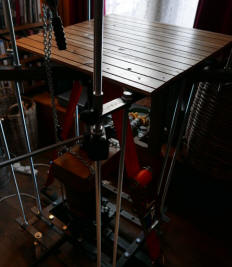
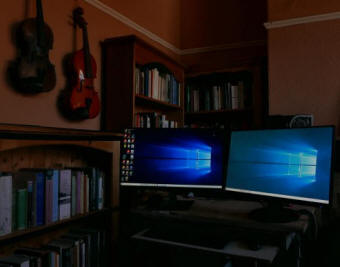
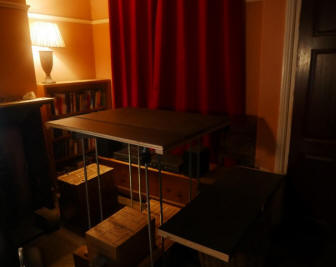
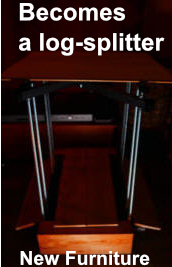
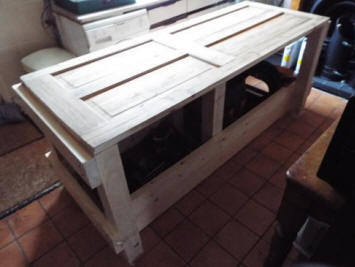
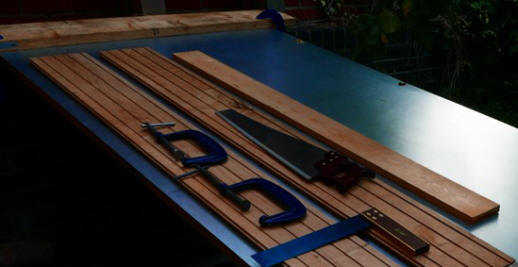
Below, an image which shows an integrated system. To the left, a piece of furniture which was been in place for a long time. Here, it supports a colour ink-jet printer and a monochrome laser
printer but the structure has many uses. Some images on this page show the structure after installation of a mechanism and cutting head. After installation of a hydraulic jack, it becomes
a log-splitter, useful in providing firewood for the stove in this room. To the right, a much newer structure, which belongs to the same system as the one which generates such different
constructs as boats, container growing units, raised water storage ponds, raised wildlife ponds and furniture, amongst others. The structure in the image below has many possible functions.
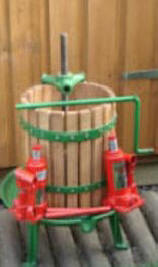
One use is as a counter / bar table, in conjunction with a counter / bar stool, for eating and drinking. Another use is as a small workbench. The structure is very sturdy but can be assembled,
disassembled and moved very easily. After installation of some additional components, including a hydraulic jack, this structure, like the one next to it, can be used to split logs and as a
fruit press. The conversion process takes very
little time. The upper surface of the structure clearly visible is made up
of grooved oak boards, not the upper surface of the larch beams. These
boards are unvarnished. The beams are unplaned and unvarnished, as in all my use of
these beams.
I appreciate varnished surfaces very much but realistically, I don't have
the time to
carry out varnishing.
of

B
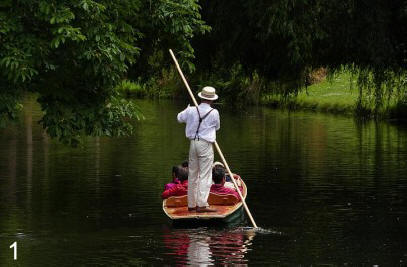
Boats in the new system described above would make good
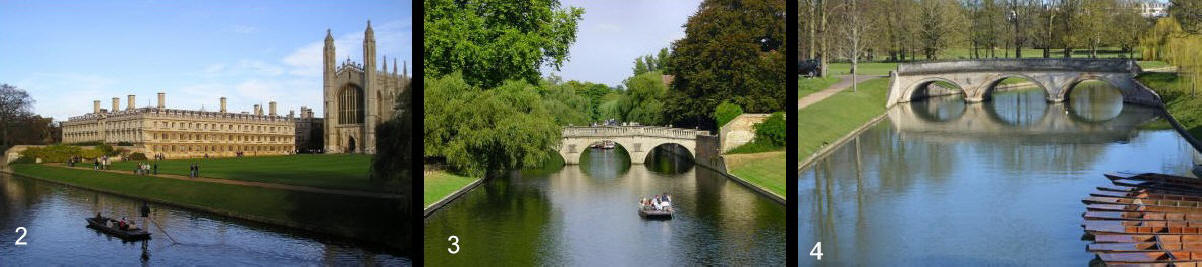
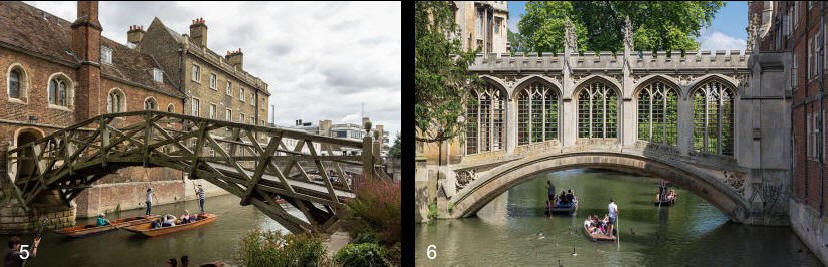
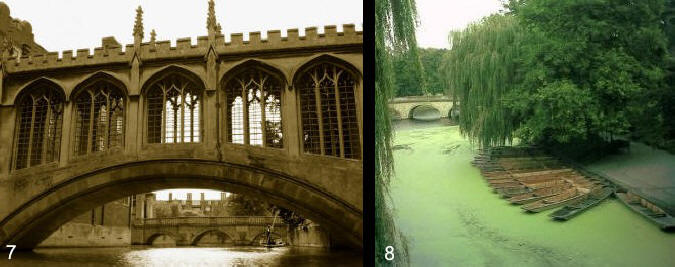
punting boats - and modifiable, to make different sizes. Below, Image 1,
punting on the River Avon - not the British River
Avon but the River
Avon at Christchurch, New Zealand. Other images: views of 'The Backs' and the River Cam at
Cambridge, with punts. Image 2: Clare College building and King's
College Chapel seen from The Backs. Image 3: Clare Bridge. Image 4: Trinity Bridge. Image 5: Mathematical Bridge, Queens College. Images 6 and 7: The Bridge of Sighs, St John's
College. Image 8: View of the River Cam near Trinity College. These photographs not taken by me.
For more on Cambridge University, see my page Cambridge University: excellence and stupidity which now includes comment on some other universities.
Below, images showing a 'sack-truck-system:' a set of applications with similarities ('linkages') and contrasts. The system which includes boats, growing and water conservation
units is another example.
The boats form a sub-system - they vary in size and are very varied in their
possible applications. In the sack-truck-system, the possible
applications
are very varied too. They include carrying loads, as a shopping trolley and
a trolley for transporting tools. These applications are common enough but
the system has a
higher degree of versatility. It includes display
and presentation facilities which can be used for portable advertizing and
for use in protests. I've taken part in many protests myself but
I think
that many public protests have become over-used and misused, heavily
dependent upon slogan shouting and practically never providing argument and
evidence sufficient to
defend the cause against reasoned objections. I
find it essential to distinguish argument against and action against
opponents with few or no redeeming features and action against
people
and organizations which have great strengths, in some cases massive
strengths. In the first category I include Christian belief, but there are
many other examples. In the
second category, I include police forces
such as South Yorkshire Police, whose strengths are accompanied by some
bizarre, disastrously misguided shortcomings. There are other
examples of
this second category described on this page and other pages. I refer to
action in these cases as 'appreciation-protest.' Another use for the
sack-truck-system is as a
replacement for a tripod. The system incorporates a monopod which has the stability of a tripod and which has various advantages.
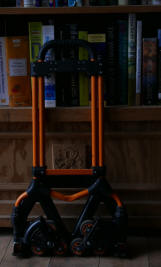


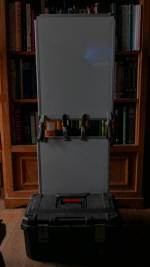


Above, images from left to right. The
lightweight sack-truck
in folded position, easily carried. There are three small wheels on each
side, which facilitate moving the trolley up steps and stairs.
Despite the small size of the wheels
(which enable the truck to be readily moved up stairs) it can be moved over
quite rough
ground.
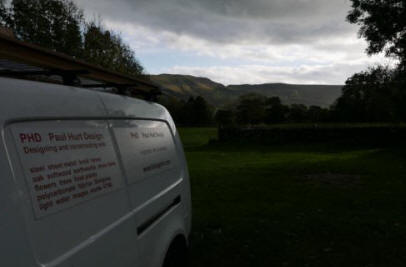
The sack-truck used as a shopping trolley, an adaptation which followed the loss of my van, which had suffered catastrophic engine damage and can't realistically be replaced.
The sack-truck used to support two white boards. The boards can be used for information hand-written with a pen and for displaying paper documents. Larger white boards can be used.
Image showing possible use for a
(non-appreciative) protest. People making use of the system for protest,
appreciative or non-appreciative, or using the system for other purposes,
may well bring the trolley and associated equipment in a car or van.
This system is a convenient way of transporting these things from a vehicle
to the place where the system will be used.
Image showing the reverse side of the trolley system. White boards, of this size or larger, can be installed on this side, to make a double-sided system.
Image showing folded chair supported on the reverse side of the sack-truck.
Image showing chair erected after removal from
storage position on reverse side. If the system is used for long periods of
time, then a chair is very useful.
Image showing use of sack-truck to
transport a tool-box. Tool boxes and other storage containers can be piled
high on the trolley, secured by straps. Once the various containers have
been removed, the white boards are visible
again and can be used to advertise the business carrying out the work, if
the trolley is being used by a business.
Image showing monopod fixed in
position and supporting a video camera, with image visible on the screen of
the
camera. The system can obviously be used for still photography also, and for
transporting photographic equipment in containers, and many other pieces of
non-photographic equipment / food / drink etc. The monopod is as stable as a
tripod and has the advantage,
when used in this way, that any
objections (generally invalid) raised against use of a tripod in crowded
places - as causing obstruction - aren't applicable to this system. It can
be
moved much more readily than a tripod and photographic activities can
be resumed. Tripods are much more unwieldy than the complete system here.
Not all photographers favour
lightweight cameras. This system can
accommodate heavy cameras, including heavy film cameras.
Image showing the camera
and the head of the monopod in more detail, larger. The head is flexible and allows
the camera to be fixed in many different positions, or rotated to follow
movement.
Two monopods, supporting two cameras, can be installed on the
system-trolley. Sound equipment can also be readily carried.
Not shown in any of these images: the provision which the
design makes for security, including the use of heavy duty chain to prevent
theft of a camera attached to the system, to
prevent theft of
containers stored on the trolley and provision to prevent the trolley from
being taken away.

Above, some uses for two of the foldable sack-trucks.
Image 1, two trucks form a horizontal surface
which can be covered with rigid boards. Image 2, another view of the linked
trucks. The two truck system in this configuration can be used
to
transport quite heavy loads. Plastic containers placed on the horizontal
support can contain a wide range of goods - manure, compost, straw bales,
bricks, building stone, timber and, of
course, many other things. Some
of the paths I've constructed have smooth strips which make movement of
single containers much easier, pulled up the slopes by straps, but the
system
here is preferable, since there are wheels at
the ends of the linked trolleys and less frictional force to overcome. It's
essential when using this wheeled system to have safety measures in
place which would make impossible downwards, possibly out-of-control
movement. This could be ensured by straps fastened securely to a person,
with checks to ensure that the person
could not be thrown off balance.
Image 3, the two trucks in a vertical position. The distance between the two trolleys is obviously adjustable, to fit various lengths and heights for polycarbonate sheet, when used.
Two uses for the two truck system: a
lightweight container growing system, in which the trucks act as
horizontal supports for the containers, as a lightweight water collecting /
conservation
system and as a lightweight shelter. The shelter can
protect the trucks from the effects of rain, protect users from the rain -
as when the system is used for displays / presentations - and protect
the displays / presentations from the rain, for example the magnetic white
boards shown in Image 4, and the colour-printed sheets attached to the
boards with clamps or magnets shown in Image 5.
Here, the displays are unsympathetic to Christian belief but there is obviously nothing to stop an end-user of this system using it to promote Christian belief, evangelism.
 i
i

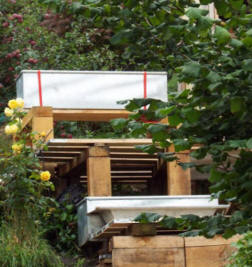

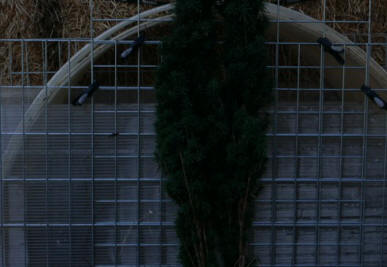


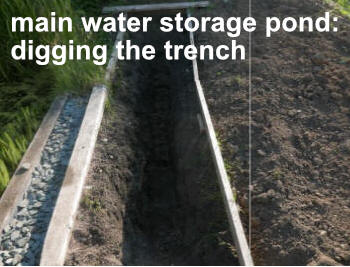
Above, construction of a new raised water storage pond, following the very, very flexible design above. The pond is very different from any of the variants described above,
but not in every way. This pond is intended to be used for one purpose only, storing water. A structure constructed according to the same design but in a different location could be
used as a solar composter or a protected growing
system, provided that one of the long sides faced south, necessary to take
maximum advantage of 'the greenhouse effect.' This
structure does have one side which follows
the pattern above, or one of the patterns: the long wall to the south,
obscured in the photograph by the nearer north facing side here,
is strengthened by a straw bale wall, one of the strengthening structures - in this case pre-existing - which can be very valuable.
The third photograph shows the
new water storage pond, still under construction but largely complete. The ideas for this
design came, I gave a great deal of thought to the details,
revising and
choosing components and spatial relationships which were practicable, all as
design thought processes. I' d
already been to the land and decided that one of the
two possible sites
for the pond was out of the question. Constructing
the structure shown in the photograph in a work period later was achieved
quickly. I already had most of
the components needed.
The site chosen is next to the
platform, of various levels, shown in the first photograph above. I built it a long
time ago. Later, I added more platforms, smaller. I built an extension
to the platform for storage, of produce and materials. The pond has been
installed in front of the extension. Years after the extension had been
built, I placed a straw bale wall in
front of the extension and in contact with it. There are strong straps to prevent the bales from falling forwards. Before I put the wall in place, I planted a yew tree in front of the wall
with a distance of 90cm between the two. I constructed the pond so that it would be 'site-specific.' The width of the pond would be 90cm. By placing the pond between the straw
bale
wall and the yew tree, the yew tree would help to withstand the outward
forces exerted by the stored water. The columnar yew tree, one of
eight, and the smallest, is Taxus
baccata Fastigiata robusta. Together,
these trees occupy a very small area of land, not in the least significant,
but the trees themselves have great significance for me. At the
time of writing, the pond liner and
underlay haven't arrived, so the structure is unfinished, but most of the
work has been done. Two panels have been added to the structure at the
east end, forming a roof and a wall, which extends the polycarbonate wall
not visible in the photograph but to the left of the central curved
polycarbonate arch. The extension is
a smaller version of rectangular container B in the diagram above. It can be used for various purposes, including storage.
The photograph shows the view looking North, so the straw bale wall is to the south and the two curved sides, formed from polycarbonate sheets, are to the east and west . The
polycarbonate sheets have been used 'additively.' The number of sheets needed to withstand water forces can be found when the pond fills with water. Here, three sheets have been
used. Sheet polycarbonate has great
structural strength. The long side to the north can
be seen clearly. It incorporates polycarbonate sheets, of course, and more than one
galvanized
wire mesh panel. Another wire mesh panel and another long polycarbonate
sheet has been installed on the south side, next to the straw bale wall. This side is already
very
secure. The precautions necessary for the north side to avoid breaking of a
wall and loss of water, aren't needed to anything like the same extent. An apparent problem, the
difficulty of inserting the liner and underlay into the structure, has been solved by a simple technique. Another apparent problem, that of extracting water (obviously, it's not
possible to remove polycarbonate sheets and wire mesh panels to use a watering can) also has a ready solution.
The fourth photograph in the row above shows a wire mesh cage containing rocks, a 'gabion.' I'm able to construct gabions of various sizes, using the wire mesh panels available to
me. but the gabion shown in the fourth
photograph in the row above wasn't constructed by me. The
Wikipedia article on gabions
can be recommended. Gabions have a very wide range
of uses, in
civil engineering and many other fields, including some unexpected, unusual
uses. (The article includes an image of gabions
used as X-ray protection during customs
inspections.) The materials which can be used to
fill the wire mesh boxes include not only rocks but used tyres and other
recycled objects. If the boxes are lined, for example with
nonwoven
geotextile, they can contain soil, sand, grit and other granular materials.
In general, wire mesh panels can withstand
water forces only if faced with polycarbonate sheets
or other continuous or almost continuous surfaces. Strong components which can prevent movement of the panels are obviously a necessity.
The fifth photograph above shows an 'Intermediate Bulk Container.' (IBC). I have an IBC but the photograph doesn't show the one I have. With suitable additions - one or more
continuous surface materials. an IBC forms a strong structure for placing a water storage pond of a design similar to this - or very different. In a design sphere which is very different,
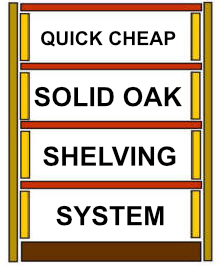
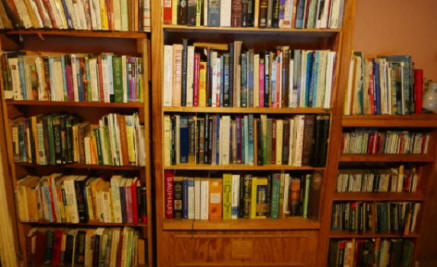
design of shelving, including design of bookcases, I've used the same principle: an existing structure, such as a conventional bookcase, if it's sufficiently robust, can be used to
construct a second structure for the same purpose (or a completely different purpose). The bookcase I constructed is held together by means other than woodworking joints or screws
or nails. It's radically different from existing bookcases. Although constructed using solid oak boards, it's very cheap, simple to construct and requires very little time to construct.
The platform in the first photograph has been modified radically, since it was constructed. The large galvanized container on the highest level is still there. It was used for
water storage but now forms part of the apple / grape press
shown on this page in various images. There are now two large water storage
barrels on the lowest of the three levels. In
the photograph, another
galvanized container can be seen on the lowest level. This is still there
and has its original purpose, water storage. There are now water collecting containers
on the large horizontal area which makes up most of the platform, the middle level. These containers cover most of the area and by collecting rainwater, protect the wooden
boards of the platform from rain water, extending the useful life of the boards. Wherever possible, whatever the function of the structure, I include protection from rain in structures,
protection for people and protection for stored materials, including construction materials, such as wood.
if
Simple Science (1) has some background information on hydrostatic forces, forces acting on these structures, but obviously not the only forces. Simple science (2) has more information.
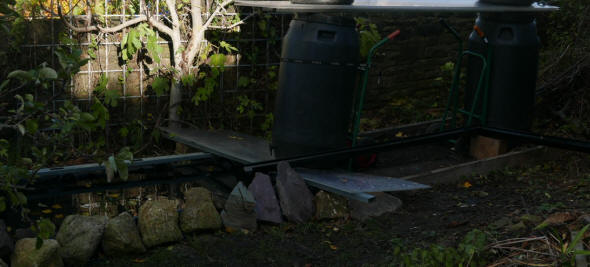

Above, image on the left, the new water storage
pond, but not the newest pond. This shows an early post-construction phase.
The two large water barrels are shown on two trolleys. The
original
intention was for the water barrels to remain here as part of a larger water
storage area. The barrels on their trolleys have now been moved to the large multi-stage-platform
(with extension). The area occupied by the trolleys and barrels is
now available for cultivation again. The straw bale wall of the extension provides
structural support for the newest water
pond on one side. The walls of the newest pond are polycarbonate sheets, straight and curved. The straight sides are reinforced by wire mesh panels. The outside of the pond is 'softened'
and partly concealed by hazel panels, visible in the photograph above to the right. A wide range of other surfaces can be installed for the same purpose.
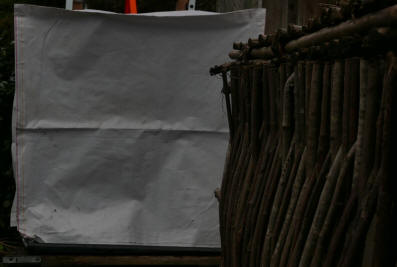
The white expanse is one side of a plastic cover which conceals the two
barrels on their trolleys. They were moved to a level surface of the
platform, the lowest one, for storage. The barrels
can, of course, store
water in their new position. The plastic cover (which is designed to protect
an Intermediate Bulk Container and which was originally bought for this
purpose) now
protects the trolleys from weather damage. Wherever
possible, I provide protection for structures and equipment. The cover can
be quickly installed, to protect the contents from rain, and
quickly removed when this protection is
unnecessary. A water-collecting surface can
be installed on the roof of the cover, directing water to a galvanized water
container on the same level
and behind the cover and contents. On
a higher level of the same platform is the new fruit press described
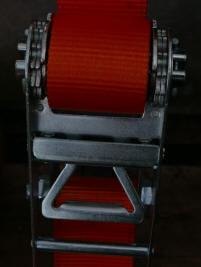
above, with images. Some of its high-visibility 'mechanism-strap' can be
seen.
The barrel-trolley units can now be used for
transporting and dispensing water. In previous years, during drought
conditions, which have sometimes lasted a long time, I've used a watering
can to water crops but I've come to the conclusion that this is an
inefficient way of working when extensive watering is necessary. There are
repeated walks to and from the water source, to
and from the area to be
watered. The weight of water has to be taken into account - 5 litres of
water weighs 5 kg and greater volumes are correspondingly heavy. For large
volumes of water,
using a trolley-water-container is easier than
repeated use of a watering can. The trolleys shown here are heavy-duty and
the barrels are large. For many purposes, lighter trolleys and
water containers can be used. In the previous section, lighter trolleys, referred to as 'sack trucks,' are shown. They are very versatile. This is a further use, as mobile water containers.
us
The pond shown above is partly hidden by the boundary rocks and not clearly seen in this photo. Visible on the right
of the photograph, the lower part of the gutter system at or near ground level, taking water from the water collecting surfaces on the upper slopes to the storage pond.
The polycarbonate sheet conceals pond liner at this end of the pond. Some of the liner here is unused but it can easily be put to use, to make the pond longer. This side of the pond has
the polycarbonate sheet as a boundary. The longer side nearer the wall has a lightweight galvanized steel bar as boundary. These two sides are straight edges, then. The other two sides,
one short, one longer (only the longer side visible here) are bounded by quite large rocks - gritstone, slate and 'Cotswold stone.' (The larger wildlife pond at the lower boundary of this
plot has two straight edges and too irregular edges, formed by vegetation and the natural boundary between land and water. The metal components give support to the polycarbonate
sheets. These metal components, of the same size or a different size, have played an important part in construction projects here, to build trellis systems for plant support (runner beans,
grape vines and others). A long table in the upper plot, used for growing watercress in containers, usable for propagation outdoors and for general purposes, was strengthened with
these metal components. The watercress has since moved on, to ground level. For many years, there was a large structure, quite high, on the largest growing area, used for various
purposes. For example, it supported netting for plant protection. This was constructed with these lightweight galvanized bars.
In water conservation systems which rely on gravity
(although two water pumps are available to supplement movement of water by gravity,
to move water uphill) then a lower pond
is
obviously a suitable storage container for water transferred from a
higher level and a higher pond or water container is obviously needed to supply a lower storage pond without the
need for pumping. As well as the ponds, there are a number of galvanised steel water storage containers. Watering cans are the obvious choice for transfer of water from these containers.
The photograph above to the right shows the fig tree growing against the wall which can be seen in the first photograph.
This photograph shows the fig tree in summer, the first photo
shows some of the fig tree in later October. The fig tree has by now lost
most of its leaves. I don't share the view that gardens can look good in
every season, for most of the year. I regard
late autumn and winter as
low points in garden aesthetics (except in snowy periods). These periods are
still very good for outdoors working, unless there's heavy rain and strong
winds.
After the magnificence of the autumn
foliage has finished, there's still the appeal of planes, surfaces and other architectural
features, and many other sources of fulfilment - and lack of
fulfilment. The
inner world can be as changeable as British weather. The rhythm of the seasons
involves many changes, adjustments, in choices and preferences, in feeling
and in
practical matters. The fig tree shown in the first photograph above has far less interest for me than the fig tree in the second one, in full leaf.
This is a water storage pond, not a wildlife or wildflower pond but I did plant a water lily, not the native water lily, Nymphaea alba, the water lily I planted in the large wildlife / wildflower pond lower
down. Instead, I planted a water lily with a
similar appearance but more suited to this smaller pond, Marliacea albida.
It will be quite a long time before this pond and the other components lose
their rawness and begin to harmonize with their surroundings. Nature
should ensure that smoothing and blending and harmonizing take place,
together with active management to ensure that
nature doesn't take over
completely. Left to its own devices, this pond, like all ponds, would
eventually be filled in, with land rather than water. The immediate
environment includes a great deal
of bare soil. Constructive work will be needed to encourage some plants and discourage others, often by drastic action.

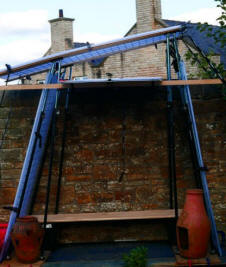
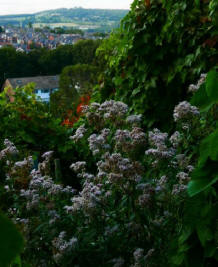

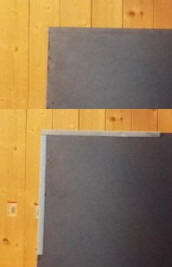


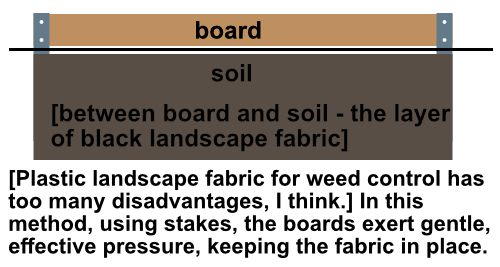
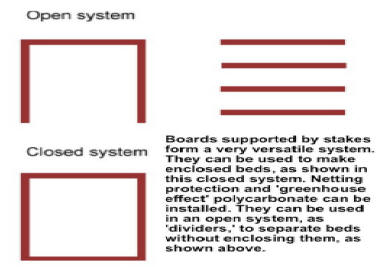


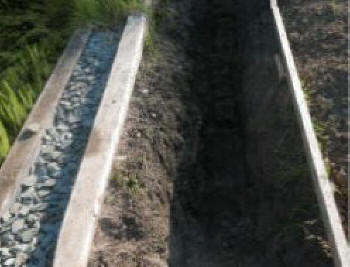

Above, some diagrams and photographs showing the uses of boards supported by stakes. The stakes are easily attached to the boards at both ends by using screws located
in the holes of the stakes. A primary
advantage is that the boards last for much, much longer than boards resting
on the soil, the usual method, as the boards are far less
exposed to
water in the soil and water on the soil. Enclosed beds can be made without
the need to join the boards with any woodworking joints. Even the use of
screws is
unnecessary in many cases. Boards can be used as 'dividers,'' one or more boards placed end to end, standing with simply the stakes for support. (In some of the photographs
below, there are boards placed flat on the
soil as well - these were placed temporarily or were placed on
water-draining surfaces. In the case of the path shown below, the boards
are placed on a ladder laid on the ground, to give a 'raised path,' with
advantages in very muddy conditions. ) Boards forming 'closed systems' can
become cloches, if solar
plastic tops are put in place to give
warming by the greenhouse effect. They can become beds for protected
cropping, if netting tops are put in place. Landscape fabric for weed
control is easily moved (or can be blown away) by wind. This system gives a
neat way to keep it in place. Landscape-fabric-beds can become growing beds
when the weeds have
been eliminated. Closed and open units incorporating
stakes can be moved very easily. The boards can be removed very easily and
relocated simply by removing the stakes
from the soil and pushing them into the soil in the new location. The stakes can also be easily removed from the boards and the boards can then be used for different purposes,
for different projects. A system of narrow beds can be replaced by a different system, of larger beds or much larger beds. It allows land use to become much more free,
allowing for much more experimentation, with far more possibilities.
Below, general images. In the case of some images below, clicking on the image takes you not to a listed page but to Home Page Images. This provides description / explanation and usually
a larger version of the image.









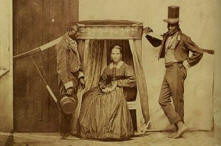








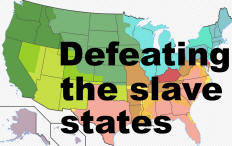
The 'teaching' of Jesus and 'St' Paul made no
mention of the evils of slavery. During most of the history of
Christianity, almost all Christians ignored the evils of slavery. During the
Roman
Empire, Christians failed to oppose the separation of babies and
children from their mothers and fathers, the selling of babies and children
in the slave markets, to become the property of
new owners - who had the
legal power to torture slaves, to use slaves for sexual gratification, to
abuse them emotionally and physically. In recent times, Christian
clergy and other Christians
have
carried out gross acts of abuse, including
rape. Only a small proportion of these cases have come to general public
attention. If this can happen in societies with strong legal
safeguards,
the abuse in slave societies must have been far, far worse.









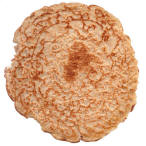































Following a section of images which include some
showing pizza: a pizza oven of novel
design. I constructed a wood-fired pizza oven and a garden
incinerator many, many years ago. The results
didn't please me, but I gained experience in the use of fire bricks
- the garden incinerator used these in complex ways. I still have the fire bricks
I used then, now available for constructing a prototype
of a pizza oven which is radically different from all existing designs known to me. The overall shape is familiar enough, a curved wall over a flat base. For this design, the curve belongs to a (short)
tunnel design rather than a dome.
The smaller, lightweight pizza ovens can't make an 'authentic' pizza. Use of pizza stones and the more
efficient pizza steels will give an approximation to an 'authentic' pizza in
many domestic
ovens. The large, expensive pizza ovens which can achieve
'authentic' results have many disadvantages, though. For most people, the expense can't be justified. I
don't have the money to buy
one of these ovens and even if I did have
the money, I would never buy one. In winter, I work outdoors, in some
winters, very often. Winter isn't the best time to build and modify outdoor
pizza ovens.
I can't share the passionate belief of the pizza
perfectionists and pizza purists in the importance of the perfect pizza, or
the importance of devoting very substantial resources to
achieving it, if it
can be achieved at all. I don't count this design as
one of the more important ones, but I've found the problems to be overcome interesting
ones.
This pizza oven is part of a system, like a number of
other design systems I've thought up and developed. This system, like the
other systems, is very flexible, easy to extend, easily modifiable,
and
portable. Like the other designs, it can be easily assembled from the
components and easily disassembled to release the components, which can be
used for completely different purposes,
to make very different structures. Small pizza ovens
can be made following this design, as well as large ovens. The small
ovens can be converted into large ovens. Constructing a domed
or
tunnel pizza oven using firebricks is a difficult skill, as is constructing
a pizza oven using clay. This design makes the construction of curved
shapes using firebricks easy. Unlike the case with
existing designs, the firebricks aren't held in position using mortar or another substance. The practical information here is restricted, necessarily so, but I intend to add further information.
Various fuels can be used for the pizza oven. I don't
intend to use pelleted or other bought fuels. I have ample supplies of
hardwood obtained by necessary pruning and felling work on
apple and
other trees. I also have available large amounts of gorse from pruning a
large gorse hedge. In past centuries, as well as more recently, gorse has
often been used as a fuel in
bread ovens. It burns with a hot flame,
although not a flame which lasts for long. The fuel has to be replenished
often. Storage of the fuels and drying of the fuels are provided for in this
pizza
system, which is also a bread-making system - but the oven can be
used for purposes other than these. Far more often than not, the hot air
leaving the oven, through a chimney or by some
other means, goes to waste. In this system, the warm
air is directed to some of the stored wood or gorse, drying it and speeding
up the process of converting green wood to wood with a
lower water
content, suitable for burning.
IINTERLUDE 1. Material on Shambolic Sheffield.. Material on 'Shambolic Sheffield.'

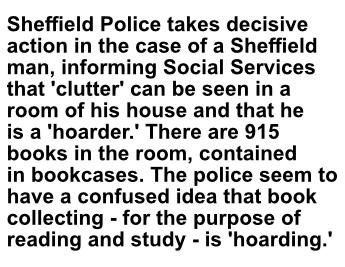



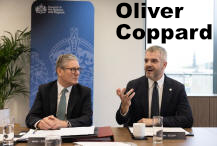


My approach to growing is broadly based. Aesthetic values are very important to me and these values underlie my use of the land rented from Sheffield City Council. From the introduction
to Jane Grigson's 'Vegetable Book,' 'In my most optimistic moments, I see every town ringed again with small gardens, nurseries, allotments, greenhouses, orchards, as it was in the past,
an assertion of delight and human scale.' The
claim that I've had 'a detrimental effect, of a persistent or continuing
nature on the quality of life of those in the locality' (the land I rent
happens
to be in 'the locality') is not just false but vile. I made
determined efforts to have cleared a large heap of fly tipped rubbish near
to the land I rent, shown below, but no action was taken by the
Allotment Officer, or by the
so-called 'Lower Walkley Community Garden' who were using the area when the heap appeared
or the Garden Church which took over the land later. As I see
it, the Allotment Office, a branch of Sheffield City Council, which owns the
land, has favoured these groups far too much, acting in a biased way. I
emailed the allotment officer on 21 September
2021, drawing the flytipped rubbish to her attention. I emailed her again on 21 September 2021 about various matters and reminded her of the fly tipped rubbish, which was still there. I've emailed
her since then, reminded her again, and got nowhere. The pile was removed in autumn, 2025, four years later. Extract from an email sent to Rowan Longhurst, Service Manager - Countryside, amongst
others. The email is long but it would take a much longer email to do justice to the issues. Justice, elementary fairness, have been lacking in the pathetic, inadequate responses I've received -
particularly in the case of South Yorkshire Police, which includes in its repertoire of responses failure to give any responses at all.
The extract from the email here (it contains
almost all of the material in the email sent) been
added to the page in preparation,
Shambolic Sheffield. I have yet
to decide whether the email extract
should remain on this page. One
advantage of allowing it to remain is this. I practically never assume that
anyone receiving an email from me will consult this Website. Very often, I'm
writing
about matters which are already explained in detail on a page of
this site. Very often, the issues need detailed coverage. Often, then, the
email sent will necessarily be a long one. Emails are
a useful form of documentation, important as evidence. I regard documents of this kind as important, but they have drawbacks. I spend a great deal of time revising material on the site, but it
would be impossible for me to find the time to revise many many pages and parts of pages adequately. There are whole areas which need revision to a greater or lesser extent. This includes
quite a number of the gardening pages. Most of the pages concerned with literature don't require much revision at all but very many do require extension - they're too short to satisfy me.
Emails, once sent, can't be revised, of course.
When the emails have documentary use, potentially, then this is a
disadvantage. I may feel that nuances haven't been conveyed, or I may feel
that some important information has been omitted. If the email is added
to a page of the Website, then this isn't in general a problem. I can add
corrections, amplifications, revisions in general.
.Another advantage of leaving the copy of the
email on this page, with other material on mistakes made by South Yorkshire
Police and Sheffield City Council Allotment Office is that the land
I rent, my two allotments, have an important part to play in these
mistakes. There are many, many photographs showing my work in growing and
construction and encouragement of wildlife
on these allotments. They are
near to my house, they are in my 'locality,' the word used in the 'Community
Protection Notice - Written Warning' which was issued to me: '... your
conduct is
having a detrimental effect, of a persistent or continuing
nature on the quality of life of those in the locality.' Absolutely no
evidence was provided of anti-social behaviour on my part in the
locality or anywhere else. I do have evidence of efforts to make the
locality one in which plants and wildlife can flourish. I do have evidence
that I made determined efforts to have fly-tipped
rubbish removed from an area in the locality. Surely this is evidence of a strong desire to benefit the locality? I have the evidence to show that I've made immense efforts to grow plants as
well as I possibly can, and this has involved
very great effort to control weeds. The Allotment Officer's claim that my
plots were 'overgrown and substantially uncultivated, despite recent
correspondence. I would estimate that the plots were far above the 75% level
for cultivation mentioned in the Regulations and the Allotment Handbook. I
regard the claim made by the
Alllotment Officer as demonstrably mistaken, deeply mistaken, disastrously misguided.
Before the text, images included in the emails sent:



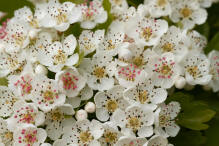
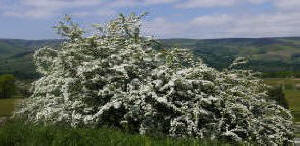
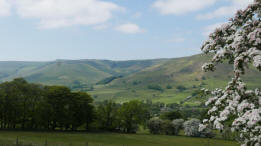
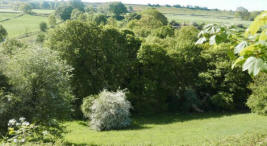


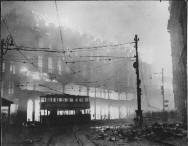














 oooooooooooooooooooooooooo






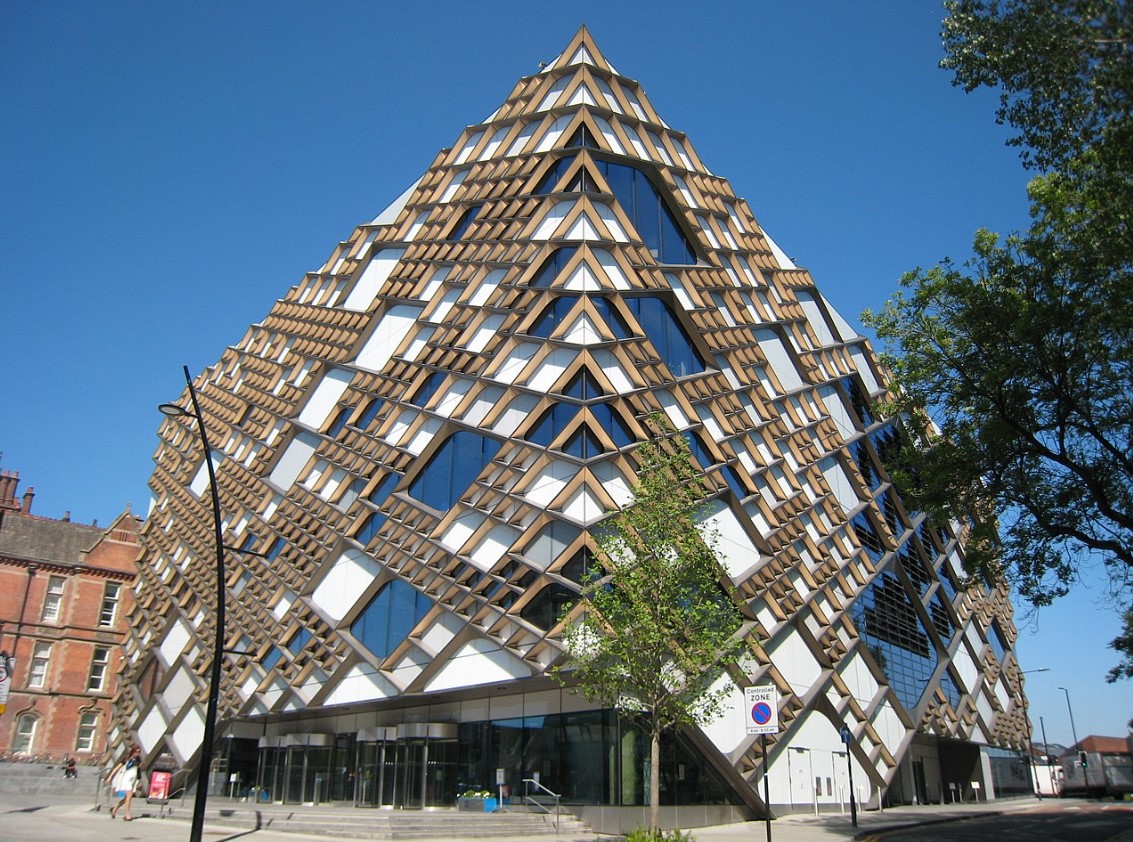








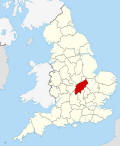

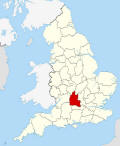
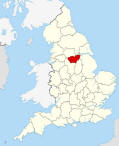
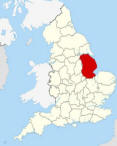










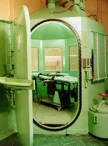







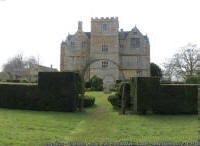


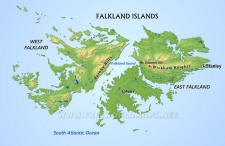








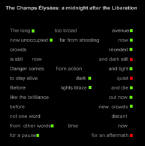

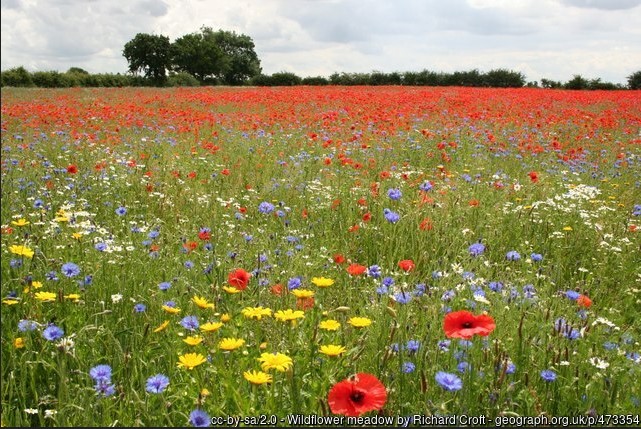
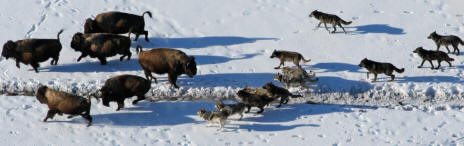


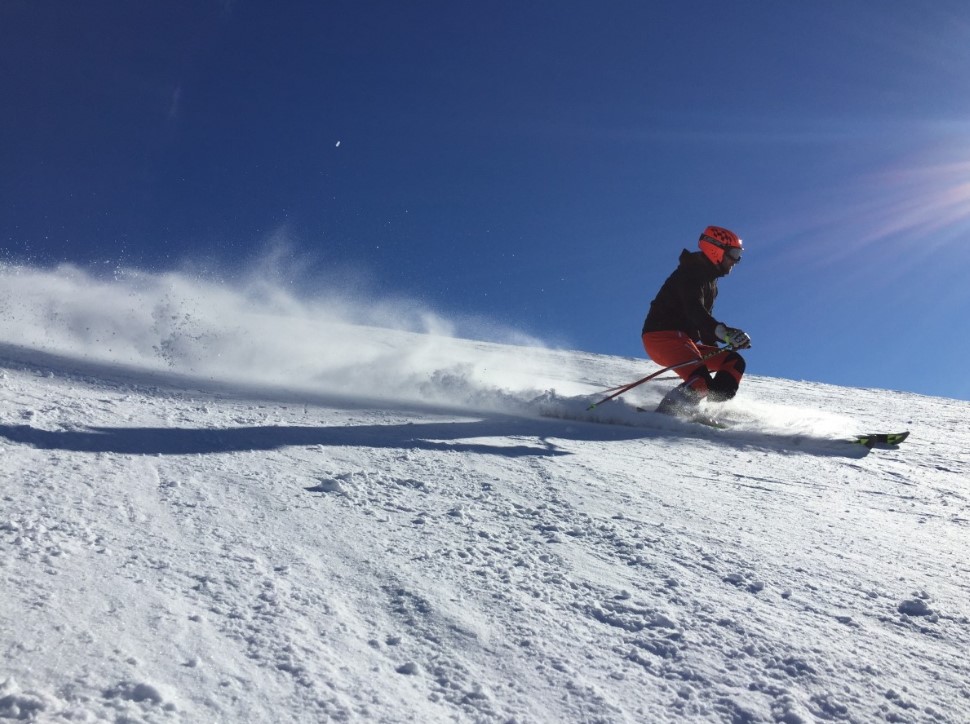


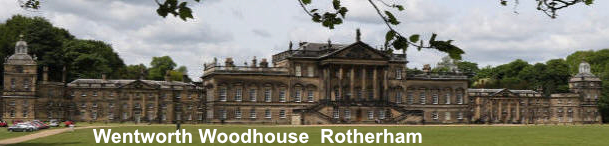 uuuu
uuuu
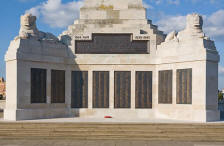


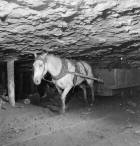

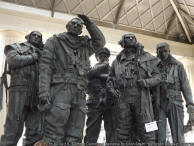
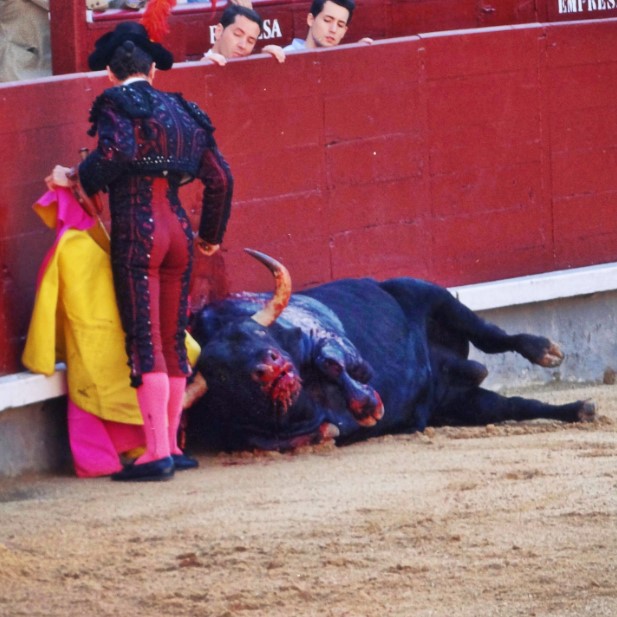
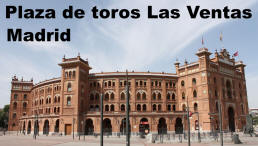
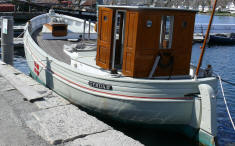
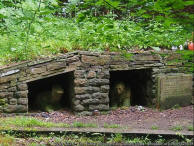
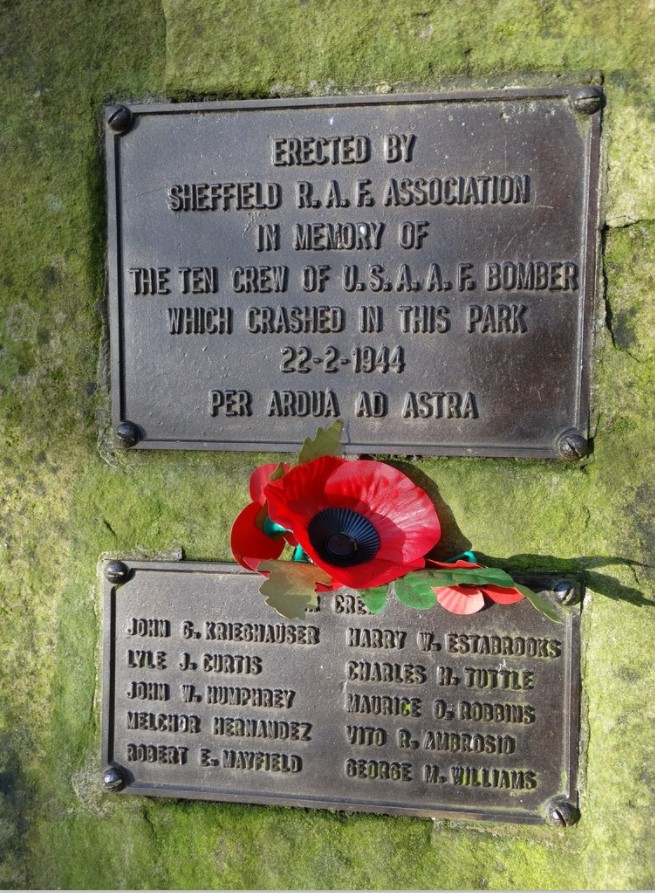


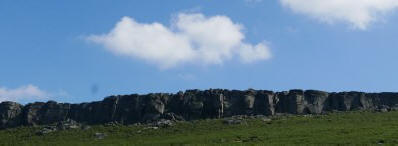






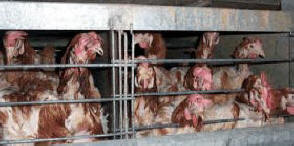
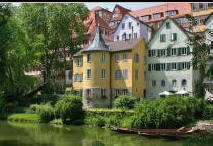
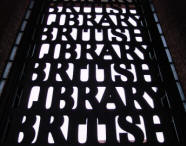
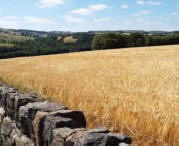
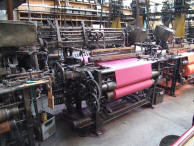 34
34
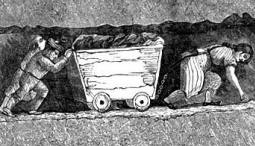
.jpg)



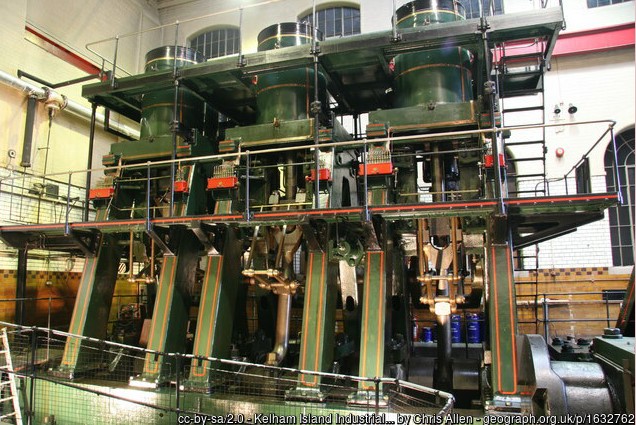









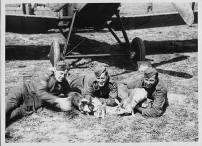



 0
0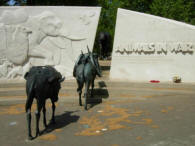
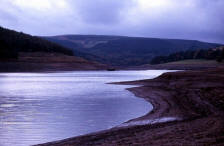
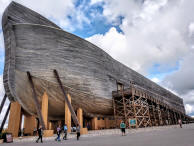
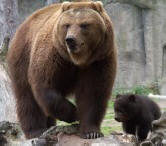
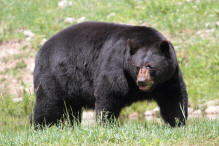

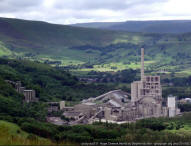






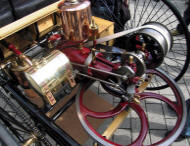
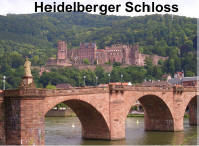











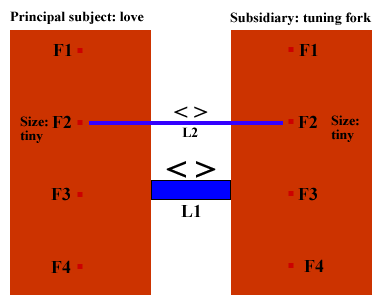
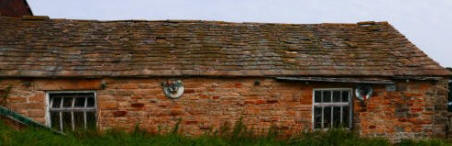
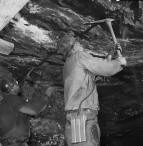
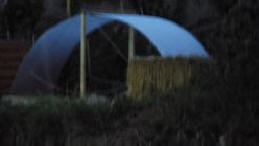
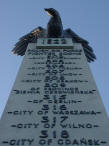
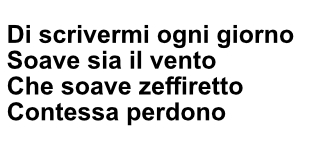
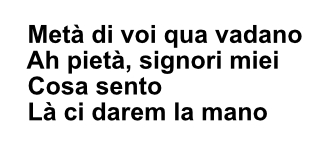

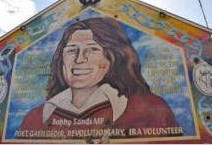
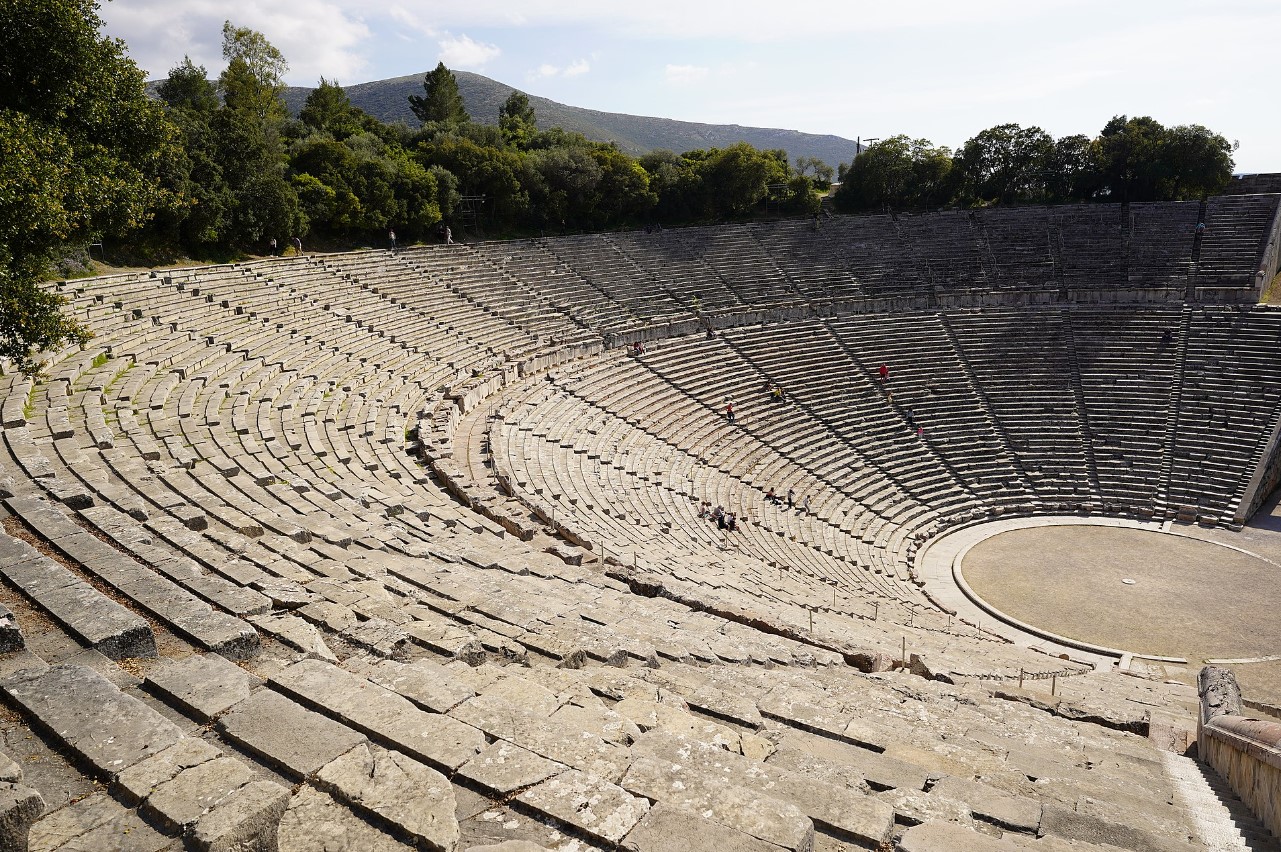












 2
2

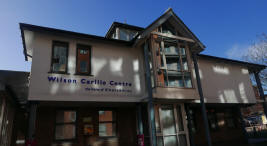

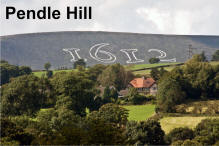

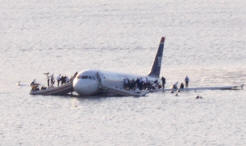


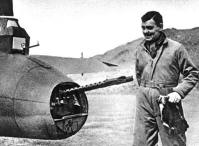

















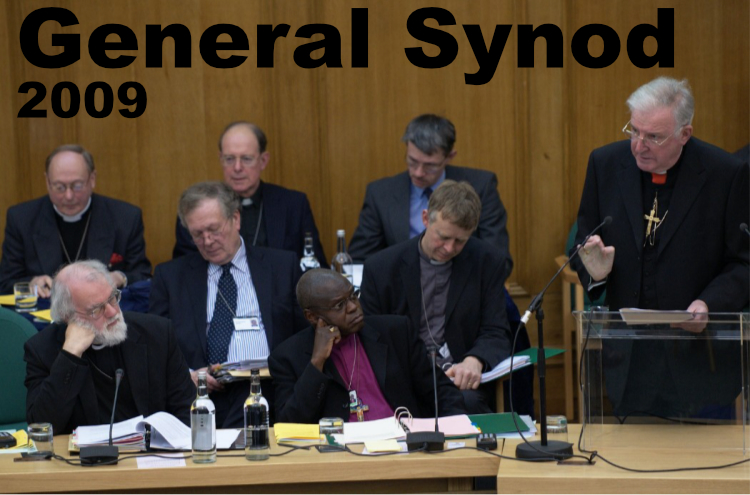







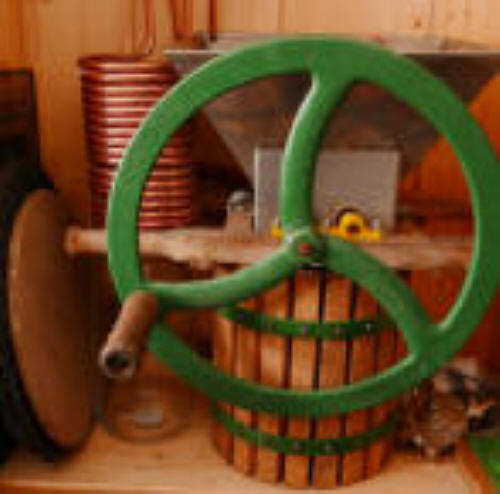

 2
2












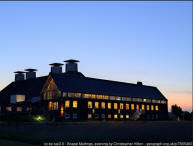
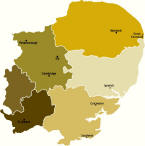
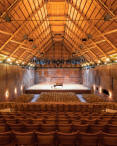
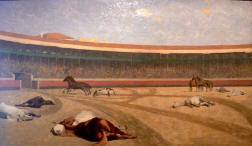
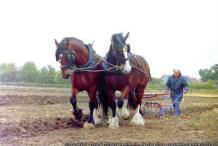
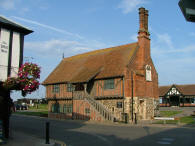
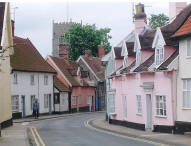
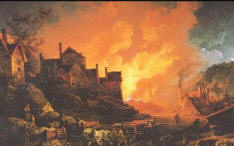
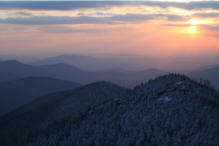






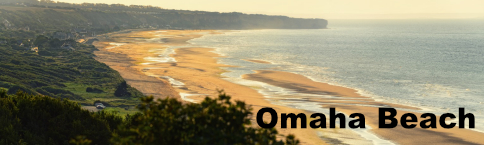














 ;
;

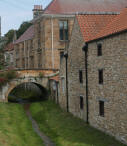
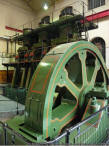


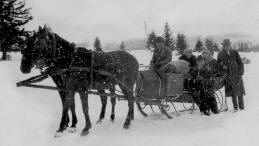





IINTERLUDE 2. More material on Shambolic Sheffield.




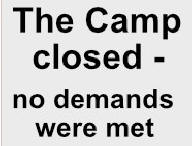


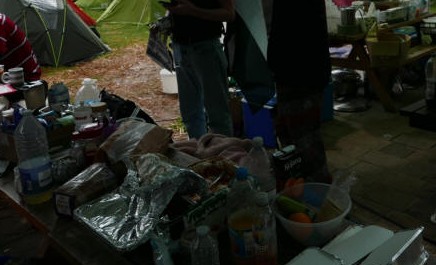





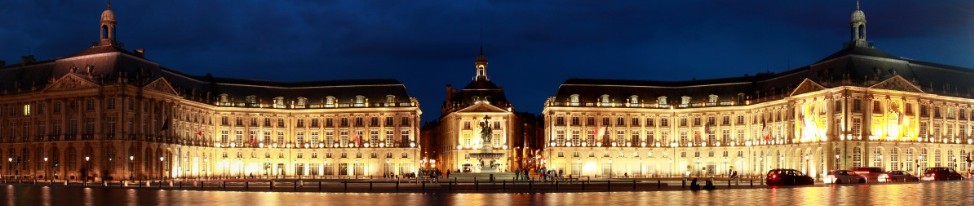




 67
67
 68
68
 69
69
 70
70

 71
71
 72
72










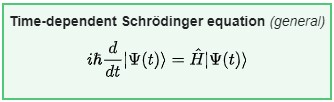

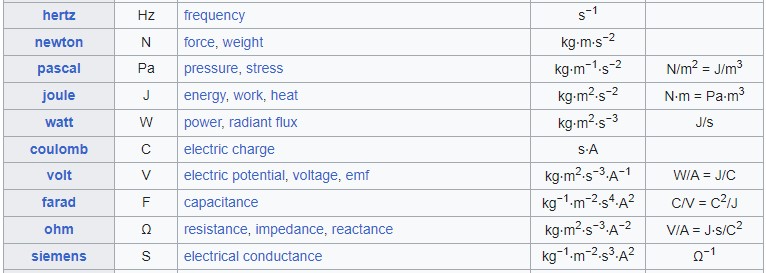

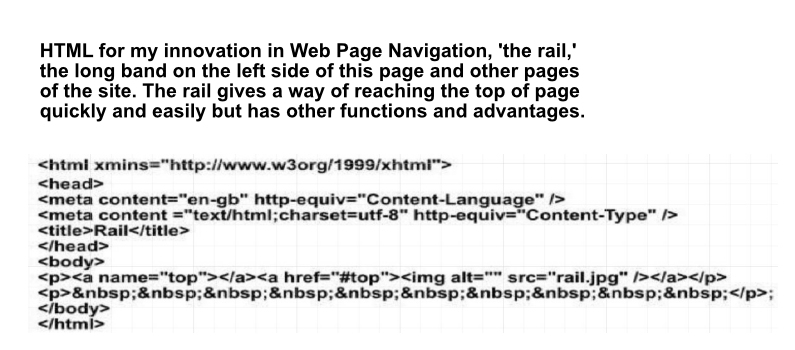

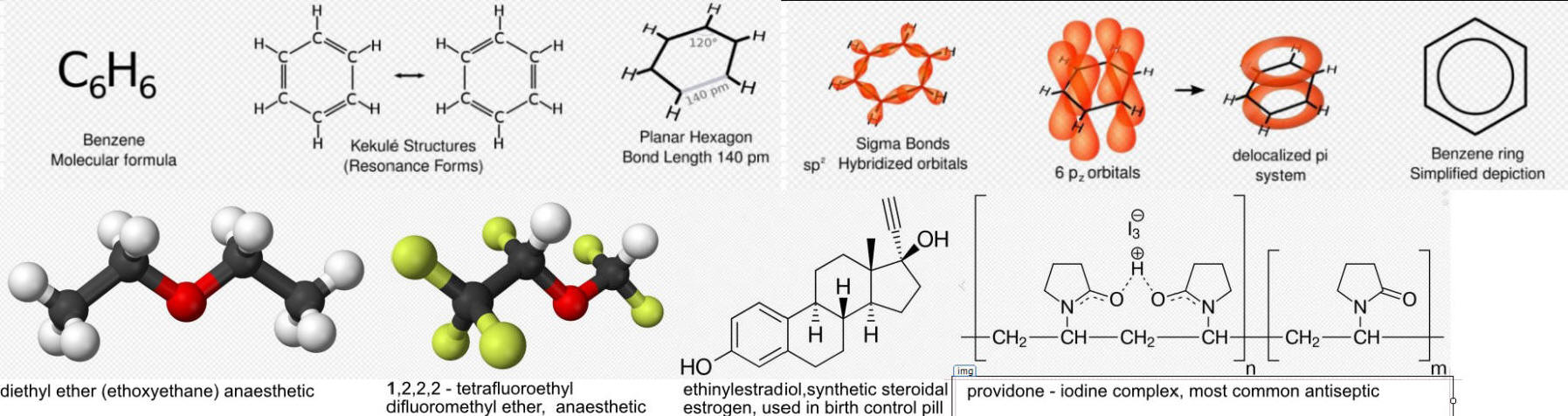



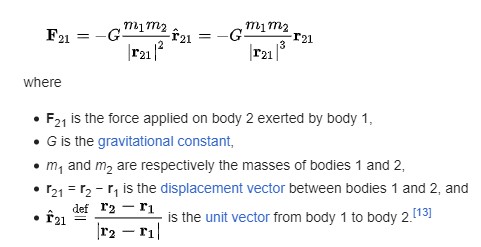
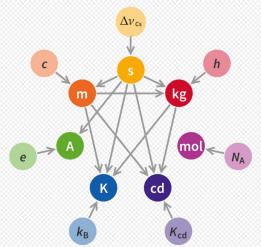
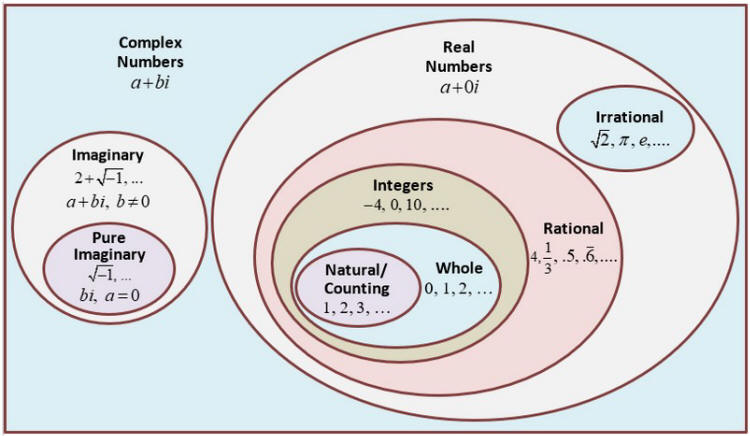
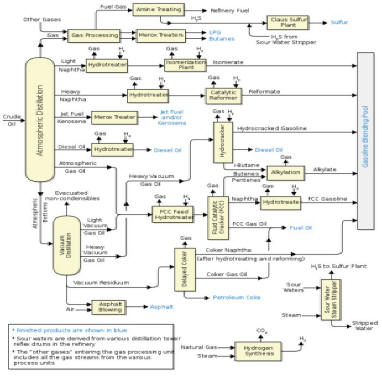
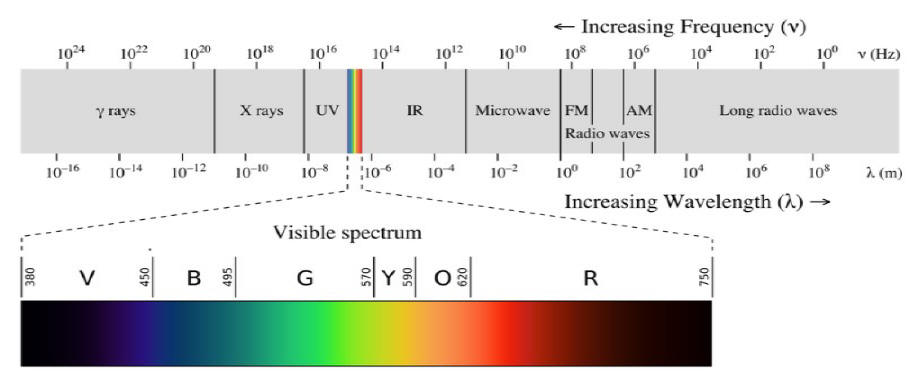

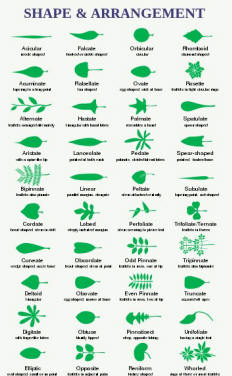
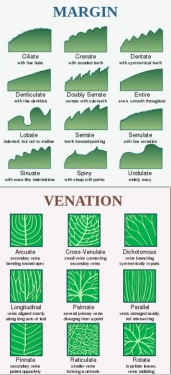
Simple Science (1): Some considerations relating to the pond constructed with wire mesh panels, amongst other components, with information above.
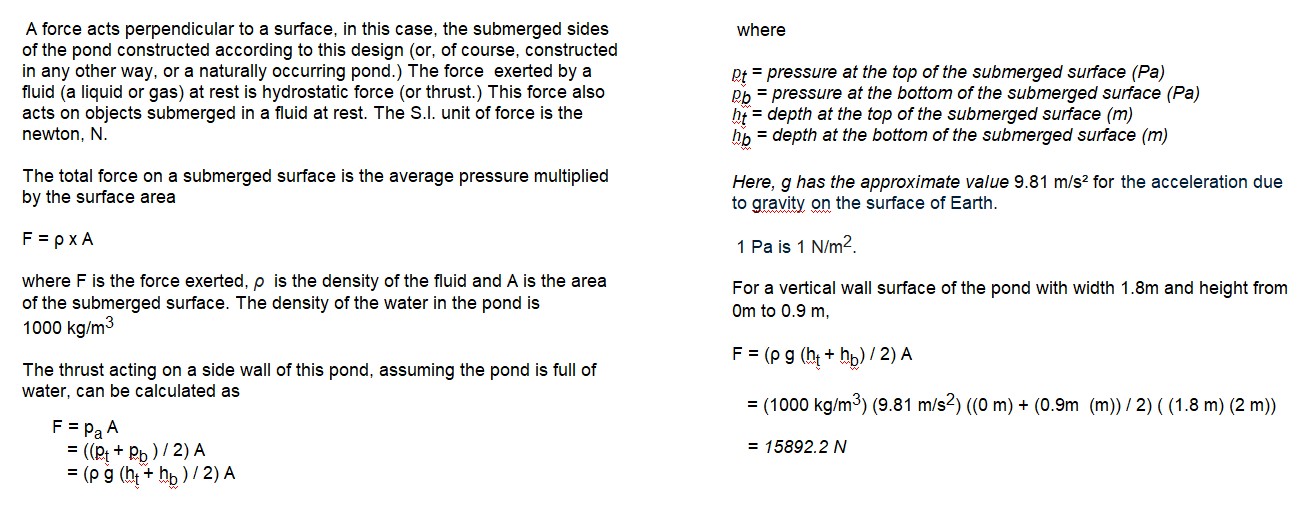
Simple science (2) Some considerations relating to the boat
(alternative use of the system: water conservation unit) shown above.
A
great deal of additional material will be needed to explain the construction
and uses of the system. For the time being, these
are the only aspects I discuss, background information concerned with (1) flotation and forces (2) background information,
very restricted in scope, concerning aspects of polymer chemistry.
in s
In static equilibrium, the boat will displace a volume of
water. The weight of this will equal the total weight of the boat,
together with any loads added to the boat. The buoyant force F, acting
upwards, will equal the total weight of the boat
acting downwards: these vector forces are equal and opposite.
The state is one of static equilibrium. The boat will
float because the
average density of the boat is less than the density of the water in
which it floats. The density of the
larch wood which makes up the bulk of
the boat is approximately 550 kg/m³ and the density of water at 4°C is
approximately 1000 kg/m³ The mass of the boat (with any additional loads) is
equal to the mass of water displaced.
The boat has a mass of approximately
200 kg. The boat can support and move large loads. The greater their
mass and
density, the greater will be the buoyant force needed to
counteract the downward force. This is achieved by adding
more larch layers
and / or the use of other flotation materials.
Calculations making use of hydrostatic equations can
supply useful information, eg, the submerged depth of the larch
beams and
the depth above the waterline. If it's found that all the beams are below
the waterline when the boat is
carrying very heavy loads, more buoyancy
material will need to be added, eg in the form of buoyancy bags, PIR
polyisocyanurate material, closed cell polyurethane foam, air-filled
plastic barrels, layers of wooden material,
but not very dense woods. (Below, complex science: structure of polyisocyanurate and polyurethane.) Strengthening
by use of steel bars or other means will often be required but the high density of these will not increase significantly
the overall density of the added material. Steel will obviously require protection from corrosion but for many uses, eg
flood mitigation, steel components are not needed.
Calculations in connection with boat buoyancy require use of equations in hydrostatics, including some of those listed here.
The associated discussion and explanations are very concise.
(1) m = ρ V where m is the mass, water, ρ is the density in kg/m³ and V is the volume in /m³ These quantities, m, ρ and V can
refer to the boat or the water. Subscripts make clear that the reference is specifically to the body, in this case the boat (B) or
the fluid, in this case the water, (f)
(2) FB = mf g = ρf
Vf g where g is the acceleration due to gravity, 9.81 m/s2
(alternative units, newton N per kg.) This gives
the magnitude of the
buoyant force. In this equation, the term m can be replaced with the expression
ρ V, using equation (1)
ρf Vf g = mB g (3) since the buoyant force, acting upwards, is equal in magnitude to the weight of the boat, acting downwards.
The boat is not fully submerged, due to the buoyant force acting on it. .
Furthermore,
ρf Vf g = ρB VB g (4) It will be obvious that the left hand side of the equation refers to the fluid, water and the right hand side
refers to the body floating in the water, the boat. The gravitational constant g which appears on both sides of this equation
can be cancelled. Solving for Vf gives this equation:
Vf = ρB / ρf x VB (6) where Vf is the volume of the fluid displaced. VB is the volume of the body itself, the boat. ρB / ρf is the
ratio of the densities of the body and the fluid.
IEquations in this section can be used to calculate how much of the semi-submerged boat will be above the water line - the height h
above the water line in m or cm - and how much will be below the water line, with and without added loads.
Calculations involving hypothetical loads, including very heavy loads, are of course crucial in establishing the possibilities and uses
of this boat, including uses in disaster situations. There are many other possible uses, which will require extended comment and explanation.
Notes on some polymers which have potential uses, important uses, in the construction of the system.
Below, left: structure of the isocyanurate group (polyols shown as R-group) in the polymer polyisocyanurate, a valuable polymer for buoyancy uses.
Below, right: a synthesis reaction in the manufacture of polyurethane, another valuable polymer for buoyancy uses. Unlike polyethene
and polystyrene, polyurethane is a group of polymers. This polymer is an alternating chain of two monomers. The starting materials for the manufacture of
polyisocyanurate are similar to those used in the manufacture of polyurethane.

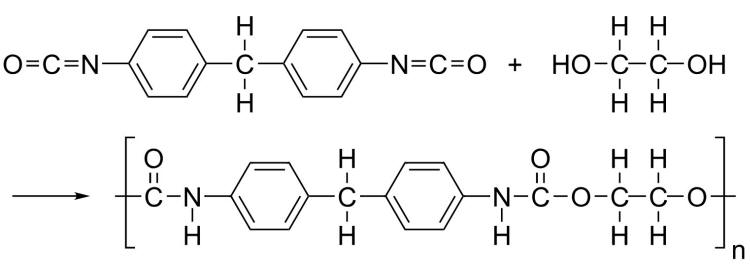
The macromolecular and polymolecular level determines and explains the very wide range of properties and applications of polyurethanes,
rigid and flexible, with different degrees of water absorption, their value as insulation materials and buoyancy materials: the polymers
very useful in providing buoyancy for the boat are also very
useful insulators, and can readily be used for insulation in applications
where the components can readily be removed, and replaced as needed. The versatility
of polymers contributes very significantly to
the versatility of this particular practical application.
Compare the complex structure diagrams for an organic polymer, lignin. Lignin makes up 30% of terrestrial carbon (non-fossil)
and up to 35% of the dry mass of wood. This is a group of heterogeneous polymers synthesized from a few precursor molecules,
lignols, all derived from phenylpropane. Varied and extensive crosslinking between the lignols accounts for the heterogeneity of lignin.

I
Pseudo-science
Commercial pressures
Nietzsche
Goya and violence
{completion}
Mathematical proof
Truth tables
Digital electronics
Biological taxonomy
Aristotle's 'telos'
{direction}
Generalized linkage connective
Implication
Material conditional
Teleological arguments
Trends
Vectors and directed lines
Ferromagnetism
Entropy
Tractatus
Logico-Philosophicus, 3.144
{distance}
Key
system in music
Modulation in poetry
Unities of drama
Narrative {distance}
'Du' and 'Sie' in
German
Edward Bullough's aesthetic {distance}
Wordsworth's boy at
Windermere
Subjunctive and optative in Thucydides
iii, 22
Web design and {distance}
Law of
negligence
The Journey
James Connolly and the Easter Rising
Innovation
Nietzsche
Transformation in Rembrandt and Rilke
Mind, body and the
rest of the world
George Orwell: capital and corporal punishment
Activism and opposition
{modification} by {diversification}
The
necessary, the impossible and the contingent
The ship of Theseus
Invariance
Variables and pretensions
Corroboration and
falsification
Typography and action
Modal properties
Ethical
decision-making
Digital technology
Military medicine: triage
Priorities in politics
Dependence
Nietzsche
{ordering} and
{grouping}
The mind and concentration
{restriction}
Limitation and
limits
Disappointment and imperfection
Exemption: slavery
Quantum mechanics
Jokes
Linkage schemata
((surveys))
Framing
Linkage isolation
Isolation and abstraction
Isolation and 'The Whole Truth'
Isolation and distortion
Poetry and prose
Kant and the limits to
knowledge
Allowing and disallowing
{reversal}
Thermodynamic
reversal
Elastic deformation
Negation
Undoing
Inversion and
musical intervals
Of people:
Shakespeare
Of people: Auschwitz-Birkenau
Commuters
Between
past and present
Vegetables and fruit
Human characteristics and
versatility
Thermodynamic separation
{separation} and
application-sphere
{separation} and separability
Causation
Areas of competence
{substitution}
Evaluating the
thing itself
Mathematical and scientific {substitution}
2. {themes}:
Some
interpretations, making use of Linkage and theme theory
Commutative operators
Demarcation: science-metaphysics
Endothermic and exothermic reactions
Foundationalism and coherentism
Implication
Induction
Inertia
Infinitesimals
Interchangeability
Intervals
Inverses of functions
Kantian categories
Mendelian
factors
Meta- and para-studies
Newton's first law of motion
Newton's third law of motion
Particle in a box
Polish (prefix)
notation
Referents
Regions
Selection: natural and artificial
SI units
Thermodynamic systems and
partitions
3. linkage and {theme} theory: glossary
Abbreviation
{adjustment} and
alignment
Allowing and disallowing
Assuming a linkage
Atypical
linkage
Close linkage and close contrast
Common interface
Constraints
Context-sensitive term
Contrasts of contrast
Deleted linkage
Distortion
Diversification
Elements
Enclosure
Evaluation
Evaluative
linguistics
Exemption
Factors and factorization
Genus and
species
Homoiolinkage and heterolinkage
Incommensurable linkage
Indeterminacy
Isolation
Layers
Limitation
Linkage diagrams
Linkage lines
Linkage schemata
Obverse linkages
Opposites linkage
Orwell's Search
Parnassian contrast
Philosophy and linkage
Primary and secondary elements
Prior linkages
Redeeming contrast
Redrawing
Reduction of contrast
Re-scaling
Restatement
Scaling: primary, secondary, tertiary
Separate worlds
Semi-precise linkage
Substitution
((survey))
{theme}
Unification
Volume
Weighting
4. Poetry: New Ideas, NewTechniques
Contrast and repetition
Directionality
Fragmentation and faulting
Inter-line poetry
'Linguistically innovative poetry'
Linkage by meaning
Modulation
Pulse poetry
Rearrangement and restoration
Regions and zoning
Sectional analysis
Semantic force and significance
Strata poetry
Tensile art
Timing
Transept
poetry
Unit poetry
Image-lines
The Set
Intra-linkages and intra-contrasts
Inter-linkages and inter-contrasts
Frames
5. Aphorisms
Religion, ideology and honesty
Ethics
Power and justice
Nature and the universe
Life and death
Happiness and suffering
The arts
Miscellaneous topics
A short introduction to the aphorism
form
Discussion of the aphorism form





My work has prominence on this Home Page and in the other pages of the site, but, particularly on this Home Page, human achievement in multifarious forms has greater prominence, from scientific and technological innovation to literary achievement - poetry has a central place - wider artistic achievement, other forms of achievement - including human goodness and human strength, as in the case of the women shown on the page who were executed by the Nazis. Wherever possible. I try to support people and organizations I respect and admire, but the financial resources I have available are very, very limited.
The books and other printed publications I own are very important to me. I subscribe to journals and magazines. I have well over a thousand books but wish I had far more. My house is small and space is very restricted. I buy the books and other publications of scholars. The authors are likely to have been paid academics, but the pay they receive doesn't reflect their achievement. When a publication is out of print - but going out of print is often a very unfair fate for a publication - then I buy a used copy. If a publication is still in print and the author seems well worth supporting, then I buy the publication new, so that the author receives a royalty payment, even if the payment from the sale of one copy is very small. When I already own a publication but a newer edition appears, I buy the newer edition if it seems well worth having. In areas which have little or nothing to do with scholarship or print publication, I try to support financially and in other ways organizations which seem well worth supporting.
The Home Page includes images showing human
strengths, architectural beauty, natural beauty, the appeal of animal and
plant life. It also includes images showing human barbarity, animal savagery, the flawed natural order. There are
achievements which transcend the division between good and bad, for example,
the achievement of military historians, a very impressive branch of
scholarship, often combining detailed accounts of barbarity with outstanding
display of human values and humane values.
Appreciation and gratitude
are fundamental in this site, without ever losing sight of the need for
criticism in many cases - but only when criticism can be justified. In some cases,
organizations and people are both praised and criticized:
'admiration-criticism.' Recognition of
complexities is a fundamental feature of the site.
The extracts from musical scores are included on this page simply out of wonder and gratitude that these works, and of course a massive number of other works, exist, the creations of the composers.
PHD, Paul Hurt Design offers genuine innovation,
practicality and a concern for aesthetics and the environment in the design
and construction of, amongst other things (but the list is far from
complete. in recent months, I've worked on projects which have yet to be
documented, or documented adequately. Most of the work I've carried out has
never been documented adequately. Lack of time is the primary reason):
Agricultural growing systems, as in
the invention which has now been awarded a Patent
in the United States.
Further information:
vineyard-orchard-polytunnel-growing-system
and
US Official Patent Document
My United States Patent cost me thousands of dollars but was very worthwhile. Now, I'm preparing an application for another Patent. The van shown in various images above, which has been used to transport materials and for other basic needs, has been lost, following a loud bang and the scattering of engine parts on the hard shoulder of the A1. I cleared the debris away and called for assistance. I didn't have the money to repair the van or to pay the insurance due. The van has had to be been sold for very little money. I take the view that the work I've done has great commercial potential but the time needed to contact potential commercial backers and customers is time I don't have: contacting very many would almost certainly be a necessity, not contacting a few. For the time being and probably for much longer, the problem seems a difficult one, if not insurmountable.
New Window-Door System is a radical system with a very wide range of applications, from small-scale domestic applications to industrial and large-scale architectural applications. It offers unparalleled opportunities to install, very quickly, different surfaces in window spaces which optimize insulation in cold weather, optimize air flow in hot weather, to reduce or eliminate reliance upon air-conditioning installations and allow the insertion of surfaces to achieve wide-ranging benefits, including benefits in security, in fire control, and benefits in storage and provision of working facilities inside homes, offices, workshops and factories.
New
roofing-walling-system
has the potential to
achieve massive benefits in mitigation of flooding, water collection
and storage on a large scale to address the problem of drought and to
reduce reliance upon mains water, and a range of other benefits, including
fire safety.
Other innovations
- there's
information about many of these on the page
PHD
New - but it includes less recent work as well):
A variety of water-collecting
surfaces, directing water to
storage containers, a pond or directly to plants.
Greenhouses - greenhouses with presence, flexible, adaptable,
with large, removable panels to lower the internal temperature
during heat waves and to allow natural precipitation
to water the crops in the greenhouse, reducing reliance on mains water, with
water-collecting surfaces to conserve water.
Implementing green roofs, eg, the roof of
an extension to the PHD Greenhouse, using grape vines / hop plants, with no need for bulky,
heavy soil or
compost.
New
bed-and-board systems in gardens / allotments, with many advantages, including huge flexibility: boards can be quickly removed
and replaced, beds
can be modified very easily, become larger or smaller, growing
areas can be divided into beds or not. When large, open areas are
chosen, water-collecting surfaces can easily be installed, if the areas are
on a slope.
A lightweight metal system allowing quick construction
of various garden / small farm structures for plant protection and
support.
A solar
composter, speeding up production of compost by the greenhouse effect.
A
solar wood store, speeding up the drying of wood for efficient burning in
wood stoves.
Wildlife aids - a bird table, swift nesting boxes
of various designs, all very different from existing designs. The
swift boxes are easily constructed, easily
installed at a height without a ladder, from inside the property - taking hardly any time.
Hydraulic machinery for log splitting / apple pressing, elegant, useful
furniture when not in use.
Other domestic furniture- a table, a bookcase,
storage systems
- distinctive designs, not copies.
A radical new roofing system, allowing inclined
roofs (including water collecting roofs) to be constructed as easily as
flat roofs, within (not above) a new walling system.
Workbenches for
woodworking / metalworking, easy to construct, easy to dismantle, easy to
move from place to place, but solid and immovable in use, with ample storage space and versatile working
surfaces.
A
vice for woodworking, with pressure exerted by a ratchet strap, not a screw thread.
Van to Campervan conversions which can be implemented easily and are cost-effective, practical and harmonious.
Van to Display Unit conversions, using telescopic and other components,
in
particular display boards. The boards can display material of many
different kinds, e.g. campaigning images and text, advertizing material.
The displays are static, for use when the van is parked, not moving.
Simple aids to moving heavy
loads up slopes and on
level ground, in
gardens / allotments.
Simple aids to safety in sheet metal work. In
recent work, I've developed more and more systems which make use of
components which can have very different applications. One example, the
system which makes use of larch (or oak) beams, or rather, beam-sections and
other components which I've used often in previous work, to construct boats
(of very different sizes, for very different uses), raised water storage
ponds and wildlife ponds, container growing units, large and small, with
facilities for protected cropping, workbenches, tables, display /
presentation stands, and more. These constructions offer a very high degree
of flexibility, allowing one construction to be transformed into others.
I've also extended a particular innovation in furniture making to include
other furniture and other constructs - constructs which make no use of nails
or screws or traditional woodworking joints, allowing quick and easy
assembly and quick and easy disassembly.

A summary of some central aspects of my work on this Website - insights provided not by me but by Google. Below, two of the sections which come up when some basic search terms are put into Google. The site has very high Google rankings for a very wide range of search terms. For example, for the search term ethical depth and the search term farming composting water collecting, pages of this site are in first place. These are current rankings which, like so many others, have been maintained over a long period.
(Section 1) Paul Hurt "theme theory"
refers to a conceptual framework developed
by an independent scholar named
Paul Hurt, which is
part of his larger "linkage and theme theory." This theory is presented on his personal academic Website
www.linkagenet.com and appears to be a unique, self-developed system for interpreting and
connecting concepts across various fields, including mathematics, logic,
physics, chemistry, biology, literature, and everyday life.
Theme theory has an extensive range of applications:
Aesthetics and literary criticism: Hurt applies it extensively to the analysis of poetry, metaphor, and music
.
Design and construction: He uses it in his practical design and construction work.
Philosophy, logic, physics, chemistry and biology: The framework is intended to have applications in these scientific and philosophical domains.
Everyday life: It is also used to analyze concrete aspects of modern life.
Key Concepts
While a comprehensive explanation of the entire theory is complex, the central idea involves linkage and theme.
Linkage: This appears to involve identifying connections, relations, and contrasts between different ideas, elements, or "spheres" (e.g., a "poem sphere" and a "reference sphere" in metaphor analysis).
Theme: This relates to the underlying or principal subject of the material being analyzed, which can have a "datum plane."
Restriction: This is another key concept, used to describe human imperfection, error, and the inherent difficulties of the natural world.
Hurt's approach is characterized by an emphasis on identifying structural and conceptual relationships that can be applied in both abstract and practical contexts. He positions his work as an original body of material developed outside of academia.
(Section 2) Linkage and Contrast: Theme theory is an extension of ideas concerning linkage and contrast.
Broad Scope: Hurt applies his framework to a wide range of subjects, from the interpretation of poetry (e.g., Seamus Heaney's work) to philosophical concepts (e.g., Kantian categories, Nietzsche, foundationalism) and scientific principles (e.g., quantum mechanics, thermodynamics).
Thematic Elements: He uses specific terms (enclosed in curly braces on his site, such as {ordering}, {grouping}, {restriction}, {reversal}, {separation}, {substitution}, {themes}) as analytical tools to explore connections and distinctions within and between these diverse fields.
"Theme, Theory, Practice:" The theory is part of a larger project.
My comments: As the Google account implies, the 'Practice' in the larger project 'Theme, Theory, Practice' isn't the analysis of practice but actual 'practice in the world - for example, campaigning for a cause with argument and evidence, campaigning against ideologies (including Christian belief) with argument and evidence, actual changes in attitude and behaviour, sustained attempts to make the changes, based perhaps on constructive criticism / self-criticism, support for realistic and effective policing, action to oppose harmful policing, support for the defence forces, with argument and evidence for the importance of defence against external threats. There are countless other possibilities. The {themes} and other components making up the Theory and Practice, are amongst the most comprehensive of all components, in the distinctive language of Theme Theory, subject to the least possible {restriction} . So, they have as application-spheres not just modern life but pre-modern historical periods. The study of these periods, or awareness of them, can avoid 'modern parochialism.' Another application-sphere: Internet links, instances of Linkage, analyzable using the distinctive techniques of Linkage / Theme Theory, e.g. {resolution}, {direction}, {distance}, {restriction}. My innovations in Website navigation are in accordance with these techniques.
For much fuller information, see the entries
for Themes / {themes} in the alphabetical list in the column to the left.




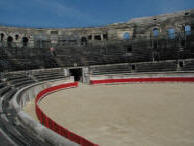







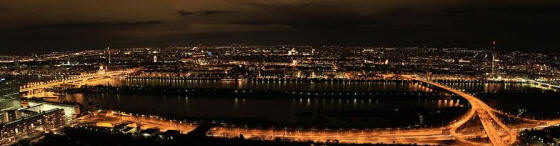

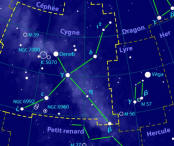
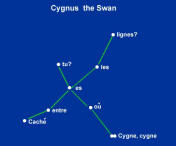





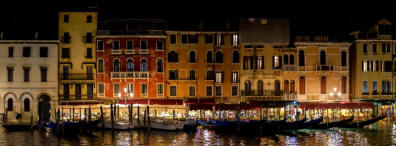

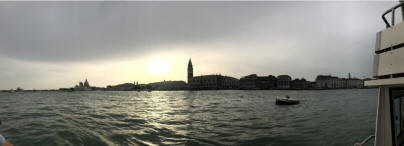

 42
42