
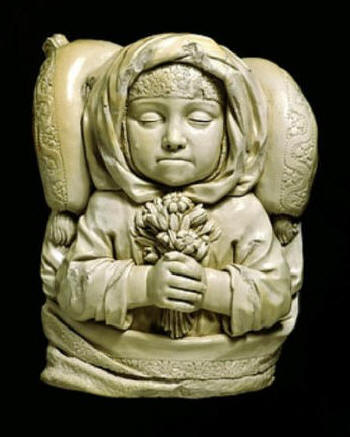
© Victoria and Albert Museum, London
'Lydia Dwight Dead,' from the collections of the Victoria and Albert Museum, which gives this information: 'Lydia Dwight was six years old when she died on 3 March 1674' and 'One of the earliest experiments in European ceramic sculpture, this object was commissioned by the father of the dead child in order to capture her likeness and perpetuate her memory. It was a personal and private sculpture, reflecting the grief of the little girl's family ... '
The sculpture was lent to the Millennium Gallery, Sheffield by the Victoria and Albert Museum and it was there that I saw this heartbreaking response to the death of a young child, which has a counterpart in the heartbreaking set of poems by the Polish poet Jan Kochanowski: the 19 elegies or 'laments' of 1580, written to commemorate his daughter Urszula, who died at the age of two. Seamus Heaney's translation of these 'Treny,' undertaken with Stanislaw Baranczak, is an important contribution to this devastating literature, an important contribution to the poetry of deep feeling.
I discuss the translation of only four lines of Jan Kochanowski's 'Treny III' and mainly a single aspect: the translation of repeated words or phrases. My knowledge of Polish is much more restricted than my knowledge of the other languages here. I studied Polish before visiting Poland, a country, and a people, of great importance and significance for me, and spoke Polish whilst I was there, but only for simple, everyday purposes. The Polish of 'Treny' is Renaissance Polish.
Stanislaw Baranczak's introduction to his translation with Seamus Heaney includes this:
'Jan Kochanowski (1530 - 84), the greatest poet of not just Poland but the entire Slavic world up to the beginning of the nineteeenth century ... '
'His cast of mind was formed by a philosophy of the golden mean and moderation, and this in turn produced a quiet acceptance of whatever life might bring, a tendency to handle the vicissitudes of earthly existence in a rational and orderly way, one always seasoned with a dose of healthy scepticism as regards both gain and loss, success and failure, happiness and misery.
'The stable - or stable-seeming - foundation of such an outlook was provided by both ancient thought and Christian theology. For a sixteenth-century Humanist - in this case, moreover, a poet whose earlier work included not only a Classical tragedy with a plot borrowed from Homer but also a poetic translation of the Psalms - elements of stoicism or epicureanism could merge conflictlessly with the belief in Providential protection bestowed on the just as a reward for their virtuous lives ...
'Yet it is precisely this kind of stable and secure philosophical foundation that may well be the first thing to crack 'when the Parcae cease to spin / Their thread, when sorrows enter in / When Death knocks at the door'. And this is what happened to Kochanowski in middle age when Death snatched away his youngest child, a two-and-a-half-year-old daughter called Ursula, devastating the poet's hitherto unshakeable equanimity ... All of a sudden, pain reaches a degree of intensity that cannot be explained away. No rationalization makes sense to us any more when its very philosophical basis is pulled out like a rug from under our feet - when we can no longer subscribe to the belief that each of us is to a large extent a master of his or her own fate, and that we therefore have the right at least to hope that our actions, if purposeful, timely and determined enough, may bring the desired results ...
' ... by making his grief public, Kochanowski came into conflict with a certain socially accepted and indeed socially required model of behaviour. What was even more striking for his contemporaries, however, was that he also broke a well-established literary convention. The classical principle of decorum reserved the genre known as the funeral elegy, lament, threnody, neniae, etc., for momentous public occasions: deaths of heroes, military leaders, statesmen, great thinkers. Therefore, the poet's reaching for this genre (unequivocally identified in the sequence's title) in order to mourn a child's death (and to make things worse, his own child, a very young daughter, unknown to anybody beyond the immediate family) was tantamount, at best, to a serious artistic error ...
'Heavily influenced by all that happened in lyrical poetry from early Romanticism to the Confessional school, we might be tempted to read Laments as a strangely pre-Romantic 'memoir of the heart', a logbook of personal suffering as it proceeds through all its dramatically varying stages towards a final consolation; and, correspondingly, we might be inclined to interpret the self-portrait of the poet as that of an individualistic rebel who rejects rigid rules in favour of unrestricted spontaneity of expression. Yet such a reading would be equally erroneous. The dramatic power of Laments lies not in its rebellion and the rule, the latter still a factor commanding enough to be reckoned with ...'
I quote from their translation but I discuss only a few lines of the translation in detail, the closing lines of 'Treny III.' My comments are severely technical in a few places. The emotional impact of poetry isn't separable (an instance of the {theme} {separation}) from its technical aspects. Clumsiness or other {restriction} in technique is one way of undermining or making impossible the portrayal of heartbreaking grief in poetry, or the translation into another language of heartbreaking grief.
I regard 'Treny' as an important corrective to the irresponsibility of Rilke and his deeply misguided view that so much is unimportant, or only important in so far as it feeds the soul of the poet, including death, premature death and suffering, his failure to recognize the force of {restriction}. 'Treny' also challenges Aristotle's concept of the mean and other aspects of his ethical philosophy.
The opening of Lament 1:
All Heraclitus' tears, all threnodies
And plaintive dirges of
Simonides,
All keens and slow airs in the world, all griefs,
Wrung
hands, wet eyes, laments and epitaphs,
All, all assemble, come from every
quarter,
Help me to mourn my small girl, my dear daughter,
Whom cruel
Death tore up with such wild force
Out of my life, it left me no
recourse.
So the snake, when he finds a hidden nest
Of fledgling
nightingales, rears and strikes fast
repeatedly, while the poor mother
bird
Tries to distract him with a fierce, absurd
Fluttering - but in
vain! The venomous tongue
Darts, and she must retreat on ruffled wing.
The opening of Lament 8:
The void that fills my house is so immense
Now that my girl is gone.
It baffles sense:
We all are here, yet no one is, I feel;
The flight
of one small soul has tipped the scale.
You talked for all of us, you
sang for all,
You played in every nook and cubbyhole.
You never would
have made your mother brood
Nor father think too much for his own good;
The house was carefree. Everybody laughed.
These are the closing lines of 'Treny III.'
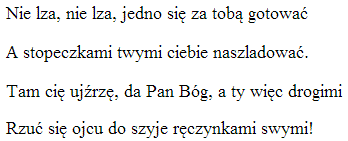
They translate this as:
What can
I do, then? what else do, except
Follow whatever way your light foot stepped?
There, Heaven grant it, at my journey's end,
Your slender arms will reach and gird me round.
Repetition of musical phrases is far more common than repetition of phrases in poetry. Translators should generally convey the repetition. If A is a phrase in the original and is translated as a, then A A should generally be translated as a a not a b.
'What can I do, then? what else do ...' reads quite well, but it would have been better to have given a translation which retained the exact repetition of the original 'Nie lza, nie lza ...' The force of the repetition is blunted not just by the variation in the translation but by the insertion of 'then.' The translation 'What can I do, then? what else do ...' is less literal, less direct, less effective than the translation 'What can I do? what else do?' which is in turn not an effective translation - even if it does read quite well.
A further example: the two diminutives in the passage have the ending -kami. To translate these two diminutives by 'light foot' and 'slender arms' involves a lessening of the gentle force of the repeated diminutive endings. The translation has a further drawback. Diminutives in Polish, as in so many other languages, may signify some aspect of physical smallness or slightness but far more important are the affection and endearment they convey. Seamus Heaney might have chosen the translation 'wee foot' and 'wee arms.' It would have been natural, unforced: 'wee' is current in the English of Northern Ireland, as in Scots. However, the undistinctive 'little foot' and 'little arms' seems preferable. 'Wee' is so distinctive as to be intrusive, and syllabic translation is better served by the polysyllable 'little' than the monosyllable 'wee,' as a translation of the polysyllable diminutives in the original Polish. The 'little' in 'the grief of the little girl's family' (in the information which follows the image at the beginning of this section) is more than adequate, and likewise here.
Syllabic translation is my term for preserving the syllabic status of the original (although not in every case the original syllabic count): the carrying over of a monosyllable in the original and a polysyllable in the original to the translation (the 'translation' of 'syllabic translation' is obviously different in meaning from the 'translation' of 'translation from Polish to English.) See also my comments below on the translation of the monosyllable 'Bóg.'
In his review of Adam Czerniawski's translation of Treny III, Steven Clancy, writing in The Sarmatian Review criticizes his failure to convey the emotional impact of the diminutives:
'Whereas the father's love for his daughter does successfully come through in Czerniawski's English in poems such as Treny VIII ... the sweetness and affection of several Polish diminutive forms (as in Treny III, VIII, and X) are not rendered at all.' He quotes the four closing lines from Treny III and adds, 'The second line here might be rendered as "And follow in your little steps" and the final line as "Cast your little arms around your father's neck." However, Czerniawski's reductive version in only two lines is:
I must make ready your steps
to trace,
There,
God willing, feel your embrace.
In this particular instance, the meaning of the diminutive forms is lost altogether.' The translation here is beyond redemption.
He also comments on the translator's successes and failures in conveying some repetitions in the Polish original. Treny I 'features the Polish word próìno four times in five lines. Czerniawski translates this as (in) vain three times, but the relentlessness of this word is broken off early by a final rendering as futile.'
I discuss other instances in which Seamus Heaney avoids repetition needlessly, in his translation of a poem by Cavafy and his version of Sophocles' Philoctetes.
The translation into a language other than English of these lines from Seamus Heaney's 'The Grauballe Man'
Who will
say 'corpse'
to his vivid cast?
Who will say 'body'
to his opaque repose?
should preserve the repetition of 'Who will say' and 'to his.' Even a far from literal version should preserve the repetition.
Translators may well avoid a translation which is direct, almost as if they have to demonstrate their creativity. In many cases, their 'oblique' translation is less satisfactory than the 'direct' translation - for example, in terms of syllable count, or in terms of nuances of meaning.
The translation which Seamus Heaney and Stanislaw Baranczak give for 'Bóg' is 'Heaven,' although 'Bóg' means 'God' in Polish. 'Heaven' is 'niebo.' The translation 'Heaven grant it ...' is syllabically not superior to 'God grant it ...' and God, not Heaven, generally grants favours or privileges, as believers see it.
But their translation of the lines is far better than that of Barry Keane. In his translation, the diction of the first line is very awkward, the feeling conveyed in the fourth approaching glibness, perhaps, but certainly remote from the world of feeling of the original.
What else,
what else, myself I must prepare to make
Ready for the footsteps you have had to take.
For there, God grant, I’ll find you so sweet,
And you’ll embrace your daddy when we meet.
His commentary on 'Treny III' is far better than his translation: 'Praise of the dead child is a common trait in Latin consolations. The writer would praise the deceased child’s possession of adult virtues such as modesty, charm, grace and honour. Even though they died before their various talents could blossom, their virtues were such that the writer was left in no doubt that their talents would have, if they had lived, realised true greatness. These same writers evoked a tragic pathos by recalling the parents' joy in listening to their child’s early progress with speech. In this poem Kochanowski, whilst not burdening Orszula with such an adult demeanour, relishes the memory of her childlike decorum. He yearns for her babbling sounds to reverberate once again throughout the house, but silence has fallen over the house ...'


Introduction
Italian: Dante, first stanza, Inferno' '
Italian: Dante, The Crossing (Seeing Things)
Latin: Anything Can Happen (District and Circle)
German: Rilke, After the Fire (District and Circle)
German: Rilke, The Apple Orchard (D and C)
Modern Greek: Cavafy (D and C)
Dutch: J C Bloem (The Spirit Level)
Classical Greek: Philoctetes (The Cure at Troy)
Polish: Jan Kochanowski (Laments)
Supplementary
French:
Mallarmé, 'Le vierge, le vivace et le bel aujourd'
hui
French: Baudelaire, 'The
Albatross.'
Hebrew language
Please see also, for material relevant to translation from German, Kafka and Rilke
IntroductionThe sections on this page contain my translations from languages which have been translated by Seamus Heaney. My translations are of the complete text, as well as extracts. I also comment on issues to do with the theory and practice of translation and a wide range of other issues, and I include some translations from French.
In the sections below, apart from the sections 'After Liberation,' 'Laments,' 'The Cure at Troy,' the sections with my translations from French and the very short section on Hebrew, there are these sub-sections:
A. Original,
with information about the source.
B. Discussion of Seamus Heaney's translation or version.
C. My translation.
D. Discussion of my translation.
In my discussion of translations of the first stanza of Dante's 'Inferno,' I provide a further section, 'Notes on other translations.'
J C Bloem's poem 'Na de Bevrijding' is in copyright, like, of course, Seamus Heaney's translation ('After Liberation,' in 'The Spirit Level') and all the other published writing of Seamus Heaney. For this poem, I give the whole of my translation, followed by the last two lines and the first line of the original Dutch and Seamus Heaney's translation of these lines. Then I discuss some phrases in the original and in Seamus Heaney's translation.
So far as I'm aware, of the languages in the translations discussed here, Seamus Heaney had effectively no knowledge of Classical Greek, Modern Greek, German, Dutch and Polish. He translated from Irish, but had only a very modest knowledge of the language. I know that he studied Latin for years and even if he never studied Italian thoroughly, it may well be that he had a fair grasp of the language. It isn't in the least uncommon for poets to offer translations from languages they haven't studied, of course. This is a handicap which is sometimes overcome very successfully, sometimes not in the least. On this page, I examine the results, the virtues and faults of Seamus Heaney's translations.
In the case of 'The Cure at Troy' I provide a continuous discussion, but only of the opening (except for some comments on the ending), not the whole play - as far as line 143.
As a first approximation, there are 'faithful translations,' 'improved translations,' 'versions' and 'unfaithful, unimproved translations.'
Faithful translations should above all be at the service of the original. They should observe 'the ethics' of translation. If the original becomes obscure or paradoxical or makes use of repetition, the translation should in general be obscure or paradoxical or make use of repetition. If the original uses repeatedly the word, in the source-language, for 'say' but not 'declare' or 'state' or 'speak' (available in the source-language but not used) then the translation should use 'say' consistently, and not give the illusion of variety by translating the one word by 'say,' 'declare,' 'state' and 'speak.' Faithful translators should serve the text and do the best they can for the text, but not by 'improving' it. Producing a faithful translation is far from straightforward. A 'faithful' translation of a word or phrase may be misleading. There may be a great gulf between the world view of the original and the world view to which the new translation belongs. Faithful translators need to know the language of the original well, although not exceptionally well.
'Versions' use the text as a starting point. Faithfulness to the text isn't required. Seamus Heaney's 'Mycenae Lookout' ('The Spirit Level') is an example. This is the least problematic of the translation-types. Writers of versions need not know the language of the original at all. I discuss on this page 'Anything Can Happen,' a 'version' which uses an ode by Horace as a starting point but not 'Mycenae Lookout' in 'The Spirit Level,' which uses Aeschylus' 'Agamemnon' as a starting point but diverges from the original to a greater extent than 'Anything can Happen.' I discuss 'Mycenae Lookout' on the page 'Criticism of Seamus Heaney's 'The Grauballe Man' and other poems.' In all the poems I discuss on this page, the original is more directly relevant than in the case of 'Mycenae Lookout.'
The most problematic is the 'improved translation.' The word 'improved' here refers not to an improvement on the original but an improvement on the 'faithful translation.' The improved translation is intended to have fidelity to the original - usually less fidelity than the faithful translator's - but it's the product of a mind with distinct literary strengths not usually found in faithful translators. Improved translations of an original with literary quality are intended to be literary works in their own right, like the original, and like 'versions.' Most poets with a reputation as poets have seen themselves as improvers or producers of versions rather than as faithful translators. I think that improved translation needs some knowledge of the language of the original, as much knowledge as a faithful translator's, preferably, but often, improved translators do without.
The last type is the 'unfaithful, unimproved translation,' which lacks the devotion to the original of faithful translations and the literary qualities of improved translations and versions.
A. Original 'Inferno,' Canto I, lines 1 - 3
Nel mezzo del cammin di
nostra vita
mi ritrovai per una selva oscura,
che la diritta via era smarrita.
B. Discussion of Seamus Heaney's translation
Seamus Heaney's translation
In the
middle of the journey of our life
I found myself astray in a dark wood
where the straight road has been lost sight of.
is poor. In the first line, the image-terms 'middle,' 'journey' and 'life' are made far less effective by clutter and clumsiness: 'in the,' 'of the,' 'of our.' The repeated 'of' is particularly obtrusive.
In the second line, 'astray' anticipates in a completely unnecessary way the third line, which makes it completely clear that Dante is now lost or 'astray,' In the third line, there's the culpable, unrhythmic clumsiness of 'has been lost sight of.' Old-fashioned stylistic rules such as 'never end a sentence with a preposition' are sometimes broken very effectively, but not here. This third 'of' compounds the effect of the first two occurrences. The sound linkage between 'astray' in line 2 and 'straight' in line 3 isn't an effective linkage: the sibilant sounds are prominent and distracting.
Not all sound-linkages of individual letters are equally effective in poetry. Some sounds lend themselves better to the prolongation and repetition of sound-linkages. Some others are less suitable, unless used very carefully and I think the 's' sound falls in this category. This was the opinion of Dionysius of Halicarnassus, referring to the 'ancestor' of 's,' the Greek sigma:
ἄχαρι δὲ καὶ ἀηδὲς τὸ σ̄ καὶ πλεονάσαν σφόδρα λυπεῖ· θηριώδους γὰρ καὶ ἀλόγου μᾶλλον ἢ λογικῆς ἐφάπτεσθαι δοκεῖ φωνῆς ὁ συριγμός·
'Sigma is an unattractive, disagreeable letter, very offensive, when used to excess. A hiss seems a sound more suited to a brute beast than to a rational being.'
Seamus Heaney's translation is unrhythmical prose-poetry. After line removal:
'In the middle of the journey of our life I found myself astray in a dark wood where the straight road has been lost sight of.'
The majestic and mysterious opening of the 'Divine Comedy' demands a translation of far higher quality.
Notes on other translations. I find most - not all - of the translations here imperfect or very imperfect but my comments are concerned only with these opening lines, no more.
C. H.
Sisson
Halfway along the road we have to go,
I found myself obscured in a great forest,
Bewildered, and I knew I had lost the way.
An unfaithful translation, with no compensating gains. Its wilfulness is
extreme: 'oscura' is translated by 'great', in the phrase 'per una selva
oscura.' 'Bewildered' is a superfluous translator's addition.
Ciaran Carson
Halfway through the story of my life
I came to in a gloomy wood, because
I'd wandered off the path, away from the light
'di nostra vita:' 'of our life.' Ciaran Carson's 'of my life' is worse than pointless: it removes the sense of universal human experience. 'away from the light' is a translator's addition: again, unfaithful, with no compensating gains.
Steve
Ellis
Halfway through our trek in life
I found myself in this dark wood,
miles away from the right road.
'trek' suggests arduousness throughout life. The original suggests a less problematic and difficult journey which has become more difficult, bewildering. 'miles away' suggests a gap, {separation}, between the 'right road' and this point in the journey which distorts the original.
Sean O'
Brien
Once, halfway through the journey of our life
I found myself inside a shadowy wood,
because the proper road had disappeared.
One of the better translations of this stanza, although the opening word 'Once' is too emphatic, a call to attention. The original slips quietly into our consciousness, with an opening phrase which is anything but emphatic.
Anthony
Esolen
Midway upon the journey of our life
I found myself in a dark wilderness,
for I had wandered from the straight and true.
Good, but flawed. 'wilderness' is an inadequate translation for 'selva,' which is 'wood' or 'forest.' There's no reason why any reader should be led to suppose that Dante is lost in an indeterminate wild or desolate tract.
Henry
Longfellow
Midway upon the journey of our life
I found myself within a forest dark,
For the straightforward pathway had been lost.
Good, except for 'pathway,' too narrow a translation of 'via.' The {ordering} of 'forest dark' is distracting for contemporary readers.
Ronald
Bottrall
Midway in human life's allotted span,
I found myself in a dark wood,
where the straight path I sought in vain.
This isn't at all resonant. 'the straight path I sought in vain' belongs to the world of conscious and even humdrum effort' rather than the 'recessed' world within the dark wood.
Tom Phillips
Just halfway through this journey of our life
I reawoke to find myself inside
a dark wood, way off course, the right road lost.
'just' in 'just halfway' makes for an over-qualified opening. 'I awoke' is an acceptable translation of 'mi ritrovai,' but not 'I reawoke. 'way off course, the right road lost' is pleonastic.
Robert
Pinsky
Midway on our life's
journey, I found myself
In dark woods, the right road lost.
This translation abandons the division into three line stanzas, three lines compressed into less than two. The translation is plain but very effective.
Dorothy L Sayers
Midway this way of life we're bound upon,
I woke to find myself in a dark wood,
Where the right road was wholly lost and gone.
This is a translation which uses terza rima. Dorothy L Sayers makes the difficult look easy. This is a good translation. The price paid is obvious here, the superfluous ' ... and gone' to give a sound-linkage between 'gone' and 'upon,' but this is a minor consideration.
Clive James
At the mid-point of the path through life, I found
Myself lost in a wood
so dark, the way
Ahead was blotted out. The keening sound
I still make
shows how hard it is to say
How harsh and bitter that place felt to me—
Clive James substitutes four-line units for the three-line units of the original and many other translations. The quatrains have the sound-linkage scheme a b a b. The cost in redistribution of material and increase in material is sometimes high, as it is in these opening lines. 'The keening sound / I still make shows ...' is increase in material, material not present in the original, delaying and blunting the forceful transition from the original's first triplet unit to the second. Redistribution of material for the sake of the rhyme eliminates the simplicity of the original's matching of material to line:
Line 1: When (the 'where' of time)
Line 2: Where (the 'where' of
place)
Line 3: Why
In this translation, meaning-enjambment is used and the 'where' of line 2 begins at the end of line 1 with 'I found,' which will be rhymed with the 'sound' of the increased material. Similarly, 'the way' is appended to line 2 in the translation and again, the structural line, the structural line-limit, are ignored. Translations very often need to ignore them, by necessity, but not here.
Alan Holder gives an account of the importance of the line in poetry in Chapter 5, 'Preliminaries to Revision,' of his book 'Rethinking Meter: A New Approach to the Verse Line.' His account diverges markedly from that of Marjorie Perloff, who 'in her essay "The Linear Fallacy," has subjected the notion of the line being the central, indispensable component of poetry to a vigorous, extended attack. He believes that the line is the central, indispensable component of poetry and I'm in agreement with both the thesis and the arguments.
I think it's important to transfer from original to translation if possible (of course it may not be possible) the meaning-material within a line of the original. In the opening of the 'Inferno,' it's perfectly possible, in fact very easy, to transfer the 'when' of line 1 to the 'when' of the translated line 1, without anticipating the 'where' of line 2.
A translator who finds sound linkage so important as to insist upon a rhymed translation may not be so very sensitive to sound. This is the case in the opening line of the translation at least. The 'th' sounds (igroning the 'th' in 'through') are obtrusive and could easily have been made unobtrusive, without radical change: the 'th' sounds in 'path' and in initial position in the two instances of 'the.' The second instance could have been avoided by replacing 'the' with 'our,' even if the original has 'our' life, not 'our' path.
Dante never claims that the way is lost because the wood is dark. This translation encourages the mistaken supposition that the losing of the way is simply a matter of optical visibility: not enough light to see the way. But 'oscura' has a much more complex reference, like 'dark' in 'dark days.'
J G Nichols
Halfway along our journey to life’s
end
I found myself astray in a dark wood,
Since the right way was
nowhere to be found.
Excellent, except, I think, for 'along,' which draws attention to itself and contributes to an excessive proportion of polysyllables in the part line 'Halfway along our journey.' Better the unobtrusive monosyllable 'in:'
Halfway in our journey to life's end
A S Kline
In the middle of the journey of our life, I came to myself, in a
dark wood, where the direct way was lost.
This translation is no longer available in print form but can be viewed at the writer's Website, www.poetryintranslation.com
http://www.poetryintranslation.com/PITBR/Italian/Danthome.htm
The quiet momentousness of the opening is conveyed very effectively. The comma after 'myself' is unnecessary, but otherwise, this is a very good translation. A S Kline's translation of the 'Inferno' isn't so much a prose translation as a prose poetry translation and can be strongly recommended.
Midway
in the journey of our life
I came to in a dark forest,
where the road I should follow was lost.
D. Discussion of my translation
I use 'midway' instead of 'halfway' because 'half' has associations of mathematical exactness, to an extent. I use 'forest' instead of 'wood' because wood suggests something too small, the experience of being lost in a wood less significant than being lost in a forest, but 'forest' has the disadvantage, in some contexts, of being disyllabic. 'Forest' would be less effective than 'wood' in A S Kline's translation but in the context here, it extends the short line and is useful. I use 'road' instead of 'way' to give a linkage of sound between the hard 'd' of 'road' and the hard 'd' of 'should.' (The sound linkage is more understated than the sound linkage in 'right road' in Steve Ellis's and Robert Pinsky's translations which I give above.) The hardness of sound can suggest the hardness of the road - now lost. On contrasts of length in the translation, see my discussion of extension-contrast in the page on 'Metre.'
I think that my translation is without the distracting awkwardness, even if sometimes a very slight awkwardness, in many of the translations quoted above. This is a poem of tremendous drama, force and scope which begins with such quiet simplicity.
The Inferno gives comparatively few contrasts between repose and dramatic momentum within its great length. The significant contrasts are block-like, between the Inferno on the one hand and the Purgatorio and Paradiso. It's essential that the opening of the Inferno, which is in contrast with so much of what follows, should have a smoothness in translation - a smoothness which is in the original. By line 5, there's roughness and harshness.
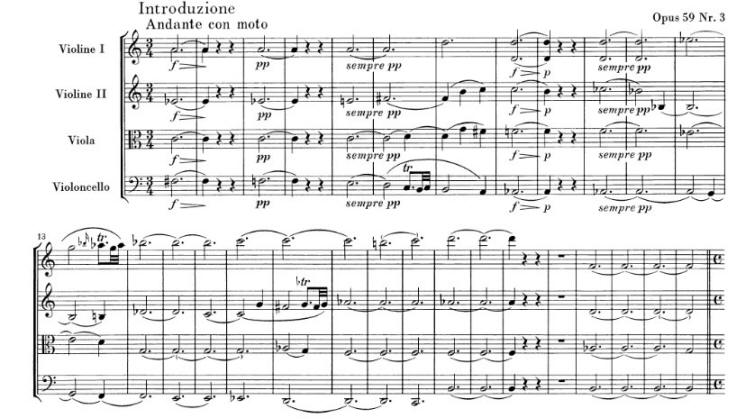
Before translating the lines, I was preoccupied with complexities, but the complexities contributed to the translation, to my choice of 'forest' rather than 'wood,' for example. The lines of the original seem to have simplicity, but cultural experience, our own individual experiences, set up expectations and make the lines resonant in a way almost impossible to convey. My view of the lines is influenced by what Basil Lam writes about the opening of Beethoven's String Quartet Op. 59 No. 3, 'Beethoven's introduction, unlike Mozart's [a reference to the 'Dissonance' Quartet in C, K. 465] deliberately obscures not only tonal structure but rhythm also. The direction Andante con moto is surely ironical, for motion is notably lacking in nearly thirty bars of 3/4 almost devoid of crotchet movement. Here is music for Dante's image of being lost in a dark wood, unable to find the right way.'
There are different experiences of being lost: the experience of being lost in a strange city, usually no more than frustrating, the experience of being lost in a hostile wilderness, more often than not terrifying, and the experience of losing our way in life.
The dark wood is more than simply dark, even if 'dark' is the most adequate translation of 'oscura.' The associations are too many for 'dark' or any other single word or phrase. I think of the Germanic forests, much more extensive and much darker, or so it seems, than English forests. Kenneth Clark, 'Landscape into Art:'
'Already in the fifteenth century artists began to feel that landscape had become too tame and domesticated, and they set about exploring the mysterious and the unsubdued ... it would be a mistake to suppose that they were similar to the Gothic novelists or the men of 1830. Horace Walpole wrote from the absolute security of Twickenham; to Grünewald, Altdorfer and Bosch the menaces of life were still real. They had seen villages burnt by passing mercenaries, had experienced the barbarities of the Peasants' War and the subsequent wars of religion. They knew that the human mind was full of darkness, twisted and fiery [compare the 'twisted souls,' in my translation of the lines from Canto III] and they painted an aspect of nature which expressed these dark convolutions of the spirit ... They are what we now call 'expressionist' artists ... Expressionist art is fundamentally a northern and an anti-classical form ... It is forest born, and even when it does not actually represent fir trees and undergrowth - as in German painting it almost invariably does - their gnarled and shaggy forms dominate the design.' Dante's wood isn't northern and doesn't include fir trees, but it may be very difficult to prevent the mind from assimilating and combining.
Mozart's opera of damnation, but much more than damnation, 'Don Giovanni' is a rich source of resonance and expectation for me: the shattering chords of the opening, the shifting and uneasy passage which follows, the momentum of the last Act which sees Don Giovanni descending into hell, defiantly. Gustave Doré's illustrations for the 'Inferno' are another source of resonance and expectation, either enhancing or interfering with reading of the original for the purposes of translation.
A. Original Dante, Inferno, Canto III, lines 82 - 129.
Ed ecco verso noi venir
per nave
un vecchio, bianco per antico pelo,
gridando: 'Guai a voi, anime prave!
Non isperate mai veder lo cielo:
i' vegno per menarvi a l' altra riva
ne le tenebre etterne, in caldo e' n gelo.
E tu che se' costì, anima viva,
pàrtiti da cotesti che son morti.'
Ma poi che vide chi' io non mi partiva,
disse: 'Per altra via, per altri porti
verrai a piaggia, non qui, per passare:
più lieve legno convien che ti porti.'
E 'l duca lui: 'Caron, non ti crucciare:
vuolsi così colà dove si puote
ciò che si vuole, e più non dimandare.
Quinci fuor quete le lanose gote
al nocchier de la livida palude,
che 'ntorno a li occhi avea di fiamme rote.
Ma quell' anime, ch' eran lasse e nude,
Cangiar colore e dibattero i denti,
ratto che 'nteser le parole crude.
Bestemmiavano Dio e lor
parenti,
l' umana spezie e 'l loco e 'l tempo e 'l seme
di lor semenza e di lor nascimenti.
Poi si ritrasser tutte
quante insieme,
forte piangendo, a la riva malvagia
ch' attende ciascun uom che Dio non teme.
Caron dimonio, con occhi
di bragia,
loro accennando, tutte le raccoglie;
batte col remo qualunque s' adagia.
Come d' autunno si levan
le foglie
l' una appresso de l' altra, fin che 'l ramo
vede a la terra tutte le sue spoglie,
similemente il mal seme
d' Adamo
gittansi di quel lito ad una ad una,
per cenni come augel per suo richiamo.
Così sen vanno
su per l' onda bruna,
e avanti che sien di là discese,
anche di qua nuova schiera s' auna.
'Figliuol mio,' disse 'l
maestro cortese,
'quelli che muoion ne l' ira di Dio
tutti convegnon qui d' ogne paese,
e pronti son a trapassar
lo rio,
ché la divina giustizia li sprona,
sì che la tema si volve in disio.
Quinci non passa mai anima
buona;
e però, se Caron di te si lagna,
ben puoi sapere omai che 'l suo dir suona.'
B. Discussion of Seamus Heaney's translation (in 'Seeing Things,' with title 'The Crossing.')
To begin with a detail, but a detail which has a linkage with plausibility and characterization and which reveals some of the fascinating difficulties of translation. The best known lines in this extract from Canto III of 'The Inferno' are about Charon, who orders the damned to get into his boat
And beats with his oar whoever drops behind
in Seamus Heaney's translation. ('beats' is 'batte' in the original.) Sean O' Brien's translation of the same line is
And clubs the laggards with his dripping oar:
In general, I like Sean O' Brien's translation of the 'Divine Comedy' very much, but this line is one of the less successful. Without commenting further on the 'dripping' oar, which isn't in the original, 'clubs' isn't the best choice of word. Clubs and similar weapons are much shorter than oars but more important, clubbing the laggards is too extreme. Charon is trying to make them hurry, to get a move on. Later, we're told that before one batch has disembarked on the far side of the river, another batch has gathered on the near side, waiting to be ferried across in its turn. Charon has to work with urgency. Charon perhaps doesn't have the time for beating either, and by injuring the damned, they are less likely to hurry, more likely to cause problems for the terrible logistics of Hell, here approximating to a hectic industrial production line. (In my translation, I try to suggest a production line by using 'assembled there' of the damned waiting to be ferried across the Styx.) Later, I discuss the obvious point - is there any need for plausibility here?
Seamus Heaney's 'beats with his oar' suggests a succession of blows. Collins English Dictionary for 'beat' : 'to strike with or as if with a series of violent blows; dash or pound repeatedly (against).' The oar needed for propelling a boat containing many people would be unwieldy (I write as an ex-rower) and very difficult to use for beating, for repeated blows. (In the story 'Black Peter,' Sherlock Holmes showed the extreme difficulty of using a harpoon by trying it himself at a butcher's. Trying to use a long and heavy oar to imitate beating is an exercise which needn't be attempted, unless someone is very curious.)
Very violent action isn't required by the character of Charon. His eyes alone give him a fearful appearance and his words to the damned are harsh, but he's also a figure of fun. Vergil, Dante's guide, finds it very easy to shut him up. He's formidable only in part. Osmin in Mozart's opera 'Die Enführung aus dem Serail' has similarities with Charon. Osmin's words are often cruel, just as Charon's are 'crudele.' In a letter to his father, Mozart refers to 'the stupid, surly, malevolent Osmin but Osmin is blustering and sometimes ridiculous too. 'Blonde can manipulate Osmin with ease'
So, for various reasons, I think that 'batte' calls for less severe action in translation than clubbing or beating. Anthony Esolen in his translation, a fairly literal translation which I like very much, uses 'smacks' but 'to smack' is 'to strike or slap smartly, with or as if with the open hand' (Collins English Dictionary.) This isn't a suitable word to describe hitting with an oar.
'Thwacks' would have the advantage that it describes hitting with something flat and the part of the oar which would be used in hitting is flat, but this is a nuance which many readers will be unaware of, and 'thwacks' isn't often used in contemporary English. In my translation, I use 'whacks,' which is without the th- sound, not a 'visceral' or 'sinewy' sound but an awkward sound in 'thwacks,' I think. An oar is well adapted to giving a 'whack,' a single, resounding blow, but not to beating or clubbing.
Dante's 'Inferno' is full of grotesque and bizarre events, people and animals. Are these considerations of plausibility and implausibility relevant? I'm sure that they are. This is a world which is still subject to {restriction}, for example {restriction} imposed by characterization. It makes perfectly good sense, for example, to consider the different characterizations of Vergil, the guide, and Charon. They're markedly different. What would be plausible words or actions for one would be completely implausible for the other.
Hölderlin's poem 'Lebenslauf' has the lines,
Herrscht im schiefesten
Orkus
Nicht ein Grades, ein Recht noch auch?
Even in most crooked Orcus
does not a straightness, a rightness rule?
where 'Orcus' is the Roman name for Hades. In Hades and Hell, despite the differences from our own world, a straightness, a rightness - and plausibility - rule, to an extent.
After this discussion of the translation of a single word, I turn to the translation of whole lines. Here, Seamus Heaney is sometimes very diffuse.
Polysyllables are far more common in Italian than English, which has such a store of one-syllable nouns and other parts of speech. A translator may sometimes use more syllables than are strictly necessary to achieve a certain end, to convey a nuance, for example, but generally, lines in English with less syllables than the Italian are in order. They are more likely to convey the directness of Dante's Italian.
In some places, such as its first line, 'The Crossing' is diffuse and simply uses, not too many polysyllabic words but too many syllables in total. Here, the original is preceded by the line number. Seamus Heaney's translation is given in the line immediately following. The number of syllables in the original line and his translation are given in in brackets.
Despite the fact that the Italian 'nave' has 2 syllables and its translation, 'boat,' has 1, there are more syllables in the first line of 'The Crossing' than in the original:
82. Ed ecco verso noi
venir per nave (11)
And there in a boat that came heading towards us (12)
This is a particularly diffuse (and ineffective) line in 'The Crossing:'
118. Così sen vanno
su per l' onda bruna, (11)
They go away like this over the brown waters (12)
In the next example, it would have been better if Seamus Heaney had used the monosyllabic 'ports' instead
of 'harbours.' The rhythm is more effective if the monosyllable is
used. Although 'porti' can mean harbours or ports, harbours are where
boats and ships dock, even though they put to sea again from the harbour.
Ports are far more places of transit. Dante is to go there 'per passare,'
to be carried from there to another destination.
91. disse: 'Per altra via, per altri porti (12)
He said, 'By another way, by other harbours (12)
In the next example, Seamus Heaney uses only one syllable less than the original, even though the original has 'isperate' (4 syllables) and the word he uses to translate it, perfectly correctly, 'hope' has one. His use of 'heavenly' was unnecessary. It's not in the original and doesn't convey the total loss nearly so effectively - the loss of the ability to see any skies.
85. Non isperate mai veder
lo cielo; (12)
O never hope to see the heavenly skies! (11)
There are no mechanical ways of arriving at an estimate of the success of a poem, including a translation-poem, and certainly not by counting syllables, but poets, and translators whose translations are in metre, have to have an acute awareness of syllables, they should keep track of syllables very carefully, even if they rarely count the actual number in a line.
Too many or too few syllables give a {restriction} on the metrical success of the poem and such linked issues as the urgency, momentum, unhurried ease, contemplative inwardness, calmness, degree of diffuseness and other qualities of the poem. The success of a poem depends upon the choice of words, the placing of words, and the punctuation, just as the success of a drawing, its emotional depth or dramatic impact, is completely dependent upon the marks on paper or another medium, broader or narrower marks, the very fine differences of weight which can be applied, the placing of these marks.
'The Crossing' gives rise to many more reservations.
In the next example, 'his God' suggests a Dante who believes 'the modern polytheism' which recognizes that different people recognize or worship very different gods, not 'the medieval Christian monotheism,' according to which there is only one God, and those who recognize or worship very different gods are heretics, and may well find a place in the Inferno.
107. ... a la rive malvagia
ch' attende ciascun uom che Dio non teme.
... the accursed shore that waits
For every man who does not fear his God.
In the next example, 'levan' means 'raised,' 'lifted,' not 'fall off:'
112. Come d' autunno si
levan le foglie
As one by one the leaves fall off in autumn
The dialogue is sometimes
stilted, for example in this line (it follows the mention of harbours) :
92. verrai a piaggia, non qui, per passare:
You shall reach a different shore and pass over.
To include this translation in 'Seeing Things' was surely a mistake. There
are more than fifty translations into English of the complete 'Inferno.'
A conductor who gives to the listening public another recording of Beethoven's
Fifth Symphony has to give a version which is exceptional. A conductor who
gives to the listening public not just a single movement of the symphony but
part of a movement is doing a disservice to music. The musical structure of
the symphony, such as the exposition, development and recapitulation of
movements in sonata form in the first and last movement, with their tonal
contrasts, doesn't allow any
serious interpreter to excerpt in this way. The 'Inferno' is one of those
works with a particularly highly organized and significant structure, of course.
Sean O' Brien in the introduction to his translation (his translation of Canto
III lines 82 - 129, the lines which make up Seamus Heaney's 'The Crossing'
is at a much higher poetic level than 'The Crossing') writes of the Commedia
in his 'Introduction,'
'It is soon apparent that the Commedia as a whole is a work of remarkably thorough and intricate design: a complete imaginative world ... The design can be seen at the level of cosmic order, where Dante adapts the Ptolemaic universe of concentric spheres to the purposes of Christianity, maintaining an exact congruence between the material universe and its moral significance and creating a poetic counterpart to the theology set out by Thomas Aquinas ...
'Dante also builds in the astrological zodiac, with constellations used as timepieces by Virgil, Dante's guide, who maintains a very strict schedule for the journey. At a less explicit level, there is also a complex system of numerological symbolism ... '
There are other organizing principles as well, but Seamus Heaney has ignored all of them by lifting these lines out of their context. His extract ends at line 129. Canto III ends at line 136, with the wonderful line 'e caddi come l' uom cui sonno piglia.' His decision to stop at line 129 is incomprehensible, although if he had continued to the end of the Canto, the objections to his procedure would remain.
There are circumstances, of course, in which the publication of extracts from the Inferno can easily be justified, but not here, in 'Seeing Things.' His own original work in the volume was ample, the volume wasn't so slim that it needed any translations to give it greater bulk.
C. My translation
And look! Heading towards
us by boat,
an old man with white and ancient hair,
roaring: 'Woe betide you, twisted souls!'
Abandon hope of seeing the sky.
I'm here to lead you to the far shore,
to eternal darkness, heat and ice.
And as for you - yes, you! - living soul,
away from those others who are dead!
But when he saw that I wouldn't budge,
he said, ' Other ports, another route,
will carry you to that shore, not here.
A light conveyance will be your boat.
'Stop worrying yourself,' said my guide.
This is willed there, where anything can
be done which is willed. Demand nothing.
Then at once the hairy jaws fell quiet,
the boatman's of the black and blue swamp,
whose eyes still darted with rings of flame.
But those exhausted and naked souls,
with all their colour drained, ground their teeth
after they had heard his callous talk,
hurled blasphemy at God, their parents,
the human race, the place, time and seed
of their conception and of their birth.
Then all of them assembled there with
bitter tears, on the accursed bank
awaiting those without fear of God.
Charon the demon, with eyes that glow,
summons every one into the boat,
whacks with his oar the ones who are slow.
As the autumn leaves are lifted off
one after the other, till the bough
sees all its treasured leaves upon the ground,
in just the same way Adam's bad seed
fling themselves from the shore one by one -
hawks returning to the master's hand.
So, they sail across the murky burn,
and before they've disembarked out there,
a new crowd has gathered in its turn.
'My son,' explained the gracious teacher,
'everyone who dies beneath God's wrath,
from every country, gather here,
and they are quick to cross the flood,
since divine justice lashes them on
so what brings terror is what they would.
Not one good soul ever comes this way;
and so, if Charon ever complains,
you know how to work out what he says.'
D. Discussion of my translation
Dante's lines generally have 11 syllables. Even though there's variation, I see every reason for attempting to convey the great regularity which exists in the original. In my translation, every line has 9 syllables. This is near to the syllable count of lines in iambic pentameter, but what's counted in lines in iambic pentameter are strong stresses, not syllables, of course. In my discussion of metre I give my reasons for diverging from an analysis in terms of metrical feet, such as those of iambic pentameters.
I find that lines of 9 syllables are well suited to translating the original hendecasyllabic lines of the original. Seamus Heaney's syllable count is surely inflated, given that English poetry uses fewer syllables than Italian. Although I use absolute regularity here, some flexibility would be called for in more extended passages. Almost always, though, the variant lines would have 8 or 10 syllables.
Generally, contemporary translators use lines which are shorter than Seamus Heaney's and sometimes much shorter.
In his translation, Steve Ellis, uses short lines, tetrameters. Robert Pinsky varies the length of lines very much. Sometimes they are very short, as in these lines from Canto 8:
' ... O Master, say:
What does this
beacon mean?
And the other fire -
What answer does it signal?
And
who are they
Who set it there?
I translate
Non isperate mai veder lo cielo:
Abandon hope of seeing the sky:
This echoes the famous line earlier in the Canto (line 9):
Lasciate ogne speranza, voi ch' intrate.
Which is translated, but not by me, as 'Abandon hope, all ye who enter here.'
I translate 'qualunque s' adagia' as 'the ones who are slow,' instead of using a word such as 'laggard,' on account of the linkage with the musical term 'adagio,' for an indication of slow tempo, a term now embedded in English. (I was also thinking of the pony in Thomas Hardy's 'At Castle Boterel' which 'sighed and slowed.')
The 'burn' in 'So, they sail across the murky burn,' is strictly a stream, not a river, made wider by poetic licence, as 'sail across' makes clear. 'burn' is linked by sound with 'turn.' I make use of full rhyme and para-rhyme in this translation but resist any temptation to make use of terza rima. The mechanical effect of terza rima in English, or at least the English of Dante translations, is too obvious.
A. Original Horace, 'Carmina:' 1: 34
Parcus deorum cultor et
infrequens,
insanientis dum sapientiae
consultus erro, nunc retrorsum
vela dare atque iterare cursus
cogor relictos: namque
Diespiter,
igni corusco nubila dividens
plerumque, per purum tonantis
egit equos volucremque currum,
quo bruta tellus et vaga flumina,
quo Styx et invisi horrida Taenari
sedes Atlanteusque finis
concutitur. Valet ima summis
mutare et insignem attenuat deus
obscura promens; hinc apicem rapax:
Fortuna cum stridore acuto
sustulit, hic posuisse gaudet.
B. Discussion of Seamus Heaney's version (in 'District and Circle,' with title 'Anything Can Happen,' after Horace, Odes, 1, 34.)
This poem about the destruction of the twin towers on 9 / 11 is one of the more obnoxious of his poems. The fact that Seamus Heaney wrote this poem for a 'good cause, ' Amnesty International, has no relevance to its literary value.
The setting and the moral circumstances of the atrocity had a lucid simplicity, to an extent - the architecture of the twin towers, their uncluttered parallel lines seeming to converge high in the sky, the sky unclouded, an intense blue, the approaching airliner-missiles, the simplicity of the moral situation - fanatics about to inflict death on the innocent, an act which needed tortuous extenuations and intricate falsehoods to justify but none at all to condemn. The aftermath was anything but simple, the snuffing out of so many lives, at once or delayed, after the desperate attempt to survive had come to nothing.
Aluminium-skinned jet aircraft piloted into skyscrapers, the burning of people by jet fuel - this was a theme that called for a fully contemporary poem, one adequate to the reality of technology but adequate too to human realities, the human flaws which make perverted use of technology.
The first two lines of the fourth stanza of Horace's Ode (in my translation) describe bringing down the mighty and raising up the lowest. Is this how Seamus Heaney interpreted 9/11: the terrorists - the lowest - bringing down America - the highest? This brings to mind the notorious comment of Mary Beard, the Latinist at Cambridge University. She wrote of 'the feeling that, however tactfully you dress it up, the United States had it coming. That is, of course, what many people openly or privately think.'
Horace is 'mindful of raving wisdom.' In the original, this is an interesting conjunction. In applying the poem to the destruction of the twin towers, there's the danger of attributing wisdom to raving fanatics. To commemorate such an event as this, Seamus Heaney's poem, like Caesar's wife, should have been beyond suspicion. It was unwise of Seamus Heaney to choose this poem as his starting-point. Mary Beard was heavily criticized. He got away with it, on the whole, although there were dissenting voices: the benefits of oblique reference and Latin obscurity.
'Anything Can Happen' reveals in stark simplicity the aridity and barrenness of Seamus Heaney's enterprise, its mythological burdens, its evasions and pretentiousness. In a poem of only four stanzas, the whole of the first stanza is taken up with mythological preparation for 'Across a clear blue sky' at the beginning of the second stanza.
The whimsy of the first stanza is as out of place in a poem with this subject as it would be at a Holocaust Remembrance Day:
Anything can happen. You
know how Jupiter
Will mostly wait for clouds to gather head
Before he hurls the lightning? Well, just now
He galloped his thunder cart and his horses
Across a clear blue sky ...
As if this isn't enough mythological intrusion into the poem, this is closely followed by another in the next verse-paragraph, the River Styx, all the more obtrusive because the Styx appears in Dante's Inferno as well, in Canto Seven, and is associated with the torments of the damned. Are these torments of the damned associations which any contemporary poet should be risking? The Styx is in the original Latin of Horace's ode but Seamus Heaney was under no compulsion to use this ode at all, or if he did use it as a starting-point, to include this. 'the tallest towers' aren't in the original, of course, and although 'Fortune,' 'Fortuna,' is, he gives it his own private interpretation: here, not a principle which makes lives unpredictable, subject to chance, but a bird of prey with a cruel beak who has similarities with 'Crow,' the bird in Ted Hughes' abysmal sequence of poems. This private avian mythology is far removed from the technological / human world of 9 / 11 and is utterly inadequate.
Nature poetry which connects us with the inner beauty or strangeness or otherness of nature isn't improved by demanding for its full appreciation a knowledge of Linnaean binomial nomenclature of the flowers or animals which it presents, even if commentators with specialist knowledge approve. In his edition of the 'Selected Journals of Henry David Thoreau,' Carl Bode distinguishes years in which Thoreau's observations were intense and illuminating from years such as 1853 in which 'science, symbolized by the Latin names for things, plays an increasing role and philosophy grows the less' (by 'philosophy' he means perceptive and interesting comment on human life, not technical philosophy at its most narrow) and 1856, in which 'The range of subjects is still wide. Yet the facts seem smaller and more exact - and there seem to be more of them.'
Poetry dense with allusions which requires detailed knowledge or the help of scholarship to understand is a legitimate form. My admiration for scholarship is practically unbounded. I regard it as one of the most important activities of the human mind. Simplicity isn't adequate in all circumstances. The complexity and intricacy revealed by scholarship are exhilarating, compelling and often indispensable.
But 'Anything Can Happen' is one of those poems which shouldn't demand scholarly explication or knowledge of Jupiter, the Styx or Atlas. This was a poem which demanded directness, intensity, a measure of simplicity, and which instead sank under the burden of its classical mythology and Seamus Heaney's private mythology.
The references in this and other poems are evidence that Seamus Heaney is very well read, but John Wilson Foster is mistaken in his claim, in 'Crediting Marvels: Heaney after 50,' one of the essays in 'The Cambridge Companion to Seamus Heaney,' that 'he became (unlike Kavanagh) a literary scholar.' There's no trace in any of his published writings that he has the distinctive skills of a scholar, such as the use and critical analysis of a very comprehensive collection of sources, or that he has a particularly detailed knowledge in a necessarily restricted field. As well describe him as a lexicographer because his vocabulary is obviously wide, although not his technical or scientific vocabulary.
He's obviously familiar with the technical word 'telluric,' though. The final line of the poem has a reference to 'telluric ash.' 'Telluric' can refer to 'earth' or 'soil,' too general for 'telluric ash,' or 'of or containing tellurium [an element], especially in a high valence state' (Collins Dictionary), far too specific - but the artistic wrongness of 'telluric ash' should be obvious.
C. My translation
A stingy, none-too-frequent
honourer of gods
(but expert in raving wisdom)
I drift - now forced
to set sail, retrace my way home,
since Jupiter on high,
who splits clouds with lightning blast,
drives through unclouded sky
his horses and chariot fast,
till the heavy earth and
wandering rivers,
Styx, rough Taenarus' headland
and the summit of Atlas
are concussed. And
he can reverse highest
and lowest,
weaken the mighty. Fortune takes the crown
with sharp hiss,
with joy and delight - sets it down.
Michael Grant (in his 'Latin Literature: An Anthology') generalizes when he comments that 'the diction [of Greek and Latin poetry] is more elevated than anything produced today' (not more elevated than the poetry of Geoffrey Hill, for example) but observes that even so, Horace has [sometimes] a 'light touch,' censured by Keble. I try to convey this lightness of touch in the first line of my translation.
Translation necessarily involves compromises and the compromises demanded by a rhymed translation are generally prohibitive, unless the translation approximates to a paraphrase. I think that this translation, using rhyme and pararhyme, is an exception.
The need in general to renew translations is obvious enough in the case of this free translation by John Conington of the ode, dating from 1882, and given as the translation in the excellent Perseus site, which contains a very extensive collection of Greek and Latin texts and other classical material. It brings to mind the style of the English Augustan age of the eighteenth century rather than the style of the Augustan age in which Horace wrote.
My prayers were scant, my offerings
few,
While witless wisdom fool'd my mind;
But now I trim my sails
anew,
And trace the course I left behind.
For lo! the sire of heaven
on high,
By whose fierce bolts the clouds are riven,
Today through an
unclouded sky
His thundering steeds and car has driven.
E'en now dull
earth and wandering floods,
And Atlas' limitary range,
And Styx, and
Taenarus' dark abodes
Are reeling. He can lowliest change
And
loftiest; bring the mighty down
And lift the weak; with whirring flight
Comes Fortune, plucks the monarch's crown,
And decks therewith some
meaner wight.
See also my critical discussion of Rilke's poetry.
A. Original Rilke, 'Neue Gedichte,' Anderer Teil. Title: 'Die Brandstätte'
Gemieden von dem Frühherbstmorgen, der
mißtrauisch war, lag hinter den versengten
Hauslinden, die das Heidehaus
beengten,
ein Neues, Leeres. Eine stelle mehr,
auf welcher Kinder,
von Gott weiß woher,
einander zuschrien und nach Fetzen haschten.
Doch
alle wurden stille, sooft er,
der Sohn von hier, aus heißen,
halbveraschten
Gebälken Kessel und verbogne Tröge
en einem langen
Gabelaste zog, —
um dann, mit einem Blick als ob er löge
die
andern anzusehn, die er bewog
zu glauben, was an dieser Stelle stand.
Denn seit es nicht mehr war, schien es ihm so
seltsam: phantastischer als
Pharao.
Und er war anders. Wie aus fernem Land.
(Linkage lines below show sound-linkages)

B. Discussion of Seamus Heaney's translation (in 'District and Circle,' with title 'After the Fire.)
In his translation of 'The Apple Orchard,' Seamus Heaney almost manages to implement a complete rhyme scheme. Here he seems to have begun a rhyme scheme but abandoned it very quickly. 'To make them realize what had stood so' isn't, in isolation, a particularly contrived line but shows the obvious wish to place 'so' last and form a sound-linkage with 'Pharaoh.'
In general, the translation reads very well, at least the second and third verse-paragraphs. In the third stanza, 'one with a doubtful tale to tell' distorts too much. The original has 'lying:' 'als ob er löge,' literally, 'as if he lied.' (Here, 'als ob' brings to mind the book 'Die Philosophie des Als Ob,' The Philosophy of 'As if.')
The first and last verse-paragraphs are less accomplished. The translation diverges too far from the original and distorts its meaning too much but has no particular literary value. In the first stanza, the abstractions 'newness' and 'emptiness' are ineffective and 'Shying at newness' is very poor. The impression is given that the 'emptiness' is separate from the 'moorland house' but of course it's the moorland house which has burnt down and which has left an empty space. 'just one more wallstead' is a poor way of taking corrective action, to prevent any misconception as to this point, and 'wallstead' has no basis is the original. I think that 'a foreigner amongst them' isn't a good translation for 'aus fermen Land,' literally, 'from a far-off land.' A foreigner doesn't always come from a far-off land, but more importantly, it doesn't suggest the importance of {distance} in Rilke. Here, the {contrast} with nearness should be brought out. I give further examples of {distance} in my page on Rilke.
C. My translation
Shunned by the early autumn
morning
and its deep suspicions, behind the scorched linden tree
that cramped this heath-land house,
lay a new and empty space, one more place
where kids, from God knows
where,
bawled at each other and grabbed for scraps,
but suddenly silent whenever he,
the son of this place, dragged from the hot beams,
half reduced to ashes,
a kettle, or troughs,
with his long, forked branch -
and then, with a lying look,
to make them believe
what stood in this place,
now no more. It seemed to him
so strange, more fantastical than Pharaoh.
And he was changed. As if from a far-off land.
D. Discussion of my translation
My own translation is far more literal than Seamus Heaney's. I use internal rhyme in the fourth line, 'space' and 'place.' I translate 'Kinder' by 'kids,' not Seamus Heaney's 'youngsters,' because 'kids' suggests the sound of 'Kinder' and is rhythmically preferable to the fussiness of 'youngsters.' I think it would be difficult to improve on Seamus Heaney's translation 'more fantastical than Pharaoh,' for 'phantastischer als Pharao' ('fantastic' would have given the wrong impression) and I've retained it. I translate 'als ob er löge' by 'with a lying look,' where 'look' is intentionally ambiguous. It refers to the look of the Son and the 'appearance' of lying.
See also my critical discussion of Rilke's poetry.
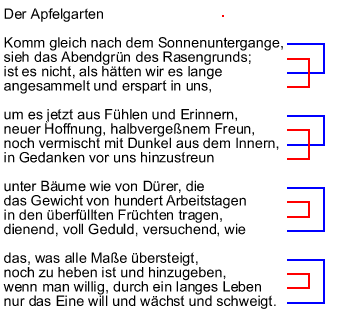
A. Original Rilke, 'Neue Gedichte,' Anderer Teil. Title: Der Apfelgarten
Komm gleich nach dem Sonnenuntergange,
sieh das Abendgrün des Rasengrunds;
ist es nicht, als
hätten wir es lange
angesammelt und erspart in uns,
um es jetzt aus Fühlen und Erinnern,
neuer
Hoffnung, halbvergeßnem Freun,
noch vermischt mit Dunkel aus
dem Innern,
in Gedanken vor uns hinzustreun
unter Bume wie von Dürer, die
das Gewicht von hundert
Arbeitstagen
in den überfüllten Früchten tragen,
dienend, voll Geduld, versuchend, wie
das, was
alle Maße übersteigt,
noch zu heben ist und hinzugeben,
wenn man willig, durch ein langes Leben
nur das Eine will und
wächst und schweigt.
(Linkage lines below show sound-linkages)
B. Discussion of Seamus Heaney's translation (in 'District and Circle,' with title 'The Apple Orchard.')
Bernard O' Donoghue writes in his Introduction to 'The Cambridge Companion to Seamus Heaney' that 'much of the book [takes place] in the Underground or afterlife. It would be far more accurate to say that a few poems have a setting in the Underground or afterlife. This was an interesting organizing principle. The poet obviously was only able to write a few poems about the theme. This is no disgrace, since poets can never produce their best work, or even adequate work, to order: ' adhering to the dogma of socialist realism, adhering to the various and varying dogmas of political correctness, the dogmas of writing 'positive poetry.' Even a fruitful and interesting organizing principle may demand 'writing to order.'
Once he'd decided to include translations to supplement his own inspiration, he had the opportunity to strengthen the theme of the Underground and the afterlife. He did this by including a translation of C. P. Cavafy's 'The Rest I'll speak of to the ones below in Hades.' He included two translations from Rilke which have nothing to do with the underworld. If the translations had been outstanding, they could have been justified, but this isn't so.
Anthologists can be inspired
or uninspired, show flair or much more than flair. Seamus Heaney showed not
nearly enough flair in his choice of translations for 'District and Circle.'
There are poems by Hölderlin which touch upon the underworld and movement
downwards and which have outstanding literary quality, such as 'Lebenslauf,'
which refers to Orcus, and 'An die Parzen,' 'To the Fates,' which also refers
to Orcus and to 'Stille der Schattenwelt,' 'tranquillity of the world of shades.'
('Orcus' is the Roman name for the underworld.)
In the third verse-paragraph of his translation of 'The Apple Orchard,' Seamus
Heaney obviously tried to find a sound-linkage between 'woodcut' and 'rooted'
but had to concede defeat, so that there's a gap in his rhyme scheme. More
often than not, a rhymed translation involves substantial compromises in diction,
rhythm and meaning. Rhyme schemes belong to what W H Auden described as the
'separable' aspect of translation, an aspect which a translation can't in
general carry over into the object language, or at least not without compromising
more important matters.
In translating the first two lines, I'd stress the importance of observing, and the good reasons for following, Rilke's distribution of verbs and nouns in the places of maximum prominence, the beginning and ends of the lines. In line 1, a verb in the imperative at the beginning, a noun given weight by its placing at the end. In line 2, a verb in the imperative at the beginning, a noun given weight by its placing at the end.
Seamus Heaney's line 1 has a verb in the imperative, 'Come' at the beginning and a verb in the imperative, 'watch' at the end. Line 2 begins with 'This' in a position of emphasis - a wasted opportunity, and ends with a noun, 'sward,' which has no currency in the living language. He chooses, then, to give this archaic word emphasis. More importantly, the German word 'Grund' which is part of the compound word 'Rasengrunds' (in the genitive) means 'ground' and has far more 'earthiness' than 'sward.'
In line 2, 'this deepening of green' in Seamus Heaney's translation is misleading. Without going into the complexities of colour theory, it suggests that the hue is becoming more saturated. Very soon after sunset, of course, perceived colours become less saturated. Colour vision becomes more and more impaired.
In line 4, 'a something' is an obvious blunder.' There's no justification for the vagueness here. In the original, there's 'es,' 'it,' referring to the 'evening green of grassy ground' (in my translation.) This is what's 'interiorized,' to express it less clumsily, brought deep into the mind, where a complex process of blending - Seamus Heaney's 'infusing' is good - and maturation takes place.
Seamus Heaney's 'thoughts as ripe as windfalls' doesn't do justice to this maturation. Windfall apples are often hard and poor, apples which have fallen before ripening. Rilke has 'overfull fruits' which bring to mind the fruit in Keats's 'To Autumn,' fruit filled 'with ripeness to the core.'
The trees they come from, 'wie von Dürer' are described in his translation as 'like trees in a Dürer woodcut,' vivid but far too restrictive, since Dürer's enormous output includes, as well as woodcuts, engravings, drawings and paintings.
The fruit is described as 'ready to serve.' There's no suggestion in the original that the fruit is now about to be brought on, as a dessert, perhaps. This is a mistranslation of 'dienend,' 'serving.'
The worst of the translation is reserved until the last. The final verse paragraph of the translation is dismal, rambling and ineffectual where the original is sturdy and decisive.
The first line of this verse paragraph, 'In the knowledge that no matter how above' seems to be missing a word like 'far,' 'In the knowledge that no matter how far above' although in either version, the linkage with the original is very tenuous. ' ... when a long life willingly / Cleaves to what's willed and grows in mute resolve' has no reference to a word of decisive importance in the original, 'das Eine,' 'the One.' But it fails in every other significant respect as well.
C. My translation
Come, just after the setting
of the sun,
see the evening green of the grassy ground;
is it not as if for a long time we had
taken it into ourselves and saved it,
sensing it now as feeling
and remembrance,
new hope, half-forgotten joys,
yet now mixed with interior darkness,
to scatter it before us in thought
under trees like those
of Dürer, that
carry the weight of a hundred
workdays in the overfilled fruits,
serving, full of patience, trying, like
that which all measure
transcends,
is still to be lifted up and offered,
when one willingly, throughout a long life,
wants but this one thing - grows, and is silent.
D. Discussion of my translation
My own translation is more faithful to the original, which has to include faithfulness to the tortuous length of the sentence: excessive, and an imperfection in the original, I think.
I've been able to follow exactly the syllable count of the original lines, but I made no attempt to convey the rhyme scheme.
This is the rhyme scheme of the original, and my translation, with the number of syllables in brackets:
a (10), b (9), a (10),
b (9)
a (10), b (9), a (10), b (9)
a (9), b (10), b (10), a (9)
a (9), b (10), b (10), a (9)
A. Original
«Tα δ’ άλλα εν Άδου τοις κάτω μυθήσομαι
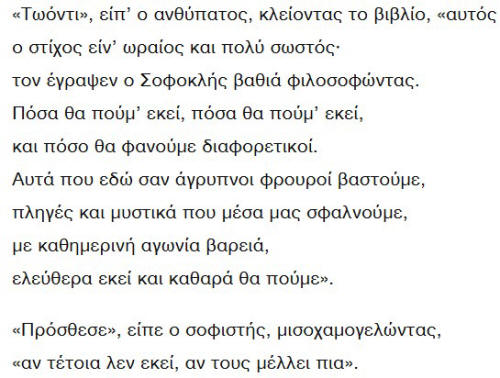
B. Discussion of Seamus Heaney's translation (in 'District and Circle.' Title: 'The rest I'll speak of to the ones below in Hades.)
It was convenient to expand 'District and Circle,' which has a subterranean theme, in part. He did it by including this routine translation. Faithful translators often have literary talents which are very considerable. Readers are entitled to expect that 'improved translators' will surpass this often high level of achievement. Seamus Heaney doesn't achieve this here.
He owed it to a fellow-poet
to make it clear that this poem wasn't part of the Cavafy 'Canon.' Cavafy,
who was a self-publisher, was meticulous. He made it clear which poems were
part of the canon and which weren't. This particular poem was left unfinished.
It was written, rewritten but then put aside. Seamus Heaney ought to have
mentioned this fact.
Poems aren't works of scholarship, but in some cases, notes can make things
clear which aren't clear in the original poem (or translation.) Seamus Heaney
has a page 'Notes and Acknowledgements.' He could have made it clear on this
page (after making it clear that Cavafy didn't want this poem to be part of
the canon of his poems) that his title is misleading as it stands. The title
is, 'Cavafy: 'The Rest I'll speak of to the ones below in Hades' which gives
the impression that Cavafy wrote the words of the quotation. The quotation
is in classical Greek, not the modern Greek of Cavafy, and comes from Sophocles'
Ajax (line 865.) I defer discussion of Seamus Heaney's translation of the
line until I give my own translation.
After the title line,' in line 1, Seamus Heaney gives for κλείοντας το βιβλίο 'replacing the scroll.' All the other translations known to me give 'closing the book,' which is faithful and accurate. βιβλίο not only means 'book' but of course is 'embedded' in English, in words such as 'bibliography' and 'bibliophile.' Seamus Heaney's translation may give the mistaken impression that the proconsul has an ancient version of Sophocles in the form of a scroll, rather than a more modern book. 'Replacing' and 'closing' are two different and incompatible activities, and 'replacing' is inaccurate. Does 'replacing the scroll' have a literary quality markedly higher than 'closing the book' to compensate for its inaccuracy ? Is it undeniably an example of improved translation? Not at all.
In line 3, βαθιά has become embedded in English too, in words such as 'bathos' and words with the prefix 'bathy-' such as 'bathysphere.' It means 'deeply.' Seamus Heaney excludes the idea of depth by translating it as 'Sophocles at his most philosophical.' Again, this is an 'unfaithful, unimproved translation.'
The fourth line is very simple in its structure, a clause which is repeated:
Πόσα θα πούμ’ εκεί, πόσα θα πούμ’ εκεί,
A translation should convey this repetition, as in:
How much we'll say there, how much we'll say there.
Seamus Heaney ignores the repetition:
We'll talk about a whole lot more down there
His translation of line 6
Here we're like sentries, watching anxiously
makes no attempt to translate the significant word άγρυπνοι 'sleepless,' of the guards or sentries. Again, it isn't self-evident that his translation has such literary quality that the omission is unimportant.
C. My translation
The rest I shall speak unto them that are in Hades
'Indeed!' said the proconsul,
closing the book,
'this line is beautiful and so, so true.
Sophocles wrote it it in a deeply philosophical mood.
How much we'll say there, how much we'll say there,
and how different we'll appear.
Things we protect here like sleepless guards,
injuries and secrets locked within us here,
things we protect so anxiously each day,
we'll speak of freely and clearly down there.'
'You might add,' said
the sophist, half-smiling,
'if they speak about them there, if it happens any more.'
D. Discussion of my translation
Seamus Heaney translates the title line as 'The rest I'll speak of to the ones below in Hades.' I try to differentiate between the language of this line in the original, Classical Greek, and the language of the rest of the poem, Modern Greek. Almost two and a half thousand years separate the two. A contemporary translation of a classical Greek text shouldn't use archaic language anywhere, except in places where it can be justified, but Cavafy's poem, including the title, has writing belonging to two very different time-strata and these can most easily be distinguished by using non-contemporary English for writing which belongs to the earlier stratum.
Another example of significant contrast: a part of Tolstoy's 'War and Peace' is in French, not Russian. Translators have generally translated the French as well as the Russian into English. Constance Garnett, Aylmer Maude and Rosemary Edmonds chose to follow this course. In their translation, Richard Pevear and Larissa Volokhonsky distinguish between French and Russian by leaving the French untranslated in the main text and providing a translation in footnotes.
The line in Cavafy's poem comes from Sophocles' 'Ajax.' (865). Giving the preceding line as well:
τοῦθ᾿ ὑμὶν Αἴας τοὔπος ὕστατον θροεῖ, τὰ δ᾿ ἄλλ᾿ ἐν Ἅιδου τοῖς κάτω
μυθήσομαι.
Using contemporary English, since there's no need to distinguish the translation
of the classical Greek here from the translation of modern Greek:
This is the last word
Ajax says to you.
The rest I will speak to those below in Hades.
He then kills himself.
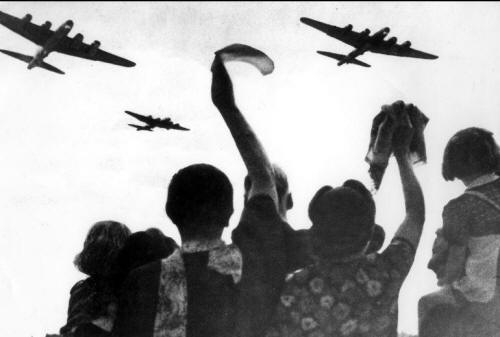
Below, Bevrijdingsdag, 'Liberation Day,' the Netherlands
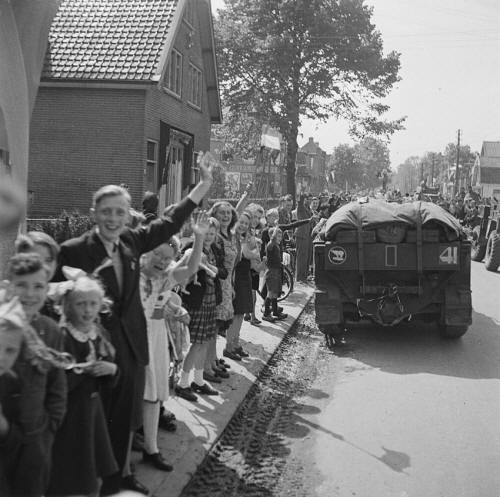
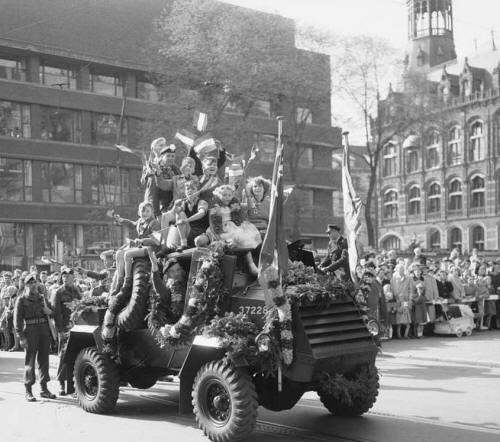

My translation of 'Na de Bevrijding,' 'After the Liberation.' (Seamus Heaney gives the title as 'After Liberation' in his translation in 'The Spirit Level.' It makes up the second part of 'To a Dutch Potter in Ireland.') I give reasons for the plainness of my translation below.
I
Beautiful and radiant
is, as then, the spring,
cold of morning, but as the days open
further, the eternal light is a miracle
for those who have been saved.
In the transparent film above the fallow
land the slow horses plough
as forever, even as the near distances
rumble with war.
To have lived through this, to say this
with body whole, each time awakening again
to know: it's gone, and now for good, the almost
unbearable servitude -
worth it it was, to have languished five years,
now resurgent, then once more resigned, and not
one of the unborn will grasp
freedom like this ever.
II
Regularity of the turning
tides!
What is the heart, that it was ever afraid,
knowing spring would liberate it,
radiant as it has forever been?
Everywhere now, imperturbable
is the life that outflowers death,
and the smallest complaint seems barely audible,
where rye beside the ruins grows.
The last two lines of the Dutch original are
En de kleinste klacht
schijnt nauwlijks hoorbar,
Waar rogge om de ruines groeit.
Seamus Heaney translates this as
And complaint is wrong,
the slightest complaint at all,
Now that the rye crop waves beside the ruins.
In the first of these two lines, he substitutes for the faintness of the complaint - it seems barely audible - the 'wrongness' of the complaint, and makes it seem that complaint is wrong because 'the rye crop waves beside the ruins.' His translation 'wrongs' the original.
The inclusion of 'crop' in the second line is mistaken. The original mentions only 'rye.' His translation lacks the economy, directness, simplicity and purity of the original - these are general characteristics of J C Bloem's poetry, a poetry which is so often 'schoon,' the opening word of the poem. The Dutch word 'schoon' means 'clean' and 'neat' as well as 'beautiful.' (Vermeer's art is surpassingly 'schoon,' neatness as the first apprehension of the beautiful.)
The repeated 'r' sounds in the original are very easy to convey in translation:
Waar rogge om de ruines groeit.
Where rye
beside the ruins grows.
This is also rhythmically far stronger than Seamus Heaney's line. In his translation,
the lack of economy in the wording - too many syllables,
as in the translation of Dante I discuss above - makes the sound-linkages
less effective by increasing {distance} between the instances of 'r.' The
instance of close proximity, in 'rye crop,' seems an isolated conjunction
within the line. 'rye crop' is at too great {distance} from 'ruins.' The 'r'
sounds in his translation are less effective than they should be:
Now that the rye crop waves beside the ruins.
The opening line of the poem is:
Schoon en stralend is, geljk toen, het voorjaar
which Seamus Heaney translates as
Sheer, bright-shining spring, spring as it used to be,
This seems, in culinary terms, akin to taking simple ingredients and ruining them by over-sophisticated cooking, too-elaborate cooking rather than, let's say, simple Tuscan cooking. The 'economy, directness, simplicity and purity of the original' (the work of a poet with very impure motives, a murky and very disreputable political past) demand a similarly restrained translation. I translate the line as
Beautiful and radiant is, as then, the spring,
A translation can't often have the advantage of metrical faithfulness to the original, but as a translator Seamus Heaney seems generally unaware of even the possibility. My translation preserves the metrical outlines of
is, gelijk toen, het voorjaar
is, as then, the spring
(Using my system of metre notation.)
In Seamus Heaney's translation, this crystalline poem in some places becomes a little opaque, its clean lines less clear and the poem becomes a little baggy, even bloated. The diction now seems too wordy, diffuse. There aren't the compensating advantages of distinctive Heaneyan resonances. The poem seems page-bound. A translator has to have a concern for small, important things, such as extraneous words - and extraneous syllables - as well as the ability to convey when necessary amplitude and richness. In this first section, the 'away' in 'war rumbles away' is extraneous and 'to give / utterance' is too wordy a translation of the simple 'spreken,' 'to say.'
There follows in his translation 'body and soul,' where 'soul' is an addition of Seamus Heaney's. The original has simply 'heellijfs,' 'body whole.' As in the case of German 'Geist,' translating the Dutch word 'geest' often presents difficulties - or opportunities. It can mean 'mind,' 'consciousness,' 'soul,' 'spirit,' 'character.' But the word 'geest' isn't used here, or 'ziel,' which has a narrower meaning and often translates 'soul.' The associations of the English 'soul' are an unnecessary intrusion in Seamus Heaney's translation.
One of my aphorisms: 'Poetry as a metrical art: poets should have an intense concern for syllables as well as words.' Seamus Heaney very often has insufficient concern for syllables. In this first section, he gives 'appreciate' as a translation for 'beseffen.' Although 'beseffen' has three syllables and 'appreciate' has only one more, this word of four syllables is metrically poor in its context, whereas 'beseffen,' in the short final line of this section, is metrically very effective:
Ooit zo beseffen.
The second section begins, in my translation, with
Regularity of the turning tides!
It seems more effective to have the line end with a decisive monosyllable than with 'their regularities,' as in the translation of Seamus Heaney.
It's significant that in this section, there's the return of words which appeared early in the first section. It's surely important to show these 'recapitulated' words, this 'tidal' movement in the poem, by translating the same words in Dutch by the same words in English. 'Stralend' in the first section returns now, and I translate it again as 'radiant.' Seamus Heaney has 'bright-shining' for the first instance and 'shining' in the second. For some reason he applies this to 'heart' not to 'spring.'
In this section, 'bevrijden' is used in the line I translate as
knowing spring would liberate it
where 'it' is the heart. 'Liberate' is surely the best translation for 'bevrijden' since the title of the poem makes use of the corresponding noun: 'Na de Bevrijding,' 'After the Liberation' or, in Seamus Heaney's title, 'After Liberation.' The liberation from winter reflects the political liberation. But Seamus Heaney uses 'release,' in the phrase 'spring's release.'
He neglects to repeat words which, arguably, should be repeated whilst he repeats a word which should never have been subject to repetition. This is 'spring,' in the phrase in his translation ' ... the life that death springs from.' 'springs from' is his translation of 'ontbloeit' in the phrase ' ... dat den bood ontbloeit.' The Dutch word has to do with flowering, not springing from, and Seamus Heaney seriously distorts the original. In the original, death doesn't spring from life, but life outflowers death. The poet's own surname, 'Bloem' means 'bloom.'
A note: J C Bloem was an admirer of Hitler and Mussolini and belonged to the extreme right-wing party the NSB, which later collaborated with the Nazis, but J C Bloem's actual conduct in the war years was better than that of the Norwegian pro-Nazi novelist Knut Hamsun.
See also my discussion of Seamus Heaney's use of a classical Greek text in the section on his poem Mycenae Lookout.
Material on this site tends to be highly dispersed. My page 'Bullfighting: arguments against and action against' contains remarks on tragedy, Aristotle's treatment of tragedy in the 'Poetics' and on the death of tragedy. See the section Bullfighting as an art form. Bullfighting and tragedy.
Seamus Heaney's 'The Cure at Troy' is a version (a very poor one, I show) of Sophocles' 'Philoctetes.' His version is in this type, my own fairly literal translation from the Greek in this type. For Seamus Heaney's version I give the page number of the text (published by Faber and Faber.) For my translation, I give line numbers of the original.
I only discuss here the opening of 'The Cure at Troy' (up to line 143 in the original), with a few remarks on the ending. Although I give close attention to the text - the original and Seamus Heaney's version - my emphasis is on contemporary theatrical performance of the play, the practicalities of performance and the difficulties which the text, and Seamus Heaney's version, may present for audiences. I discuss one particularly important difficulty. In 'The Cure at Troy,' Philoctetes' wonder-weapon is a bow, as in the original. Audiences are likely to find this bow completely unconvincing. I offer a different, spectacular weapon, which eliminates these difficulties.
The opening speech of Odysseus in the original is superb scene setting, as well as graphic description of the hideous wound that festers in this idyll. Odysseus tells us that this is the shore of the island of Lemnos and that the island is untrodden, not inhabited, except, that is, by Philoctetes. I would have Odysseus to begin with barely visible, the shore still untrodden, empty. The shore is the acting area. There are rocks (Philoctetes threatens to fling himself from them later) and a cliff face, with a cave part of the way up.
Odysseus describes how he stranded (8) Philoctetes here
νόσῳ καταστάζοντα διαβόρῳ πόδα
his foot dripping with the disease eating it away
βοῶν, στενάζων.
shouting, screaming.
This isn't one of the illustrative examples chosen by Demetrius for his superb 'On Style' but his discussion of the elevated style at II: 49 - 50 is applicable to these words, with their intensification from less vivid to more vivid:
Ὥσπερ γὰρ ὄνομα τραχὺ μέγεθος ἐργάζεται, οὕτω
σύνθεσις. ὀνόματα
δὲ τραχέα τό τε῾
· κεκραγὼς᾿ ἀντὶ
τοῦ ῾βοῶ
'Just
as a rugged word gives stature [μέγεθος]
so does composition. Such rugged words as 'screaming' instead of
'shouting' [βοῶν] ...
Τάσσειν δὲ τὰ ὀνόματα χρὴ τόνδε τὸν τρόπον.
πρῶτα μὲν τιθέναι τὰ μὴ μάλα ἐναργῆ,δεύτερα
δὲ καὶ ὕστατα τὰ ἐναργέστερα. οὕτω γὰρ καὶ
τοῦ πρώτου ἀκουσόμεθα ὡς ἐναργοῦς,καὶ τοῦ
μετ̓ αὐτὸ ὡς ἐναργεστέρου.
'Words should be ordered in this way. First should
be placed those which are not so vivid and in the second place or last place
the most distinctly vivid. In this way, we hear what comes first as vivid
and what follows as more vivid still.'
But the shouting and screaming of Philoctetes was in the past. Odysseus
should speak sotto voce now. He
says that this is no time for long conversation. Philoctetes must not learn
that he has come. He asks Neoptolemus to go forward 'quietly.' Odysseus' opening
speech conveys quiet and stealthiness and the danger of being discovered by
Philoctetes. Odysseus plans to capture Philoctetes and the plan must not be
frustrated. Expectation has been aroused in the audience, dramatic tension
established.
My translation of ἐξέθηκ᾽ ἐγώ ποτε, is 'I once stranded [Philoctetes].' (6) 'Stranded' has a satisfying ambiguity. 'Strand' is the usual Irish and Northern Irish word for beach (as in the title of Seamus Heaney's poem 'The Strand at Lough Beg.') Seamus Heaney's version is fine, to an extent, but not a particularly interesting use of language. It's also without any trace of poetic rhythm and has no claim to be considered poetry, of course, but this is an objection to almost all of the 'poetry' in 'The Cure at Troy.'
Odysseus: Yes. I left
Philoctetes here.
Marooned him -
Translation determines performance, to an extent. Performances demand suitable translations. A modern production may demand the removal of aspects of Greek thinking and Greek theatrical practice which are stumbling blocks to a modern audience. There's the need not to disrupt theatrical illusion unnecessarily, not to have the audience unnecessarily perplexed at the beginning. So, the version-translator should give 'untrodden' and not, as in the original, 'untrodden by mortals.' The contrast between mortals and gods has great importance in Greek drama, of course, but there's no need to insist upon it so early. The description of Philoctetes as the Malian, the son of Poeas in lines 4 and 5 should be removed. This giving of information isn't essential at all.
Another production may emphasize the {distance} of the ancient Greeks from a contemporary audience. A production which retains {separation} of Gods and mortals demands a translation which retains 'untrodden by mortals,' or similar wording.
Odysseus asks Neoptolemus to help him to find a cave with two mouths - giving a seat in the sun in winter, a cooling breeze in summer, and, a little below it on the left, a spring with drinking water, if it's still there. The experiences evoked by his words are archetypal and basic - heat and cold, cooling breezes and the warmth of the sun, thirst and water.
There's the difficulty that the cave which Neoptolemus asks for help in finding will be visible in many modern theatrical performances. In the original, when Odysseus has finished speaking and Neoptolemus speaks, he tells us almost immediately, in the second line, that he sees just such a cave. For an audience of any sophistication, the finding of something almost immediately seems contrived. The best solution for the version-translator, it seems to me, is not to ask Neoptolemus to find the cave (whilst the cave is fully visible to the audience) and not to show Neoptolemus finding it almost immediately, but to show Neoptolemus standing high up by the cave, a dramatically effective position, Odysseus simply thanking Neoptolemus, perhaps, for having found the cave just before. From his high vantage point, Neoptolemus is able to see objects in the cave which Odysseus can't see.
In the original, his answers to the questions Odysseus puts to him give the audience a curiosity about the absent occupant of the cave:
Neoptolemus: I see an empty dwelling with no man there.
Odysseus: Are there no household comforts in there?
Neoptolemus: A bed of leaves pressed down, as though for someone who spends the night there.
Odysseus: But is the rest desolate, is there nothing beneath the roof?
Neoptolemus: A drinking cup made from a single piece of wood, made by an incompetent hand, and with it stones for kindling fire. [and fire is again archetypal.]
Odysseus: The treasures you point out must be his.
Neoptolemus:
Ah! Ah! Something else! Rags drying in the sun, stained with matter from some
disgusting sore!
(31
- 39)
And with this, we are returned to the play's insistence not just on Philoctetes' 'suffering' but the atrocious physical evidence of his suffering as well. This is a festering wound, with the emphasis not at all on symbolism.
Odysseus has a plan to capture Philoctetes, but there's danger in the plan. Odysseus is fearful that Philoctetes will attack him.
How does Seamus Heaney convey this scene-setting? Can he improve on this, so that a modern audience can feel even more intensely the physicality of the play so far - sea shore, deserted island, suggestions of heat, the cooling breezes and cold, the extreme physicality of the suppurating sore - and the stealth and quiet needed to escape detection, the undercurrents of danger? Will a modern audience at a performance of 'The Cure at Troy' feel curiosity, anxiety about the outcome, even fear?
Not at all likely, until Seamus Heaney begins to follow the original more faithfully (Page 4). Until then, his attempt to show his independence comes to nothing. Sophocles has to come to the rescue.
So far the chorus hasn't appeared. (It enters in the original at line 135.) No part of a Greek play presents more difficulties to a modern audience, is harder to assimilate. This is to exaggerate, but not ridiculously: to many audiences, the chorus suggests women in shawls crying, 'Woe! Woe!' But the chorus presents difficulties above all because its delivery of lines, like the lines of opera, is in conflict with normal speech. In normal speech, lines are rarely delivered in unison. The exceptions include the responses in a church service - again, very different from normal speech patterns. There are many people who can never come to terms with the artificiality of opera, in which, unlike in everyday life, the lines are sung (except in operas which have 'spoken recitative.') But when we listen to the quintet 'Di scrivermi ogni giorno' in Mozart's 'Cosi fan Tutte,' or what follows, the Terzettino 'Soave sia il vento,' the wonderful artistry dispels any misgivings. The chorus in Greek tragedy has wonderful lines, very often, but the convention of speaking in unison is harder to accept than the operatic convention.
In fact, 'Philoctetes' presents fewer difficulties than most extant Greek tragedies. H D F Kitto, in 'Greek Tragedy: 'The role of the chorus is diminished not only in extent, but also in significance, for the chorus remains firmly embedded in the immediate action, and says nothing to set it in a wider perspective. Essentially, it is a minor character in the piece ... What the chorus loses, the actors gain. The play might fairly be said to resolve itself into a struggle between Odysseus the schemer and Philoctetes his embittered victim, with Neoptolemus first doing his best to serve Odysseus, then, after humiliating experiences, going over without reserve to the side of Philoctetes.' The version-translator should leave the chorus in its minor role and concentrate attention upon these struggles and the change in Neoptolemus which makes him an exception to the lack of development usual in the characters in Greek drama. These characters are often more compelling than Neoptolemus, but unchanging.
In a version, unlike a faithful translation, the chorus can even be eliminated altogether. If the chorus is given any prominence, it seems clear that it will need great imagination, the imagination needed to radically recast the play.
Simon Goldhill, in his compelling book 'Sophocles and the Language of Tragedy' provides an account of 'Philoctetes' which is rich in insights. He makes the best possible case for the artistic importance of the chorus:
'As Pucci has noted, this chorus is not just a group of "the people", but
figures who significantly do not share their leaders' ethical qualms,
political ideals or vision ... the chorus' pragmatism, emotional
insensitivity, and their crassness even, contrasts tellingly with the
protagonists in the ethical intrigues of the drama. Their first question
vividly shows the dramatic technique of Sophocles in this ... Sophocles
explores the interaction of a protagonist and the collective of the chorus
from the very first moment in fully dramatic, engaged exchanges ... '
'The chorus are already in on the plot, though we have only just seen
Neoptolemus accede to Odysseus' intrigue. They already know Philoctetes will
be suspicious, that they have a role to play in the verbal web.
'In the long and extraordinary first scene, which runs to 675, they sing only
two short stanzas, which are strophic but separated by over a hundred lines.'
However, 'Each little ode develops our understanding of deception through
remarkable performances.'
Later, he writes,
'This heightening of the choral language prepares us for the coming scene, where for the first time Philoctetes will be ravaged by the bloody, gnawing disease before our eyes. It is part of the growing tension of the play. But it is also an integral element in the chorus' own narrative. Over the first scene, while they have remained silent, they have moved from their first encounter with the cave, where they tried to imagine Philoctetes' life, to this passionately sympathetic imaging of his condition ... '
In general, 'the engagement of the chorus ... is as a full partner in an emotional narrative of power and alienation' and 'a chorus can be fully part of the action of a play, even through their silence.'
Another book by Simon Goldhill', 'How to Stage Greek Tragedy Today,' is an impressive account of the subject, the work of someone who understands practical theatre production, the high-level knowledge, the thought and the insights which are required for artistically successful theatre production, and obviously someone with a depth of scholarly knowledge. Chapter two, on the chorus in Greek tragedy, interests me intensely, but so does the rest of the book. My account here is obviously much more brief and is concerned almost entirely with Seamus Heaney's version. I think my discussion of 'The Cure at Troy' is not in need of radical {modification}, with the possible exception of my comments on the chorus.
To return to 'The Cure at Troy,' the play begins with the chorus, and the stage direction has the chorus 'wrapped in shawls:' deeply unimaginative. At first they are still but then they move. The uninhabited island has this group treading on the 'untrodden' shore just as 'uninhabited' islands today have their tour groups, deposited for a few hours from a cruise ship. The stealth and quiet needed for Odysseus and Neoptolemus to avoid being detected by Philoctetes are undermined by the chorus speaking in unison.
In productions in classical Greece, the lines of the chorus were often delivered only by the 'Chorus Leader.' There was every reason for Seamus Heaney to specify a Chorus Leader, to eliminate the artificiality (for most members of a modern audience) of the chorus speaking in unison, but every reason for Seamus Heaney to employ a Chorus Leader without any other chorus members, at least in professional productions. He's obviously oblivious of the harsh financial constraints of the modern professional theatre. He specifies three members of the Chorus - the payment of three acting professionals for a fairly small number of lines when it would have been easy to specify one (I write in full knowledge of the desperate finances of most actors and actresses as well as the desperate finances of most professional theatre, and very much hope that whenever there's a way to give a living wage to more actors and actresses, the opportunity should be used, provided that this can be justified artistically.) The amateur theatre generally demands larger cast sizes rather than smaller. For amateur productions, a chorus of more than three would have been better - but again, with lines spoken only by a Chorus Leader.
The opening lines of the chorus in 'The Cure at Troy' don't come from Sophocles and don't have anything Sophoclean about them, more's the pity. There are trite observations about 'gods and human beings,' 'every one of them / Convinced he's in the right ...' Trite observations about people who spend 'their whole life admiring themselves / For their own long-suffering.'
But this is a high point before the decline into this:
For my part is the chorus,
and the chorus
Is more or less a borderline between
The you and the me and the it of it.
(P. 2)
Leaving at the interval is a well established but rarely followed theatrical convention for people who decide that if they've wasted their money on the ticket, at least they won't waste any more time on the play. It's understandable if a member of the audience heads for home at this early point in the play but it would be a mistake. There are better things later on - the lines and theatrical intelligence of Sophocles, even if refracted through Seamus Heaney.
But after just a few more lines, there's another temptation to head for home. The stage directions at the beginning have contained this: 'If a volcano can be suggested in background, all the better but it should not be overemphasized.' This presents difficulties, like suggesting that the Matterhorn or the Empire State Building can be suggested in the background, but not overemphasized.
This volcano now erupts (P. 3). The stage directions have 'Volcanic effects. Lurid flame-trembles, commotions and eruptions.' These effects are difficult for lighting professionals in the theatre, let alone for those who work in amateur theatre, although it's quite easy for anyone to give a risible, embarrassingly bad impression of a volcano erupting.
The objections multiply. The eruption is contrived. It follows immediately after the lines
For now, remember this:
Every time the crater on Lemnos Island
Starts to erupt, what Philoctetes sees
Is a blaze he started years and years ago
Under Hercules's Funeral pyre.
The god's mind lights
up his mind every time.
(P. 2)
(That last line is the work of a poetic ignoramus rather than one worthy of Seamus Heaney.)
The volcano has, of course, eliminated every last trace of stealthy quiet. This is a prologue, but any separation intended between the prologue and what follows is undermined by the persistence of 'volcanic effects. Lurid flame-trembles, commotions and eruptions,' the difficulty of {adjustment} for the audience, the difficulty of establishing quietness, the conditions needed for stealthy planning and for escaping detection. The stage directions do acknowledge the need for {adjustment}, in effect: 'a gradual, brightened stillness' but what the audience sees is the same scene which was convulsed only a short time before.
Seamus Heaney then has Odysseus and Neoptolemus enter, and gradually he gets closer to the original, including the need for stealth:
Go canny.
One false move
And everything is wrecked.
(P. 4)
It gets better, to a limited extent, as Seamus Heaney fades from the text:
Odysseus: Take care he's not inside there, dozing.
Neoptolemus: There's a pile of old leaves that somebody slept on.
Odysseus: And is that it? No other sign of life?
Neoptolemus: No: wait.
There's a mug or something, very rough
Hagged out of a log. And bits of kindling.
Odysseus: All his earthly goods.
Neoptolemus: Aww! Look
at this.
Aw! Rotten, rotten stuff. Bandage-rags.
Nothing but old dry pus and dirty clouts.
(P. 5)
Seamus Heaney omits a question:
Odysseus:
Are there no comforts of a dwelling in there?
(32)
This is completely acceptable for a version-translator but it does alter the balance of the dialogue. I'd make the point that Greek tragedy has a linkage with the Platonic dialogues in the relative frequency with which it employs question and answer form, reflecting one aspect of the classical Greek mind, its nimbleness and curiosity, even if the questions and answers are devoted to very different ends. Sophocles' Oedipus the King has sustained examples of questions and answers (lines 99 - 131, 558 - 569 and particularly 1119 - 1181), the questions and answers in the end uncovering terrible truths.
The questions and answers in Greek tragedy sometimes seem to a modern audience a roundabout and excessive way of establishing less than momentous facts. In his wonderful parody 'Fragment of a Greek tragedy,' A E Housman, an important Classical scholar as well as poet, draws attention to this questioning and answering and some expressions which are stumbling blocks in classical Greek tragedy.
Alcmaeon Chorus
Cho. O suitably
attired in leather boots
Head of a traveller, wherefore seeking whom
Whence by what way how purposed art thou come
To this well-nightingaled vicinity?
My object in inquiring is to know.
But if you happen to be deaf and dumb
And do not understand a word I say,
Nod with your hand to signify as much.
Alc. I journeyed hither a Boeotian road.
Cho. Sailing on horseback or with feet for oars?
Alc. Plying by turns my partnership of legs.
Cho. Beneath a shining or a rainy Zeus?
Alc. Mud's sister, not himself, adorns my shoes.
Included in the excellent, 'The Oxford Book of Parodies,' edited by John Gross (and followed by 'Applying sealant round a bath with Johann Wolfgang von Goethe.')
Now to examine the form which Seamus Heaney chose: poetry, allegedly, rather than prose. A faithful translator can use poetry or prose, each with well known advantages and disadvantages. I think that a contemporary version-translator should only choose prose. There are cautionary examples, warnings, from the history of verse drama in the past century. T S Eliot's verse dramas and the verse dramas of Christopher Fry are the most prominent examples in English. Who can point to a single example of a verse drama from the last century with deep poetic strength as well as the ability to engage an audience? The vitality of verse drama has gone. Contemporary plays in metre face resistance for the same reasons as plays which have a chorus. Audiences are willing to accept theatrical convention when an actor presents an imitation ('mimesis') of a king, and so on, but not in general to accept the convention of verse, even if the material is elevated rather than basic (such as asking someone to buy something at a shop.)
On the page, the setting out in lines, the capitalization of the first letter of each line, make the claim to be poetry obvious, but for most of its length, the audience will have no reason to think that 'The Cure at Troy' is intended to be poetry. The poetry is so prosaic.
I discuss the 'Line Removal Test' in my discussion of Seamus Heaney's prose poetry and prose-poetry.
After the line
Nothing but old dry pus and dirty clouts.
there's this section, shown here with Line Removal. It makes obvious enough the kind of un-poetic poetry Seamus Heaney offers, throughout the play as well as here:
Odysseus: That's it. That's him: so he has to be around. With a foot like his, he'll not be travelling far. Out scavenging, likely, poking for things to eat, or maybe out gathering herbs to try to get relief. Anyway, he's going to be back, and something tells me, soon - so get your lookout posted. We can take no risks. I am the marked man here. Of all the Greeks, I am the one that Philoctetes wants.
These are the first three lines of the original (40 - 43):
ἁνὴρ κατοικεῖ τούσδε τοὺς τόπους σαφῶς, κἄστ᾽ οὐχ ἑκάς που: πῶς γὰρ ἂν νοσῶν ἀνὴρ κῶλον παλαιᾷ κηρὶ προσβαίη μακράν;
This must be where the man lives, and not far - how could a man stricken with a long-standing disease go far?
The absence of the man has been stressed, but now we have every reason to believe that this man, the man who has every reason to capture Odysseus, is near. In the original, anxiety and dramatic tension have been carefully intensified. Later, we're told that this is a life and death issue. In Seamus Heaney's version, the danger is mentioned but no more. The danger isn't dramatically shown. The language is far too casual for that.
Odysseus goes on to give his orders to Neoptolemus and the reasons for his orders, in a speech which has central importance in the play (54 - 85.)
Philoctetes has an invincible weapon, a bow. The bow is essential to capture Troy. Odysseus can't approach Philoctetes to steal the bow, since it was Odysseus who marooned Philoctetes on Lemnos and Philoctetes would kill him with his invincible bow. The help of Neoptolemus is needed. Neoptolemus has to lie to Philoctetes, and for Philoctetes to be taken in Neoptolemus will need to insult Odysseus. Odysseus recognizes that Neoptolemus has a strong morality - but for just a short period of time he has to speak and act amorally.
In the original the tension is preserved between expediency and the right course of action whilst in Seamus Heaney's version the tension is markedly reduced, the dramatic tension as well as the moral tension, by the bluff, rough-and-ready tone. Odysseus is no longer the cunning and wily schemer but someone less formidable.
But of course, son, I
know what you are like.
I know all this goes against the grain
And you hate it. You're a very honest lad,
But all the same: even you must enjoy
Coming out on top.
Do it my way, this once.
All right, you'll be ashamed
but that won't last.
And once you're over it, you'll have the rest of your life
To be good and true and incorruptible.
Odysseus stresses τὴν γλῶσσαν, οὐχὶ τἄργα the tongue, not actions, as decisive, but in Seamus Heaney's version there's little trace of the 'silver-tongued Odysseus.' The machinations are minimized. In the original, Odysseus is trying to persuade Neoptolemus that lying will be essential to capture the bow but so far, Seamus Heaney's Odysseus has given no evidence of being an accomplished liar.
A little later, he does mention the bending of truth:
But experience has taught
me: the very people
That go mad at the slightest show of force
Will be eating from your hand if you take them right
And tell the story so as to just suit them.
(P. 9)
Here, 'so as to just suit them' is very clumsy. Avoidance of
the split infinitive gives the far preferable 'so as just to suit them.'
Odysseus gives reasons why Philoctetes' bow must be captured. It shoots arrows that invariably kill. The bow is needed to capture Troy.
For Greek audiences, this magic bow presented no difficulties. For a contemporary audience, this is one more stumbling block, the central one in the play. An audience can accept the magic flute of Mozart's 'Die Zauberflöte' very easily - the whole world of the opera is a make-believe world, from the time that Tamino enters, pursued by a giant snake, onwards - but a make-believe world with authentic human emotions. Once the audience enters this world, no {adjustment} is needed for particular events.
In 'The Cure at Troy,' the bow has contrast with the naturalistic elements and requires radical {adjustment} on the part of the audience. For the Greek audience in classical times, the dilemma would have been real - the need to capture such a powerful bow, the need to flout morality to capture it. A modern audience will accept that morally dubious means have to be employed to capture the bow, but not that the bow is powerful or that the bow is essential to capture Troy. A contemporary audience knows that bows and arrows aren't powerful weapons and resists the idea of a bow and arrow so powerful that it's essential to capture Troy.
The solution I offer is this. Bows and arrows as weapons of war became obsolete with the introduction of gunpowder - muskets and later rifles. The introduction of machine guns was dramatic. Machine guns accounted for so much of the carnage in The First World War. As the rifle was less effective by far on the battlefield than the machine gun, Philoctetes shouldn't own a rifle, but to show him as having a machine gun is hardly feasible. Machine guns are cumbersome and their associations aren't at all what are needed for the play.
The best solution, I think, is for Philoctetes to have a weapon similar to a bazooka or other anti-tank weapon. This is easy to make - a simple metal tube, not too small in diameter, with a few simple fittings. Philoctetes is shown entering with the wonder-weapon, a simple tube, the fittings not in place, at line 219. At a suitable point in the play, Philoctetes attaches the fittings, puts the weapon to his shoulder and fires at a target. The most suitable point is soon after line 654. Neoptolemus asks,
ἦ ταῦτα γὰρ τὰ κλεινὰ τόξ᾽ ἃ νῦν ἔχεις
Is that the famous bow you're holding?
This becomes 'Is that the famous weapon you're holding?'
Philoctetes says that it is, and demonstrates it by blasting a target. The great explosion which results is easy to implement in the theatre, far easier than Seamus Heaney's volcanic eruption. There are audio recordings for many different kinds of explosions, including massive ones. A blast of light would accompany the sound.
Neoptolemus is suitably impressed and the audience really will believe that Philoctetes has a wonder-weapon, one that will be decisive in capturing Troy. The dilemma for Neoptolemus in Seamus Heaney's version - the bow is needed to capture Troy but Neoptolemus has to practise deceit to obtain the bow - is inert. The replacement of the bow by the wonder-weapon reinvigorates the dilemma.
A weapon from a different time-stratum, modern times, inserted into the time-statum of the play is no more artificial than the world of gods inserted into the human world, presented freely in 'The Cure at Troy.' (In the original, the god Heracles appears towards the end of the play, as deus ex machina. 'The Cure at Troy,' sensibly, presents the god as an experience of Philoctetes, 'I heard the voice of Hercules in my head' (P. 78) but calling the god by the Roman name 'Hercules' instead of the Greek 'Heracles' is surely mistaken.)
Seamus Heaney must be aware that very radical productions of works from the past are common. Directors may simply wish to impress but their motives are often compelling. Changes in language, dramatic conventions, human attitudes and the rest often do require significant {modification} in contemporary productions. My own preference is often for conservative productions - classical Greek tragedy set in classical Greek times or Greek mythological times, rather than, for instance, modern New York. (Compare Peter Sellars' controversial productions of Mozart's 'da Ponte' operas: 'Le nozze di Figaro takes place in the ersatz elegance of Fifth Avenue, Don Giovanni in the darker streets of brownstone New York and Così fan tutte in the chrome-&-neon surroundings of a seaside diner.' From the Website www.arkivmusic.com ) But the changes which need to be made in the case of Sophocles' 'Philoctetes' go beyond any made in 'The Cure at Troy,' which shows very clearly Seamus Heaney's limited and plodding theatrical imagination.
In the original and 'The Cure at Troy, Neoptolemus at last agrees to set aside his principled objections and to take part in the plan. Odysseus orders him to stay where he is and wait for Philoctetes whilst Odysseus goes back to the ship. If Neoptolemus seems to be taking too long, then Odysseus will send a man disguised as a sea captain. Odysseus exits and the chorus enters, in the original the sailors of Neoptolemus. In 'The Cure at Troy' the three women making up the chorus have been visible throughout. After witnessing the ridiculous volcanic eruption, Seamus Heaney has them 'positioned as lookouts attending the entry of Odysseus and Neoptolemus.' All this time, they have had to look interested or observant or to show any other emotions which might just about suit the words and actions of Odysseus and Neoptolemus. This presents dramatic difficulties and is unlikely to succeed. The need to eliminate superfluous presence on a stage is an important task for any dramatist, or version-translator.
In the original, the chorus has wonderful lines, wonderful in their stark use of repetition, contemporary in their syntax, more adventurous in their syntax than any lines by Seamus Heaney. The repetition can be appreciated even without any knowledge of Greek by examining the first four words and the last two words of the first line here
τί χρὴ τί χρή ... ξένᾳ ξένον
and by comparing the penultimate word of the third line with the first word of the fourth line, τέχνα ... τέχνας.
Lines 135 - 140:
τί χρὴ τί χρή με, δέσποτ᾽, ἐν ξένᾳ ξένον στέγειν ἢ τί λέγειν πρὸς ἄνδρ᾽ ὑπόπταν; φράζε μοι. τέχνα γὰρ τέχνας ἑτέρας προύχει καὶ γνώμα παρ᾽ ὅτῳ τὸ θεῖον Διὸς σκῆπτρον ἀνάσσεται.
In a translation, a redistribution of these words within the lines is called for but the repetition of phrase and words in the original is clearly conveyed by the repetition of phrase and words in the translation. In the case of 'stranger' and 'strange' the repetition is obviously not exact but the noun and the adjective are linked rather than contrasted.
What am
I, what am I, lord,
to hide, a stranger in a strange land,
what am I to say to a suspicious man?
Tell me!
His judgment and skill skill-surpassing,
Zeus's divine sceptre held by him.
Here, 'skill skill-surpassing' means that his skill surpasses the skill of others.
The note of anxiety and urgency here disappears in 'The Cure at Troy.' Seamus Heaney never used repeated repetition in his own poetry and wasn't about to break the habits of a lifetime. Here, instead of anxiety as to what to do there's simple confusion. (The Director might ask the chorus to scratch their heads as they say the lines, but it wouldn't make them any more effective. The Director might ask the chorus to seem unsteady on their feet as they mention 'shifting sand.')
What are the likes of
us to do?
We're here and we're supposed to help you,
But we're strangers in a maze.
We're strangers and this place is strange.
We're on shifting sand. It is all sea-change.
Clear one minute. Next minute, haze.
(P. 12)
The lines here are closer to the patterns of everyday speech than my translation, but it has to be remembered that they are spoken (or perhaps chanted) by three people in unison. Most of their naturalness will disappear then. When the convention is artificial rather than natural, then the chorus's fairly colloquial language may well appear incongruous.
The ending of 'Philoctetes' shows that the notion that all Greek tragedies end in death or extreme suffering is mistaken. From my Bullfighting and tragedy, with very minor changes:
'Aristotle hardly mentions death in tragedy in the 'Poetics.' His examination of tragedy was based upon a much greater number of Greek tragedies than the ones available to us, of course. At the beginning of his discussion, he gives a definition of tragedy, which makes no mention of it: 'Tragedy is an imitation of an admirable action, which has completeness and magnitude, in language which has been made a source of pleasure, each of its species separated in different parts; performed by actors, not through narrative, and giving through pity and fear the purification of these emotions.' This will seem obscure to anyone not familiar with the extended discussion of such terms as κάθαρσις ('catharsis') and the rest. In section 6.5, which is very brief, Aristotle turns to suffering: 'suffering is an action involving destruction or pain.'
'The surviving Greek tragedies of Aeschylus, Sophocles and Euripides are in accordance with Aristotle's discussion: the death of the protagonist is far from being invariable or if it does occur is not necessarily the distinctive tragic death. A few examples, from each of these tragedians. Aeschylus' 'The Persians' takes place at the court of the Persian king. A messenger arrives to announce the Persian defeat at the hands of the Greeks - this based on historical fact. King Xerxes arrives, a broken man, and the play ends with him a broken man. The first play of Aeschylus' Oresteian trilogy portray the death of Agamemnon, the second the death of his murderer Clytemnestra at the hands of Orestes, but the third play, 'The Eumenides,' portrays the acquittal of Orestes and is without a tragic death. In Sophocles' 'Oedipus the King,' Oedipus survives. When he does die, in 'Oedipus at Colonus,' his death is quiet, not a violent, tragic death. Sophocles' 'Philoctetes' has a happy ending. The god Heracles promises to send Asclepius to Ilium to put an end to Philoctetes' disease. Philoctetes is shown about to leave his island, joyful.'
Supplementary. French. Mallarmé: 'Le vierge, le vivace et le bel aujourd' hui'
Seamus Heaney does not include translation from French in his works. I include a short extract from 'Le Vierge, le vivace et le bel aujourd' hui' with my translation as an example of my translation from French, with accompanying commentary. The commentary is wide-ranging and includes comment on Seamus Heaney and comment on matters I regard as important in translation studies, although they have wider applicability.
The opening verse-paragraph of 'Le Vierge, le vivace et le bel aujourd' hui,' followed by my translation.
Le vierge, le vivace et
le bel aujoud'hui
Va-t-il nous déchirer avec un coup d'aile ivre
Ce lac dur oublié que hante sous le givre
Le transparent glacier des vols qui n'ont pas fui!
The pristine, the vibrant,
the beautiful today -
will it with a blow of its drunken wing tear
this forgotten lake - hard, haunted beneath the frost
by the transparent glacier of flights unflown!
Glaciers
(and lakes) appear in the opening and closing lines of another poem by Mallarmé,
Le Pitre châtié, 'The Clown Punished:
Yeux, lacs avec ma simple ivresse de renaître
...
Ce fard noyé dans l' eau perfide des glaciers.
Eyes, lakes with my simple drunkenness to be reborn
...
this make-up drowned in the deceitful water of glaciers.
In poetry, 'le vivace,' the vivacious, generally has the decisive advantage over ideas, such as the symbolist ideas which would justify the use of glaciers in these poems by Mallarmé, or any ideas which would justify the use of glaciers in the poetry of Seamus Heaney. The music critic Donald Francis Tovey wrote that when the human voice enters instrumental music, the voice tends to dominate, the instruments become background. The concreteness of a glacier which, with all its associations, is unsuitable for a given poem, remains a dominating and jarring presence in the foreground, any justification from theory or a manifesto in the background, with lesser semantic force.
David Hume is generally agreed to be the most important English-speaking philosopher either present or past, and the empiricist philosophy he presents in Book I, Part I of 'A Treatise of Human Nature' is relevant here. Section I begins, 'All the perceptions of the human mind resolve themselves into two distinct kinds, which I shall call IMPRESSIONS and IDEAS. The difference betwixt these consists in the degrees of force and liveliness, with which they strike upon the mind, and make their way into our thought or consciousness. Those perceptions which enter with most force and violence, we may name impressions; and under this name I comprehend all our sensations, passions and emotions, as they make their first appearance in the soul. By ideas I mean the faint images of these in thinking and reasoning.'
Later, 'I must must make use of the distinction of perceptions into simple and complex ... I observe, that many of our complex ideas never had impressions, that corresponded to them, and that many of our complex impressions never are exactly copied in ideas. I can imagine to myself such a city as the New Jerusalem, whose pavement is gold and walls are rubies, tho' I never saw any such.'
The ideas necessary to accommodate the glaciers in the poetry of Seamus Heaney and the far more complex poetry of Mallarmé are complex ideas, which involve {restriction}:- factors of the glaciers and {ordering}. These ideas may well be ineffective in cancelling the vivacity of the glaciers, viewed as wholes. The filtering of factors may be ineffective, for many readers if not all. See also my discussion of cancellation and non-cancellation in connection with Seamus Heaney's poem 'Wordsworth's Skates,' ('District and Circle').
Even so, the vivacity of the glaciers is subject to {modification}, in the light of experience, thought, study. Hume's account has the disadvantage of being overly passive and inadequate in its isolation of 'force and liveliness.' His account has to be supplemented with a consideration of genetic considerations.
Spinoza gives a corrective to this mistaken emphasis. In 'Imagination and Consciousness' ('The Principles of Art') R G Collingwood points out that the philosophy of Spinoza is a corrective to domination by feelings. Our life, 'from being a continuous passio, an undergoing of things, can become a continuous actio, or doing of things.' (Although the quotation he gives from Spinoza's 'Ethics' immediately afterwards has no direct bearing on this.) Including R G Collingwood's comment after the quotation, ''Affectus qui passio est, desinit esse passio, simulatque eius claram et distinctam formamus ideam.' (Ethics, part v, prop. 3). As soon as we form a clear and distinct idea of a passion, it ceases to be a passion.'
My translation of this proposition, 'An emotion which is passive ceases to be passive as soon as we form a clear and distinct idea of it.' R G Collingwood is surely confusing passivity ('passio' in the original) with passion ('affectus' in the original.) 'Affectus' is difficult to translate. Emotion is stressed, but 'affectus' also refers to bodily state and idea.
Stuart Hampshire, in his book 'Spinoza' refers to 'the helpless irrationality of normal human loves and hates, desires and aversions, and their entire independence of conscious thought and purpose,' and to 'the transition from the normal life of passive emotion and confused ideas' to the free 'life of active emotion and adequate ideas,' which can be achieved by 'making the patient more self-conscious.'
Spinoza uses the verbs 'agere' and 'pati,' their meanings explained in the definitions of Part III of the 'Ethics.' 'agere' is to be active, 'pati' to be passive, as when our emotions are beyond our control. Nobody is entirely active or entirely passive but to become more active and less passive is a good. Christopher Norris (in 'Spinoza and the Origins of Modern Critical Theory') stresses 'Spinoza's understanding of the constant interaction between 'passive' and 'active' ideas, [although 'ideas' is too restrictive] or the extent to which errors brought about by force of circumstance ... may yet become the starting-point for a process of critical reflection that points a way beyond those errors.'
Hume's psychology (and ethical theory) reflects a passivity which is inadequate - but this isn't in the least to give it the amplification needed to do it justice. Reading not just immensely self-conscious writers such as Mallarmé but writers such as Seamus Heaney with preliminary notions of passivity, not activity (notions which are applicable to reading as well as to such matters as human folly and weakness) is inadequate. By these preliminary notions, glaciers have an unexamined vivacity which makes them poetically ineffective, but the more active reading may well not give {modification} of ineffectiveness. I think that the conscious isolation of factors, the conscious consideration of the {ordering} of factors and of {restriction}:- (factors) in this case gives results which are close to those obtained by a more passive reading. This is an example of what I call alignment, the alignment in this case of active and passive reading.
This isn't a discussion of a translation or version by Seamus Heaney but a discussion of the poem on my page The Daily Telegraph and Richard Alleyne. The page includes material on Seamus Heaney. I provide my translation but there is no available translation of the poem by Seamus Heaney. My comment is very short. The page gives the context.
Baudelaire's poem 'The Albatross:' The original and my literal translation:
Souvent,
pour s'amuser, les hommes d'équipage
Prennent des albatros, vastes
oiseaux des mers,
Qui suivent, indolents compagnons de voyage,
Le
navire glissant sur les gouffres amers.
À peine les ont-ils déposés sur
les planches,
Que ces rois de l'azur, maladroits et honteux,
Laissent
piteusement leurs grandes ailes blanches
Comme des avirons traîner à côté
d'eux.
Ce voyageur ailé, comme il est
gauche et veule!
Lui, naguère si beau, qu'il est comique et laid!
L'un
agace son bec avec un brûle-gueule,
L'autre mime, en boitant, l'infirme
qui volait!
Le Poète est semblable au prince
des nuées
Qui hante la tempête et se rit de l'archer;
Exilé sur le sol
au milieu des huées,
Ses ailes de géant l'empêchent de marcher.
Often, to amuse themselves, the
men of a crew
capture albatrosses, huge birds of the sea
that follow,
indolent companions of the sea journey,
the ship gliding on the bitter
abyssal deep.
Hardly have they put them on the
planks
than these kings of the blue sky, clumsy, ashamed,
let their
great white wings pathetically
drag besides themselves like oars.
This winged voyager, how clumsy
and weak!
The one so beautiful before, how hilarious, hideous!
One man
teases his beak with a pipe,
another mimes, limping, the cripple who
flew!
The poet is like the prince of
the clouds
who haunts the storm and laughs at archers;
exiled on earth
amidst jeers,
his giant's wings prevent him from walking.
Does Baudelaire's imagery, his choice of imagery, tell us nothing about Baudelaire's attitude to the poet? Does Seamus Heaney's imagery, his choice of imagery when he compares W H Auden to the man who stabs the bull with barbed darts, something 'closer to comedy than tragedy,' tell us nothing about Seamus Heaney's attitude to bullfighting at the time of writing? Does imagery, the choice of imagery, convey in general nothing of the deeper - and less deep - attitudes of the poet?
Below, Biblical Hebrew, the opening of Genesis 1

This amounts to a bare mention. I couldn't justify fuller comment. I used to have enough knowledge of the language to be able to translate passages like this. I can still translate the passage above. I have no belief that the Old Testament - or the New Testament - give guidance which can be taken seriously. I have no religious beliefs of any kind, as various pages of the site, including the Home Page, make clear.
At the beginning of his initial Hebrew language lesson, I would think for future clergymen, a teacher of Hebrew used to say, 'Gentlemen, this is the language that God spoke.' There were no ladies in the captive audience. This was a long time ago.
The knowledge I have of Hebrew, a non-Indo-European language, does provide some insights into language, but more importantly, it provides some background knowledge for my work in support of Israel.
People with a strong interest in languages, people who are 'polyglots' (an ugly word, I think) might benefit from learning some Hebrew. It's refreshingly different from the Indo-European languages which English speaking people learn far more often than not. To some extent, in some respects, English is closer to Hebrew than to languages such as German, Russian, most Indo-European languages, but not, of course, in vocabulary. Learning Hebrew vocabulary, like learning Finnish vocabulary, is much harder than learning the vocabulary of an Indo-European language.
Hebrow has no cases, no declensions, none of the cumbersome (as it seems to me) baggage which requires such effort by the learner. English, though, is almost free of this problem. There are traces of the possessive, the genitive, and that's all.
Plurals in Hebrew are regular and consistent. German plurals, to give just one example, are anything but: a significant number of plurals have to be learned. Italian isn't nearly so cumbersome, but it's not nearly as simple as Hebrew. English plurals are wonderfully simple too. The number of exceptions is small. So, learns that the plural of 'mouse' is 'mice' and not 'mouses' and that the plural of 'sheep' is 'sheep.'
Pronunciation of Hebrew words is very simple and very regular. This can't be claimed for French and even more so for English. English has so many irregularities, but this is a disadvantage which I'm sure is outweighed by the relative simplicity of English in so many other areas. Irish is another language with pronunciation problems.
One massive benefit of English is the lack of grammatical gender, which is a massive disadvantage in languages which make use of gender, such as French, with the definite articles 'le' or 'la,' and German, with the definite articles 'der,' 'die' and 'das.' Hebrew has gender, but I found it much easier to manage than gender in French, let alone in German.
I've no knowledge of modern Hebrew but I would say of Biblical Hebrew that this is a language which is sleek, simple, streamlined, although not at all in its pronunciation. I'd cite German as a language which is anything but sleek, simple and streamlined but which has an interesting and attractive feature, its wonderful compound word building. In comparison, English seems very inflexible.
If the claim that Hebrew is the language spoken by God is ridiculous, this isn't a ridiculousclaim in the least. I take the view that German hasn't recovered from its historical catastrophe: German is the language that Hitler spoke, the language used by the German - and Austrian - Nazis. German is a brute of a language in other respects, but these are infinitely less significant than the political taint. I don't find German unpleasant in its sounds, quite the opposite and German isn't in the least unpleasant in so many of its associations.
German is the language that Haydn, Mozart, Beethoven, Schubert and so many other people of the highest cultural importance spoke - and the highest scientific importance, the highest importance in so many other fields. Anyone with a strong interest in cultural history, scientific history, technological history, military history - particularly the history of the two twentieth century world wars - people with many other interests too, should strongly consider learning German.