introduction
Courageous men, courageous women, and animals
The horses: terror and trauma
Horse disembowelling
and the 'Golden Age'
The bull
Courage of the bullfighters - illusions and distortions
Bullfighting: the last serious thing in the modern world?
Bulls, elephants and tigers
Bullfighting and comedy
Fadjen, a
fighting bull
paigning techniques
Three Spanish restaurants
Human welfare and animal welfare
Other forms of bullfighting
Pamplona: a proposal
Bullfighting and tourists
Andy
Goldring, 'Permaculture Educator,' attends a
conference
in
San Sebastián, Spain
The Duncan Wheeler Case
La
Route de Sang: contre la corrida en la France,
en
français
A L Kennedy on bullfighting
Fiske-Harrison: The Baboon and Bull Killing Club
Alexander Fiske-Harrison's blog: The Anti-blog
Alexander Fiske-Harrison: the bullfighter-comic
Antalya Nall-Cain: commentary on the writing of
Sarah Pozner, five star fiancée
Stanley Conrad and the infant Jesus
Giles Coren: Pensées et Réflexions d'un
Gourmet
Daniel Hannan (who also calls himself 'Christopher North'): the 'tender relationship' of matador-bull'
The Club Taurino of London: fighting talk
Orson Welles: who changed his mind
Michael Portillo, speaker
See also
Carmen and bullfighting
Seamus Heaney: ethical depth?
Women and bullfighting
Animal welfare and activism
Ethics: theory and practice
Introduction
The
bullfight I discuss on this page is the 'corrida,' the bullfight of Spain and some other countries,
but I discuss very briefly other forms of bullfighting.
I explore
the mind of the bullfighter and the bullfight supporter, discussing in detail
their conviction that bullfighting is a developed art, that it requires special
courage and other deeply misguided views. This discussion of bullfighting
gives new information and puts its cruelties in a wide context.
For example, I acknowledge the courage of bullfighters
but make clear that this courage is limited, far surpassed by the courage
shown, for example, by high-altitude mountaineers and in the war experiences
of countless people. I provide some instructive statistics, which show that
the risk of being killed in the bullring is negligible.
The sufferings of the
horses in the bull-ring have a context: the enormous, never-to-be forgotten
indebtedness of humanity to horses in times of war and peace. Instead of
this suffering being secondary or of no account at all (the usual attitude
of apologists for the bullfight such as Hemingway), it becomes a central
objection to bullfighting. The suffering of the horses is often a prominent
part of the anti-bullfighting case but I give an extended argument. The
section after this, The Golden Age of Bullfighting,
is about horses in the bullring too. It gives information about the
astonishing number of horses killed during bullfights before 1929 but I try
to show that this is of far more than historical importance.
The multiple stabbings inflicted on the bull are a matter of common
knowledge to opponents of bullfighting. I document and
discuss these, of course. An extract from my discussion: 'Alexander Fiske-Harrison saw a bull stabbed
three times with the 'killing sword' but still alive, and then stabbed
repeatedly with the descabello. According to the 'bullfighting critic'
of the newspaper 'El Mundo' who counted the stabbings, the bull was
stabbed in the spine seventeen times before it died.' Alexander
Fiske-Harrison went on to kill a young bull himself, with hideous cruelty. Like this matador,
he stabbed it three times with the 'killing sword.' The bull was still
alive, with the sword embedded in its back. It too was stabbed in the spine
to kill it. The number of blows isn't recorded. I include an extended
review of his book Into the Arena.
Bullfighting apologists
claim that bullfighting is an art rather than a sport, pointing out that it's
reviewed in the arts sections rather than the sports sections of newspapers.
I expose the artistic pretensions of bullfighting. I quote defenders of bullfighting who have made revealing
admissions about the artistic limitations of bullfighting.
In fact, every aspect
of bullfighting is shown as limited. Ignore the sick and decadent claims to
importance, the romanticized exaggeration, the flagrant myth-making.
I don't confine my attention to animal suffering. I argue
that the adulation given to bullfighters by bullfighting supporters
distorts. The
matador Padilla, for example, has been portrayed as a heroic figure.
He was injured in the
bullring and lost an eye. This is a bullfighter whose recklessness has been extreme. Padilla is still alive - not so Marie Colvin, the
journalist who was hit by shrapnel during the conflict in Sri Lanka
and lost an eye and who has now been killed by shellfire from Syrian forces.
Abolition of bullfighting is long overdue. Bull-baiting
and bear-baiting were abolished in this country in 1835. On other pages of
this site, I write about some of the cruelties, abuses and injustices to
people which were prevalent before and in some cases after this time, such as the 'bloody code,' which punished
a large number of offences in this country with public hanging (two thirds of the hangings
were for property crimes) and the sufferings of adults and children during
the industrial revolution, in particular the dangerous and back-breaking work
of men, women and children in the mines. But the tearing of a bull's or bear's
flesh by powerful dogs for public entertainment - the teeth and claws of the
bear pulled out beforehand to make it more helpless - was no minor matter.
Bull baiting and bear baiting were indefensible and their abolition was necessary.
In countries of modern Europe and the bullfighting
countries of Latin America, animals with swords embedded in their backs are
made to twist and turn by flapping capes, in the hope that the sword will
sever a vital organ and bring about the death of the bull - a procedure
which so often fails. Even when the animal is killed by the sword at once, it will
previously have been stabbed a minimum of seven times. I believe that bullfighting, which,
unlike bull-baiting and bear-baiting, has artistic pretensions, is indefensible in both its Portuguese and Spanish forms
and ought to be abolished. But action against bullfighting should be with
full
awareness of context, the context of preventable suffering, animal suffering,
such as the suffering of factory-farmed animals, and human suffering.
I've made every effort to ensure that the information I
give concerning bullfighting and the other spheres I discuss is accurate.
I'd be grateful if any errors are brought to my attention - and, of course,
relevant information not included here, different interpretations of
evidence, objections and counter-arguments.
This page gives an introduction to the subject. I give
much more space to the arguments against bullfighting, the reasons why there
should be action to end bullfighting, than to the forms that action takes
and, I argue, should take, although I do comment on some campaigning
techniques.
So much writing in support of bullfighting is suffocating
in its exclusion of the world beyond bullfighting. I see no reason why my
anti-bullfighting page should follow this example. The supplementary
material I include goes far beyond the limited world of bullfighting.
For example, I give reminders of human courage and artistic achievement which owe nothing
to bullfighting and discuss or mention natural beauty, wildlife, wildlife conservation and other
topics. The starting point in every case is a bullfighting topic.
Professor Duncan Wheeler, whose multiple, and deeply
disturbing failings (as I see it) are discussed at length in the first
section of this column, studied Philosophy as well as Spanish for his
undergraduate degree at Oxford. He may well know of this, section 593 of
Ludwig Wittgenstein's 'Philosophische Untersuchungen' ('Philosophical
Investigations'):
'Eine Hauptursache philosophischer Krankheiten - einsitige
Diät: man nährt sein Denken mit nur
einer Art von Beispielen.'
'A main cause of philosophical diseases - a one-sided
diet: one nourishes one's thinking with only one kind of example.'
I quote this in various places on the site and give it
much wider applicability (in terms of my theme-theory, the
application-sphere is much less subject to {restriction}.
It can be applied to (it's application-sphere includes)
bullfighting as a discussion-sphere and the range of arguments and evidence
employed in discussion of bullfighting.
Bullfighting isn't self-evidently one of the most
important of all ethical/aesthetic issues but to focus entirely on 'Big
Issues' or the Biggest Issues would be a mistake, except for people who have
very good reason to focus on them, perhaps to solve Big or Very Big
problems. Ecological investigation which focused only on the most widespread
species in a habitat would be a Bad or Very Bad mistake.
I see the need for a wide range of evidence and a wide
range of arguments to address the issue of bullfighting, and I find every
reason to believe that the evidence against bullfighting is overwhelming.
As for Wittgenstein's 'Philosophische Untersuchungen,' I
vastly prefer the 'Tractatus Logico-philosophicus,' a work I've given my
close attention over a very long period of time.
The
horses: terror and trauma
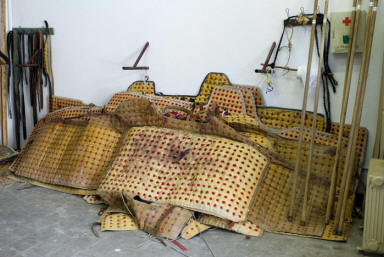
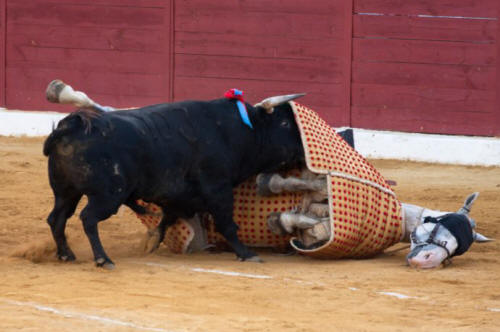
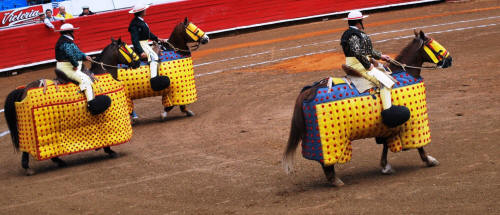
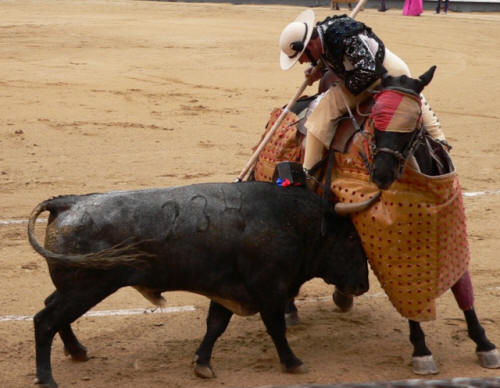
Petos ('protective mattresses') of picadors' horses.
Ernest Hemingway, 'Death
in the Afternoon:'
'...the death of the horse
tends to be comic while that of the bull is tragic.' He relates the time when
he saw a horse running in the bull-ring and dragging its entrails behind it,
and makes the further remark 'I have seen these, call them disembowellings,
that is the worst word, when, due to their timing, they were very funny.'
He
was writing of the time when the horses of the picadors were completely unprotected.
A decree of the government of Primo de Rivera in Spain ordered that picadors'
horses should be given a quilted covering 'to avoid those horrible sights
which so disgust foreigners and tourists.' This took place in 1929. Note that it wasn't bullfighters
or bullfight enthusiasts who called for this protection. If they had, it would
have been something in the balance to set against their depravity, but no.
Before that time, it was common - in fact, usual - for far
more horses than bulls to be killed in a bullfight - as I explain in
The Golden Age of Bullfighting, as many as 40.
Disembowelling
is uncommon now, for the horses of the picador and the
rejoneador or mounted bullfighter.
However, Hemingway was
clear about one thing. 'These protectors avoid these sights and greatly decrease
the number of horses killed in the bull ring, but they in no way decrease
the pain suffered by the horses.' And, in the entry in the Glossary for the
pica, the spear with which the bull is stabbed by the picador, 'The frank
admission of the necessity for killing horses to have a bullfight has been
replaced by the hypocritical semblance of protection which causes the horses
much more suffering.' One of the reasons is that 'picadors, when a bull, disillusioned
by the mattress, has refused to charge it heavily more than once, have made
a custom of turning the horse as they push the bull away so that the bull
may gore the horse in his unprotected hindquarters and tire his neck with
that lifting...you will see the same horse brought back again and again, the
wound being sewn up and washed off between bulls...'
Whether the picadors take
this action or not, the objective in the bullfight is to tire the bull not
just by spearing it with the picador's lance (although this is far more than
'tiring.' It's a vicious injury.) The objective is to tire the bull also by
exposing the horse to the force of the bull. So, horses in the bullfight are
crushed against the wooden barrier of the bullring, lifted, toppled, trampled
and terrorized, suffering broken ribs, damage to internal organs - treated
worse than vermin. The mattress may offer some protection against puncture
wounds but not against other injuries and it hides the
injuries which are caused.
Larry Collins and Dominique
Lapierre in their biography of the bullfighter 'El Cordobes' describe injuries
to horses during his 'career' - this was long after the adoption of the
'protective' mattress. Internal organs protruded from the bodies of the
horses. How were the injuries treated? The horse contractors shoved the organs
back and crudely sewed up the wounds. The organs still protruded, though,
to an extent. The protruding parts were simply cut off. The horses might well
last another bullfight or two. The authors - 'aficionados' - relate all this
in a matter of fact tone, without the least trace of criticism or condemnation.
From my review of A L
Kennedy's book, On Bullfighting,
quoting first from the book. She received the help of an aficionado
in writing the book, Don Hurley of the 'Club Taurino.' ('This book could not
have been written without ... the expertise and advice of Don Hurley.')
A L Kennedy 'Arguments are cited which state, reasonably enough, that the
blindfolded and terrified horse is currently buffeted by massive impacts,
suffering great stress and possibly broken bones.' She might have mentioned
the internal injuries which horses also suffer.
Even if a horse is lucky and suffers no broken bones or internal injuries, it can
be imagined what terror it will feel when blindfolded and led out to take
part in the parade before the bullfight,what terror it will feel when forced
to enter the arena to face the bull, what terror it will feel when it hears
and smells the bull, and the terror it feels when the bull, in its frantic
effort to escape, hits it very hard.
The first film I saw which
showed a bullfight included a 'rejoneador,' a mounted bullfighter. (The same
film also included horrendous footage of a bull which had obviously hit the
wood of the bullring very hard, with a horn hanging off, almost detached,
and almost certainly feeling severe pain - even before it faced the lance,
the banderillas and the sword.) The horse of the rejoneador isn't protected
in any way. The intention is that the horse's speed and agility and the skill
of the rider enables it to avoid the horns of the bull. Sometimes, the reality
is otherwise.
Jeff Pledge, on the methods used by Alain Bonijol, the French
supplier of picadors' horses: 'He has built, on a pair of wheels from some
piece of farm machinery, a kind of heavy-duty carretón, which has a pole
with a flat plate on the end sticking out the front. Several hefty blokes
shove it into the horse, who is wearing his peto, and try to push him over
or back ...' ('La Divisa,' the journal of the Club Taurino of London.) This
gives information not just about training methods but about the hideous
mentality of these people.
Since it's necessary, as
bullfight apologists admit, to injure horses in order to have a bullfight,
why, then - abolish the bullfight, and as soon as possible too, and not only
for the sake of the horses. Catalonia has shown the way.
Horses in human service have suffered horrifically, and continue to do so.
This is some necessary context for the horrific suffering of horses in the
bullring:
Hugh Boustead, a South
African officer, of an experience during the Battle of the Somme in the First
World War. (Quoted in 'Somme,' by Martin Gilbert):
'Dead and dying horses,
split by shellfire with bursting entrails and torn limbs, lay astride the
road that led to battle. Their fallen riders stared into the weeping skies.'
Dennis Wheatley, describing
an aerial bombing attack on the Western Front in December 1915 in his book
'Officer and Temporary Gentleman.'
'When the bombs had ceased
falling we went over to see what damage had been done. I saw my first dead
man twisted up beneath a wagon where he had evidently tried to take shelter;
but we had not sustained many human casualties. The horses were another matter.
There were dead ones lying all over the place and scores of others were floundering
and screaming with broken legs, terrible neck wounds or their entrails hanging
out. We went back for our pistols and spent the next hour putting the poor,
seriously injured brutes out of their misery by shooting them through the
head. To do this we had to wade ankle deep through blood and guts. That night
we lost over 100 horses.'
Without horses, or similar
animals, no developed human civilization was possible. Before the modern era,
their role in carrying loads (as pack-horses), pulling heavy loads and carrying
riders was crucial, all-important.
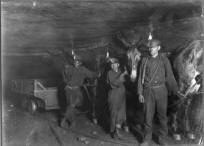
Horses of substantial
size as well as ponies went down the mines and were used well into the twentieth
century. They were stabled underground and lived the rest of their lives underground,
in complete darkness or almost complete darkness. From a display at the National
Coal Mining Museum: 'To the miners, the pony was a workmate. Together they
experienced the same conditions [back-breaking work, breathing in coal-dust]
and faced the same dangers [of explosions that mutilated or killed, of drowning
when the workings were flooded, and the rest]' After nationalization of the
mines, they spent 50 weeks of the year below ground but were given two weeks
holiday. A photograph of conditions in an American mine in the early 20th
century:
Gratitude, overwhelming
gratitude, is the only proper response. The horse: this is a species which
has benefitted mankind more than any other, which has earned, many, many times
over, the right not to be subjected to disgusting cruelty. These facts alone
should have made it unthinkable to subject horses to the cruelty of the bullfight.
The link between horses and humanity is ancient and central. The tradition
of bullfighting is not at all ancient. Bullfighting in anything like its modern
form is only centuries old. In France, the tradition is more recent still.
A fact often overlooked
is that, even after the development of mechanical means of carrying loads
and transporting people, horses continue to play their ancient role today,
as uncomplaining, useful - indispensable - beings. In many parts of the developing
world, they continue to be as indispensable as they ever were in Europe. Their
treatment is very varied. It may be as good as could possibly be expected
in desperately poor societies. It may, on the other hand, be vile, with avoidable
sufferings - and not only the vicious use of the whip, which leaves so many
horses with open wounds and scars. Often, there is the absence of basic care.
From the newsletter of a charity I support:
'Across the developing
world, thousands of brick kilns in poor villages and towns are churning out
millions of bricks to feed a growing demand for houses, hospitals and schools.
These blisteringly hot open-air factories are relentless brick-making machines.
Desperately poor workers and their horses, mules and donkeys are merely part
of that machine. For the workers, kiln life is tough enough, but for their
animals, these can be the worst workplaces on earth.
'Temperatures can hit
50 C, yet often there is little water or shade. Uneducated owners don't understand
their animals' needs and work them hard as they can under tremendous pressure
to meet production targets. Many animals are denied rest on 12-hour shifts
that see weary donkeys and horses hauling bricks by the ton across hilly,
pot-holed terrain.
'Donkeys, horses and mules
working in brick kilns suffer dehydration, exhaustion, hoof, skin and eye
problems, and a catalogue of other illnesses. They bear horrific wounds from
beatings and from falling down, and struggle with filthy, ill-fitting harnesses
and saddlepacks. Sadly, many who fall never get up again. Life expectancy
for kiln animals can be dreadfully short.'
George Orwell, in the
twentieth century, wrote of the ponies in parts of the Far East: 'Sometimes,
their necks are encircled by one vast sore, so that they drag all day on raw
flesh. It is still possible to make them work, however; it is just a question
of thrashing them so hard that the pain behind outweighs the pain in front.'
(From 'Down and out in Paris and London.')
Another dimension - and
another, even worse, dimension of horror - comes from the role of animals
in war. When cavalry was an active instrument of war, a period lasting millennia
rather than centuries - even as late as the First World War, cavalry had a
real if restricted role - then horses, like men, were injured and killed by
arrows, javelins, spears, axes, musket shot, rifle bullets, were blasted by
cannon and artillery, the link between horses and humanity again strengthened
by common suffering.
From the enormous documentation
available, here is one source.
From Franz Kafka, The
Diaries 1910-23:
'Paul Holzhausen, die
Deutschen in Russland 1812. Wretched condition of the horses, their great
exertions: their fodder was wet green straw, unripe grain, rotten roof thatchings...their
bodies were bloated from the green fodder.
'They lay in ditches and
holes with dim, glassy eyes and weakly struggled to climb out. But all their
efforts were in vain; seldom did one of them get a foot up on the road, and
when it did, its condition was only rendered worse. Unfeelingly, service troops
and artillery men with their guns drove over it; you heard the leg being crushed,
the hollow sound of the animal's scream of pain, and saw it convulsively lift
up its head and neck in terror, fall back again with all its weight and immediately
bury itself in the thick ooze.'
Although I concentrate
here for very good reason on the sufferings of horses, I never at any time
forget the human suffering. During the French retreat from Moscow, this was
extreme - but an extreme often approached or equalled before and after this
time. From David A. Bell's very searching book, 'The First Total War: Napoleon's
Europe and the Birth of Modern Warfare:' 'The men slept in the open, and in
the morning, the living would wake amid a field of snow-covered corpses. Lice
and vermin gnawed at them. Toes, fingers, noses and penises fell victim to
frostbite; eyes, to snow blindness.' The horses' suffering was extreme - but
again, an extreme often approached or equalled before and after this time.
'The starving soldiers' were desperate for 'the smallest scraps of food. Some
ate raw flesh carved out of the sides of live horses...'
According to the
historian David Chandler he lost a total of 370 000 men and 200 000 horses.
During the First World
War, there was approximately one horse for every two combatants and although
horses were not directly targeted, cavalry by now becoming less important,
they were still used on a massive scale to haul guns and waggons. About 400
000 horses were killed in the conflict. Many of them died, like the soldiers,
by distinctively new methods, by phosgene, mustard gas, chlorine gas. At Passchendaele
horses, like many of the soldiers, suffocated in the mud.
There are accounts by
soldiers who regretted that horses had been caught up in the conflict. The
account of Jim Crow, quoted in 'Passchendaele,' by Nigel Steel and Peter Hart:
'You hear very little
about the horses but my God, that used to trouble me more than the men in
some respects. We knew what we were there for, them poor devils didn't, did
they?'
In one of his last letters
before he was killed at Verdun, the German expressionist painter Franz Marc
wrote, "The poor horses!" On a single day at Verdun, 7 000 horses
were killed.
At the end of the conflict,
the martyrdom of horses was far from ending. Large numbers of them were sold
to work in the Middle East and were worked to death.
Even after the development
of mechanized warfare and mechanized transportation, horses were used often
- in enormous numbers as late as The Second World War. I think of a photo I have of 'The Road of Life.' For 900 days, during the
Second World War, Leningrad was besieged by the Germans: an epic story of
heroism, and starvation, which accounted for most of the deaths during the
siege, at least 632 000 and perhaps as many as a million people dying. With
the capture of Tikhvin, it became possible to develop an ice road, 'The Road
of Life,' across frozen Lake Lagoda to supply the city. The photo shows gaunt
horses dragging sledges across this ice road.
Horse disembowelling and bullfighting's 'Golden Age'
In each twentieth
century Spanish corrida (bullfight) before 1929, six bulls were killed, as
is the case now. In each of these bullfights, how many picadors' horses do
you think were killed? One horse per bullfight on average, not as many as
one, more than one, much more than one? The answer is shocking: as many as
40 during each bullfight. Disembowelled dying and dead horses, the
intestines of horses and the blood of horses made battlefields of the
bullfighting arenas.
In these scenes of utter carnage such bullfighters
as Joselito, ('a classical purist,' according to Alexander
Fiske-Harrison) Belmonte and
Ignacio Sánchez Mejías, the subject of the poem by the poet and
dramatist Lorca, practised their art. Like Hemingway, the poet and
dramatist saw large numbers of these dead and dying horses but found
them not in the least important.
A pre-Peto film showing the slaughter of horses in the bullring during
this period: the horrifying scenes which Lorca and Hemingway witnessed
often, the horrifying scenes which took place in the bullfights of matadors
singled out for praise by Alexander Fiske-Harrison, Tristan Garel-Jones and
so many others.
A
contemporary film showing similar scenes of disembowelling, but without
the 'artistic purity' which for Lorca, Hemingway and others made such a
difference. Before the film can be viewed, it's necessary to sign in.
The fate of the picadors' horses in the bullring before
the protective mattress or 'peto' was adopted in 1929 is a subject of
far more than historical interest. It was revulsion against the
slaughter of the horses (not shared by Hemingway or Lorca) which led to the
adoption of the protective mattress. But this didn't end the suffering of
the horses. Revulsion against their suffering - and the suffering of the bull - is much
more widespread now than then. The revulsion which makes a return to conditions
before 1929 unthinkable makes it very likely that bullfighting will
eventually be abolished.
Bullfighting has surely reached its lengthy final phase.
'From 1914 to 1920 was bullfighting's Golden Age,' according to Alexander Fiske-Harrison's blog. In this estimation, he
more or less follows Hemingway, who ' placed the
Golden Age between 1913 and 1920. In this 'Golden Age' up to 40 horses were
slaughtered in each bullfight. Alexander Fiske-Harrison tries to balance the 'artistry' and
animal suffering at various places in his book
Into the Arena (I don't accept in the least his claims concerning the
artistry) and makes his own decision as to their relative importance - a
decision which is in stark contrast with my own ideas. I don't discuss the 'artistry' at all here, only the cost in animal
suffering, and not the suffering of the bulls (atrocious though it was, and is),
only the suffering of the horses.
As for the evidence, I make use of the book by Miriam Mandel
'Hemingway's The Dangerous Summer: The complete annotations.' Miriam Mandel
has more than enough knowledge of bullfighting and more than enough
enthusiasm for bullfighting to be considered an aficionado. This doesn't
affect the thoroughness or accuracy of the scholarship in the book, but it
does affect my attitude. The book is repulsive, horrible, but invaluable.
The figures given by Miriam Mandel apply to 'The Golden Age of Bullfighting'
and to a much, much longer period before 1929:
... many horses—sometimes as many as forty - were killed at each corrida.
[bullfight]'
A great deal of information is given about the rulings and regulations
governing the bullfight. The rulings and regulations which concern the
number of horses to be provided for each bullfight reflect
expectations about the numbers likely to
die at each bullfight. The book gives this information:
'In 1847, a local ruling
required that forty horses, inspected and approved by the authorities,
stand ready for use in each bullfight. The 1917 and 1923 Reglamentos
called for six horses per bull to be fought, with the added proviso that
the management provide as many additional horses as were necessary. Sometimes all the horses would be killed and replacements would be hastily
bought off cabbies and rushed into the ring.'
The addition of (!) to this last piece of information, about the
'replacements ... hastily bought off cabbies and rushed into the ring' would
be understandable but inadequate to the horror.
The scholarly information includes this: 'Perhaps the most important marker of change is
the Reglamento (taurine code), which evolved
significantly from its early version, drafted by Melchor Ordóñez in about
1847, to the increasingly detailed and prescriptive documents published
in 1917, 1923, 1930, and, post Hemingway, in 1962, 1992 and 1996.'
Whatever the number of horses killed in the ring
- fewer than twenty, or twenty, thirty or forty - the sight of the
horses' blood, the intestines of the disembowelled horses, the horses in
agony, the dead horses, the sights which didn't disturb Hemingway or Lorca,
the sights which Alexander Fiske-Harrison overlooked or didn't think too
important - these sights aren't going to
return to the contemporary bullfight.
Miriam Mandel writes, 'Occasionally one hears reactionary calls for the abolishment of the peto, but modern sensibilities would not allow a
return to the pre-peto
bullfight that Hemingway encountered when he first went to Spain.
The peto or
'protective mattress' for the picadors' horses 'was first used at a
Madrid novillada on 6 March 1927, and it was mandated by law on 18 June 1928.' After the peto was introduced, there was a vast decrease in the number of
horses disembowelled and the number of horses killed in the ring, but as I
explain in the next section, The horses, there are
still horses disembowelled in the ring - the horses of mounted bullfighters
('rejoneador') and the horses of picadors. The peto protects against
puncture wounds but not at all adequately against the weight of the bull
smashing into it and the peto disguises so many injuries. The
horses in the bullfighting ring are still treated with despicable cruelty.
It's true that 'modern sensibilities would not allow a return to the pre-peto
bullfight' but Miriam Mandel overlooks the obvious fact that modern
susceptibilities find unacceptable - repellent - the treatment of horses and
bulls in the contemporary bullring. The page gives abundant documentation of
this treatment. What was once accepted isn't accepted any longer, except by
the supporters and patrons of bullfighting. Many of these wouldn't object in
the least if forty horses died by disembowelling at every bullfight, but I'd
claim that although there's no such thing as certain moral progress, these
people have been left far behind by this particular moral advance.
When Alexander Fiske-Harrison described the years between 1914 and 1920
as bullfighting's 'Golden Age,' I doubt if he gave the least thought to any
other contemporaneous events. When humanity was undergoing the catastrophic
sufferings of the First World War, and the influenza pandemic of 1918 -
1919, which killed far more people than the First World War, somewhere
between 20 million and 40 million people in all, including vast numbers of
people in Spain (the term 'Spanish flu' is often used), was all this
outweighed by, compensated by, the Golden Age of bullfighting? Elementary
sensitivity should have led him to use a different term or to make his
discussion much more complex.
The bull
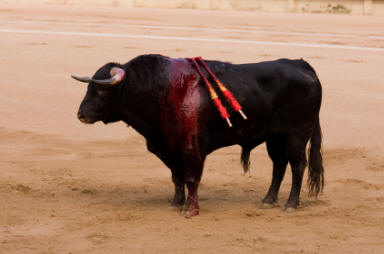
Before abolition in Catalonia: bull in the plaza 'La Monumental,'
Barcelona
There are many, many images
and films available on the internet which show the course of a bullfight.
I think it's advisable to see some of these images and watch some of the films.
None of these films, none of the films distributed by convinced opponents
of the bullfight, show untypical 'atrocities,' incidents which are very rare.
The bull is never wounded and killed under controlled conditions. Whatever
the intention, the lance of the picador, the banderillas and the sword regularly
penetrate flesh not at all near the targetted area. The picador's horse may
be about to fall as the bull's massive weight charges into it, the lance may
sever an artery and blood pulses out. Hemingway mentions the fact that the
bull 'may be ruined by a banderillero nailing the banderillas into a wound
made by the picador, driving them in so deep that the shafts stick up straight.'
When blood pours out of the mouth and nose of the bull, which is often, the
sword has failed to cut the aorta (the heart is out of reach of the sword.)
When the bull is about
to be killed, it will already have had its back torn open by the lance of
the picador and will already have had its back lacerated repeatedly by the
barbed banderillas. By the time of the sword thrust supposed to kill the bull,
the bull will have two or three stab wounds inflicted by the picadors and
six stab wounds from the banderillas.
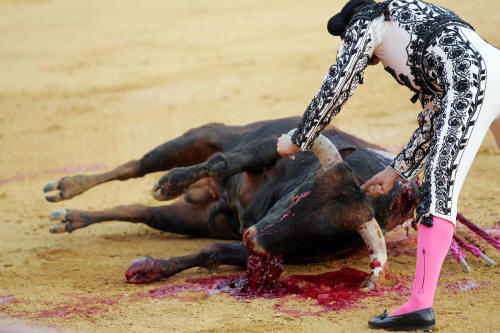
The sword often hits bone,
or goes deep into the animal but fails to kill. The bull, staggering, still
alive and conscious, with the sword embedded in its body - this is far more
common than an instantaneous death. A report by Tristan Wood in 'La
Divisa,' the journal of the 'Club Taurino' of London, on the bullfighter
Miguel Abellán: ' ... an excellent faena of serious toreo, only for its
impact to be dissipated by four swordthrusts.' The excellence and seriousness
found here are surely only an aesthete's response.
In the same set
of reports, on the bullfighter Morante de la Puebla: 'the swordwork
was very protracted.' Or, alternatively, the bull died a very slow death.
From the gruesome, matter of fact accounts of bullfights on the site 'La
Prensa San Diego'
http://laprensa-sandiego.org/archieve/october04-02/sherwood.htm
'Capetillo received a difficult first bull and encountered big troubles
at the supreme moment, requiring 12 entries with the sword.' 'Moment' is
very badly chosen. The writer is Lyn Sherwood.
Daniel Hannan, a Member of the
European Parliament and devoted aficionado: 'After the banderillas, as
the bull stood spurting fountains of blood ... ' there was 'a
miserable excuse for a sword-thrust into the bull’s flank.'
This shocking video
shows
the bullfighter Antoni Losada stabbing a bull with the 'killing sword' seven
times in the bullring at Saint-Gilles, France.
After the 'killing
sword' has been used to no effect, a different sword, the descabello, or a short knife,
the puntilla, is used to stab the spine, often repeatedly.
Alexander Fiske-Harrison saw a bull stabbed
three times with the 'killing sword' but still alive, and then stabbed
repeatedly with the descabello. According to the 'bullfighting critic'
of the newspaper 'El Mundo' who counted the stabbings, the bull was
stabbed in the spine seventeen times before it died. This experience had a
lasting effect on his girlfriend, 'her perspective on bullfights changed for
ever,' but Alexander Fiske-Harrison went on attending bullfights, went on to
kill a bull himself and opposes the abolition of bullfighting.
From my critical review
of A L Kennedy's On Bullfighting, quoting from the book. A L Kennedy is watching
a bullfight at the most prominent of all bullrings, Las Ventas in Madrid:
' At the kill, the young
man's sword hits bone, again and again and again while the silence presses
down against him. He tries for the descabello. Five blows later and the animal
finally falls.' The descabello, as the Glossary explains, is 'A heavy, straight
sword' used to sever the spine.
' 'I have already watched
Curro Romero refuse to have almost anything to do with his bull, never mind
its horns. (The severely critical response of a member of the audience to
a cowardly bull or a cowardly bullfighter.) He has killed his first with a
blade placed so poorly that its tip protruded from the bull's flank...As the
animal coughed up blood, staring, bemused, ['bemused?'] at each new flux the
peones tried a rueda de peones to make the blade move in the bull's body and
sever anything, anything at all that might be quickly fatal, but in the end
the bull was finally, messily finished after three descabellos.'
'The suffering of the
bull 'left, staggering and urinating helplessly, almost too weak to face the
muleta' wasn't ended by a painless and instantaneous death: 'Contreras...misses
the kill...Contreras tries again, hooking out the first sword with a new one
...Contreras finally gives the descabello.' So, the sword is embedded in the
animal, the sword is pulled out and thrust into the animal yet again, but
it's still very much alive, the ungrateful creature. The descabello is hard
at work in this book. People who have the illusion that the 'moment of truth'
amounts to a single sword-thrust and the immediate death of the bull are disabused
of the notion here. More often, the moment of truth is hacking at the spine
with the descabello.'
The cutting off of the
bull's ears before it's dead - this is less common. What humanitarians these
people are! They generally wait until the bull is dead before cutting off
the ears! Not always, though. On occasion, they are impatient for some reason
and can't wait.
The life and death of
the bull are sharply contrasted. The bulls are treated humanely until they
arrive at the bull-ring, but their sufferings may begin even before the picador
thrusts his lance into them. Sometimes, thick needles have been pushed into
the bull's testicles before they enter the ring.This practice is said to subdue
any bull, and no wonder.
The claim is made by bullfighting
apologists that the bull that dies in the bullring is 'lucky.' The claim is
made that these bulls have a far better life and a longer life (although not
much longer) than the bulls reared for beef, kept in factory farms and slaughtered
at a younger age. The claim is made that when bulls are 'tested' for their
fighting qualities - the 'tienta' - the bulls which go to the bull ring are
much more fortunate than the ones that fail, that will be slaughtered for
beef.
Pigs and chickens, both
the chickens reared for meat and laying chickens, are very often kept in factory
farms but this isn't true of beef cattle in most cases. I can claim to have
an exhaustive knowledge of the subject - I've opposed factory farming for
a very long time. Animals other than pigs and chickens have been kept in factory
farms to a lesser extent, or attempts are being made to factory farm them.
In this country, there are planning applications - which are being strenuously
resisted - to adopt the hideous 'zero-grazing' system for dairy cows in massive
factory farm complexes.
But generally, beef cattle
have just as good a life as fighting bulls, grazing in fields. It's true that
their life is generally shorter. Fighting bulls are at least four years old
when they enter the bullring for the regular corrida, but the 'novillos,'
the bulls fought by the apprentice matadors or 'novilleros' are closer in
age to beef cattle. When Frank Evans, the British bullfighter, came out of
retirement to fight - and kill - a bull, the bull was just two years old.
The picture I have is poignant, not for its image of the bullfighter fighting
long after most bullfighters have retired but for the bull, not at all a good-looking
bull, much slighter than a four year old bull, of course - to put this animal
to the sword needed even more callousness than usual, I feel.
But the arguments of bullfighting
apologists which refer to factory farming and the age of slaughter are surely
cynical, opportunistic. There's no evidence at all that most of these people
are concerned in the least about factory farming and the slaughter of animals.
'Thought
experiments' are often used in ethical discussion. They can be used to support
or oppose an ethical argument very graphically. In the case of the 'lucky'
fighting bull, these analogies suggest themselves. The death of gladiators
in the Roman arenas is widely recognized as a blot on Roman civilization -
indefensible. The Romans might have developed a system according to which
all the gladiators were made up of men condemned to death, volunteering to
fight instead of being executed. They had the chance of living for longer,
and perhaps much longer. Even if they were beaten in combat, the crowd might
spare their lives. What if a contemporary jurisdiction which often executes,
such as Texas, proposed to allow condemned men the same chance of living for
longer and by similar means?
It
would be unthinkable, of course. There's massive opposition to the infliction
of death in public. In the history of the death penalty, the trend has been
for executions to be public, then not seen by the public, within the confines
of a prison, before being abolished altogether. Similarly, if an animal is
being slaughtered, then to make a public exhibition of the slaughter is felt
to be degrading.
Human responsibility towards
domesticated animals, and standards for keeping domesticated animals should
include as a bare minimum (1) humane treatment whilst the animal is reared
and (2) a humane death. These should be regarded as essential, fundamental
principles of animal welfare in a modern civilization. Battery chickens are
denied (1). They have the benefit of (2) almost always, but not invariably.
The bull has the benefit of (1) but not (2). Beef cattle generally have the
benefit of (1) and (2). No matter how well treated it may have been before
arriving in the bullring, the death of the bull, more often than not far from
instantaneous, preceded by injuries which are likely to be painful or agonizing,
is an act of disgusting cruelty that shames Spain, France, Mexico, Peru, Colombia,
Venezuela and Ecuador.
The
courage of the bullfighters. Mind Mush: Paul Staines, Guido Fawkes.

Alex Honnold on Liberty Cap, Yosemite, climbing without a climbing rope
or any other form of protection - free climbing.
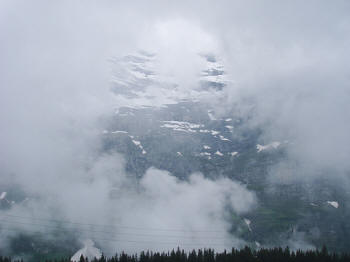
The North Face of the Eiger (Acknowledgments: flickr)
NEW: The illusions and distortions of Paul Staines, founder of the blog
'Guido Fawkes.'
Here, I concentrate on some of his weaknesses: his support for bullfighting,
his support for the reintroduction of the death penalty for some offences,
in an initiative of 2011, the stupidity of some of his attitudes to safety.
With this section, I launch a very small campaign against Paul Staines.
Anything bigger would be a waste of my time and a waste of space. Paul
Staines himself isn't a complete waste of space, far from it. His blog
'Guido Fawkes' has many strengths. I intend to include a profile of
his site on this site. There are already profiles in depth of other mainly
political sites with extensive comments sections,
https://www.linkagenet.com/themes/gbnews4.htm
'GB News,
other anti-woke sites and other issues'
and a long review of Harry's Place on my page on
The Culture Industry
Below, some ridiculous Mind Mush from the Guido Fawkes page.
I can also show that it's loathsome - the mention of 'safety nazis,' gross
misuse of the word 'Nazi, which should be reserved for attitudes and actions
which led to extermination or results of similar seriousness. Does Paul
Stains drive a vehicle? I don't know. If he does, does he wear a seat belt?
Climbers, discussed below at length, sometimes wear a safety helmet,
sometimes not. For dangerous Alpine and Himalayan climbs, they'll always
wear a safety helmet. For bouldering and sometimes for very short short climbs, climbers dispense with a climbing rope but virtually all climbers use a climbing rope
for longer climbs. I discuss the exceptions here, free climbers, and one
free climber in
particular, Alex Honnold.
This is Paul Staines, 'Guido:'
https://order-order.com/2009/07/10/remembering-running-with-the-bulls/
Guido was rummaging in the attic last weekend and found his old blood
spattered pañuelo and faja (the
sash and neckerchief worn by the runners in Pamplona). This week is
the festival of San Fermin and the news this morning
that a runner was gored to death made Guido feel a bit misty-eyed. The
second week of July every year for a decade from Guido’s mid-twenties to his
mid-thirties would see him in Pamplona doing the run, usually with his
brother or friends. As a veteran of some 30 runs it is fair to
say it was an adrenaline addiction – partying all night and running for your
life in the morning. Hangovers clear fast
when you hear the rocket fired that signals the release of the bulls.
In a sterile world of safety belts, safety helmets and safety nazis, the Pamplona bull run is a glorious celebration of the
irrational side of the human spirit. They say that an old man who has
not risked his life for his country feels less of a man than an old soldier,
so to have never risked your life must be far worse. To risk your life
makes you feel more alive.
Guido prays the cloak of San Fermin will protect los
corredores who will run this week
and wishes he was with them. May God have
mercy on the soul of the corredor who so vicerally [he means: 'viscerally']
lost his life: Saludo!
To appreciate just how ridiculous and overblown this is, we need to look
at it with the cold gaze of a statistician. ''Pamplona bull run deaths are rare, but since 1910 when record-keeping
began, 16 people have died.' This is according to the page
Runningofthebulls What's the point of the word 'but' here? 16
fatalities in this time span is rare.
Please see also in this column, Pamplona: a proposal.
My page on The death penalty has the
heading, 'The death penalty: against, but not always.' The exceptions relate
mainly to the past. I take the view that far more Nazi war criminals should
have been executed after the Second World War. I give my reasons on
the death penalty page.
In this section, I discuss the risks of
mountaineering and some forms of rock climbing, the risks of battle and the
risks of bullfighting. I point out that the risks of bullfighting are
grossly and grotesquely exaggerated by bullfighters and defenders of
bullfighting.
I begin with mountaineering. I was a cross-country skier and I've
used cross-country skis in the Alps for downhill skiing. Steve Barnett's
book 'Cross-Country Downhill,' mainly about skiing in the Canadian and
American North-West, is a fine introduction to its compelling attractions,
but my own skiing was much more limited. My rock climbing career, on the
other hand, was very brief. The experience of dislocating a shoulder twelve
times - not on a rock face - was one of the things that convinced me that I
wasn't well suited to rock climbing.
Of course, anyone who takes up mountaineering and climbing in other
settings will need to consider very carefully the risks. Many of them are
avoidable, but not all. .
Edward Whymper wrote in 'Scrambles Amongst the Alps,'
“Climb if you will, but remember that courage and strength are nought
without prudence, and that a momentary negligence may destroy the happiness
of a lifetime. Do nothing in haste; look well to each step; and from the
beginning think what may be the end.”
Edward Whymper is best known for the first ascent of the Matterhorn in
1865. During the descent, four members of the climbing party were killed.
Climbers almost always use modern methods of protection, which include
not just climbing ropes but many other sophisticated pieces of equipment.
Free climbers don't. The best known free climber is Alex Honnold, shown
above. If free climbers fall, almost always they die.
If we compare bullfighting
and high-altitude mountaineering, then high altitude mountaineering is far
more dangerous than bullfighting, as well as incomparably more interesting,
more demanding, and, if you like, more 'noble.' Now, with modern equipment
and techniques, it's far less dangerous than it used to be but the fatality
rate on high mountains still averages something like 5%. That is, one in twenty
of the mountaineers on an expedition will not return. Some mountains have
a much higher fatality rate. K2, the second highest mountain in the world,
has claimed more than one death for every four successful ascents. Annapurna
is even more deadly. Compare the number of fatalities for the tiny
number of mountaineers attempting to climb just one Himalayan peak,
Annapurna 1, which can easily be confirmed (Unlike bullfighting,
Himalayan mountaineering has immensely detailed sources of statistics, such
as
himalayandatabase.com): 58 fatalities between the successful summit attempt in
1950 and 2007, a total of only 153 summit attempts. (And whereas injured
bullfighters have speedy access to modern medical care, the case is very
different for injured high-altitude mountaineers. The frostbitten fingers
and toes of the two climbers who made the first ascent of Annapurna 1 became
gangrenous and were amputated on the mountain without anaesthetic.) To
climb Annapurna (a deadly mountain, but not the most dangerous peak) or
another very high mountain - or many much lower mountains, for that matter - just once involves a far higher risk of death
than a bullfighter faces in an entire bullfighting 'career.'
Reinhold Messner
describes the first ascent by the French climbers Herzog and Lachenal,
which was also the first ascent of any mountain over 8 000 metres high. Herzog
was caught in an avalanche, knocked unconscious, was suffering from frostbite.
Along with others in the party, he waded through deep snow back to Advanced
Base Camp, in an epic of endurance. To climb K2 or Annapurna or another very
high mountain just once involves a far, far higher risk of death than a bullfighter
faces in an entire bullfighting 'career.'
France has every reason
to feel pride in these and so many other mountaineers, just as France has
every reason to feel shame about its bullfighters.
Injuries to mountaineers
occur not only as a result of falling but from a range of other causes, such
as rock fall and avalanches - the snow which makes up the avalanche may resemble
the consistency of concrete rather than anything soft and fluffy, capable
of causing crushing injuries and multiple fractures.
On high mountains, the
ferocity of the winds and blizzards often make a rescue from outside impossible
until it is too late. Rescue facilities are well organized in the Alps, not
at all in the Himalayas and the Andes. Even in the Alps, bad weather can delay
rescue for days, or rescue may be impossible. For the mountaineer, safety
and medical help are generally far, far away.
An injured bullfighter,
on the other hand, can be taken from the ring almost immediately to the bull-ring
clinic and then to a main hospital. For this reason, injuries in the bull-ring
are almost always non-fatal. And on the other side of the barrera, the low
barrier surrounding the bull-ring, lies safety. At all times, safety is so
near. Another advantage: a bull-fighter is in the position of danger for such
a short time. A mountaineer may be in an area of acute danger for days or
weeks. The dangers are not just the ones that result from errors, which are
completely understandable, given the enormous demands which the mountains
make on the human mind and body. There are also 'objective' dangers, from
the stonefalls that occur regularly in the mountains, avalanches, crevasses,
other dangers that result from the unpredictability and instability of snow.
When, on the mountain
called 'The Ogre,' Doug Scott broke both his legs, safety was far away. The
party was caught by a storm and it took six days, five of them without food,
to descend. Chris Bonington, also in the party, broke ribs during the descent.
Another,
now famous, story of magnificent bravery and endurance in the mountains is
that of Joe Simpson, which he recounts in his book 'Touching the Void' (available
in French, Spanish and many other languages). In 1985, he and Simon Yates
set out to climb the remote west face of the Siula Grande in the Peruvian
Andes. It was 1985 and the men were young, fit, skilled climbers. The ascent
was successful, after they had climbed for over three days. But then Joe Simpson
fell, and broke his leg badly. There was no hope of rescue for them. They
had to descend without any help. Yates was lowering Simpson on the rope but
lowered him into a hidden crevasse. He couldn't hold him and was forced to
cut the rope. Simpson wasn't killed by the fall, He managed to drag himself
out and drag himself down the mountain, dehydrated and injured, until, at
last, he reached base camp.
The Wikipedia entry for the
Eiger gives valuable information about the ascents of the infamous North
face, shown in the image at the beginning of this section, including solo
ascents, the injuries, fatalities, rescues, successful and unsuccessful,
stories of courage and endurance which put bullfighting in its place. Since
1935, at least sixty-four climbers have been killed whilst climbing it -
compared with the 52 bullfighters who have been killed in the ring in a
period of over 300 years since 1700. Taking into account the number of
climbers making the attempt, tiny compared with the number of bullfighters
fighting in that period, climbing on the North face is far more dangerous.
The Wikipedia information on one summit attempt, made
only a few years after Lorca made his fatuous remark about bullfighting
being 'the last serious thing in the world.' This attempt on the Eiger, like
all the others before and since, was a serious matter by any reckoning. It
also underlines the closeness of safety in the bullring, the availability
of prompt medical care in the bullring, the lack of these in the mountains,
and the fact that it's not only bullfighters who face injury.
'The next year [1936] ten young climbers from Austria and Germany
came to Grindelwald and camped at the foot of the mountain. Before their
attempts started, one of them was killed during a training climb, and the
weather was so bad during that summer that after waiting for a change and
seeing none on the way, several members of the party gave up. Of the four
that remained, two were Bavarians, Andreas Hinterstoisser and
Toni Kurz, the youngest of the party, and two were Austrians, Willy
Angerer and Edi Rainer. When the weather improved they made a preliminary
exploration of the lowest part of the face.
Hinterstoisser fell 37 metres
(121 ft) but was not injured. A few days later the four men finally began
the ascent of the face. They climbed quickly, but on the next day, after
their first bivouac, the weather changed; clouds came down and hid the group
to the observers. They did not resume the climb until the following day,
when, during a break, the party was seen descending, but the climbers could
only be watched intermittently from the ground. The group had no choice but
to retreat since Angerer suffered some serious injuries as a result of
falling rock. The party became stuck on the face when they could not recross
the difficult Hinterstoisser Traverse where they had taken the rope
they first used to climb. The weather then deteriorated for two days. They
were ultimately swept away by an avalanche, which only Kurz survived,
hanging on a rope. Three guides started on an extremely perilous rescue.
They failed to reach him but came within shouting distance and learned what
had happened. Kurz explained the fate of his companions: one had fallen down
the face, another was frozen above him, the third had fractured his skull in
falling, and was hanging dead on the rope.'
In the morning the three guides came back, traversing across the face
from a hole near the Eigerwand station and risking their lives under
incessant avalanches. Toni Kurz was still alive but almost helpless, with
one hand and one arm completely frostbitten. Kurz hauled himself off the
cliff after cutting loose the rope that bound him to his dead teammate below
and climbed back on the face. The guides were not able to pass an
unclimbable overhang that separated them from Kurz. They managed to give him
a rope long enough to reach them by tying two ropes together. While
descending, Kurz could not get the knot to pass through his carabiner. He
tried for hours to reach his rescuers who were only a few metres below him.
Then he began to lose consciousness. One of the guides, climbing on
another's shoulders, was able to touch the tip of Kurz's crampons with his
ice-axe but could not reach higher. Kurz was unable to descend farther and,
completely exhausted, died slowly.
The intensity of the dangers
in the high mountains, the fact that these dangers are so protracted, the
beauty of this hostile environment - these and other factors have their effect
on human consciousness. Anyone who has read enough books about mountaineering
and by mountaineers and enough books about bullfighting and by bullfighters
to be able to compare the two will surely be convinced that the states of
consciousness revealed in mountaineering literature are incomparably richer,
deeper and more complex.
What are the achievements
of bull-fighters to be compared with the achievements of mountaineers? What
bravery has been shown in the bull-rings of Arles, Nîmes, Madrid, Seville,
Valencia, Granada, Mexico City, all the bull-rings of the bullfighting world,
that could possibly be compared with the bravery shown on Annapurna, Everest,
the Matterhorn, the North Face of the Eiger and the other peaks? The summit
may be reached or not, but mountaineers have every reason for pride. Bullfighters
are obviously very proud of those bleeding, still-warm ears that have been
cut from the bull as a mark of their 'achievement.' Revulsion is the only
proper, civilized response.
Of all risky activities,
none has anything like the bullfighters' highly developed Mythology of Death.
Mountaineers tend to be self-effacing and reticent, at least in talking about
the dangers. They are acknowledged and mentioned, but there's none of the
decadent boasting indulged in by bullfighters, and so for other people who
take part in risky activities. During the Winter Olympics at Vancouver,
2010, one of the competitors in the luge event, one of the men and women who
hurtle down the ice at terrifying speeds, was killed. The competitors showed
restraint and dignity and hurtled down the ice in their turn, without
histrionics. The biography of the Spanish bullfighter of a previous
generation, El Cordobes, was entitled, 'Or I'll dress you in mourning,' referring
to his boast that he would make good in bullfighting or die in the attempt.
(Like the vast majority of bullfighters, he didn't die in the attempt.) The book
- one I haven't, to be fair, read from cover to cover, only in large extracts
- is astonishing. I think particularly of the effusive bullring chaplain
holding up a religious medal when it seemed that El Cordobes' histrionic
heroics were becoming particularly risky.
The English
bullfighter Frank Evans has written about the women who are attracted to him
because of the supposedly glamorous danger he faces.
A L Kennedy makes a grotesque
comparison, in connection with the bullfighter 'El Juli,' who, rumours have
it, 'will soon attempt to face seven bulls ... within the course of one day...
At this level, the life of the matador must be governed by the same dark mathematics
which calculates a soldier's ability to tolerate combat: so many months in
a tour of duty, so many missions flown, and mental change, mental trauma,
becomes a statistical inevitability. But in the corrida, the matador is not
exposed to physical and emotional damage by duty, or conscription - he is
a volunteer, a true believer, a lover with his love.' This comes from her
book 'On Bullfighting.' I note in my review of the book, ' ... ten years after
she wrote about him and his likely demise, El Juli is still with us, still
very much alive, despite the dark mathematics.'
John McCormick gives the same argument in the morass of
ignorance and falsification that makes up a significant part of 'Bullfighting: art, technique and
Spanish society.' He writes of the bullfighter, 'Just as the suit of lights
marks him off in the plaza from the run of men, so in his own mind he is
marked off always ... The closest thing to it I knew was fear of combat, but
that was different too, because there was always the comforting sense of
having been coerced.
The difference in toreo lies in the element of choice.
Only the toreo chooses freely to risk wounds or death.'
Not true of the volunteers from this country and others who went to fight
in the Spanish civil war, such as George Orwell, who was shot in the throat.
The merchant seamen who served on the ships bringing supplies to this
country during the Second World War were all volunteers. Many of the
particularly dangerous missions undertaken in the Second World War were
undertaken by volunteers. All those members of the armed forces from
Northern Ireland who fought against the Nazis were volunteers - there was no
conscription in the province during the war - and obviously all those from
the Irish Republic who joined the British armed forces to fight
against Nazism, around 38 000 in number. The soldiers of this country who
fought in The First World War in 1914 and 1915 were volunteers. Conscription
wasn't introduced until 1915. This is an incomplete list, which could be
vastly extended, of evidence from before the publication of the book in
1967. Events since would provide further contrary evidence. For example, the
soldiers from this country and others who fight against the Taliban in
Afghanistan. The men and women who work in bomb disposal, amongst other
things making it safe for villagers to return to their villages, are all
volunteers. And evidence from other activities before and after he
wrote, for example, the mountaineers who risk death in the mountains,
practitioners of high risk sports in general, are obviously all volunteers.
Again, obviously an incomplete list.
Some opponents of the
bull-fight refer to the matador as a coward. This is a clear instance of what
I refer to as alignment, which involves a distortion of reality.
It's also an instance of alignment to claim that Picasso cannot have been
a great artist because he was so devoted to the bullfight. Picasso's work
leaves me cold, including the overrated painting 'Guernica,' but I recognize
his importance as an innovator, his secure place in the history of artistic
modernism. (All the same, when I think of his devotion to the bullfight rather
than his artistic importance, then to me he's 'Pablo Prickarsehole.')
The mistake of rejecting
achievement because of an objection to the person's personality or one aspect
of the work, is discussed in the case of another Spanish artist, Salvador
Dali, by George Orwell ('Benefit of Clergy: some notes on Salvador Dali.')
Similarly, to decide that Descartes cannot have been a great philosopher because
of his notorious view that animals are automata and cannot feel. Descartes'
position as one of the great philosophers is beyond dispute. His 'Meditations'
is one of the most attractive works in all philosophy, and certainly one of
the greatest works of rationalist philosophy.
To return to the bullfighters,
their courage surely can't be in doubt. If fatalities in the bullring are
rare, gorings and other injuries are not. Nobody who was a coward would choose
to occupy the same space as a half-tonne bull with sharp horns, but I think
I've established that their courage is strictly limited.
A related issue: the ethics
of climbing and the ethics of bullfighting. 'The ethics of bullfighting' here
has a very narrow meaning: whether or not the bull is tampered with to make
the work of the bullfighters much less dangerous. Better to call it 'code.'
The word 'ethics' shouldn't be used in connection with bullfighting. The shaving
of the bull's horns is one notorious practice that makes a bull far less dangerous
but is commonly practised. There are others. Stanley
Conrad who runs what has been described as the 'best' (pro-) bullfighting
Web site in the world in English, admits this, in a review of A L Kennedy's
'On Bullfighting:' 'the critical issues plaguing the present
day corrida - weakened taurine bloodlines, horn shaving and other pre-corrida
attacks on the central creatures' integrity...'
Another critical issue plaguing the present day corrida is
cited in the routine and otherwise uncritical book 'Bullfight' by
Garry Marvin, a social anthropologist, which includes information about one
practice which I can't confirm from other sources. If true, it reflects the
tawdry dishonesty and corruption of the relationship between bullfighters
and journalists in Spain. He writes,
'In whatever novillada or corrida he is performing, it is important for
the matador to have preparado la prensa (literally, 'prepared the press',
meaning to have paid a certain amount of money to the reporters and
photographers who will cover the event), because the reports of a
performance can have a considerable influence on the chances of further
contracts. If not sufficiently 'prepared', the press can damn a good
performance with faint praise or can concentrate on the odd bad moments
rather than on the overall performance. If well 'prepared' they can do
exactly the reverse and can find good things to say even though the matador
might have been booed from the plaza.' The same novillero who had the
problem with the festival performed extremely well on two afternoons in a
series of novilladas in a town near Valencia. He paid as much as he could to
the local newspaper critic, who was also a correspondent for a national
magazine dedicated to the corrida. The amount paid was obviously not enough,
and he received a few cursory lines in the report. Other novilleros who had
not done as well but who had obviously given more money received much more
coverage, including several flattering photographs.'
The book is described by the publisher as one which 'explains how and why
men risk their lives to perform with and kill wild bulls as part of a public
celebration ...' The usual ignorant or shameless overestimation of the
dangers to life which I discuss on this page.
Opponents of bullfighting
are often pessimistic - how to win a victory against forces seemingly so powerful
and entrenched? They should remember, though, that they are opposing something
which is diseased.
Breaches of climbing ethics
make the mountain easier to ascend, with less danger. They include resting
in the rope rather than using the rope purely to arrest a fall, in climbs
where artificial aids aren't permitted. Climbing ethics are almost always
observed, the 'bullfighting code' very often flouted. Climbers who would like
to climb a particularly dangerous rock face don't bring along explosives to
make the rock face less difficult and dangerous, but in bullfighting, the
most devious practices are common. And the bullfighters, not the climbers,
are the ones who will boast of the dangers, of how, in the case of male bullfighters,
the vast majority, the glamour of danger makes them attractive to women ...
The 'courage' of bullfighters
in the past was the means - the morally obnoxious means - by which a few individuals
could escape poverty and deprivation. As the bullfight apologist Michael Kennedy
acknowledges in 'Andalucia,' the growth of prosperity makes individuals less
and less keen to take risks in the bullring. The amounts that can be earned
are enormous. A bullfighter may earn more than most footballers in Spain. The
financial rewards of climbing are far less - for the vast majority of climbers
nothing whatsoever.
The people who run with
the bulls at the San Fermin Festival in Pamplona (and similar events) run a
risk of injury but most of the injuries are minor. The most common injury is
contusion due to falling. There have been fatalities in the bull-run: 15 fatalities in the last 100 years. Given the large
numbers of people who take part, this isn't very many. They include someone
suffocated by a pile-up of people and someone who incited a bull to charge him
by brandishing his coat.
The attempt to claim excellence
for bullfighting stumbles upon the fact that two categories essential for
these claims, physical courage and artistic achievement, are also categories
where humanity's achievements are stratospherically high.
Alexander Fiske-Harrison
lets slip in his book 'Into the Arena' the information that between 1992 and
the publication of his book in 2002, no bullfighters were killed in the ring
in Spain. In his blog, he gives a figure for the number of
professional bullfighters killed in the last three hundred years: 533. This is
one of the lists he refers to, the annotated list of deaths of matadors
since 1700:
http://www.fiestabrava.es/pdfs/MVT-1.pdf
This document, like
the others, omits context and comparison. For example, in 1971, José
Mata García died as a result of bullfighting injuries, but would probably
have survived if medical facilities at the ring had not been very poor. In
the same year, two Spanish matadors were killed in car accidents (a
Venezualan matador was killed in a car accident as well.)
Between 1863 and
1869, no deaths are recorded for matadors. During the American Civil War in
just one prison (Salisbury, North Carolina) during a four month period (October 1864 - February 1865) 3,708 prisoners died out of
a total of about 11 000. (Information from the 'Civil War Gazette.') This is
about a 33% mortality rate. If a similar mortality rate applied to
bullfighting, then in one single bullfighting season in Spain there would be
markedly more bullfighters killed than have been killed in three centuries
of bullfighting.
Or consider this as context for the death of 533
bullfighters in a period of over 300 years: Italian soldiers
facing soldiers of the Austrian-Hungarian army. On December 13, 1916
(later known as 'White Friday') 10,000 soldiers were killed in
avalanches.
Essential background for bullfighting mortality
statistics is the frequent recklessness of bullfighters. In the Anti-blog, I
refer to Padilla, injured but not killed, who head-butted a bull, obviously
very near to the horns, twice. Padilla lost an eye as a result, but in the
same year in which more bullfighters were killed in car accidents than in
the ring, 1971, a bullfighter lost an eye in a car accident.
The pro-bullfighting Website carrionmundotoreo.com has a
page on bullfighting risks written by Michael Cammarata, which includes
this: ' ... toreros are not inherently at risk for many health
conditions. Their lives may be complicated by injuries, but death by the
bull’s horns is rare, they are unbelievably resilient, and healthcare has
improved to the point that nearly all consequences or mishaps are
manageable.' Penicillin transformed bullfighting. Before its introduction,
accidents in the bullring, like accidents on the farm, were far more likely
to be fatal.
'In 1997, the Spanish government issued the first Royal
Decree significantly pertaining to "sanitary installations and
medico-surgical services in taurine spectacles" (Real Decreto de Oct. 31,
1997).' The regulation outlines the facilities which must be available:
'All infirmaries are expected to have basic amenities,
including sufficient lights, ventilation, generators for back-up energy
supplies, and a communications system. Mobile infirmaries should have a
minimum of two rooms; one for examination and another for surgical
intervention; however, the standards for fixed infirmaries are higher. A
bathroom, recovery room, and sterilization and cleaning room are also
necessary. The regulation continues to outline a list of necessary supplies,
such as central surgical lamps, tables, anesthesia machines, resuscitation
machines with laryngoscopes, intubation tubes, suction, and a cardiac and
defibrillator monitor. The responsibility for such materials lies in the
hands of the chief surgeon of the plaza.... events with picadors require the following staff: a chief
surgeon, an assisting physician with a surgical license, another physician
of any type, an anesthesiologist, a nurse, and an auxiliary person. Events
without picadors such as novilladas without picadors, sueltas de vacas, and
comic taurine events require a chief surgeon, a physician, a nurse, and
auxiliary person. Therefore, the difference is in the assistant surgeon and
the anesthesiologist. A plaza de toros has ambulances on site for emergency
transports from the plaza to the nearest hospital, during which at least a
nurse and physician must be on board the vehicle.
Fatalities to bullfighters may be very rare, but
fatalities to the horses used in bullrings don't seem to be nearly so rare -
but I haven't been able to find any statistics whatsoever. This
surprises me not at all. The bullfighting world seems to consider the
welfare of horses completely unimportant. When I found
bullfightingNews.com, this news piece was on the Home page, headed 'Diego
Ventura [a 'rejoneador,' not a picador] triumphs, but loses his horse to
goring.' (He 'lost' another horse two years earlier):
'The star horse "Revuelo" was gored in the right hind quarters,
during a performance in Morelia, Mich.
'The goring was deep about 30 centimeters, fracturing the femur. It was
reported in several newsoutlets [sic] that the goring was on the left when
in actuality it was on the right.
'The
veternarian [sic] that was onsite was looking after the horse trying to see
how bad the goring was, with his hand exploring the goring, it was said that
when he took his hand out he brought bone with it.
'The horse was losing too much blood, and even though they
tried to transport him to a clinic, he succumbed to his injuries.
'The horse, called "Revuelo" was 7 years old and a horse
that was used during the placement of the banderillas.
'This is Diego's 2nd loss, his other was in 2009 of the
horse named "Manzanarez".'
Although bullfighters
may be severely injured in the bullring, the severity of the injuries in warfare,
particularly since the introduction of explosives, is of a different order
of seriousness. John Keegan writes well about the subject in 'The Face of
Battle.' The injury to the bullfighter Jose Tomas in Mexico was a
particularly severe injury, but it was one wound, not the severe multiple
wounds common in times of war. Bullfighters who have been gored can
almost always still walk, they still have the use of their limbs, they can
still see. The effect of high explosive, in the current conflict in
Afghanistan, in the massive bombardments of the First and Second World War and
other wars, can leave the soldier - or the civilian - with a single limb or
even none at all, or blinded, or mutilated so much that even advanced surgery can never restore
anything like the person's appearance. Similarly in the case of the horrific
burns which are common in time of war. Ordinary people in vast numbers have
faced these risks, with none of the romanticized myth-making of the bullfighters
and their supporters.
The courage of bullfighters
is completely eclipsed by the courage shown by innumerable ordinary people
in time of war, including civilians. The life expectancy of
many soldiers at the Western Front during periods of intense fighting, the
life expectancy of new RAF pilots in 1917, was a few weeks. The men who flew in RAF Bomber Command during the Second World
War were all volunteers.
55,573 were killed out of a total of 125,000 aircrew - a 44.4%
mortality rate. What
French bullfighter has had to show a fraction of the courage, has faced a
fraction of the dangers faced by the countless, ordinary (or extraordinary)
French soldiers at the relentless killing machine of Verdun?' Of the 20 million
Russian soldiers who fought in The Second World War against the Nazis, well
over 10 million were killed. Over half the population of Warsaw died during
The Second World War, 800 000 people in all. The risk to life involved in bullfighting is
tiny compared with the risks to civilians as well as combatants in
much modern warfare.
During The Second World
War, this country was dependent upon the convoys bringing food, fuel and other
materials across the Atlantic. The merchant seamen who served on these ships
were all civilians and all volunteers. Of the total of 185 000 who volunteered,
over 30 000 were killed, the majority after their ship had been attacked by
a U-boat. The war experiences of the survivors often involved the explosion
of the torpedoes, their ship burning from end to end, burning oil in the water,
men drowning in oil. These acute dangers were even worse, of course, for the
many who faced the long voyage across the Atlantic on oil tankers. The well-developed
propaganda machine of bullfighting has never yet faced such realities.
The French author Antoine
de Saint-Exupéry had a very adventurous period in aviation and eventually
a very dangerous one. He became a fighter pilot for the Free French and was
killed in action in 1944. But the mythology of death had no attractions for
him. He wrote: 'It is not a question of living dangerously. That formula is
too arrogant, too presumptuous. I don't care much for bullfighters. It's not
the danger I love...It is life itself.'
Bullfighting: 'the
last serious thing in the modern world?'
See also the images and discussion in the section
Lord Tristan Garel-Jones and war, pets, sentimentality
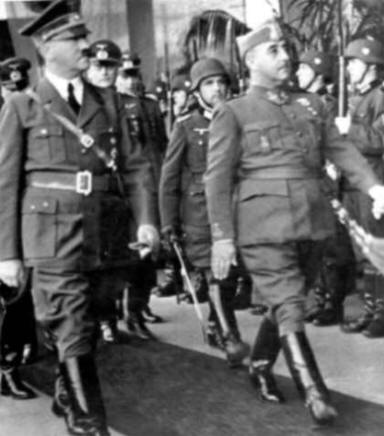
Hitler and Franco, the Spanish fascist dictator
See also the previous section Bullfighting and 'duende'
for more on the supposed superiority of the Spanish attitude to death,
an argument often used to justify bullfighting.
The bullfighting audience tends to make clear its
disapproval, of bullfighters and bulls, by throwing cushions into the arena,
jeering and whistling. I think that the stupidities of Alexander
Fiske-Harrison and other bullfighting apologists, their falsification of
reality, deserve a strong and robust counter-response. Towards the end
of 'Into the Arena' he claims of the bullring, "And in that ring are all the tragic
and brutal truths of the world unadorned.' In the Prologue, he quotes the
words of the poet García Lorca: 'the bullfight is the last serious
thing left in the world today'.
These words, written in the thirties, when
many millions had been left maimed in mind or body by their
experiences in the First World War, when many millions remembered their
losses during the Influenza Pandemic of 1918 and 1919 which killed 60 or 70
million people - known sometimes as 'Spanish flu,' on account of its
severity in Spain, when the anything-but-trivial movement of Nazism was
beginning, were falsified by the seriousness of reality in these and
countless other ways then and have been falsified in countless ways in every
decade since then, and falsified in countless ways too by the serious
achievement or the striving for serious achievement of countless men and
women. Lorca's 'the bullfight is the last serious thing left in the world'
has the benefit of sounding impressive, to many, but it belongs only to what
I call 'the world sphere.' Anyone who reflects on such matters as
serious politics, art, culture, the realities of war and the realities of
peace, the struggles of everyday life and struggles for survival, will
surely realize the extreme
falsity of those words. Equally worthy of contempt are the words of the
writer and director Agustín Díaz Yanes who declared that 'bullfighters were
the only free men left in the world.' (Reported
in The Times Literary Supplement blog, 'Tagore in Segovia.'
The material I give on this page of the horrific
occupation of Poland during the Second World War and its utterly ruthless
Governor, Hans Frank, is a reminder of some realities. To say that the
extermination camps in Poland at Auschwitz, Treblinka, Belzec, Chelmno and
other places, the crushing of the Jewish uprising in the Warsaw ghetto (some
6 000 burnt alive or dying of smoke inhalation), the crushing of the
resistance Home Army in Warsaw, the daily terrors of the long occupation,
during which over 5 million Polish civilians died, to say that these and all
the other tragic and brutal truths of the world are in the bullring,
unadorned, is monstrous and Alexander Fiske-Harrison's endorsement of the
lie is monstrous.
During the
fascist dictatorship and during the Second World War (Franco kept Spain out
of the Second World War but supported Hitler), bullfights took place
throughout the bullfighting season, so bullfighting supporters had reason to
be content. Spanish bullfighting supporters took pride in their
bullfighters and gave them their adulation.
In this country, we have very
different reasons for pride, the courage, endurance and sacrifices made by
people in this country when it didn't give up or stand aside, like Franco's
Spain, but fought
against Hitler.
It can be argued that the prominence of bullfighting in Spain now is
a consequence of Franco's victory in the Spanish civil war. A note on the
place of bullfighting in Spanish society during the Franco era. From Carrie
B. Douglass, 'Bulls, bullfighting and Spanish identities:'
Franco and the "Spain" that won the Civil War, the Nationalists,
seemed to value the fiesta nacional in a special way. Although Franco was
from Galicia, a region without much of a bullfighting tradition, he was a
great aficionado of los toros ... Corridas were included in the bundle of
images considered to be "castiza" (pure) Spain which Franco and his
Nationalist supporters in general patronised. General Franco was often
photographed with popular bullfighters ...
'In fact, had it not been for the Nationalists (the Right) during the
Civil War the toro bravo and the corridas de toros may well have died out
completely ... the Republicans and the political left had been against los
toros ... the Anarchists opposed bullfighting totally, calling the corrida a
"remnant of medieval cruelty" claiming that it desenstized people to
suffering and distracted them from the task of educating themselves."
From my page A L Kennedy's 'On
Bullfighting:'
'The republican Lorca and
the nationalists were linked as well as contrasted. They were linked by the
cult of death. One nationalist rallying cry was 'Long live death!' Lorca:
'Spain is unique, a country where death is a national spectacle...In every
country death has finality. Not in Spain. A dead person in Spain is more alive
than is the case anywhere else.' Another republican, El Campesino, again quoted
in 'The Battle for Spain' : 'I am not pretending that I was not guilty of
ugly things myself, or that I never caused needless sacrifice of human lives.
I am a Spaniard. We look upon life as tragic. We despise death.'
Massacres on a vast scale have taken place in countries without anything
like a death-cult, but the Spanish death-cult faces enormous problems in
coming to terms with these massacres - including the massacres which took
place during the Spanish civil war.
The Spanish cult of death - not a justification of
bullfighting, something to be used in defence of bullfighting, but something
which has encouraged and been used to justify human slaughter as well as
animal suffering in the bullfight - is a sign of disease, not health. Paul
Preston is the foremost British historian of the Spanish civil war. His
books include 'The Spanish Holocaust: Inquisition and Extermination in
Twentieth-Century Spain,' which documents the slaughter and torture of those
years. He estimates that at least 130 000 people were executed by the
nationalists during the war but the total is likely to have been much
higher. He estimates that just under 50 000 people were killed by the
Republicans. Compare the attention given to the 533 bullfighters killed in
the ring since 1700 by Alexander Fiske-Harrison. When the town of Badajoz
was captured by the nationalists on August 14, 1936, the prisoners were
confined in the bullring. Hundreds were killed in the executions which began
that night. Soon, as many as 4 000 people were killed.
Alexander Fiske-Harrison's bucolic portrayal of fighting
bulls living a life of ease in the wide open spaces of the ranches ignores
the history of such places: the misery of the landless poor in
Southern Spain, regarded with indifference or contempt by the landed
aristocracy. Land reform was one of the chief proposals of the Popular Front
government elected in February 1936 on the eve of the Spanish civil war.
Helen Graham, on events early in the war:
'It was a war of agrarian counter-reform that turned
Andalusia and Extremadura into killing fields. The large landowners who
owned the vast estates which covered most of the southern half of Spain rode
along with the Army of Africa [Franco's Moroccan forces] to reclaim by force
of arms the land on which the Republic had settled the landless poor. Rural
labourers were killed where they stood, the 'joke' being they had got their
'land reform' at last - in the form of a burial plot.
'Reforms, and not only land reforms, were crushed with the
victory of the nationalists in the war, and large numbers of the landless
poor were exterminated. The wealthy land-owners who bred and reared bulls
were amongst those who benefitted from the crushing of the legitimate
government and its supporters.
Many of the bull-rearing ranches have a very dark history.
Alexander Fiske-Harrison may be aware of these aspects of Spanish history,
but his writing on Spain never mentions them. A wider interest in history, a
less exclusive interest in the history of bullfighting, would add
perspective to some of his views - or even overturn them.
Bulls, elephants and tigers
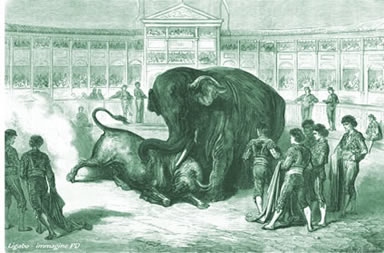
In the bullfighting
arena: Madrid, 1865
Hemingway, 'Death in the
Afternoon:' '...Huron, a bull of the ranch of Don Antonio Lopez Plata ...
fought a Bengal tiger on the 24th of July 1904 in the Plaza of San Sebastian.
They fought in a steel cage and the bull whipped the tiger, but in one of
his charges broke the cage apart and the two animals came out into the ring
in the midst of the spectators. The police, attempting to finish the dying
tiger and the very live bull, fired several volleys which 'caused grave wounds
to many spectators.' From the history of these various encounters between
bulls and other animals I should say they were spectacles to stay away from,
or at least to view from one of the higher boxes.' The 'other animals' which
took part in these 'encounters' included elephants, as in the illustration
above.
Hemingway's reservations
are only to do with the danger to the spectators. He has no revulsion at the
effect of the tiger's teeth on the bull and the bull's horns on the tiger.
What might a more detailed account of this 'encounter' have revealed? Perhaps
an eye of the bull hanging down by a strip of flesh, its face almost ripped
away, the tiger pumping out blood from deep wounds, perhaps with an empty
eye socket too. What would a detailed account of the injuries to the bull
and the elephant have revealed, when the 'encounter' was at a later stage
than the one shown above? It should be apparent to anyone with any moral sense
that the Nobel Prize Committee gave its prize to a sadist.
As well as the formal,
ordered bullfight, with its three 'acts,' the bull has been pitted against
other animals. Why is it that they are unthinkable today? There has been a
transformation in human attitudes to animals, so powerful that it has even
influenced many, but not all, bullfight apologists. Now, there are more bullfight
apologists who would go so far as to condemn the cruelty of a bull fighting
other animals but who continue to defend the practices of the bullfight, using
supposed arguments which rely heavily upon words like 'art,' 'tragedy,' 'honour,'
'courage.' The fight between an elephant and a bull which seems to have aroused
no opposition in the Madrid bullfighting supporters of 1865 would probably
be opposed by the majority of bullfighting supporters now. They will find
that the transformation of attitudes which has condemned such events as these
has condemned the formal, ordered bullfight as well, and has condemned them.
One common justification for the treatment of the
bull in the bullring appeals to the longer, privileged life of the bull up
until that point. An entrepreneur in Spain could appeal to the same argument
in an attempt to reintroduce the combat of elephant against bull. Elephants
due to be culled owing to the fact that there's insufficient food for them
to be imported into Spain, given five more years of life, in a separate
section of bull-rearing ranches, and then made to fight in the arena,
speared to make them weaker, any animal which survives for a quarter of an
hour to be humanely killed. An arrangement which might appeal to many
bullighting supporters fails because it's no longer within the bounds of
possibility. The reputation of Spain, the reputation of Europe, is one
consideration among many.
It's becoming ever more clear, if not in every part of
Europe and the wider world, that bullfighting dimishes the reputation of
every country which allows it and that whatever arguments are brought
forward against abolition, its cruelty demands abolition.
More evidence that
Hemingway could be disgusting. A 'capea,' as the glossary of 'Death in the Afternoon' informs
us, refers to 'informal bullfights or bull baitings in village squares in
which amateurs and aspirant bullfighters take part.' Now, Hemingway tells
us, 'one bull which was a great favourite in the capeas of the province of
Valencia killed sixteen men and boys and badly wounded over sixty in a career
of five years.' So, simple enough. The bull was defending itself. The people
who were killed and injured knew what risks they were running and there was
an easy way to avoid all these risks. After the bull had killed or injured
people in its first season, it was allowed to go on for years afterwards.
What happened to this
'great favourite,' also described by Hemingway as 'a very highly valued performer?'
The bull's owner sent the bull to the slaughterhouse in Valencia. Two relatives
of a someone killed by the bull asked permission to kill the bull, which was
granted. The younger of the two 'started in by digging out both the bull's
eyes while the bull was in his cage, and spitting carefully into the sockets,
then after killing him by severing the spinal marrow between the neck vertebrae
with a dagger, he experienced some difficulty in this, he asked permission
to cut off the bull's testicles, which being granted, he and his sister built
a small fire at the edge of the dusty street outside the slaughter-house and
roasted the two glands on sticks and when they were done, ate them. They then
turned their backs on the slaughter-house and went along the road and out
of town.'
Hemingway was in the vicinity
when all this was done, although he doesn't reveal the fact in 'Death in the
Afternoon.' There's not the least evidence that he disapproved of the treatment
of the bull.
Bullfighting
and comedy
Hemingway had a less than
sure feeling for comedy. He found comedy where there was none at all, in the
death of the horses in the bull-ring, and was oblivious to comedy in his own
writing. Isn't this comic, or, rather, bizarre? It comes from the Glossary
of the book, where, as well as explaining the diseased world of bull-fighting,
he includes an entry on, of all things:
'Tacones: heels;
tacones de goma are rubber heels: these are sold by ambulatory vendors
who will come up to you while you are seated in the cafe, cut the heel off
your shoe with a sort of instant-acting leather-cutting pincers they carry,
in order to force you to put on a rubber heel. The rubber heels they attach
are of a low, worthless grade...If any rubber-heel attacker ever cuts a heel
of your shoe without your having first definitively ordered a pair of rubber
heels, kick him in the belly or under the jaw [!] and get the heels put on
by someone else...There is one sinister-faced Catalan high-pressured heel
ripper...I gave him that [whether a kick in the belly or under the jaw isn't
specified] but he is more of a dodger by now and you might have difficulty
landing on him. The best thing when you see this particular heel-selling bastard
(hijo de puta will do) approaching is to take off your shoes and
put them inside your shirt. If he then attempts to attach rubber heels to
your bare feet [!], send for the American or British Consul.'
For Hemingway, 'in the
tragedy of the bullfight the horse is the comic character ... Therefore the
worse the horses are, provided they are high enough off the ground and solid
enough so that the picador can perform his mission with the spiked pole, or
vara, the more they are a comic element.' And in connection with the disembowelling
of the horses, 'There is certainly nothing comic by our standards in seeing
an animal emptied of its visceral content, but if this animal instead of doing
something tragic, that is, dignified, gallops in a stiff old-maidish fashion
around the ring trailing the opposite of clouds of glory, it is as comic it
was the horse which provided the comic touch' then according to Hemingway
it is as comic as burlesque farce: 'If one is comic the other is; the humour
comes from the same principle ... I have seen these, call them disembowellings,
that is the worst word, when, due to their timing, they were very funny.'
See also Seamus
Heaney on the actions of the banderillero, (stabbing the bull six times)
which he thinks are 'closer to comedy than tragedy.'
The humour of some bullfighting
enthusiasts, their idea of 'fun', make a deeply depressing study. The animal
victims of the 'informal events' of Spanish fiestas are presumably regarded
as hilarious, light relief from the solemn 'tragedy' of the corrida itself.
A page on the impressive Web site of FAACE gives examples. The live goats thrown from the church tower in Manganeses de la Polvorosa,
the pigeons and squirrels stoned in Robledo de Chavela, the live chickens
hung from a line and hacked to pieces in Tordesillas, the chickens buried
up to their necks and beheaded by the blindfolded villagers of Aduna, the
bulls attacked with hundreds of darts in Coria. [This has now been ended.]
See also the sombre, harrowing, informative, intelligent page on the same
Web site, http://www.faace.co.uk/faqs2.htm. The same page includes comments on the
'hazy and outrageous mythology' of the bullfight industry and the economic
momentum which perpetuates the bullfight.
Donkeys are sometimes
used in a 'hilarious' event which mimics the mainstream Corrida. (And sometimes
there's another 'hilarious' character - a dwarf dressed as a bullfighter.)
The horse is regarded as a comic character in the bullfight (so its sufferings
are of no account) and a donkey is even more comic.
Fadjen, a fighting bull, and
Christophe Thomas
http://www.youtube.com/watch?v=ntWd5Pq4Xyo
This is a remarkable film from Pablo Knudsen showing the warm relationship between a bull
bred for fighting and Christophe Thomas, the French man who saved him from ever
fighting in a bullring, It shows too the gentle relationship
between the bull and the goats who play with him and the bull's complete
acceptance of a horse. 'Fighting
bulls' are subjected to treatment which is artificial and
abnormal, treatment calculated to make them aggressive. In the bullring, the
bull has nowhere to escape or to hide. The film exposes this treatment and
the trickery often used by bullfighters, which fools so many people.
The idyll, the possibility of a wonderfully harmonious relationship between
human and animal, is far from being a myth. It's no more impossible in the
case of human and 'fighting bull' than in the case of human and dog.
The film comes from Christophe Thomas's
Website, which has other films about Fadjen. The site deserves a prominent
role in the
anti-bullfighting movement, www.sauvons
-un-taureau-de-corrida.com
I don't in the least claim that all bulls are non-aggressive, only that
in this respect, as in others, they show variability.
Campaigning techniques
I provide an illustration of the distinction I make here in the next
section, Three Spanish restaurants.
In campaigning, I think
it's essential to distinguish two things:
(1) The most effective
techniques to win, in this case, to abolish the corrida. This will often demand
short, vivid messages and simple slogans - as when the French Alliance Anticorrida
organized an amazing air campaign over Nîmes in May, 2007, two planes
flying and towing banners with a short message against the bullfight over a
distance of 600km. It will often demand arguments presented very briefly, and
action which is concentrated rather than diffuse, action which is not at all genteel, but action which keeps within the law. In a democracy, it may
be necessary to break the law in exceptional circumstances if that seems
the only way to end a serious abuse, but the most effective actions for
opposing bullfighting don't require the law to be broken (I mention an
exception below.) In
fact, violence against people and damage to property damage the
anti-bullfighting cause. I oppose these tactics in all cases. (Where the opponent is a totalitarian power,
as in the occupied countries of Europe during the Second World War, then the
use of violence and force an damage to property can easily be justified.)
In fact, in most cases, anti-bullfighting activists
use tactics which can be supported wholeheartedly, for example, the
tactics used by these
Spanish activists
shown in this film. It shows them
travelling to the scene of their protest outside the bullring, followed by
horrific scenes during a bullfight.
I support disruption of bullfights, whether or not they
entail a public order offence which is a breach of the law. The rule of law
is very important but a perfectionistic approach to observance of the
law isn't possible or even desirable in every single case. People
handing out leaflets opposing bullfighting (or some other activity) may be
'guilty' of obsruction if they stand still whilst doing so, but any feelings
of guilt on that score are unnecessary.
In this film, a bullfight in Barcelona is disrupted:
http://www.youtube.com/watch?v=OibprDli4BM
No bullfights take place here now, of course, as in
the rest of Spanish Catalonia. (The same moral advance hasn't been made in
French Catalonia so far.)
(2) The reasoning which underlies the action. This should not be simple. It
should be comprehensive (covering all relevant aspects of the subject rather
than a few), fair-minded (taking every care to avoid distortions of reality,
taking note of possible objections), sophisticated in moral argument and,
also, factually correct. It's not true, for example, that the bull is killed
by a sword thrust to the heart, as is often claimed, for example, in the current
'Rough Guide to France.' Very often, the bull isn't killed by a sword thrust
to the aorta either, but, after hitting bone, by brutally prolonged attempts
to sever the spinal cord.
I would stress the power
of ideas. The ideas which seem vastly more forceful, developed, persuasive
than the opposing ideas are amongst the most important contributions to activism.
They're a precondition for activism, or should be. One of the most striking
demonstrations comes from the history of penal reform, on which the Italian
thinker Beccaria has had an incalculable influence. To read more about his
achievement, click here.
Beccaria's achievement is amongst other things a massive practical achievement
- concrete reforms can be traced back to his work - but these were due purely
to his ideas. He had none of the attributes of an activist. The introduction
to his work 'On Crimes and Punishments' in the Hackett edition describes the
work as 'greater than its self-effacing author, a man of almost crippling
shyness.'
The philosophical literature
to do with animals and animal suffering is now vast. The fact that most aficionados
in the bullfighting regions of Europe, from Andalucia to Arles, are not aware
that it exists is a serious deficiency. This literature, which reflects a
fundamental change of consciousness, is comparable in importance with the
literature and the changes which began the secularization of Europe during
the Enlightenment. A non-technical statement by Jeremy Bentham, often quoted,
is a good starting point. His 'utilitarian' view is now better termed a 'consequentalist'
view. It appears in The Principles of Morals and Legislation, 1789, Chapter
XVII, Section 1d:
'The day may come, when
the rest of the animal creation may acquire those rights which never could
have been withholden from them but by the hand of tyranny. The French have
already discovered that the blackness of the skin is no reason why a human
being should be abandoned without redress to the caprice of a tormentor. It
may come one day to be recognized, that the number of the legs, the villosity
of the skin, or the termination of the os sacrum, are reasons equally insufficient
for abandoning a sensitive being to the same fate. What else is it that should
trace the insuperable line? Is it the faculty of reason, or, perhaps, the
faculty of discourse? But a full-grown horse or dog is beyond comparison a
more rational, as well as a more conversable animal, than an infant of a day,
or a week, or even a month, old. But suppose the case were otherwise, what
would it avail? the question is not, Can they reason? nor, Can they talk?
but, Can they suffer?'
Three Spanish
restaurants
This section illustrates the discussion of the previous section
on Campaigning techniques. It gives
suggestions for practical action and gives further reasons in support of
action.
Abel Lusa is the owner of three Spanish restaurants in London. In an interview on ultravie.co.uk
he mentions 'a
strong torero influence' in answer to the question, 'Where do you take your
inspiration from when creating your menus and the ambience in your
restaurants?'
These restaurants are
within a short distance of each other on Old Brompton Road: 'Tendido Cero,'
(174 Old Brompton Road), 'Capote y Toros' (157 Old Brompton Road) and 'Cambio
de Tercio (163 Old Brompton Road.) In an interview
'Tendido Cero.' 'Tendido' refers to 'rows of open seats in
a bull ring' (Hemingway, 'Death in the Afternoon.') 'Cero' is zero. The rows
of seats are numbered. This restaurant has 'huge, rather camp photographs of
matadors.' ('Time Out.')
'Capote y Toros.' 'Capote' is the cape of the bullfighter and 'toros,' of
course, means bulls. In this restaurant there are ' ... framed pictures of
bullfighters.' ('Time Out.') These can be seen by scrolling down a little
way, past the images of some foods on offer, on this page
on this page.
'Cambio de Tercio.' 'Cambio' means 'change' and the 'tercio' refers to
one of the three parts of a bullfight, the 'tercio de varas,' in which the
bull is lanced by the picador, the 'cercio de banderillas,' in which the
bull is stabbed with the six banderillas, and the 'tercio del muerte,' where
'muerte' means death. This restaurant too makes use of a bullfighting
theme, the bullfighter paintings of Luis Canizares, whose work is also
prominent on their Website, cambiodetercio.co.uk
Less indirect ways of opposing bullfighting would be preferable but
anti-bullfighting activists in this country aren't able to
make use of them, since
there are no bullrings here, this country being so much in advance of Spain
in matters of animal welfare. This being so, I believe there's a case
to be made for action against these restaurants, but principally by handing
out leaflets to customers. This would be my interpretation of 'direct
action,' a form of action which
is almost instinctive
with me, but a form of action which has to be used with great
restraint if it isn't to be counter-productive. (There's no reason, however,
why leafletting should be conducted in too genteel a way.) In the past, my
interpretation of direct action was far less restrained, but never to the
point of advocating or of course taking part in violence and damage to
property
I can think of ways in which opposition
to bullfighting which used these restaurants as a focus could be very
useful. I think it's a mistake for activists to overlook actions which
it could be argued are marginal. Small scale actions can make a
contribution in this sphere as in others.
This page is about bullfighting, not about other animal
welfare issues, but I resolutely oppose the cruelty involved in producing foie gras. Its production is illegal in this country. In my page on
Israel I mention the fact that Israel
used to be the fourth
largest producer of foie gras in the world but, to its very great credit,
banned its production in view of the cruelty involved. Importation of foie
gras into this country and selling it here aren't illegal. Many
restaurateurs never use it, as a product of gross cruelty. It will
come as no surprise that Abel Lusa isn't one of them and that his
restaurants offer foie gras.
Shops and large stores
have sometimes come under intense pressure for this one issue, selling foie
gras. Kirk Leech, writing in defence of Foie Gras huffingtonpost.co.uk
'On Friday 9 December a small group of animal rights activists 'targeted'
a list of Yorkshire based restaurants that serve foie gras. Van Zeller, a
restaurant in Harrogate was subjected to a short but noisy demonstration.
The protestors then made their way to the small village of Ramsgill where
they protested outside the Yorke Arms Hotel. From there they moved onto
Bolton Abbey, near Skipton where the Devonshire Arms Hotel was 'targeted'.
Their activities included leafleting customers as they arrived to eat and
making speeches condemning foie gras outside the establishments.
Occasionally they book tables and then when seated stand up and denounce
foie gras in front of other customers.'
This will seem very unsophisticated behaviour to gourmet-aesthetes of a
certain kind, or the usual kind. But the ethics of these gourmet-aesthetes,
and the bullfighting-aesthetes, will seem very unsophisticated - primitive -
to many people who have given thought to the matter. Matthew Norman gives an
appreciation of the cooking at 'Cambio de Tercio' which is very, very
effusive (in 'The Daily Telegraph.') A sample: “Ooh, ooh, ooooooohh,”
moaned my friend. “Woo, wooo, woooooo,” I whimpered back.' This appreciation
of 'a thing of genius' ( ... gazpacho decanted into a bowl hosting a juicy
disc of lobster and a scoop of cherry sorbet) was succeeded by appreciation
of another thing: 'This was a creamy, eggy, potatoey mush with
caramelised onions at the bottom of a cocktail glass, followed by a sheet of
foie gras terrine atop smoked eel and apple slices.' Could such a
sophisticate be an ethical ignoramus, in matters appertaining to foie gras
at least? Quite easily.
Kirk Leech continues,
'Most restaurants and shops don't need the hassle of these protests and
cave in to this degree of pressure. Only this week Brook's, in Brighouse
Yorkshire, and Six Baltic, based in the Baltic Centre for Contemporary Art
on the river Tyne, became the latest restaurants to drop foie gras.'
'Were it that all campaigns could be won with such little effort. In the
past, animal rights activists have been known to participate in illegal and
occasionally violent attacks against their opposition. Now it's phone calls,
emails and small protests.
'Low input activism this maybe, but it's clearly effective.'
I couldn't put it better myself. I resolutely oppose illegal and violent
action and make phone calls, send emails and take part in small protests
(I've travelled great distances to take part in these.) I advocate 'low
input activism' as more effective than the alternatives. Kirk Leech does
underestimate the difficulty and arduousness of action so often, or almost
always.
I think that
the evidence available justifies taking action against these three
Spanish restaurants, 'Tendido Cero,' 'Capote y
Toros' and 'Cambio de Tercio' for selling foie gras and a
second issue, bullfighting. Action against these restaurants could well be
given a high priority, using the methods of 'low input activism.'
It can be argued that opposition should only take the
form of presenting ideas, arguments and evidence, with no attempt to target
a specific individual, organization or commercial concern. My priority is
very much to present contributions which belong to the realm of ideas,
arguments and evidence, but I see the need to supplement these with specific
action. I'm completely receptive to criticisms of this approach.
I've given an outline of action which
could be undertaken, part 1 in the previous section on
Campaigning techniques. Part 2 in the previous
section is concerned with the reasoning which underlines the action.
Here, I concentrate on foie gras rather than bullfighting. The reasons for
opposing bullfighting are given in the rest of this page. I now need to
address the matter of foie gras, so that any opposition to these restaurants
for their connections with foie gras and bullfighting can be carried out
with a comprehensive set of arguments and evidence.
The reasons Kirk Leech gives in his article for defending foie gras production
are completely inadequate. In this area, as in so many others,
evidence-based argument is in short supply. An evidence-based document which
should be studied with care by defenders of foie-gras production, one giving
a wealth of biochemical, physiological and other information, and scrupulous
in its drawing of attention to areas where adequate information is lacking, is
the
European
Union's Scientific Committee
on Animal Health and Animal Welfare on Welfare Aspects of the Production of
Foie Gras in Ducks and Geese.
However, the matter can't be decided by citation of
biochemical, physiological, ethological and other scientific evidence alone,
and this particular document has to be supplemented with other studies and
other approaches, such as ones which make an appeal to moral philosophy.
There are films available from 'show farms' which attempt to give an idyllic
picture of the life of geese and ducks. It can be shown that these are
misleading. For a very different perspective, an inquirer could watch this
very harrowing film,
Force-Fed to Death (the narrator is Reger Moore) and after watching it could well come to the conclusion
that action against the three Spanish restaurants, and other restaurants and
food outlets which sell foie gras, is fully justifiable. The film comes from
the large organization PETA. In general, I don't endorse in the least some
of the tactics used by PETA, which are sometimes deranged, or some of the
deranged thinking which lies behind the tactics. Some of PETA'S work is
genuinely impressive, and the film is an example of PETA at its best,
I think. Abi Izzard of PETA
changed her name officially to 'StopFortnumAndMasonFoieGrasCruelty.com'
(changes to documents like her driving licence were necessary) to publicize
the fact that the store Fortnum and Mason still sells foie gras - not
in the least a useful contribution.
This is the introduction to the Scientific
Committee's document. It sets out the principles which I think should
underlie all animal welfare work. Giving the reasons for practical
opposition will not always entail the giving of very comprehensive evidence
in dispassionate form, but the scrupulousness and comprehensiveness of an
adequate ((survey)) should inform the practical
action.
'There is widespread belief that people have moral obligations to
the animals with which they interact, such that poor welfare should be
minimised and very poor welfare avoided. It is assumed that animals,
including farm animals, can experience pain, fear and distress and that
welfare is poor when these occur. This has led to animal welfare being on
the political agenda of European countries.
'Legislation varies, but E.U. member states have ratified the
Council of Europe's Convention on the Protection of Animal kept for Farming
Purposes. Article 3 of that Convention states that " Animals shall be housed
and provided with food, water and care in a manner which, having regard to
their species and their degree of development, adaptation and domestication,
is appropriate to their physiological and ethological needs in accordance
with established experience and scientific knowledge” (Council of Europe,
1976).
'In addition to political debate, the amount of information based
on the scientific study of animal welfare has increased. Scientists have
added to knowledge of the physiological and behavioural responses of animals
and philosophers have developed ethical views on animal welfare.
Nevertheless, all agree that decisions about animal welfare should be based
on good scientific evidence (Duncan, 1981, Broom, 1988 b).
'Scientific evidence regarding the welfare of ducks and geese in
relation to foie gras production is gathered together in this report. In
chapter 1, different definitions of animal welfare are presented, the four
main indicators of animal welfare are discussed and the importance of
combining results from several indicators is emphasised. In the second
chapter the extent of production of foie gras is described and in the third,
practical aspects of production are summarised. Chapter four concerns the
behaviour of geese and ducks in relation to force feeding or “gavage”. The
consequences for the birds of force feeding are described in chapter five.
The remaining chapters concern the likely socio-economic consequences of any
changes whose aim is to improve the welfare of the birds, suggestions for
future research and conclusions. Finally, there is a list of references
quoted in the report.
'There is widespread belief that people have moral obligations to
the animals with which they interact, such that poor welfare should be
minimised and very poor welfare avoided. It is assumed that animals,
including farm animals, can experience pain, fear and distress and that
welfare is poor when these occur. This has led to animal welfare being on
the political agenda of European countries.
'Legislation varies, but E.U. member states have ratified the
Council of Europe's Convention on the Protection of Animal kept for Farming
Purposes. Article 3 of that Convention states that " Animals shall be housed
and provided with food, water and care in a manner which, having regard to
their species and their degree of development, adaptation and domestication,
is appropriate to their physiological and ethological needs in accordance
with established experience and scientific knowledge” (Council of Europe,
1976).
'In addition to political debate, the amount of information based
on the scientific study of animal welfare has increased. Scientists have
added to knowledge of the physiological and behavioural responses of animals
and philosophers have developed ethical views on animal welfare.
Nevertheless, all agree that decisions about animal welfare should be based
on good scientific evidence (Duncan, 1981, Broom, 1988 b).
'Scientific evidence regarding the welfare of ducks and geese in
relation to foie gras production is gathered together in this report. In
chapter 1, different definitions of animal welfare are presented, the four
main indicators of animal welfare are discussed and the importance of
combining results from several indicators is emphasised. In the second
chapter the extent of production of foie gras is described and in the third,
practical aspects of production are summarised. Chapter four concerns the
behaviour of geese and ducks in relation to force feeding or “gavage”. The
consequences for the birds of force feeding are described in chapter five.
The remaining chapters concern the likely socio-economic consequences of any
changes whose aim is to improve the welfare of the birds, suggestions for
future research and conclusions. Finally, there is a list of references
quoted in the report.
Human welfare, animal welfare
Bullfighting supporters
quite often criticize animal welfare and animal rights supporters (I don't
give arguments here for preferring one form of words or the other but I describe
myself as involved in 'animal welfare,' not 'animal rights') for neglecting
human welfare and human rights. More often than not, I would think, the bullfighting
supporters haven't been very energetic themselves in furthering human welfare
and human rights (they may have been too busy watching and reading about bulls
being slowly put to death.) If one person has done little or nothing to reduce
human suffering but a great deal to reduce animal suffering, whilst another
person has done little or nothing to reduce human suffering or animal
suffering, then I think that the moral advantage in this respect, if not necessarily
in all respects, lies with the former.
Another common criticism
made by bullfighting supporters: you oppose bullfighting but you eat meat!
This particular criticism can't be made of me - I've been a vegetarian for
over thirty years. I'd wish to defend meat-eating bullfighting opponents,
though. The argument used in the previous paragraph is applicable here, in
modified form. I doubt if there are many vegetarian bullfighting supporters.
I don't have the results of any meticulous surveys but I would think that
almost every one eats meat. If one person eats meat and opposes the cruelty
of the bullfight and another person eats meat and supports the bullfight,
then the moral advantage in this respect lies with the former.
If someone eats meat but
takes care to eat meat from animals which have been humanely reared and humanely
killed, then at least this is to observe the basic standards of animal husbandry
and slaughter. There are abuses and imperfections in slaughterhouses, sometimes
substantial, but at least it can be claimed that in a modern, well-regulated
system, an attempt is made to ensure that slaughter is instantaneous and painless.
Slaughter in the bull-ring is in anything but controlled conditions. It's
impossible to ensure that the sword is placed so as to ensure instantaneous
death. The bullfighter is often terrified of being gored as the sword goes
in, so that the 'aim' is far from accurate. For whatever reason, again and
again, the sword strikes bone, or is embedded in an animal which is still
very much alive. If slaughter in the modern abattoir falls short of the ideal,
sometimes very much so, then slaughter in the bull-ring is vastly more objectionable.
Bullfighting apologists
in my experience are usually fond of very short, supposedly conclusive but
not at all conclusive arguments, such as this objection to meat-eating bullfight
opponents. They're not nearly so good at addressing a very wide range of issues
in depth, in detail.
Other
forms of bullfighting
On this page, I discuss
the 'corrida,' the form of bullfighting practised in Spain, the bullfighting
countries of Latin America and Southern France. Southern France has other
forms of bullfighting as well and Portugal has its own form of bullfight.
A page which gives useful
information about
the Portuguese bullfight and is well written, although with
typographic errors. Quotations below are from this page.
The Portuguese bullfight is
less objectionable than the corrida but is barbaric and activists do well
to oppose it.
The Portuguese bullfight
is far from being bloodless. As in the corrida, the bull is stabbed with six
banderillas and these are heavier than the ones used in the Spanish bullfight.
This phase of the bullfight is brutal. The bull isn't killed in the arena,
but it is killed later, and it may well wait for slaughter, suffering from
its wounds, until the next morning or longer.
Horses in the Portuguese
bullfight in general suffer far, far less than in the corrida but the risk
of severe injury and death is always present.
'The horses themselves,
a cross of Arab and English thoroughbred, are animals of great beauty, quite
unlike the horses in the Spanish bullfight, who are there primarily to be
gored by the bull, and consequently, are beat-up old nags that can barely
carry their mounts on a hot afternoon.' [Although horses are often gored in
the Spanish bullfight, they aren't there 'primarily to be gored by the bull,'
but they are there to be charged by the bull, hit by the bull and lifted by
the bull, with all that this implies when the bull moves so fast and weighs
about half a tonne.]
Even so, the horses in
the Portuguese bullfight are terrorized:
'[a difficulty which]
the horseman overcomes is the fear of his horse. Anyone who rides horses will
know that courage is not one of the virtues of the animal, which shies even
from a pile of rubble at the side of the road. Imagine, then, the control
necessary to get this nervous animal to ride toward a charging, half-ton hulk
of bull. Naturally, use of the spurs is necessary, and even the best of the
horsemen leave unaesthetic patches of blood on the sides of their mounts from
repeated spurring.'
In fact, the dangers to horses in Portuguese bullfights are similar to
the dangers of the horses of the rejoneadors in Spanish bullfights. This
film shows what may happen to them:
http://www.youtube.com/watch?feature=player_embedded&v=rN2q5YiNfAE
Pamplona: a proposal
Efforts to carry out reform or to abolish abuses are always more
difficult when reform or abolition involves an opponent which
has great economic power. There is, of course, no linkage
between economic power and powerful ethical arguments in favour.
The fighting in the Roman amphitheatres brought economic
benefits but required abolition. The festival of San Fermin at
Pamplona involves not just bull running but bull-fighting.
Scenes from bullfights at Pamplona are shown below.
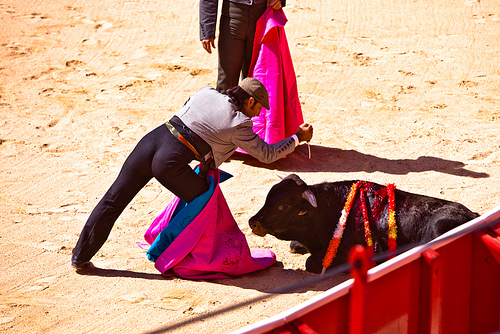
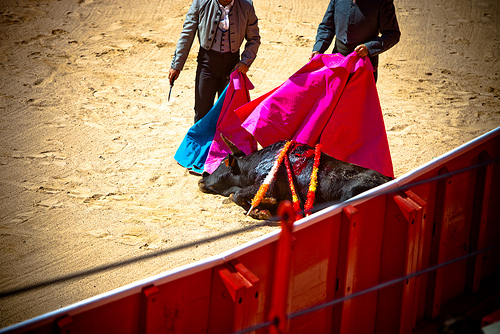
One of the bulls which ran at
Pamplona earlier in the day. The sword-thrust (or perhaps
multiple sword-thrusts)
failed to kill it, as usual, and the animal is finished
off with a dagger.
Acknowledgments: Maroc's photostream
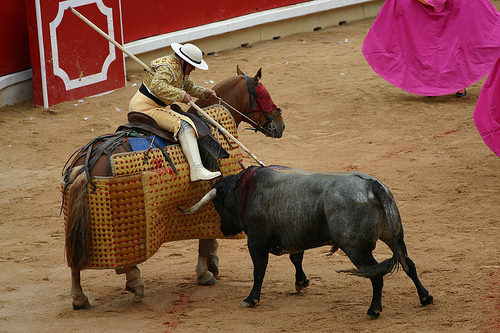
Another scene from the San Fermin Festival, Pamplona:
spearing the bull and terrifying the horse, or worse (but referred to by aficionados as the 'tercio de varas,' the first stage of the
bullfight.)
Acknowledgments: Elarequi61's photostream
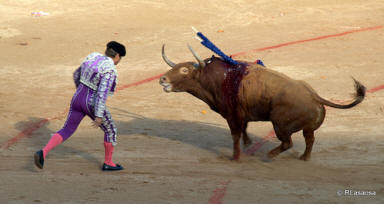
And another scene from the San Fermin Festival, Pamplona:
stabbing the bull with the banderillas (the second stage of the
bullfight, the 'tercio de banderillas.')
Acknowledgments: Rufino Lasaosa's photostream
A San Fermin festival at Pamplona without the bullfight, a festival
without the killing, would do a very great deal for the reputation of
Pamplona and the reputation of Spain. The people who have a riotous party at
Pamplona and turn their backs on the bullfighter are on the right lines. If
only Pamplona could transform itself during its festival into a place of
drinking, high spirits, song, debauchery and general excess until the early
hours or day and night, a place where there's still the thunder of hooves
and people taking their chance with the bulls, but without the barbarity.
This isn't to suggest that having a party and running with the
bulls, or watching other people run with the bulls, has anything
like the significance so often claimed. These are unimportant
rather than important, except for the people who take part. The
importance of Pamplona is primarily importance for the local
economy. Pamplona shares the narcissistic exaggeration which is
the 'soul' of bullfighting. As for the risks to life, running
with the bulls, like fighting bulls, is a low-risk activity.
For those who want it, running of the bulls could take place, just as now, offering exactly
the same experience, and there could be bloodless bullfights in the arena, like
the ones in Southern France, or activities involving bulls such as the 'Recortes.'
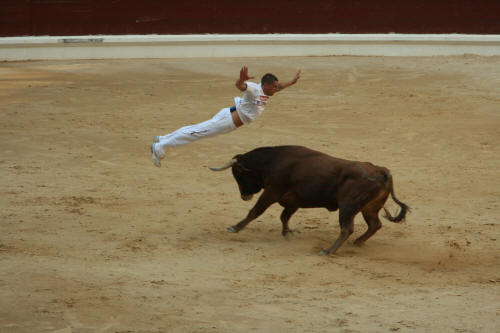
A recortador in action
Many animal welfarists would object, claiming,
perhaps, that the bulls would be stressed, but I wouldn't. Better this by far
than any corrida. Animal welfare, like politics, is the art of the possible.
Animal welfare, like politics, is an area where perfectionism is likely to
delay effective reform, perhaps for ever, rather than advance it. Reformers, like mountaineers,
can attempt near-impossible objectives or objectives that seem impossible
but which aren't so. But working for a world in which all living things are
without stress, all living things are happy, is to attempt the impossible.
'HillmanMinx,' an uncompromising opponent of bullfighting, included this
in one of his comments on a Website: 'I've been to the Pamplona
bull run myself - Spain is fascinating, and bulls will always be part of
their culture, but it takes little imagination to see that that could
continue to be so without the savage cruelty inflicted on the animals.'
Alexander Fiske-Harrison, writing on his other blog, 'The
Pamplona Post,' writes something remarkable, for once:
'I forget whether it was Stephen Ibarra or Rick Musica,
those pillars of Pamplona, who said that if they took the bulls
away from the feria, but kept the people, they’d still come, but
if they took away the people, it wouldn’t be worth it for the
bulls alone.'
I don't think people would come in large numbers to a
bull-free Pamplona but they would certainly come in large
numbers to a bullfight-free Pamplona (a 'corrida-free Pamplona,'
that is, a Pamplona where no bulls were killed in the bullring.)
A Pamplona which offered thrills, excitement, riotous living and
took away the abject barbarity would be worth supporting. As it
is, no humane person should support the San Fermin festival.
The probability of a Pamplona with bull-running but no bull-fighting is
probably remote, but if other towns offered bull-running
but no bullfighting (except perhaps for bloodless bullfighting or activities
such as 'Recortes,' these towns could attract many, many people who attend
the San Fermin festival at Pamplona but who have qualms about the cruelty of
the corrida, or no interest in the corrida. They could offer real
competition to Pamplona. Eventually, the economic arguments for Pamplona too
abolishing corridas could become very strong.
There are many, many towns and cities in bullfighting areas which could
obtain great financial benefits by offering a festival similar to the San
Fermin festival, but without the cruelty. Carcassonne in France would be a
strong contender, I think. The town introduced corridas not so very long
ago. It would gain rather than lose economically if it abolished them and
began to offer a festival of the bulls without killing of the bulls. The
appearance of the town would certainly be an advantage:
It might be expected that Spanish
towns and cities would be particularly resistant to bull-running
without corridas, certainly in areas like Andalucia, but the Spanish
financial crisis has made the chances of success greater.
Bullfighting and the Spanish financial crisis was the subject of an
article published in 'The Times' recently (4 June). A good article, not
sympathetic to bullfighting. (Notice the mention of 'the prolonged agony
that ends with the estocada (sword thrust.)'
‘… The crisis that has pushed
Spain to the brink of financial ruin has produced (arguably) an unlikely
winner – the fighting bull …
'Rather than ending their lives at the hands of a matador in the ring,
increasing numbers of toros bravos are being
slaughtered for their meat, a quick exit in an abattoir that is seen as
somewhat kinder to[than] the prolonged agony that ends with the estocada (sword
thrust).
'Since the financial crisis began, the number of bullfights has fallen by
46 per cent, from 2,177 in 2007 to 1,177 last year, according to government
figures, a decline partly attributable to cultural changes but accelerated
by economic decline.
'The cost of going to a bullfight has put off many fans … Local councils,
which traditionally have paid for bullfights during civic festivals, have
cut back on such expenditures. And the high cost of raising a fighting bull
… has hit breeders …
' "We are looking for other sources of business,” Carlos Nunez, president
of the Association of Fighting Bull Breeders, said. “We hope we can bring in
tourists to see the bulls.” …’
Andalucia's economic problems are severe. 'The Atlantic' gives
a brief account which includes this:
'82.1 percent of 16 to 19 year-olds and 63.1 percent of 20 to 24
years looking for work can't find it. In total, 66.4 percent of
people under 25 are unemployed.'
This site isn't in the least a single issue site and although I
concentrate on bullfighting on this page, understandably enough, it's not to
the exclusion of other issues. I make this completely clear. The Spanish
financial crisis isn't important only in its effects on bullfighting. The
Spanish financial crisis is important, obviously, for a whole host of
reasons. This is one of them: extreme financial difficulty - and the crisis
may become worse, immeasurably worse - will often be the precursor of
extreme political instability, instability which may even lead to wars. This
is one of the extreme dangers facing Europe as a whole, far more than a very
remote possibility for Europe as a whole, which everyone must hope will
never materialize. Politicians and others have to do more than hope,
however: they have to take decisions, often very difficult decisions.
It's impossible to generalize. There are Spanish people living very
pampered, very wasteful lives - aficionados amongst them - for whom it's
impossible to feel any sympathy if they suffer hardship. There are
also many, many good people in Spain - active opponents of bullfighting
amongst them - who face extreme hardship, and many good causes in Spain
likewise, and not just the anti-bullfighting causes.
The duties of Spanish politicians aren't in the least confined to
issues to do with bullfighting and taking steps to abolish bullfighting is
only one issue with which they should be concerned. This is an elementary
consideration. Opponents of bullfighting have to take care not to overlook
or to minimize the responsibilities and skills of politicians, which
obviously include matters such as taxation policy, planning policy,
fiscal regulation, defence expenditure, and so much else.
Financial and economic considerations have an impact on bullfighting but
the decline of bullfighting and the defeat of bullfighting interests have to
be based on more secure grounds. Otherwise, the ending of the financial
crisis in Spain could end this particular threat to bullfighting.
Ethical issues remain paramount. Pamplona's bullfighting connections
bring it great economic benefit, but the same can be said of many morally
flawed and morally disastrous practices. From a very different sphere, a
flood of imports of cheap clothing, produced by badly paid, in fact,
exploited workers, many of them children, has economic benefits for many
people. Again, these are elementary considerations.
I resist completely any suggestion that in situations of crisis, only
issues which are relevant to the crisis are important. Unless it
becomes more or less impossible, interest in the full range of human issues
(which include issues to do with animals) should continue as before. There
are many historical examples to show that this has been the case. The
stupendous cultural achievements of 5th century Athens were achieved despite
the fact that Athens fought the Peloponnesian War. The fact that Athens'
survival was so often in doubt didn't lead to any ignoring of architecture,
drama and other fields. During the Second World War, many, many books were
published in Britain which had nothing to do with the winning of the war or
Britain's fight for survival - books on poetry and so much else.
Similarly with events in other countries. The atrocities and suffering in
Syria don't consign the struggle to end bullfighting to irrelevance.
Bullfighting and
tourists
Here, I discuss only on aspect - the promotion of
bullfighting in tourist guidebooks, their lazy-minded endorsement, sometimes
by writers who should know better. The Madrid guide by Anthony Ham is one
example. From
http://www.all-creatures.org/alert/alert-20090309.html
'The Guide gives ticket agencies for the purchase of bullfighting tickets
and where to find a bullfighting museum. Although
it quotes polls saying that 75% of Spaniards have no interest in the sport,
there is no mention of the large and growing anti-bullfighting movement
spreading through Spain.
'The only attempt to show the “other side” is the question “An epic drama of
blood and sand or a cruel blood “sport” that has no place in modern Europe?
(Page 221)
'But the Madrid guide makes it obvious where the ‘Lonely Planet’ stands on
the question of bullfighting. At the very beginning of the guide a picture
is chosen featuring the interior of a pro-bullfighting restaurant
concentrating on bullfighting memorabilia.
'They also write: ‘Nothing can exceed the gaiety and sparkle of a Spanish
public going eager and full-dressed to the fight’ (Page 101) ‘at once
picturesque, compelling theatre and an ancient ritual that sees 30,000 bulls
killed in 17,000 bullfights each year in Spain.’ (Page 222)
'Tony Moore, Chairman of FAACE, wrote to the Editor on the 7th of January
2009 saying
'Your writer would be better employed making a good job of researching what
is a very controversial subjecting instead of repeating the same old staid
clichés. One wonders if he is just lazy or in the pocket of the bullfighting
industry.
'You are doing no favors to Spain; they want to break away from the outdated
and cruel picture that bullfighting paints.
ask you to make sure that when the subject of bullfighting is mentioned in
one of your travel guides, if you do not condemn it, at least you should not
promote it!
There was no reply to his letter.
The author of the guidebook wrote this, but not
as part of the guidebook. It was written in 2006 but the
situation seems not to have improved - for bullfighting's defenders, that is
- since then. For one thing, they have been defeated in Barcelona and the
rest of Catalonia. They've made attempts to minimize the ban on bullfighting
and explain it away but there's evidence that when it did happen, it was
regarded as a severe setback.
'That bullfighting should become a thing of the
past in separatist Barcelona is less important than that public apathy is
taking hold in Madrid, Valencia and Andalusia, Spain's bastions of
bullfighting. "Before, you put up a poster and the people came," says Juan
Carlos Beca Belmonte, the manager of Madrid's Las Ventas bullring, Spain's
most prestigious plaza de toros. "Now we are the ones who have to chase
after the crowd." Luis Corrales, president of the Platform in Defence of the
Bull Festival, says: "There used to be only bullfighting or soccer, or maybe
a movie. But now there are so many other leisure choices." Spanish state
television, mindful of the corrida's diminishing appeal, has also cut by
almost one-third the air time it devotes to bullfighting, and many private
channels no longer broadcast from the ring. The concomitant fall in
advertising revenues is exacerbating the financial crisis confronting
bullring operators, who must pay up to $50,000 for a full quota of bulls and
as much as $575,000 for a top matador and his entourage for a single corrida.
To break even for each fight, promoters must sell at least 75 per cent of
seats. At one level, rumours of bullfighting's demise are premature, for
this remains a multimillion-dollar industry that employs 150,000 Spaniards.
Every year, Spain's 60 major bullrings draw about 20 million spectators who
pay $1.35 billion into the industry's coffers. The mid-May Fiesta de San
Isidro in Madrid, which heralds the start of Spain's most important
bullfighting season, is a major social event where the great and good of
Spain gather to be seen in illustrious company. Matadors, defined by their
statuesque grace, dazzling traje de luces (suit of lights) and glamorous
lifestyles, are national celebrities whose private lives are dissected by
Spain's scandalised and scandalous prensa rosa (pink press). But the fact
that the average Spaniard is now more likely to know a bullfighter's face
from the pages of a magazine than they are to have seen him in the bullring
reinforces the widely held view that bullfighting's glory days have passed.
The figures that attest to the size of the industry also conceal the serious
financial difficulties that confront almost every major bullring. Even
members of the bullfighting fraternity admit that they no longer stand at
the centre of Spanish life. "My goal is for bullfighting to form a part of
today's society, instead of remaining on the margins," says Alejandro Seaz,
a Spanish businessman and bullfighting promoter. Of far greater concern for
supporters of bullfighting are two simple, telling statistics: the average
spectator at Las Ventas bullring in Madrid is a fiftysomething male and just
17 per cent of Spaniards younger than 24 say that they are at least
"somewhat interested" in bullfighting. In an attempt to attract a younger
generation of bullfighting aficionados, and in order to pay the bills,
promoters have been forced to transform the amphitheatre-style bullrings
into multipurpose arenas. Bullfights now share the stage with rock concerts,
and sanitised performances akin to circuses (where the bulls are not killed
and acrobats leap over the bulls' horns) have begun to replace the
traditional battle to the death between man and beast. In Valencia, ticket
prices, which for keynote bullfights can run as high as $200, have been
slashed, cocktail bars installed and free glossy magazines handed out so as
to widen the corrida's appeal. In the largely conservative world of
bullfighting, however, resistance remains to the idea that the tradition
must reinvent itself. The corrida is an essential pillar of Spanish cultural
identity, their argument runs, and something quintessentially Spanish would
be forever lost were bullfighting forced to change. According to Jose Maria
Garcia-Lujan, a lawyer involved in the running of Las Ventas: "They don't
like to touch anything, lest the magic wear off". There are nonetheless
signs that the magic may have already worn off for an industry showing the
unmistakeable signs of permanent decline. Increasingly abandoned by younger
Spaniards, tarnished by sordid kiss-and-tell scandals and suddenly
peripheral in the country of its birth, bullfighting is being forced to ask
whether it can survive as a viable tradition beyond the current generation
of aficionados. The question has been asked before, not least by Hemingway,
one of bullfighting's most trenchant defenders, who wrote in the 1930s: "How
long the bullfight survives as a lynchpin of Spanish life probably depends
on whether the majority of the population thinks it makes them feel good."
Whether because bullfighting no longer makes Spaniards feel good or simply
because they have better things to do with their time, the answer has never
been less certain.'
I don't use trends and
opinion polls to argue against bullfighting, but I think that the
opinions here help to explain why defenders of bullfighting are worried.
A L Kennedy on bullfighting
Appearances are deceptive.
Her photographs perhaps suggest someone not too robust, she complains in the
book about her bad back, about not being able to sleep. 'I'm in the Plaza
Mayor, Madrid, and feeling uneasy...too little sleep...' and 'I had a bad
night on the train back from Granada - stayed unpleasantly awake for the duration.'
'On Bullfighting' starts
with an unsuccessful suicide attempt. She decides not to go ahead when 'my
least favourite folk song in all the world - Mhairi's Wedding begins
to play' and '...I can't face jumping while the bloody thing is still being
sung. Murdering myself to this accompaniment is more than I can bear.'
But in fact she has a
strong stomach, an enormous appetite for suffering and death. This is someone
who will put up with a very great deal, in a severely restricted sense, one
that involves no pain and discomfort for herself. She writes about 'the cramped
grip of the aeroplane seats' and, whilst walking in Madrid, 'the cold gnawing
in my neck.' Whilst she's waiting for the bullfight to start in Madrid, this
writer from Scotland with such sensitivity to chills complains, '...I am regretting
my stupidly Calvinist choice to forego the hire of a cushion. The rigid chill
of the masonry has already crept up as far as my hips.' There were animals,
horses as well as bulls, waiting to experience something more drastic than
this discomfort in the backside and hips. She'd felt no warmer in Granada.
There, she decides to eat bull's tail, although with reservations '...I know
it's absurd to be eating something stewed when the temperature's in the eighties,
but I'm having a personal cold spell, shivering.'
Her reports from the bull-ring
left me drained and disgusted, but I was only reading them. She was there
at the ring-side, watching it all, watching the blood flow. She reports tourists
walking out during one bullfight: 'Some tourists leave, unhappy. I take one
of my larger pills and eat some lemon biscuits...' She stays right to the
end, and comes back for more.
There's no indication
that she found this a painful duty, for the sake of 'the book.' When capital
punishment was used in this country, there were judges who did find sentencing
a man or woman to death a painful duty (but none of them ever considered it
to be a resigning matter.) The judge who sentenced Christie to hang, black
cap on head, was in tears. (Timothy Evans, who was innocent, had previously
been hanged for the murder. ) This was sentimentality to judges like Lord
Goddard, who was sometimes brought to orgasm as he passed sentence of death,
and, significantly, when he sentenced young men to be whipped with the birch.
His clerk used to bring in a spare pair of trousers on these occasions so
that he could change from the ones soaked with judicial semen. (See the
Wikipedia
page on Lord Goddard where I'm given as one of the three references
for this information.)
The fast approaching death
of the bull sometimes seems to bring A L Kennedy closer and closer to a kind
of orgasmic writing. 'Ponce talks to the toro gently...The faena lasts six
minutes: six minutes of coaxing and pauses...The dust lifts about the pair
as they tighten on each other...he arches his body high and back...As the
bull sinks, Ponce faces it...I have never seen the gesture filled with this
tension, this sense of worship and violation, this naked hunger for a soul.'
Later: '...there is something sexual about the faena' and 'Matadors often
liken the faena to making love.' (From the Glossary: 'The faena is 'The final
act of the corrida - the Act of the Kill.') Of another bull: 'Rather
than tricking the bull, Ponce gives the impression that he knows what it wants
before it does, that he is here to help. This is the body knowledge of a lover...'
But she's often denied
the fulfilment she craves and the death of the bull is like bad sex, very
bad sex. Before the bull can die, though, there's a kind of perverted foreplay,
in which the spears of the picadors and the banderillas play their part:
'...the picadors spear
as much danger as they can out of the bull.'
After the picadors have
lanced it '...another bull is left, staggering and urinating helplessly, almost
too weak to face the muleta.' She comments, prosaically,
'I do appear to be observing considerable distress.' The muleta, as she has
explained in a footnote, is 'The small red cape, stiffened with a rod, which
is used by the matador during the final passes which lead to the kill.' But
before the bull could face the muleta, he still had to endure six more stabbings
from the six barbed banderillas. These would bring him to an even more helpless
state.
This is from the first
bullfight she witnessed. After it, she writes, 'I have to see more corridas.'
On the back of the book,
Michael Ignatieff is quoted as giving his approval: 'A strange and beautiful
book.' I would put it differently, 'A strange and ugly book.'
And more scenes which
didn't bring her to walk out:
'The picadors are, if
anything, more brutal in their work...' The picadors lance the neck muscles
of the bull, but she asks for our sympathy not for the bull but for her own
neck muscles: 'Take it for granted that lifting and travelling still hurt
my neck...' Later, she writes about the difficulty of settling into 'another
two hours or so of sitting upright, of trying to make my neck muscles relax,
of thinking the pain away,' the difficulty, that is, of sitting for two hours
or so watching bulls stabbed eight times or more in the neck muscles.
Unlike the work of some
common and literal-minded bullfighting supporter, where there's an exclusive
emphasis on the bullfight, we're reminded that this is a more complex
response - descriptions of the violence and the supposed ecstasies of
the bullfight artistically interspersed with accounts of her own sufferings.
This organizing principle is disastrously misguided. Her own sufferings are
real enough, no doubt. It's found that she has a displaced disk in the spine,
according to one account. According to another, her back pain was simply due
posture, sitting at a desk for long periods of time, as writers tend to do.
Perhaps she had no real intention of killing herself in Edinburgh but I assume
that her distress was real. When she was in Spain, she gives no evidence that
she was still suicidal. Again and again she forfeits our sympathy and unwittingly
makes clear the disproportion between the suffering of the animals and her
own sufferings.
'At the kill, the young
man's sword hits bone, again and again and again while the silence presses
down against him. He tries for the descabello. Five blows later and the animal
finally falls.' The descabello, as the Glossary explains, is 'A heavy, straight
sword' used to sever the spine.
'I have already watched
Curro Romero refuse to have almost anything to do with his bull, never mind
its horns. (The severely critical response of a member of the audience to
a cowardly bull or a cowardly bullfighter.) He has killed his first with a
blade placed so poorly that its tip protruded from the bull's flank...As the
animal coughed up blood, staring, bemused, ['bemused?'] at each new flux the
peones tried a rueda de peones to make the blade move in the bull's body and
sever anything, anything at all that might be quickly fatal, but in the end
the bull was finally, messily finished after three descabellos.'
The suffering of the
bull 'left, staggering and urinating helplessly, almost too weak to face the
muleta' wasn't ended by a painless and instantaneous death: 'Contreras...misses
the kill...Contreras tries again, hooking out the first sword with a new one
...Contreras finally gives the descabello.' So, the sword is embedded in the
animal, the sword is pulled out and thrust into the animal yet again, but
it's still very much alive, the ungrateful creature. The descabello is hard
at work in this book. People who have the illusion that the 'moment of truth'
amounts to a single sword-thrust and the immediate death of the bull are disabused
of the notion here. More often, the moment of truth is hacking at the spine
with the descabello.
Even the sexual apotheosis
which Ponce has offered is accompanied by this hack-work: 'He has risked a
long faena, working on the bull, steadying it, but still the kill goes badly
and a time warning sounds as Ponce tries to finish the job and the regulation
twelve minutes for the kill expire. Three times he goes in with the sword,
then there is a rueda de peones, then three descabellos before the animal
sways and falls.'
The horses are mentioned
very briefly. (For me,
the
suffering of the horses is a central objection to bullfighting.)
A decree of the government of Primo de Rivera ordered that horses should be
given a quilted covering 'to avoid those horrible sights which so disgust
foreigners and tourists.' This was in response not to the concerns of aficionados
but the concern of Primo de Rivera's English wife. A 'horrible sight' ended
by this reform was disembowelling of the horse ('evisceration' sounds too
clinical.) Before this reform, disembowelling was very common. Very often,
as many horses as bulls were killed during a bullfight. But the protective
mattress didn't end the suffering of the horses. It hides many injuries. Again
and again, horses suffer injuries to their internal organs and broken ribs.
Horses are still gored in areas unprotected by the mattress.
Bullfighting supporters
generally acknowledge these facts. A L Kennedy admits them: 'Arguments are
cited which state, reasonably enough, that the blindfolded and terrified horse
is currently buffeted by massive impacts, suffering great stress and possibly
broken bones.' But some aficionados have advocated 'kinder' treatment of the
horses. Humane aficionados! What is the reform proposed by these good, kind-hearted
people to reduce animal suffering? This: taking away the protective mattress
and returning to disembowelling of the horses! As A L Kennedy puts it, 'a
return to the 'kinder' option of evisceration.' She perhaps forgets that death
by disembowelling - evisceration - was often not instantaneous. As Hemingway
admits, a horse might carry on running whilst trailing its intestines behind
it. (If only some of the horse's innards were showing, the gap in the horse's
body could be filled with sawdust 'by a kindly veterinarian.' 'No sweeter,
purer sawdust ever stuffed a horse than that used in the Madrid ring' according
to Hemingway.)
She discusses these things
in a strangely detached tone, and, in the same strangely detached tone, 'It
is believed in some quarters that horse-killing greatly improves the bull's
'spirit' for the remainder of its time in the ring and is the only fit proof
of its 'bravery'. And she goes on attending bullfights.
She's properly sceptical
about the bullfight as art form:
'The corrida can sometimes
create the effect of art (as can, for that matter, a voodoo ceremony, a funeral
or a high mass) but it is divided against itself, because of the unpredictability
of the bull, because of the numerous abuses of its own laws, because it hopes
to weaken the bull, but leave it glorious, to defend the matador, but give
him something to overcome. The corrida, although it has its own rigours and
remarkable individual toreros, currently lacks the overarching discipline,
creative economy and communicative breadth of an art. It could also be said
that its levels of cruelty and violence prevent it being an art, that an art
cannot exceed certain parameters of damage, that it cannot cause death.'
Even so, this is weedy
prose, for someone with some reputation as a prose stylist: 'communicative
breadth' is the language of educational bureaucrats and '...cannot exceed
certain parameters' the language of a scientific paper, necessary in most
cases - 'the levels of adenosine triphosphate in the biosynthesizing cell
cannot exceed certain parameters.' I'd have to claim that my own way of expressing
A L Kennedy's last point is far better. From the section
Bullfighting
as an art form. Bullfighting and tragedy
in which, unlike A L Kennedy, I do
grant bullfighting some right to being an art form, although the most limited
and perverted of art forms:
'Hemingway, 'Death in
the Afternoon:' 'Bullfighting is the only art in which the artist is in danger
of death.' I would emphasize a different aspect. Bullfighting is the only
art form where the artist inflicts suffering and death, the only art form
which is morally wrong. Bullfighting is the pariah amongst the arts. Suffering
and death have enough power. An art should do nothing to increase it. In other
arts, suffering and death are confronted, explained, found impossible to explain,
raged against, transcended, balanced by consolation and joy, not inflicted.'
There are sections of
genuinely accomplished prose in the book but too much of it is routine or
worse. There's cliché, 'the more bulls, the merrier' and, of Lorca,
'like any young artist worth his salt...' - and weak phrasing that any writer
with any pride should have eliminated: of the Coliseum, 'the negative atmosphere
of the place.' The misuse of 'literally' - '...the fact that I'm literally
boring myself to death.'
The main weakness of the
book, apart from the shocking evidence that this is someone whose feelings
are severely restricted, is the common or universal failing of those who find
excuses for bullfighting, the glamorisation of danger and the failure to put
the danger to the bullfighters in context. I deal with this at length in
the
courage of the bullfighters. From that section:
'Not only is the courage
of bullfighters completely eclipsed by the courage of mountaineers, it's completely
eclipsed by the courage of ordinary people in time of war, civilians as well
as soldiers. In some operations of war, death has been overwhelmingly likely
or ever-present. The life expectancy of a British pilot in the First World
War was typically 11 days, the life expectancy of many soldiers at the Western
Front during periods of intense fighting something like three weeks. The men
who flew in Bomber Command during the Second World War were all volunteers.
They served for thirty operations before they became instructors or took up
other non-combatant roles. In 1943, the chances of them surviving the thirty
operations amounted to one in seven. After 15 operations, when they were more
experienced, they had a 25 % chance of survival. What French bullfighter has
had to show a fraction of the courage, has faced a fraction of the dangers
faced by the countless, ordinary (or extraordinary) French soldiers at the
relentless killing machine of Verdun?'
A L Kennedy makes a grotesque
comparison, in connection with the bullfighter 'El Juli,' who, rumours have
it, 'will soon attempt to face seven bulls...within the course of one day...
At this level, the life of the matador must be governed by the same dark mathematics
which calculates a soldier's ability to tolerate combat: so many months in
a tour of duty, so many missions flown, and mental change, mental trauma,
becomes a statistical inevitability. But in the corrida, the matador is not
exposed to physical and emotional damage by duty, or conscription - he is
a volunteer, a true believer, a lover with his love. And there are no limits
to love, it is quite merciless.' This attempt at high-flown language is an
abject failure, a chicken's attempt to soar. At least 'merciless' is accurate,
given that in this case the lover may plunge the sword into his love repeatedly,
hitting bone, or thrust the sword in and take it out with another sword, or
the lover may hack away at the spine of his love with a heavier sword.
In the book, the merging
of love and killing is only superficially deep. Love and killing are insidiously
merged, recklessly and dangerously. Lorca's execution by a nationalist firing
squad during the Spanish Civil War, instead of being a squalid and despicable
act, is transfigured. Of Lorca, 'he might almost be aware of the darkness
coming, might almost be asking himself when it will come, when a man who loves
his country will be killed by other men who love it differently.' As an intransigent
opponent of executions I make no exception for the execution of the bullfighting
supporter Lorca, and of the bullfighter who was killed at the same time. After
he was killed, Lorca was shot in the backside. The Falangist Juan Luis Trescastro:
'We killed Federico Garcia Lorca. I gave him two shots in the arse as a homosexual.'
Does this shatter and make ridiculous the romanticized vision of A L Kennedy?
Or is shooting someone in the backside an act of love too, like the sword
thrust to the bull?
More evidence that she
has a fondness for 'transfigurations' which falsify reality. 'I wonder again
why Lorca came back to Granada, why he came home, why he took that last risk
and came looking for extinction.' This came looking for extinction is
pure supposition, imagined, arising from that same source as the over-written
musings on the death of the bull at the hands of his 'lover.' In the Spanish
civil war, according to Julius Ruiz, the republicans executed almost 38 000
people and the nationalists about 100 000 (and about 50 000 more after the
war was over). Other sources give widely differing estimates, but whatever
the number, it's likely that very few of these victims, innocent or far from
innocent themselves, were 'looking for extinction' and there's no evidence
that Lorca had a death wish.
The Falange, the Fascist
or near Fascist group, were the foremost executioners in the conflict. The
group 'had rapidly developed into the nationalists' paramilitary force, assuming
the task of 'cleaning up'...Their leader, José Antonio, had declaimed
that 'the Spanish Falange, aflame with love, secure in its faith, will conquer
Spain for Spain to the sound of military music.' (Antony Beevor, 'The Battle
for Spain: The Spanish Civil War 1936 - 1939.')
The republican Lorca and
the nationalists were linked as well as contrasted. They were linked by the
cult of death. One nationalist rallying cry was 'Long live death!' Lorca:
'Spain is unique, a country where death is a national spectacle...In every
country death has finality. Not in Spain. A dead person in Spain is more alive
than is the case anywhere else.' Another republican, El Campesino, again quoted
in 'The Battle for Spain' : 'I am not pretending that I was not guilty of
ugly things myself, or that I never caused needless sacrifice of human lives.
I am a Spaniard. We look upon life as tragic. We despise death.'
When the darkness came
to Germany, some Germans were revolted by the darkness and conspired against
Hitler. Over four thousand of them were executed by the Nazis after the failed
conspiracy of1944, but these were not people who loved Germany killed by others
who loved Germany differently. A L Kennedy would never follow her dangerous
idea so far, but others have done.
Facts and figures can
be supplied which make A L Kennedy's 'dark mathematics' ridiculous. I give
just a few of them above. And, ten years after she wrote about him and his
likely demise, El Juli is still with us, still very much alive, despite the
dark mathematics. (And the author's back problems have also subsided.)
In this book, A L Kennedy
is an 'imaginative' writer in the worst sense of the word, as in 'The matador
is at the heart of a strange balance between the demands of safety and fame
[mention of the money at this point would have spoilt the effect], between
the instinct for self-preservation and the appetite for the ultimate (and
therefore ultimately dangerous [my emphasis]) execution of
the corrida's three traditional acts.'
The matador often has
some inducements generally denied to combat troops or the mountaineers who
face death - adulation and high earnings: perhaps 80 000 euros for killing
two bulls (much more for El Juli, the most highly paid bullfighter ever, until
the advent of even higher earners) and, as the matador starts his journey
to the ring 'perhaps...admirers and autograph-hunters.'
El Juli is exposed to
danger, from two bulls, for just over half an hour to earn his 100 000 euros,
or whatever it is he earns. Very, very infrequently, he's faced six bulls
- just over an hour and a half in the ring. This is said to make exceptional
demands on stamina. Bullfighting supporters are lost in admiration for someone
who can not only face death but show such superhuman strength and stamina
for an hour and a half.
I'd strongly recommend
an immersion in the history of coalmining, and the present of coal mining
in some countries, as an antidote to these particular delusions, and other
delusions of bullfighting apologists: an immersion which demands, however,
compassionate imagination. Witnessing death in the bull-ring makes no demands
on compassionate imagination at all, just the ability to keep your eyes open
and look. To enter into the hidden lives and deaths of miners (who of course
included women and children as well as men) does demand it.
My poem
Mines
is about child-labour in coal mines. It mentions the rock falls and
explosions which have caused so many deaths and injuries, but there were other
ways of dying horribly, such as drowning when the mine workings were flooded,
or a fall to the bottom of the mine shaft when the cage fell uncontrollably.
A very few statistics (for single incidents, not the total for the year) from
an enormously long list: the 439 deaths at Senghenydd in Wales in 1913, the
290 deaths at Cilfynydd, the 388 deaths not far from here, near Barnsley in
Yorkshire in 1866, and the 1 549 miners killed at Benxihu in China in 1942.
As for injuries, in mining
as in bullfighting so much more numerous than the fatalities, it isn't obvious
in the least that a horn wound in the leg is worse than the crushing of legs
by a rock fall. And there's a very significant difference. An injured bull
fighter is taken out of the bull-ring in a minute or two and is immediately
treated in the bull-ring infirmary. The crushed coal miner had, and still
has, no such benefit. Even with modern equipment, reaching the miner after
a rock fall may be very difficult and may take days, or may be impossible.
A severely injured high-altitude mountaineer also faces a prolonged and agonizing
wait for rescue and medical treatment, if rescue and medical treatment are
practicable at all.
A L Kennedy, on bullfighting
plazas: '...all first-class plazas have fully equipped and staffed operating
theatres standing ready, next to the ring.'
Well into the twentieth
century, coal-mining made extreme demands on stamina, for far longer than
an hour and a half, of course, day after day, miners working, very often,
bent almost double in almost complete darkness, using a pick axe and moving
desperately heavy loads for a full shift. George Orwell pointed out (in 'On
the Road to Wigan Pier') that simply to get to the coal face and back from
the coal face was very often time-consuming and intensely hard work in itself.
In some countries, there are still these extreme demands.
A L Kennedy writes about
her air travel to Spain and 'the general horror of picking up my bag which
weighs, I've made sure, almost nothing.' Granted, she had at the time her
spinal complaint, but any miner who had a spinal complaint like hers which
wasn't permanently disabling would have had to carry on working and put up
with the pain whilst moving tonnes of coal.
On the evidence of this
book, watching bullfights tends to do nothing for sensitivity, sensitivity
to human suffering as well as animal suffering. The risk of distorted perspectives
is an occupational hazard of pro-bullfighting writers, the gross distortion
involved in singling out one group as especially fearless - and giving them
adulation - whilst ignoring the vastly greater claims upon our attention of
others.
To return to El Juli,
and to return to the cheerful prose of A L Kennedy: 'He's seventeen [at the
time of writing], has been dubbed 'the Mozart of Toreo' and is electrifying
the corrida.' If there are any further editions of 'On Bullfighting,' she
can feel free to use this comment of mine: 'A book about love, life, death,
danger, glamour, youth, celebrity. She was thirty-four, at the time of writing,
has been dubbed 'the prose stylist in the Salons of Toreo' and is electrifying
the world of corrida propaganda.'
The unchallenged and uncriticized
comparison with Mozart, who lived and died in poverty, a universal genius,
is bland and gross at the same time, but to most bullfight supporters a bullfighter
ranks much higher than a universal genius.
More bland and gross manufactured
rubbish: 'In 1999 Enrique Ponce was a multimillionaire, a superstar with jet-set
friends. He still is.' (A L Kennedy writing not in this book but in the Guardian.)
Nothing in this book is
fresh. Everything is routine, standard, unexamined or, if apparently examined,
examined many, many times before: the ecstasies of the audience, the disappointments
of the audience, 'duende,' everything. I examine in some detail Lorca's writing
on duende
in
my page on bullfighting. I fully acknowledge Lorca's importance as a poet
and dramatist, but make the point that his writing on duende is demonstrably
ridiculous.
The discussion of the
methods used to tamper with the bull is far from being frank and fearless.
These methods are generally admitted. (I wasn't aware, though, that the most
common method of making the bull far less dangerous is to give it large quantities
of salt, deny it water and then allow it to drink large quantities of water.)
In my page on bullfighting, I I make the comparison with mountaineering, in
which devious practices intended to reduce danger are almost unknown.
The healthy modern scepticism
which, far from being dry and arid, has helped to reduce or even human and
animal suffering in many ways, if not nearly enough, is completely absent.
The book marks no advance on the primitive level of Hemingway's 'Death in
the Afternoon.'
One aspect of the bullfight
which should be subjected to very close examination, but isn't in this book,
is the audience and its emotions. Emotions are far from being self-justifying.
The congregation feels - or many of them feel - extreme emotion at the climax
of the mass, when they believe that the bread and wine are transformed into
the actual body and blood of Christ. This emotion becomes - cold word, but
necessary - problematic if you think, as I do, that no such thing
has happened, that although the emotion seems real, the event which is supposed
to have inspired the emotion, transubstantiation, is non-existent. The emotions
of the bullfighting audience (or bullfighting congregation) are genuinely
felt, no doubt, but they are compromised, and fatally, by the moral objections
to the act and by misinterpretation.
As just one example of
misinterpretation, the bull after all is a herd animal. There are obvious
difficulties in inferring the inner life of a bull from observation of its
behaviour. A L Kennedy is very good on the behaviour of herd animals like
bulls. What is very, very unlikely is that the bull is sharing any of the
'higher' experiences claimed by the bullfighter and the audience when the
bullfight is going well, going well, that is, for the bullfighter and the
audience. The bull's focus will be on the cape (if it were allowed to live
for a little longer, it would learn and attack the man directly rather than
follow the cape). This being the case, so many of the most intense passages
in this book collapse. The higher emotions, the ecstasies claimed by bullfighting
supporters turn out to be based on insecure foundations, on transcendental
appearances, illusory appearances, rather than inner realities.
As when, in connection
with Ortega and bull - wounded, a few minutes before its death - she writes
of '...something which is a celebration of this moment, these creatures, this
breath, this fine time they are having together.'
She writes, 'Standing
in the medios, the central area of the ring, Ponce removes his hat
and slowly turns, holding it up for us. This will be our bull, he is giving
us this death.' A death for the price of an entrance ticket costing a few
euros! Such good value! These supreme experiences are remarkably cheap!
The books of professional
historians, amongst others, are often very long and contain vast numbers of
facts, even though the books are far more than a collection of facts. Sometimes,
of course, historians make mistakes, but their own care for factual accuracy
and the criticism of other professional historians ensure that the standards
of factual accuracy are very high. 'On Bullfighting' is a very short book,
168 small pages without the glossary. The number of facts to be checked was
very small. Which countries allow bullfighting and which ones don't is surely
a basic, elementary fact, one which a barely adequate book would get right,
let alone 'one of the best books of the year.' A L Kennedy states: 'when the
European season is over, more and more bullfighters go to 'Peru, Mexico, Ecuador,
Chile.' This is a slur on the reputation of Chile. The List of Shame
(confining attention to this one issue, no others), the list of
countries which allow the corrida, Spanish style bullfighting, is:
Spain
France
Mexico
Colombia
Peru
Venezuela
Ecuador
but not, to its credit,
Chile. 'On Bullfighting' 'could not have been written without...the expertise
and advice of Don Hurley.' Don Hurley is a bullfighting 'expert' associated
with the shadowy Club Taurino of London. He allowed this particular mistake
to pass.
'On Bullfighting' is described
on the back cover by Jeanette Winterson, another fiction writer, as 'One of
the best books of the year.' This claim - it appears on the front cover as
well - is moronic, of course. To make an elementary, a supremely obvious point,
to be familiar with the publications in one single sub-field is difficult,
almost always impossible. Nobody can possibly decide what are the best books
of the year.
The comment of Julian
Barnes isn't as ridiculous as Jeanette Winterson's but it's tired and routine:
'...the public spectacles are treated with a fresh particularity...' John
Banville's formulaic 'a thrilling and thought-provoking read' is almost as
bad as Jeanette Winterson's comment. 'Thought-provoking' is wide of the mark.
These writers, and A L
Kennedy too, have achieved success by routes which are desperately difficult.
(Michael Ignatieff is a very prominent politician in Canada as well as a writer,
but politicians may face difficulties which are just as severe as the ones
faced by writers. I'm far from sharing the cynical attitude towards all politicians.
I admire Michael Ignatieff very much and I quote him in my page on
attempts
to demonise Israel.)
Some defenders of bullfighting
Alexander Fiske-Harrison: The Baboon and Bull
Killing Club
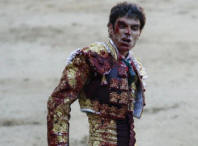
Not Alexander Fiske-Harrison but José Tomás: the bullfight as horror film.
(Acknowledgments: luispita.com)
Alexander Fiske-Harrison decided that to understand bullfighting and to
understand himself, he had to kill a bull. He trained with
bullfighters and has now killed a bull, or, to be precise, mortally
wounded a bull. What he did was to stab a bull repeatedly. It was
finished off by someone else, a bullfighter called Rafaelillo.
Alexander Fiske-Harrison's first sword-thrust struck bone. His second
sword-thrust struck bone. His third sword-thrust was 'behind the proper
killing spot.' His helper swung his cape on one side of the bull and then he
swung his muleta on the other side, the standard technique of making the
bull turn this way and that, so that the sword embedded deep in his body
would move around and sever some vital organ: a hideous way of trying to
ensure death, and very often completely unsuccessful. He was reassured to find that 'the bull was dying. I
could see his legs shaking now.' And 'Rafaelillo came over with the
descabello sword to sever the nervous link between brain and spinal
column.' In the professional bullring, a long time may elapse between the
first sword thrust and the stabbing with the descabello. The book gives no
indication of the time it took for the wounded bull to die.
This killing was regarded as outstanding. He writes, 'please note that
two misses, pinchazos [hitting bone with the sword] followed by a
killing strike on your first animal is absolutely unheard of ...' The death
of the first animal is usually much more messy and protracted. The death of
bulls at the hands of the most experienced bullfighters is often messy and
protracted.
In the Prologue of 'Into the Arena' he writes of bullfighting,
'When it was done well, it seemed a good thing; when done badly it was an
unmitigated sin.' On his blog, he gives great prominence to this: 'I can't
think of many spectacles in the world which are evil when done badly but
good when done well.' 'But he knew for certain that his own performance would be without 'artistry,'
the people who came to watch him - nearly a hundred of them, including
his parents - knew that it would be without artistry. In the Prologue, he
writes of bullfighting, By this principle, he has to regard
his own fight and killing as an 'unmitigated sin' or 'evil.' Alexander
Fiske-Harrison, the other bullfighters present and the spectators, including
Alexander Fiske-Harrison's parents, were all morally culpable.
He was about to kill a
bull and the spectators were about to witness a killing which couldn't even
be justified by the warped reasoning of bullfighting supporters (as I see
it), a killing by someone who would never make a 'career' out of his
performance, someone who was killing for the sake of his inner
compulsions and his book, and death for the bull which was unlikely to be
instantaneous and in the event wasn't at all quick, even if quicker than
many of the
long-drawn out deaths which shame Spain, France and the other countries of
the corrida.
The death he planned to inflict had no justifications of necessity -
other than the satisfaction of his inner compulsion, and of course the
book. Whilst running in Seville he injures his knee, although he can still
flex it, but he decides that his fight couldn't be postponed. 'Rescheduling
that many people - and by which I mean those intrinsic to the fight - simply
could not be done in the near future, certainly not within the projected
publication date of the book.'
After the killing, he becomes very thoughtful. A bullfighter asks him,
'What did you feel?'
'I tried to answer, 'Mi corazón esturo con el toro muerto en la
plaza. ['My heart was with the dead bull in the ring.'] I just wanted to go
and sit with him in the ring with a bottle of whisky. Only he understood
now.'
I believe that Alexander Fiske-Harrison is making a film about
bullfighting. He could consider a dramatic adaptation of this scene - the
words softly spoken, accompanied by sentimental, sloppy music. He could
consider this title for the drama, a long one, but, there are longer: 'Only
the dead bull understands the one who kills him.'
To imagine that to understand killing it's necessary to kill - this is a crude, cruel and disastrously misguided notion of
understanding. To understand the mind of a different kind of killer, a
murderer, one uses reflection, insight and other qualities of the mind, one
doesn't kill someone, of course. Dostoevsky's incomparable insights into the
mind of the murderer Raskolnikov in 'Crime and Punishment' was achieved by
these means.
Another crude, cruel and disastrously misguided notion of
understanding: A A Gill, a restaurant critic, claimed that he shot a baboon
'to get a sense of what it might be like to kill someone ... What does it
really feel like to shoot someone, or someone's close relative?' He
wrote (in 'The Sunday Times') 'I took him just below the armpit. He slumped
and slid sideways. I'm told they can be tricky to shoot: they run up trees,
hang on for grim life. They die hard, baboons. But not this one. A
soft-nosed .357 blew his lungs out.'
The Club Taurino of London caters for the depraved tastes of the
aficionado-voyeur, who feels the psychological need to watch killing. I
offer an argument in moral philosophy which I've called, for convenience,
The Argument from The Baboon and Bull Killing Club.
Defenders of bullfighting very often claim that watching bullfighting is
justifiable because the kind of experience available to the spectators
outweighs the suffering of the animals. (Many defenders of bullfighting
argue - or simply assume - that animals can't suffer, as in the case of
those who maintain that 'animals have no souls.' These individuals are
mentioned in 'Into the Arena.') Alexander Fiske-Harrison and A A Gill
believe that killing an animal - a bull and a baboon in their case - is
justified on account of the kind of experience which they gained.
Presumably, many, many other people would also have similar experiential
benefits if they too killed an animal? If their example were imitated, and
many, many animals were killed for the sake of the experience (provided it
were legal in the country) would they approve or disapprove? I
believe, of course, that their whim, craving, need, whatever it may be, is
far from harmless and not to be imitated. In the case of killing for these
reasons, and watching killing as a spectator, the moral arguments against
are decisive, it seems to me. It would be morally wrong to set up a
Club for killers of animals, but clubs such as the Club Taurino of London,
which cater for spectators of killing and which foster and encourage public
killing of animals, are morally unjustifiable too.
Giles
Coren, another restaurant critic, and a defender of bullfighting, has
fantasized about killing. He posted this on twitter "Next door have
bought their 12-year-old son a drum kit. For fuck's sake! Do I kill him then
burn it? Or do I fuck him, then kill him then burn it?" These thoughts would
have been better left buried in his consciousness ... not everything that is
thought should be spoken, not everything that is spoken should be published.
(But see also my discussion of freedom of expression.)
Alexander Fiske-Harrison is a friend of Giles Coren. His blog shows
the two comrades watching a bullfight. If Alexander Fiske-Harrison's defence
of bullfighting seems far
more sophisticated than that of his fellow enthusiast, appearances are
deceptive. He's got ample reserves of simple-mindedness too.
This is one of the milder examples. The quote is from Mark Rowland's
review in 'The Times Literary Supplement,' a review which seems to have enraged AF-H:
'After being present
at the killing of a bull in practice, Fiske-Harrison gets blood on his
hands. He writes: ‘I went straight to Flaherty’s, Seville’s Irish pub … and
ordered a large glass of Johnny Walker, sitting staring at it with the blood
from the great, dead bull staining my hands pink and my nails black. It took
days to wash out.’
'This does seem a little narcissistic ...
While having no direct experience of the blood of a
recently deceased Spanish bull, I would be very surprised if it were that difficult
to remove from one’s hands. And, so I cannot allay the suspicion that
Fiske-Harrison is sitting in the bar with blood on his hands because he
enjoys it, his little red badge of courage.'
Victor Hugo wrote, 'It is good to wash one's hands, but to prevent blood
from being spilled on them would be better.' ('The Last Day of a Condemned
Man.') The reference isn't to bullfighting, but the words are apposite.
The photograph at the beginning of this section shows the matador Jose Tomás in action (the blood here
is from the bull, not his own). Alexander Fiske-Harrison has things to
say about Jose Tomas and blood in the book, seemingly oblivious of his own
milder obsession.
He writes of the matador, 'He divided the aficionados ... the reason I
had most often heard is that he fights with 'demisiado sangre',
'too much blood', and by blood, they mean his own. Even a cursory glance
through the press cuttings of his bullfights shows his face and body
drenched in blood like something from a Jacobean tragedy.' Or a horror film.
Haematophilia is a form of fetishism - an intense interest, often of a sexual
kind, in blood. The bullfight as blood fetishism - this is a neglected
area of research.
One of the quotations which precede the
Prologue is this, simple-minded, pompous and inflated rather than deeply
impressive, surely:
Ser un torero es como hablar con Dios
[To be a bullfighter is like talking to God]
Eduardo Dávila Miura (matador)
He has some insight into the cruelty of the bullfight, but his lack of
insight into 'the sick and decadent claims to
importance, the romanticized exaggeration, the flagrant myth-making,' as I
put it in the introduction, is obvious.
This is an inbred world, generally oblivious of the
achievements - including achievements that require enormous courage -
of the world outside, achievements which vastly surpass those of the
bullfighters. Alexander Fiske-Harrison settles into this world of
extreme {restriction},
despite the moral qualms he advertises occasionally, and long before the end
of the book he seems to be at complete ease there.
But throughout, as early as the book's Prologue, Alexander Fiske-Harrison can be as uncritical as any
bullfighting slob who ever
slouched on a bullring cushion.
In his account of the bullring in Seville, of
the first bullfight he witnessed, he
gives us this: 'The gate was opened ... by Manolo Artero, a stout
middle-aged man, who shouted to the rustling crowd the words he had shouted
for thirty years: 'Silence! A man risks his life here today.' How impressive the words of Manolo Artero sound to bullfighting supporters, how
stupid to other people, ones with a healthy sense of the ridiculous and
an appreciation of equally dangerous acts or far more dangerous acts.
The last fatality in this ring was in 1992. This was the last fatality in
any bullring in Spain.
Later in the book, he writes, of a small bullring, 'It is
not a place where one would wish to be gored by a bull. How good, I wonder,
is the local doctor and how far is the nearest hospital? it is the length of
the journey to the hospital that kills the matador as much as the
bull's horns.
For injured mountaineers, on the other hand, the hospital is much
further. Above, I write,
'On high mountains, the
ferocity of the winds and blizzards often make a rescue from outside impossible
until it is too late. Rescue facilities are well organized in the Alps, not
at all in the Himalayas and the Andes. Even in the Alps, bad weather can delay
rescue for days, or rescue may be impossible. For the mountaineer, safety
and medical help are generally far, far away.'
Mountaineers don't have the comforting knowledge that an
equivalent of the 'Burladero' is close by. There are a number of these
convenient things around the bullring. John McCormick: 'Burladero: a narrow
wooden shield ... permitting the torero to slip to safety when necessary but
wide enough for the toro not to pursue him.'
Again and again, Alexander Fiske-Harrison stresses the death-defying exploits of
bullfighters, completely oblivious, it seems, to something else which he
wrote in the book (published in 2011): ' ... no torero has died in
the ring in Spain since 1992.' The bullring isn't, it seems, anything like the
deathtrap commonly portrayed by bullfighting apologists.
I don't have an exact figure for the number of bullfights which
took place in that period of not far short of twenty years (taking account
of the time between writing and publication, of course) but it will probably
have been in excess of 17 000, with the death of at least 100 000 bulls. And
the number of bullfighters killed in that period, by his account: 0. Whether
the bull has been a bull of the Saltillo breed, the Miura breed (described
by Alexander Fiske-Harrison as 'the bulls of death') or some other breed,
including the taurine equivalent of mongrels, whether the bull has been
massive, heavy and powerful or tiny, in taurine terms. whether the
bullfighter has had long experience in taurine slaughter or virtually none,
whether the bullfighter is amateur, like Alexander Fiske-Harrison, or
professional, not one bullfighter has been killed in all that long period.
An appreciative piece by Victoria Aitken on the site
www.thewip.net includes this: 'the book
is extremely well researched' and 'According to Fiske-Harrison's research,
one in four matadors die in the ring.' There's no mention of this particular
piece of 'research' in the book. If she had taken the trouble to read
the book, all the book, she would have found that there's no mention of it
at all, only a mention of the complete lack of fatalities. I haven't been
able to find any mention of the 'one in four' statistics anywhere but
Victoria Aitken's piece. Alexander Fiske-Harrison needs to present evidence
and to explain himself.
Unless he can come up with convincing evidence, which seems very
unlikely, the claim seems justified that bullfighters risk serious injury in
the bullring but not to any significant extent death: the courage needed to
face the risk of serious injury is less than the courage needed to
face death. Aristotle writes succinctly about degrees of courage in
the Nicomachean Ethics (III, 115a, 25.)
'What, then, are the fearful things which concern the courageous person?
The most fearful of all ... now the most fearful of all is death ... '
περὶ ποῖα οὖν τῶν
φοβερῶν
ὁ ἀνδρεῖος; ἢ περὶ τὰ μέγιστα;
...
φοβερώτατον δ᾽ ὁθάνατος:
Alexander Fiske-Harrison refers to bulls which refuse to play the game (not his words) and
fight but a striking omission from the book is any discussion of
tampering with the bull before the fight, a notorious way of reducing the
danger to the bullfighter. One method of tampering or doctoring,
sawing off the tips of the horns, 'afeitado' in Spanish, is referred to in the report of Antonio Lorca in
the newspaper ABC, published in 2008 and referring to bullfighting in
Seville: 'At first sight they looked like bulls, with long hoofs, and
horns looking suspiciously doctored, but in reality they were kittens.'
Bruce Schoenfeld, a bullfighting enthusiast, writes of bullfights in
Seville, 'The trappings remain the same year after year.
Unfortunately, so does the deplorable condition of many of the bulls fought
in Sevilla. Because the so-called sophisticated crowds here want to see
artistic bullfighting, breeders send animals that are smaller, less
dangerous and theoretically easier to work with ... In actuality, bulls in
Sevilla often come out weak and docile, tiring so easily that sometimes they
simply fall down on their own accord, even without a sword thrust.' This
seems a very naive comment for someone who has written so much about
bullfighting. He seems not to acknowledge the distinct possibility, or
likelihood, that the bulls are so weak and docile and tire so easily because
they have been subjected before entering the ring to one or other of the
standard methods of ensuring that the bull is weak, docile and tires easily.
Jérôme Lescure's
very disturbing film entitled 'A Two Hour Killing
(commentary in French, the images overwhelming) shows sawing of the horns
being performed,
followed by monstrous cruelties in corridas in five places in the South of France.
(You may need to scroll down a little way to locate the arrow button you click
on to start the film.) The cruelties include the use of capes to make the
bull turn its head from side to side, in the hope of making the sword
embedded in the animal cut a vital organ - the same technique used in
Alexander Fiske-Harrison's debut as a would-be bull-killer - and the
severing of the spine when this fails to work. In the film, the bulls are
stabbed with a dagger rather than the descabello, the sword which was used
to end the life of Conséjote after Alexander Fiske-Harrison had
finished stabbing him.
The man performing the sawing and reshaping in the film says 'Afeitado,
c' est interdit, mais tout le monde le fait,' 'Afeitado is forbidden but
everyone does it.' (The 'everyone' is obviously hyperbolic.) Another method of tampering with the bull is
administration of massive doses of sulphates or salt.
I sent this next paragraph to him, for posting in the comments
section of the site he uses for promotion of 'Into the Arena'
and discussion of its themes.
‘ 'Afeitado,’ as you know, is the practice of sawing off the horn
tips of the bull, the action disguised by further work. (The video ‘A
two-hour killing’ shows it being performed on a bull before a French
bullfight.) Like other well known practices, not universal but common, such
as the dosing of the bull with a substance of one kind or another, afeitado
decreases the risk to the bullfighter substantially. Illustration 13 in your
book ‘Into the Arena’ shows you fighting the bull which you later killed –
or rather the bullfighter Rafaelillo killed, by severing the spine, after
you had made repeated attempts to kill the bull with your sword. The
photograph shows clearly that the tips of this bull’s horns are missing
[I missed this when I first looked at the photograph. It was the
anti-bullfighting campaigner 'HillmanMinx' who noticed the missing
horn tips, on a Web photograph], not
only making it more difficult for the bull to fight but reducing the risk of
serious injury to you, blunt horns obviously having much less penetrating
power than sharp horns. Do you have a comment? Were the horns of this bull
sawn before your fight to make the horns blunt, was this bull chosen for
your fight because it had these blunt horns, or is there another
explanation? I write as an opponent of bullfighting.'
This material was 'awaiting moderation' for some time but eventually, the
information was given that it had been 'deleted.' So he decided not to bring
the matter to the attention of his readers and he decided that he had
no need to answer the questions, or would rather that he didn't answer the
questions. It seems to me that he fought an incapacitated bull. If he claims
otherwise, then he needs to present evidence and argue his case - preferably
without making the personal smears against me that he did on this occasion,
after the information about deletion.
The American aficionado John McCormick writes about afeitado in his book
'Bullfighting: art, technique and Spanish society:
'Horn shaving (and other abuses to the toro) create a parody of the
fiesta because it upsets the toro's timing, and therefore allows the torero
to take 'risks' that look suicidal but are not so.
' ... the toro is lured into a narrow corral, trussed with ropes to the
point where he is immobile, and 2 or 3 inches (called 'the diamond') are
sawed off each horn with a hack-saw. The entire horn is then reshaped by
filing, including a sharp point, but the toro has been raped of his
life-long training in the precise use of his horns ... After filing, the
horn may be rubbed with mud and dung to dirty up the dirty work ... Whoever
has tried to force pills down a cat's throat is prepared to appreciate the
effect upon the toro of being trussed by ropes and violated by the saw and
the file; in addition, if the saw cuts too far down, tissue will be torn,
and pain and perhaps fever follow, just as though one were to cut deeply
into the flesh of one's nails.'
He follows this with a comment about the transportation of bulls to the
ring: 'The length of the journey alone, during which the animals take
neither food nor water, weakens them.'
This film (with commentary in French) shows the bull 'lured into a narrow
corral, trussed with ropes to the point where he is immobile' and then
subjected to sawing of the horn tips. The process is shown towards the end
of the film - after a succession of shocking images, with diagrams which
show exactly what the various stabbing implements (such as the
'rejones
de castigo'
or 'lances of punishment') do to the bull. A bull is shown
with the 'killing sword' sticking out of its flanks.
Phil Davison writing just before the 1994 bullfighting 'season' began.
There's no evidence that afeitado is any less of an issue now. '
El afeitado (horn-shaving) has been an unprecedented scandal this year,'
said the then Interior Minister, Jose Luis Corcuera, at the end of last
season. Unprecedented, perhaps, but hardly new. Permit me to cite the words
of another ageing and near burnt-out scribe written 34 years ago.
' 'To protect the leading matadors, the bulls' horns had been cut off at
the points and then shaved and filed down so that they looked like real
horns. But they were as tender at the points as a fingernail that has been
cut to the quick and if the bull could be made to bang them against the
planks of the barrera, they would hurt so that he would be careful about
hitting anything else. . .
' 'With the length of the horn shortened, the bull lost his sense of
distance, too, and the matador was in much less danger.' Thus wrote Ernest
Hemingway in 1960 in The Dangerous Summer, hardly his best book but
certainly his last. 'A bull whose horns have been altered is at least 10
times as safe to work and kill as a bull with its horns intact,' the great
man calculated.
'Bullfighting critics' descriptions of individual bulls are increasingly
headed with the euphemism 'sospechoso de pitones' (suspicion over the
horns).'
In Chapter 3, Alexander Fiske-Harrison notes of a cow due to be fought, ' ... I am surprised to
see the farm manager cut the tips of its horns off with bolt-cutters. When
it gets up, blood pumps out of the horns with little pulses of the heart,
like water from a drinking fountain on an alternating current.' [This is rubbish, of course. A pump which uses alternating current shows
no difference in its mode of working from one which uses direct current.] I
do not ask why they do this, I merely watch.' Were bolt-cutters used on the
bull which Alexander Fiske-Harrison took part in killing?
He certainly fought against a bull with blunt
horns. No attempt had been made to reshape the horns and make them pointed,
but it seems clear that this bull was not nearly so dangerous as he
claims, as in the caption which accompanies Illustration 13: 'There are
faults here. I am just happy to be alive.'
'British writer risks death in the afternoon' was the title of a
depressingly large number of pieces by writers unaware of the real level of the
risk of death during his fight - very, very low, with those blunt horns, the
horns too of a young and undersized bull. Even if the horns had been sharp,
his survival in the ring would have been overwhelmingly likely. Where are
the fatality statistics which show that apprentice bullfighters,
bullfighters killing their first bull, are at great risk of death? How many
of the reviewers read all of the book? If they had, they would have found Alexander
Fiske-Harrison's unintentionally revealing fatality statistics which make
the title 'British writer risks death in the afternoon' ludicrously
dramatic.
Bullfighting apologists can easily remember the lost bullfighters, the
mortals but near-immortals whose names resonate with and impress so many outside the
faith - there are so few of them. Alexander Fiske-Harrison shamelessly
aligns himself with these few. The date was set for his fight to the death,
5 November, and the time. 'Enrique also decided that the fight should occur
at five o' clock in the afternoon. This being the time mentioned in the
refrain of the García Lorca poem every schoolboy in Spain knows so
well.
A las cinco de la tarde.
Eran las cinco en punto de la
tarde.
'At five in the afternoon.
It was at exactly five in the afternoon.'
'Of course, there was something more than a little ominous about that
choice of time for, as the first verse ends:
Lo demás era
muerte y sólo muerte
a las cinco
de la tarde.
'The rest was death, and death alone
at five in the afternoon.' '
The blunt horns alone, whether cut with bolt-cutters or by some other
means, made this very, very unlikely.
Section 1 of this poem is certainly an artistic failure. The
repetition 23 times of 'at five in the afternoon' is interminable rather
than inexorable. An unsophisticated writer who protested 'at five in the
afternoon! We get the point! Now get on with the poem!' would have a point.
Towards the end of the poem, the mono-culture of Andalucia, for such
people as Lorca, is made clear in all its exhausted and parochial
limitation: the bullfighter as the supreme representative of this society,
or one of the supreme representatives, the inability to imagine far greater
achievement in a different sphere, perhaps for all time:
'It will be a long time, if ever, before there is
born
an Andalusian so true, so rich in
adventure'
Alexander Fiske-Harrison's fixation on the alleged dangers to life
of bullfighting becomes more and more wearisome. This is far from being only
his fixation. It pervades the bullfighting world.
He trains with a small calf (an animal less than a year old).
Illustration 27 draws attention to 'the grim determination' on his face.
He goes to a bullring where his friend Padilla is due to fight. He
describes the way matadors get out of bed on the day of a bullfight. 'His
focus at the time is completely on his forthcoming war with Death ...' The
bullring is small. He sees Padilla's father, wife and daughter. 'It seems a
strangely cosy place to risk your life with your family watching.'
Before a bullfight, the matador Cayetano looks at 'the flag of Spain
fluttering above the ring.' Cayetano says, 'That! That is what I hate.' Not,
we're quickly informed, the flag but the wind that makes it fly.
Bullfighting is more dangerous when there's a wind. Cayetano says, 'The
wind, that is what kills you.' This goes unchallenged by the author, of
course. But no bullfighter has been killed in Spain since 1992, in all
meteorological conditions. If the winds were strong or almost gale force,
they made no difference.
In one of the later chapters of the book, the author is with a matador, Alfonso, due to fight the next
day. He talks about members of his family. This becomes, 'Tomorrow he
struggles with Death, so tonight he struggles with his life.' This would
sound much less impressive is, 'Tomorrow, he struggles with the
possibility that he may become the first fatality in the bullring since
1992, so tonight he struggles with his life.' If the death of the bulls is
meant, this ought to have been made clear.
On the previous
page, he reports his father standing up to the men who attempted a coup d' état
in 1981. They fired into the air. His father sat with arms folded. 'How did
he do that? He was never a soldier. How? Because when you have fought a
bull, gunfire just becomes one more thing that can kill you. Just one more
among many, and not the most terrifying at that.' Here, as well as the usual
overestimation of the dangers of bullfighting, there's obviously an
underestimation of gunfire.
A few pages later, on the day of the bullfight, 'In Adolfo's hotel room I
join him in the strange silence of a man preparing for war.' The men about
to land on the beaches on D-day against machine gun fire were preparing for
war too, but with the odds not nearly so favourable.
In Chapter 15, he recounts a visit to an army base on Salisbury Plain. He
arrives in the office of a lieutenant-general, where finds the office
'running at unusual speed to deal with the fact that a record number of
British servicemen had died earlier that day in Afghanistan.' The main
incident had killed five men at once and 'involved a secondary attack
with improvised Explosive Devices (IEDS).' On the same page, ' ... what
struck me most was the calm manner with which everyone - and I include the
rank and file I met - dealt with the death of comrades and the risk of death
to themselves. It contrasts a great deal with the way people talk about
matadors, and sometimes the way matadors talk about themselves, even though
no torero has died in the ring in Spain since 1992.' His book is a
dramatic confirmation of this. He indulges in the flagrant exaggeration of
danger again and again. The restraint of these soldiers is conspicuously
lacking.
In my section The courage of the bullfighters
above I compare the fatality rate of bullfighters and fatality rates
in some other activities, and point out that bullfighting is much, much less
dangerous than these activities. Alexander Fiske-Harrison records injuries
to bullfighters, and here, his argument has apparently more substance.
Bullfighters would seem to risk injury, sometimes severe injury. I maintain that
accusations of 'cowardice' against them can't be sustained. But I also point
out that the injuries sustained in modern warfare have been and are much
more severe, very often.
There's evidence - not evidence which aficionados share with those
outside their circle, for obvious reasons - that most of the injuries
in the bullring are due to recklessness or negligence. An 'aficionado,'
Andrew Moore, writing for 'La Divisa,' published by the Club Taurino of
London, provides a perspective in his piece 'José Tomás in
Madrid' which was intended to be read by bullfighting supporters but which
has obvious importance for bullfighting opponents. He relates some
criticisms made of this bullfighter, including his '
"excessive” daring ... the ragged, unorthodox kills. This is not what toreo
is all about, they are saying, reminding us that Pedro Romero killed over
2,000 bulls without ever getting scratched, and that Marcial Lalanda always
said that, “good toreros don’t get gored”.' The
information is given that José Tomás earned 720 000 euros for his two
performances in Madrid.
Avoiding injury isn't completely within the control of the
bullfighter, but avoiding recklessness reduces the risk a great deal.
In Chapter 6, the author gives a graphic description of the scars left on
the body of Padilla, a bullfighter who has suffered severe injury more than
any other in modern times. He has been severely injured since the book was
published. This is a reckless bullfighter by any standards, as this account
from 'Into the Arena' makes clear:
'At one point, when the bull refuses to charge, he approaches it and
leans down asking it why. He leans his head between the points of the two
semi-circular horn arcs and asks again. The crowd holds its breath. Then,
with a flash, he head-butts the bull between the eyes and steps back to
receive the inevitable charge. The applause is loud, but even louder when he
does it a second time.' Anyone who shows this degree of recklessness, who
head-butts a bull, has only himself to blame if he gets hurt. On this
occasion, he isn't.
At the end of the chapter, Padilla is described as a 'showman' and 'a man
who fits the old Roman description of what makes a great gladiator ...' Many
of the arguments for bullfighting are also arguments for gladiator-fighting.
Both activities, despite the differences, are morally beyond the pale, I
claim.
In Chapter 13, it becomes even clearer that if bullfighters are injured,
it may well be due to their own flaws. Padilla follows the bullfighter Jose
Tomás, and is aware that he's regarded as a far less accomplished
bullfighter, so he tries to compensate:
'Padilla went into the ring to impress, and doing so, and in contrast to
the images of Tomás still replaying in my mind's eye, he came
across as reckless and artless. He brought the bull so close to his body
that it was constantly buffeting him ... Every audience member seemed to be
thinking the same thing simultaneously: 'Padilla, we forgot about Padilla!
And he took his revenge on our nerves, forcing us to the edge of our seats
with his ludicrously dangerous caping, staring up at the crowd rather than
at the bull with accusing eyes, the jilted lover standing at the cliff's
edge.'
For such reasons as these, the dangers of bullfighting have to be put
into context, a context concealed by the bullfighting apologists who have
a vested interest in exaggerating them and making them part of the
bullfighting mythology but unwittingly revealed here by the author.
The only strength to have emerged so far at this early stage in the book
is a strength, a comparative strength, which has nothing to do with
the ethics of bullfighting, the rendering of sights and sounds. These
descriptive powers have nothing to do with the ethics of bullfighting. A
moral case isn't won if one side has superior skills in writing. As for
Alexander Fiske-Harrison's skills, he's obviously a stylist, although not a
stylist with any noticeable individuality. 'As Fandi's
sun-blinded eyes stared into the darkness he heard the distant protest of
heavy steel bolts sliding into their housings, followed by muffled shouting
and the hollow sound of unshod hooves skittering on concrete. Then came the
dull crash of horns against steel. The sounds repeated closer as further
doors were opened, followed by more crashes. Then, from within the darkness,
came a rearing, jolting black head, eyes focused, nostrils flaring, ears
forward, a foot and a half of horns tapering to fine points above it. And
behind it came a half-ton of pulsing muscle propelling it at a steady
twenty-five miles an hour.'
The set-piece is over very quickly and gives way to some trite
observations,
trite observations disguised as penetrating observations and trite observations
which are undisguised. He writes, 'A final word about El Fandi. It turns out he was
indeed unusually good. The next day the national
newspaper ABC said of that fight: 'El Fandi saved the honour of Seville.'
Any city of this size which regards its reputation as bound up with one
activity to the exclusion of all others must have a fragile self-confidence
and very limited horizons - to say nothing of the worse than disreputable activity it
embraces. This is a variant of the Lorca error, of course - the deluded
belief that bullfighting is uniquely important. After quoting the newspaper,
Alexander Fiske-Harrison concludes his Prologue: 'There was a lot I didn't
know back then.' Some things never change.
Chapter 1 contains samples of high-flown language, and of the
basic, simple-minded language. After the killing of one bull: 'I turn to
Tanis [an aficionado] and say, 'Cojones.' He has balls.' 'Cojones'
is what I call a 'cliché word' (not all clichés are phrases).
After this not so interesting observation, there's bathos. Tanis replies,
'Si, mi amigo, pero no dos, cuatro.' Translation: 'Yes, my friend, but not
two, four.' Presumably the bravest bullfighter who ever lived had, or does
have, an even larger number of balls - eight. sixteen, thirty-two or
whatever.
In some later chapters, Alexander Fiske-Harrison's enthusiasm for bullfighting is tested by events he
witnessed in the bullring. His reaction is disturbing. Anyone who thinks
that there is any Acceptable Face of Bullfighting should consider his
reaction and reconsider. The post of Acceptable Face of Bullfighting is now
vacant again, and can't be filled. Alexander Fiske-Harrison reverted to
type.
'Not only did this "matador" ... have to go in three times with the
killing sword, but then, when the bull was clearly insufficiently wounded
for death, his use of the descabello sword to sever the spinal cord
was execrable. I lost count of the number of times he stabbed the poor
animal - twenty, thirty? [the critic from El Mundo counted
seventeen] - by then its neck began to resemble a dish you might serve on a
plate ... when it finally died, I asked my girlfriend if she wanted to
leave, but now, her perspective on bullfights changed for ever, she felt she
had a duty to see it through.'
He makes a comment about the need for matadors to be regulated, for
withdrawal of their position as matadors to be possible, but in the
meantime, with any such regulation far off, if it ever happens at all, with
stabbings at the spine of the bull with a sword embedded in its back
commonplace, if not usually so many stabbings, with all the hideous cruelty
inflicted by the most prominent bullfighters at the most prominent bullrings
and the hideous cruelty inflicted by the amateurish - or amateur -
bullfighters at the small arenas, he continued to attend bullfights
and he continues to oppose the abolition of bullfighting. He seems oblivious
of the fact that any system of regulation would have to prohibit
people such as himself from attempting to kill a bull.
He describes the reaction of a woman, Geri, who 'had been a regular
attendee at bullfights in her youth.' After an operation, 'she contracted
'the flesh-eating bug' of newspaper horror stories. She survived, but says
that to now see the bull with the sword in its back, as the
banderilleros flash their capes in front of it to make it turn so that
the blade will sever a major blood vessel within and hasten its death, was
now almost unbearable for her.' This is a moral advance which Alexander
Fiske-Harrison feels unable to follow in this book.
In various places, I draw attention to the linkage between the depraved
world of the Roman amphitheatre - the gladiators and the killing of animals
- and the depraved world of the bullfight. At one bullfight he attended, the
bull gained the approval of the crowd. 'First of all one or two white
handkerchiefs came out, then it spread throughout the crowd
...
'They are asking for an indulto, they want the bull to be
pardoned.' [The author's photographer.]
At this point Fandi let his muleta drop down by his side and the
bull, only two feet away, duly stopped its charginhg, its focus remaining on
the limp cloth. Then he looked up at the president in exactly the same
manner as thousands of gladiators had looked up to Caesar over the still
living form of a defeated opponent, and waited to see if he would be
condemned to death or spared.
The mob [the author's name for the bullfighting audience, himself
included, but a suitable one] bayed for mercy, the matador indicated he
followed their opinion with a small gesture of his hand and an inclination of
his head, but the president merely rolled his fingers, giving the universal
gesture of 'carry on'. Carry on and we shall see. The bull was eventually
spared, but this was no more a demonstration of the humanity of bullfighting
than the sparing of some gladiators as a demonstration of the humanity of
gladiator-fighting.
The author records the monotony or mediocrity of most bullfighting,
the cruelty of bullfighting, but claims that a few, a very few bullfights
are transcendental (not his word.) But these are workings of 'the same
poem' (the phrase he uses), not the endlessly varied forms of authentic art,
and they are examples of cruelty, like all the monotonous and mediocre
bullfights.
David McNaughton, in his book concerned with ethics 'Moral Vision'
(1988), written from the perspective of particularist moral realism, gives
arguments which are surely very cogent, or decisive, against the limitations
of classical utilitarianism: pleasure as a nonmoral aspect which is taken to
have moral relevance. The example he gives is of a government considering
reintroducing public executions. 'If reactions to public hangings in the
past are anything to go by, a lot of people may enjoy the spectacle. Does
that constitute a reason for reintroduction? Is the fact that people would
enjoy it a reason for its being right? It would be perfectly possible to
take just the opposite view. The fact that spectators might get a sadistic
thrill from the brutal spectacle could be thought to constitute an objection
to reintroduction. Whether the fact that an action causes pleasure is a
reason for or against doing it is not something that can be settled in
isolation from other features of the action. It is only when we know the
context in which the pleasure will occur that we are in a position to
judge.'
The pleasure which people derive from the brutal spectacle of
bullfighting has to be examined in the same way. The pleasure doesn't
authenticate, make legitimate, the spectacle. The same argument applies to
all the ecstatic reactions to the bullfight which are claimed to go beyond
simple pleasure. These reactions too have to be examined in the context of
the action, the bullfight. See also the examples I give in the section
'Bullfighting as an art form,' beginning with my discussion of a comment
made by Nietzsche in Thus Spake Zarathustra. Even
if it could be shown that bullfighters faced an enormous risk of death every
time they entered the ring, and this isn't the case at all, courage wouldn't
authenticate, make legitimate the spectacle. The truth of Christianity isn't
established by the courage of the Christian martyrs. Nazism isn't converted
from a bad cause to a good cause because enormous numbers of German soldiers
and civilians showed enormous courage in promoting and defending Nazism.
An appreciation of Neil White, an academic in the field of computer
science who had died recently, included this:
'One perhaps surprising sporting interest of Neil's was his
love-affair with bull fighting. Of course, as a Guardian-reading left-wing
socialist he was against bull fighting on principle, but as a scientist he
knew he should see at least one fight before condemning it out of hand. He
went only to have a Damascene conversion. It changed his life. In order to
keep up with the latest bull fighting news, not much carried in the sporting
pages of the UK national papers, Neil determined to learn Spanish. In one
year he passed his GCSE and the following year his A Level in Spanish.'
This will seem very impressive, decisive not just to supporters of
bullfighting but evidence in favour of bullfighting to many uncommitted
people. In fact, it's not in the least impressive or decisive.
'Damascene conversion' is a reference to the conversion to Christianity
of Paul, the future St Paul, on the road to Damascus. St Paul
developed a theology of justification to faith as opposed to justification
by works. According to a theology of justification by works, good deeds
could allow a person to enter heaven. According to St Paul, good deeds (such
as a life devoted to relieving suffering) were irrelevant. Only faith in
Christ counted. Anyone who has reservations about Christianity or who
opposes Christianity, many Christians who reject Pauline theology, including
justification by faith, will be unimpressed by this Damascene conversion.
Just because Paul had his intense experience, his 'Damascene
conversion' we have no obligation to accept his views.
Bullfighting supporters have experienced momentous de-conversions. The
Colombian bullfighter El Pilarico turned against bullfighting as
decisively as Neil White turned in favour of bullfighting, for
example. A conversion and a de-conversion have to be examined very
carefully, from a variety of perspectives. I think that multiple
perspectives very much favour the anti-bullfighting case. Someone
'converted' to bullfighting is likely to see things from the partial - the
selfish - perspective of someone who feels a new form of pleasure and
excitement. The perspective of the horses and bulls suffering in the
bullring is likely to be overlooked.
In the twentieth century, many people accepted Communism with the passion
of converts. The book 'The God that failed' records the disillusionment of
ex-Communists, de-converted Communists.
Alexander Fiske-Harrison ignores, at least in this book, all the
transcendental experiences outside bullfighting which involve no cruelty. I
think of the thrilling calm of a lake with a strong sun beginning to beat it into
gold, the lake beginning to dissolve into darkness at dusk, the violence of
the sea battering huge cliffs, a conflict more titanic than anything
to be witnessed in the bullring, the sea as calm as a lake, seeming to
stretch not to the horizon but to infinity, the sea from sunrise to sunset
and at night

Acknowledgments, photograph of the Aegean Sea:
vogageAnatlia.tumlr.com's photostream (flickr)
the sea in great and authentic
art: Homer's 'wind-dark' sea, Turner's wild seascapes - the power and the
fury - the North Sea, the sea of the sea interludes in Britten's
'Peter Grimes,' and as sombre and perplexing as Peter Grimes himself, the
Great Bear and Pleiades shining above this sea, the calm sea conveyed with
transcendental beauty in 'Soave sia il vento' in Mozart's 'Cosi
fan Tutte' as two of the lovers set sail, an opera which is ambiguous,
elusive, enigmatic, subtle, rendering an astonishing range of human
experience and far more complex than any bullfight, the mastery of
orchestral colour in this as in Mozart's other great operas - the muted
violins in thirds, the bassoons climbing from their lower register in
Soave sia il vento' (David Cairns writes of 'the smooth, mellifluous
sonority of clarinets, horns, muted violins, and women's voices entwined in
long, lingering phrases full of half-suppressed longing in 'Mozart and his
Operas'), the transcendental technique of this and Mozart's other great
works and all the other works of developed artistry of other artists, of a
completely different order from the technique of any bullfighter,
books which may or may not be about the sea but which reflect Kafka's 'a
book must be the axe for the frozen sea within us. '
To
quarry stone, transport it, shape it, lift it and produce a work of
architectural art such as the fan vaulting of King's College Chapel,
Cambridge - and the other stonework of the chapel - and the wood carving of the
massive screen, and the stained glass windows - obviously
requires technique of a very high order, completely eclipsing any
bullfighting technique. Although images of the chapel interior are very
familiar, I include one below, as a further reminder of the incomparable
richness of the world beyond bullfighting, including the incomparable
richness of performing art, such as musical performance, as well as
non-performed art. The image shows both.
Acknowledgments: Vocalessence (Flickr)
To attend to one thing so many others must be neglected. People who
ignore or loathe the bullfight aren't unfortunates cut off from the
possibility of transcendental experience. I mention just two other
sources of deep satisfaction, and sometimes of
transcendental experience, for me. One is watching the swifts
during the summer months, their swooping flight and moving cries, high
overhead or dramatically close, shooting by, lower than the rooftops. These are birds which
fly all their lives, except when they are nesting and feeding their young,
mating on the wing and sleeping on the wing. The other is the experience of
growing, which will be clear from two of the pages of the gardening section
of this site, Photographs 1
and Photographs 2.
I've never had the money to travel extensively and frequently.
I've no envy of people taking long-haul flights for pleasure year after
year, several times a year. I've travelled far more than Thoreau, who
remained close to Concord, Massachusetts, except for one visit to Canada,
but his rapt observations of nature and landscape, including the lake he has
made famous, Walden, are incomparable. From his essay 'Walking, on what he
saw not in the summer months or the time of the brilliant autumn foliage but
when the trees were leafless, in the unpromising month of November:'
'We had a remarkable sunset one day last November. I was walking in a
meadow, the source of a small brook, when the sun at last, just before
setting, after a cold, gray day, reached a clear stratum in the horizon, and
the softest, brightest morning sunlight fell on the dry grass and on the
stems of the trees in the opposite horizon and on the leaves of the shrub
oaks on the hillside, while our shadows stretched long over the meadow
eastward, as if we were the only motes in its beams. It was such a light as
we could not have imagined a moment before, and the air also was so warm and
serene that nothing was wanting to make a paradise of that meadow. When we
reflected that this was not a solitary phenomenon, never to happen again,
but that it would happen forever and ever, an infinite number of evenings,
and cheer and reassure the latest child that walked there, it was more
glorious still.'
Authentic art offers more than transcendental experiences, of course, but
a range of experiences and a range of insights vastly wider than anything
available at a bullfight, evading no aspect of human experience - harshness,
ugliness, the everyday, desolate urban life, streets and commerce and
factories as well as sunsets lighting up unspoiled countryside or the
Aegean. It would obviously be completely impossible to
list them, to do the least justice to them. I simply mention the spare and
unsparing insights into human life of Samuel Beckett, in such novels
as 'Malone Dies,' and provide this image, of
Van Gogh's 'Two women in the Moor,' of work, of bent backs. Van Gogh lived at Arles for a
time. Arles can be proud that Van Gogh chose to live there, if not in
the least proud of its ignominious status as one
of the main centres of bullfighting in Southern France. Van Gogh was, of
course, an artist of the utmost seriousness, but there have been innumerable
serious painters and other serious artists since his time with serious
themes - more evidence that Lorca's description of bullfighting as 'the last
serious thing in the world' (quoted with approval by Alexander
Fiske-Harrison) is a travesty.
Acknowledgments: Creative Commons BY-SA license
These images of nature, architecture and painting, and the examples I
give, are no more than reminders, of course - other people can come
up with reminders of their own - of the world beyond bullfighting. The wider
world can seem distant when one is within its narrow confines, even if only,
temporarily, as a reader of bullfighting works. Contact with a narrow
religious sect might give rise to similar feelings, the need for similar
simple reminders of the wider world beyond the sect. I know that Alexander
Fiske-Harrison has wider cultural knowledge (I don't have any evidence of
wider cultural interests, which is a different matter) but it's striking that in his book, they seem so distant.
Nobody who had an adequate view of the world outside bullfighting could
possibly repeat as he does, as if by rote, Lorca's rubbish about bullfighting being the
last serious thing in the world, or the rubbish he perpetrates in other
places.
Alexander Fiske-Harrison's parents went to see him kill a bull and attended
one or more 'professional' bullfights before that. After watching
Padrilla kill his bulls in the arena, together with his parents, he
describes their reaction: 'We walk back to the hotel and my parents are
excited and alive [unlike the bull, of course]; Padrilla's display has
invigorated them ...' His parents are wealthy. (His father
founded Fiske plc, the stockbrokers.) They could afford the fees for Eton
College, the exclusive school which Alexander Fiske-Harrison attended. If they like to travel, they can travel to
many interesting and beautiful places, if they like fine wine, they
can afford to buy it, if they like fine food, they can afford to
eat in fine restaurants. There are so many other pleasures
available to them, including ones that cost nothing at all, the riches of
the world which are free. With such riches, why the need to see these
killings? They should be ashamed.
All over the world, villages, towns and cities have festivals and other
events, small and low-key or large and ambitious, which can be a complete
delight and which are untarnished by cruelty. Arles is the only bullfighting
town I've ever visited, and all its obvious attractions were overshadowed
for me by bullfighting. I travelled from there to Northern France and across
the border to Belgium, setting up camp at Ieper / Ypres. In the square in
front of the cloth hall, there was an event taking place, or rather many
small events, all of them unpretentious, not dramatic, but such a
pleasure to watch - singing, Flemish street theatre, people in the costume
of the area, and a band of pipers in Scottish highland dress - Flemish
pipers! With, in the cafes around the square, wonderful Belgian beer.
Another example, the festivities at Hartland in Devon - not much
more than farmers and other local people using their imagination to
construct floats pulled by tractors and other scenes, but in its good
humour and sense of occasion, like the event at Ieper impressive as
well as enjoyable.
The Munich Oktoberfest, the Carnival at Cologne and other German
cities, opera performances in the Roman arena at Verona, are far bigger and more
ambitious, of course, but are further evidence, if evidence is needed at
all, that people who do without bullfighting aren't in the least reduced to
a an unsatisfactory state of existence. None of us are reduced to an
unsatisfactory state of existence because we do without gladiator-fighting.
Alexander Fiske-Harrison's abilities as a stylist are evident throughout the book, sometimes
intermittently, sometimes for long stretches - these have to be considered
separately from what he's trying to express. It has to be acknowledged
that bad causes sometimes have personable advocates, that bad
causes may be supported by gifted
organizers, notable intellectuals, good or great writers and artists, and
other people of note. Bullfighters have to show courage, some, such as Jose Tomás, much greater courage than others (subject to the
severe qualifications I make above), bullfighters have to show skill, some,
such as Jose Tomás again, show much greater skill than others (but
the levels of skill in many human activities are stratospherically high).
Gladiator fighting (very different from bullfighting, but with too
many linkages with bullfighting for comfort) called for courage
and skill of a high order too. The fact that bullfighting demands courage
and skill isn't a reason for condoning it, supporting it or failing to
ban it.
To return to Jose Tomás, the author agrees with the admirers, not
with the detractors, and uses superlatives profusely in a long section on
him. What would he answer if asked these questions: how does the best
bullfighter, in your view and the view of many others, compare in
importance, skill, courage, and other ways, with 'the best' in very
different fields? The author's failures of perspective seem overwhelmingly
obvious to me.
This film
shows Jose Tomás in
the third phase of the bullfight. It shows how
long he takes to kill a bull: the cruelty of Jose Tomás.
Even when he has killed a bull at once, then the death always follows multiple woundings: the cruelty of Jose Tomás.
After running with the bulls, Alexander Fiske-Harrison attended a bullfight in Pamplona,
vowing never to attend another there. It's cause for great regret and cause
for moral condemnation of Alexander Fiske-Harrison that he
didn't decide never to attend another bullfight anywhere. This is the most
heartfelt and most sustained description of the plight of a bull in 'Into
the Arena' by far:
'It was a strangely moving experience running side-by-side with a bull,
close enough to touch, although I have been warned that that was frowned upon
... he was pure brown in colour and apparently totally ignorant of my
existence at his flank, his whole being determined only to keep with his
herd and get clear of this mass of humanity. The kinship I felt with him was
purely physical, locomotory, experience, but it was still more than
superficial.
'Later that evening I watched the one and only bullfight I will ever see
in Pamplona. The party atmosphere from the streets was magnified in the
ring. Not one, but six bands were in operation, each one from a different
fan club celebrating. The fans themselves danced and shouted and swore and
drank, half the time with their backs to the sand. The matadors valiantly
tried to get their attention by fighting, but the bulls were so distracted
by the noise - and being run through the streets that morning - that they
were almost impossible to make charge. It was an ugly, barbaric thing. And then the bull I had run beside came
in, and although he was fought well, he refused to die, despite the sword
being within him. As the crowd cheered and booed, swayed and screamed, he
walked over to the planks and began a long slow march around the ring,
holding on to life as though with some internal clenched fist, refusing to
give up, refusing to die. I had run next to this great animal, had matched
myself to him as best I could, and in doing so felt some form of connection
to the powers that propelled him. Now I watched them all turned inwards in
an attempt to defy the tiny, rigid ribbon of steel within his chest, and
having been blinded by no beauty, tricked by no displays of courage or
prowess by the matadors, I just saw an animal trying to stay on its feet
against the insuperable reality of death. I left the plaza de toros
with tears in my eyes after that. And there was nothing good in all that
place.'
This is far from being the only instance of confusion in the book, but
here the confusion is particularly acute: heartening and not in the least heartening at
the same time. The
plight of the animal is memorably shown, but at variance with this is the
implied criticism of the crowd for disregarding the bullfight, for ignoring
the matadors 'valiantly' trying to gain their attention, and the drawing of
attention to the 'failure' of the bulls to charge. Worst of all, he
overlooks that fact that the plight of Conséjote, the bull he fought, was the same as this bull at Pamplona - he
too 'refused to die, despite the sword being within him,' the sword thrust
in this case
delivered by one Alexander Fiske-Harrison. He doesn't record whether or not
the matador at Pamplona struck bone before thrusting the sword in deep, as
Alexander Fiske-Harrison did, twice. His parents and the others who watched
him can have seen 'no beauty ... or prowess' in this amateur bullfighter's
performance, and as for 'displays of courage,' the young age, undersized
development and blunt horns of the animal largely excluded any possibility
of extraordinary displays of courage or anything very special. There
was nothing good in the small arena where Alexander Fiske-Harrison gained
the material for Chapter 20 of his book, entitled 'La Estocada,' (the
killing sword, and the sword thrust made with it.)
For many or some of the people who attend the running of the bulls at Pamplona
and the bullfights, it seems, the events are secondary, having a party primary. It may
well be that bulls die in other places so that people can get out of
the house, improve their social life, meet new friends, talk with old
friends, have a focus in their life. There are many other interests which
would serve just as well, without the devastating consequences.
A few lines later, he starts a new chapter, travels from Pamplona
to Ronda to watch more bullfighting, the tone quickly brisk and matter
of fact, callously matter of fact. From this point on, he records
practically no misgivings about bullfighting. Of the first bull of the
bullfight in Ronda, ' ... when Manzanares goes in with the sword, I seem to
see the bunched muscle of the shoulders actually preventing the blade from
going in, catching the steel as though in a clenched fist. However, it does
go in the second time and [unlike the majority of the bulls' deaths
described in the book] the death is quick.'
'The crowd seem an eager bunch, silent when necessary, but generous with
applause for good work. They demand an ear for the performance, but the
president is more sober than they and ignores the appeal.' Another bull's death is dedicated 'to the plaza with style, and
to roaring applause. The appreciative audience, without the boorishness of
the Pamplona audience, gains his approval.
His descriptions are sometimes vivid, including his descriptions of the
most harrowing scenes, the dialogue is often well done, but the omissions
are glaringly obvious too. In the book, too much of importance is left
unexamined. For one thing, he doesn't examine at all deeply this society
which has welcomed him. He's sufficiently objective and independent to
criticize individual bullfighters, including ones who have become his
friends, but he doesn't examine at all deeply this society of Southern
Spain. He describes his visits to bull breeding and bull rearing farms but
no matter how well he describes his experiences, the perspective is a
limited one. His account has to be supplemented, by an examination, for
example, of the finances of these places.
The European Union gives the bull breeders and bull rearers
something like 185 pounds per bull per year, 37 million pounds per year in
total subsidies. The European Union pays for the renovation of bullrings as
well.
The book is meant to be about bullfighting and is about bullfighting, but
it suffers (but that may not be the best word to use in a book which gives
so many instances of suffering) from a lack of context. These bullfighting
supporters, or very many of them, are supporting not just the formal bullfight but a host of
different informal events, the 'blood fiestas.'
FAACE: 'The vast majority of Blood Fiestas use cattle as their victims.
Bulls, cows and calves from the bullfighting herds ...' In Spanish law,
'Blood fiestas with cattle are classified as bullfighting.'
A little information about the fiesta called the 'Toro de la Vega' in Tordesillas, North West of Madrid, will convey the context of cruelty and
the context of finance.
The bull is driven by horsemen wielding spears from the town
to a meadow. During the run, the horsemen are only allowed to wound the
bull. It's only when the badly wounded animal reaches the meadow that it can
be killed. The person who finally kills the bull cuts off the bull's
testicles, impales them on the point of his spear and parades them through
the town, which gives him a gold medal.
In an article in 'The Daily Mail,' an exceptional piece of investigative
and humane journalism, Danny Penman describes the treatment of the bull
which he witnessed:
'I watched as men on horseback tried to skewer it with their eight-foot
long spears. Spear after spear sliced open his back.
'Once his strength began to ebb, the men became increasingly bold and
moved in closer. This was the bit they clearly loved most of all - a time
when they could begin to play with the bull without serious risk of injury
to themselves.
'I watched as one horseman impaled the creature and twisted and turned
his spear deeper and deeper into him.
'This seemed to fatally weaken the animal and he fell onto his front
knees snorting and bellowing - his distress apparent. Within moments,
several more spears had pierced his body.
...
Marcos held aloft the blood-soaked bull's ears and bowed deeply to the
crowd. Moments earlier he'd sliced them off the young bull, which now lay on
one side, blood pooling beneath him.
'But the poor creature wasn't quite finished yet. In a pitiful act of
defiance, he mustered just enough energy to raise his head a few inches off
the ground ...
'Marcos responded by unsheathing a vicious-looking knife and stabbing him
in the back of the neck a second time. The bull's head flopped back into the
dust - he was finished ...'
Alexander Fiske-Harrison, like Giles Coren and others, gives very great
prominence to one particular argument: that whatever the bull may suffer in
the bullring, it's had a better life than factory farmed animals. The bulls
repeatedly stabbed and killed in the bullring are the fortunate ones.
He seems not to realize that beef cattle haven't been subjected to factory
farming in the same way as pigs or chickens. In the
United States, they often spend time in feedlots, but without the close
confinement of very intensive farming.
The important point is this. Their argument would justify as well the
cruelty of this event at Tordesillas, the argument that the bull has had a good life
compared with factory-farmed animals and that this outweighs any cruelties
in the killing. Do Giles Coren and Alexander Fiske-Harrison really believe
that the bull repeatedly stabbed and killed at Tordesillas
is one of the 'fortunate' bulls?
Alexander Fiske-Harrison writes of Conséjote, the bull he stabbed:
'Conséjote lived three years among his brothers, and died within
their call, in the country where he belongs.' Just as much could be claimed
of the bull speared at Tordesillas, and this bull lived for longer
than three years. By Alexander Fiske-Harrison's arguments, this bull was
even more fortunate than Conséjote.
Against this, it's essential to stress again and again this point, which
I've already made above. Minimum standards for the care of domesticated animals
which are eventually slaughtered are these:
(1) Conditions as humane as
possible during the animal's lifetime.
(2) Every effort made to ensure humane slaughter,
by comprehensive regulations governing slaughter and efforts to enforce
regulations.
Bulls killed in
the bullring, bulls killed during this and similar 'blood fiestas' have the
advantage of (1) but not at all (2). Abolition of the blood fiesta at Tordesillas and the other blood fiestas is necessary and abolition of the
bullfight is necessary.
The farm that bred this bull, Platanito, is called Finca Valdeolivas,
Danny Penman reveals, and it's owned by the Gil family. 'Judging by
the number of expensive cars and pick-up trucks parked in their driveway,
they must be one of the richest families in the area.
'Finca Valdeolivas is in the heart of Spain's fighting bull country and
it's clear the Gils are taking full advantage of it.'
...
'I tried to talk to Don Miguel Ángel Gil Marín, head of the
family that owns the finca, but he declined to answer my questions.
'I was, however, able to examine the EU's accounts and discover that
Finca Valdealivas received at least 139 000 pounds in subsidies last year.
...
'The majority of the money flowing into Finca Valdeolivas is from the
Common Agricultural Policy's Single Farm Payment scheme. This pays
landowners a fee for managing the land, leaving them free to farm it in
anyway they choose.'
In Britain, landowners have often used the scheme to abandon intensive
farming practices. In Spain, many landowners have used the money in a
similar way, but many have used it to rear animals for the bullring and the
blood fiestas.
The picture of sturdy independence which Alexander Fiske-Hamilton
implicitly conveys
in his book is misleading. The reality is much more awkward and much less
impressive, involving the receipt of handouts from the Common Agricultural
Policy's Single Farm Payment scheme.
John McCormick wrote of the book on bullfighting by Kenneth Tynan, the
theatre critic and bullfighting enthusiast, 'Although Kenneth Tynan's
instincts are critical and aesthetic, in his book he was busy recording
impressions rather than constructing arguments.'
This is certainly true of Alexander Fiske-Harrison. The arguments he does
put forward are feeble. He studied philosophy in the course of his
higher education and has been described as 'the bullfighter-philosopher'
but this description is patent rubbish, on the evidence of this book. He
refers to 'the slow construction of the philosophical edifice of how I made
peace with the idea of becoming a killer' but his reasoning is perfunctory
and has nothing to do with philosophy. Anything less like a philosophical
edifice is difficult to imagine.
He read Peter Singer's
'Animal Liberation' and Tom Regan's 'The Case for Animal Rights' and
declares that 'the end point of all their arguments is an unavoidable one.
If man has a moral duty to minimise the suffering of non-human animals in so
far as he is capable, then there is no way in this scheme, in theory, to
distinguish between domestic animals and wild ones. So our duty would
include, for example, stopping lions from killing antelope in so far as we
are capable.' Mark Rowlands disposed of this erroneous argument in his
review.
This 'argument' is worse than feeble, practically moronic. Humanity has a
general responsibility to domestic animals and a general responsibility not
to inflict unnecessary suffering on wild animals, but no general
responsibility to prevent the suffering of a wild animal caused by another
wild animal. There are no responsibilities in cases where action is impossible,
except for token gestures. Making these token gestures would be a ridiculous
waste of time, energy and money. Are people with a concern for animal
welfare expected to fly to an African country, equip ourselves with
tranquillizing equipment and begin 'stopping lions from killing antelope in
so far as we are capable,' or send money to people in Africa who can
undertake the task on our behalf? All
the world's resources would be completely insufficient to do more than make
a start on such a grandiose and nonsensical project.
It seems logical to Alexander Fiske-Harrison that opponents of
bullfighting should be opposing meat-eating instead, or as a greater
priority. He seems to have no conception of concrete realities, of the
choices to be made by people with an intense concern for animal welfare but
with obvious {restriction}: time, money and energy. Many opponents of
bullfighting will also oppose meat-eating, but these people will realize
that bullfighting and meat-eating pose vastly different challenges. Two
areas of Spain have banned bullfighting, Catalonia and the Canary Islands.
No areas of Spain have banned meat-eating, of course. Banning bullfighting
in further areas of Spain is a difficult but achievable objective. Modest
reductions in meat-eating and even significant reductions in meat-eating are
an achievable objective, but not the banning of meat-eating. Opponents of
bull-baiting and bear-baiting in this country in the early nineteenth
century had an achievable objective, an objective which was won in 1835 with
the abolition of bull-baiting and bear-baiting.
The principle that 'ought implies can' is relevant to these two
matters, preventing killing by wild animals and preventing the slaughter of
farm animals by humans. The principle is
often ascribed to Kant. He never formulates it in these words, but it
appears in less epigrammatic form in many of his writings, eg in 'The
Critique of Pure Reason:' '... since they [principles of the possibility of
experience] command that these actions [in conformity with moral precepts
which could be encountered in the history of humankind] ought to happen,
they must also be able to happen.' (A 807, The Cambridge Edition, Paul Guyer
and Allen W. Wood.) Lewis White Beck gives a list of occurrences in his 'A
Commentary on Kant's Critique of Practical Reason,' which includes:
'Critique of Practical Reason, 30 (118 - 19); Über den Gemeinspruch,
VIII, 287; Vorlesungen über Metaphysik (Kowalewski ed.), p. 600. (Lewis
White Beck op. cit. p. 200 n.)
This is very much 'supplementary material,' obviously. I advocate
symbolic representation in my page
Introduction to {theme} theory and explain the symbolism which I use.
The established symbolic representation of 'ought implies can'
in deontic and imperative logic is this (I use / ... / to indicate that the
possibility here is established logical possibility, not generalized
possibility and that '→' is the established material conditional,
/ ... / constituting what I call a 'declaration, Dn):
/ O A →
◊ A /
O is a deontic operator which can be attached to imperatives, forming
deontic wffs.
The generalized possibility which I use in {theme} theory includes
the logical possibility here and also such instances as physical possibility
and psychological possibility. {resolution}:-
◊ → / ◊ / + ...
Kant held that what we ought to do is not only logically possible but
lies within our psychological and physical capabilites.
Compare the formalized statements of other Laws (which, however, like
Kant's law, are contentious), such as Hume's Law, on the non-deducibility of
an 'ought' from an 'is.' (Stated in 'A Treatise of Human Nature,' Book III,
Part 1, Section 1. Compare G E Moore and the 'naturalistic fallacy.'')
Hume's Law has wide applicability, including arguments to do with
bullfighting.
Banning bullfighting in Spain, although difficult, is certainly
achievable. Jason Webster lives in Spain and has defended bullfighting. Some
complimentary remarks about 'Into the Arena' are given on the back cover of
the book (although this is a minor detail, Alexander Fiske-Harrison gives
the mistaken information on the blog that the quotation is given on
the front cover.) Even so, Jason Webster writes in an article entitled, 'Bullfighting - a slow death?'
on his own blog (http://www.jasonwebsterblog.com):
'Interestingly the number of Spaniards watching bullfights has
been declining steadily for the past ten years or more. The only thing
that brought any change in that trend was the return to the ring in 2007
of José Tomás, regarded by many as the greatest matador of his
generation - or perhaps ever.'
He asks, of bullfighting, ' ...
could it disappear?' and gives this opinion:
'In part that process has already begun, but I find it hard to see it
vanishing altogether. At least not for a while. This is a country that
has a healthy disrespect for 'laws', so the more legal pressure is put
on bullfighting, the more it will continue ... should the 'art' fall
into decline, as it was in danger of doing quite recently, then
bullfighting could well diminish until it becomes a side-show, a museum
piece, perhaps kept going in a couple of cities for die-hards and
tourists, but essentially dead in any real sense.'
Alexander
Fiske-Harrison has no insights that I can detect into activism - or
activism as I and many other people, I think, understand it. There are
objectives which demand stamina, determination, with no end in sight,
seemingly, objectives against opposition so powerful that the objective
may seem unattainable in the near or distant future - but there has to
be realism. No activist is going to take as an objective the abolition
of killing of animals by other wild animals. He seems completely unaware
of the importance of success in activism, the attaining, if not of
the overall objective, of lesser objectives. Morale is as important in
activism as in other human activities, and obviously benefits from
successes, even partial ones.
My experience of working
against the death penalty confirms me in
this. Activists in this field can take heart from the many, many
successes - country after country has abandoned use of the death penalty
in law or practice. There are countries which are very difficult ones,
and they include the United States. In the United States, Texas and some
other states, to a lesser extent, offer extreme difficulties, but
even in the United States, there are successes to report. To add
to the states which have been abolitionist for a long time, there are
others which have repealed the death penalty in the modern era of
capital punishment: New Jersey in 2007, New Mexico in 2009 and Illinois
in 2011.
I'm well aware that many, many people with a strong
interest in animal welfare / animal rights are indifferent to the death
penalty or support it. They can at least be thankful that reform of the
criminal law hasn't been a matter of indifference to legislators in this
country - otherwise, as I note on my page
Animal
welfare: arrest and activism there would presumably still be the
death penalty for property offences, and members of the Animal
Liberation Front who damaged laboratories, butchers' shops,
slaughterhouses and other places might face public hanging. (By the end
of the eighteenth century, there were 220 offences punishable by the
death penalty in this country, most of them property offences.)
He makes a very candid comment in Chapter 17:
'I've already heard all the arguments in favour of the bullfight and
they're usually bad, so I'd rather not hear people I like come up with
them.' (It's surprising that his editor didn't save him from himself
here, as in some other places. This quote can certainly be used by opponents of
bullfighting.)
This doesn't stop him from adding more bad arguments himself. One of
these dire arguments concerns the 'dehesas.' 'Dehesas,' according
to a document he quotes, 'a European Commission environmental study on
Mediterranean ecosystems' are 'typical ecosystems in western and south
western parts of the Iberian Peninsula. They result from ancient methods of
exploiting the landscape, which are well adapted to Mediterranean ecological
conditions.'
The quoted extract which includes these words makes no mention of bulls,
but he immediately claims,
'The harsh economic reality is that if the bullfight is banned, the
breeders will have no choice but to convert their land to normal
agricultural use or sell it to those who will.'
I haven't been able to find the document quoted here. None of the
academic or other studies I've consulted mention bulls.
This is
a document
which originates with a Spanish animal welfare organization which has
relevance to the issue. It mentions the lack of reference to bulls and bull rearing in studies of
the dehesas ecosystem and has great relevance to his claim. Anyone interested in this issue
will obviously want to take account of a wide range of documentary evidence.
I don't think that anyone who does take the time to study the matter in a fair-minded way is
at all likely to conclude that bull breeding and bull rearing is vital to
the continued existence of the dehesas. Even if it were otherwise, there
would be advantages as well as disadvantages in allowing the change to
something nearer to climax vegetation in this area. But these ecological
arguments can only be decisive for people who lack an interest in the other
dimensions of the issue, above all the ethical dimension.
In his review of 'Into the Arena' in 'The Sunday Times,' Brian Schofield
writes that bullfighting 'still has giant ethical questions to
answer. Fiske-Harrison’s responses to those questions never convince. His
claim that banning the fight would mean the stunning dehesa (meadow)
landscape of the breeding ranches “would be turned into farms for beef
cattle” is just supposition (75% of Spain’s dehesa is already
being conserved without bulls), and his stance that taunting a bull to death
is indistinguishable from eating a hamburger smacks of desperation.'
He argues in Chapter 8 that if bullfighting were abolished, the breeding
ranches would be turned into farms for beef cattle and that
'bullfighting is actually better in terms of welfare' than rearing beef
cattle, that replacing the bull-rearing farms with beef cattle rearing farms
would lead to 'massively diminished animal welfare.'
It's obvious that if x million people in Spain are eating y kilograms
of beef per year, supplied by beef cattle, then the abolition of
bullfighting will do nothing to increase the amount of beef consumed. The
beef cattle on the converted bull-rearing farms wouldn't be factory farmed.
He gives the misleading and erroneous impression that factory farming is
routinely used for the rearing of beef cattle.
There's not the least evidence that the vast majority of bullfighting
supporters have any concern at all about the welfare of beef cattle. Bulls are killed in the bullring at an older age than beef cattle,
but bullfighting supporters have no objection to the killing of bulls
at a young age, either. Whilst bullfighters are training, before they ever
kill these older bulls, they kill younger ones. The bull killed by the
author was a year younger. Calves are killed in large numbers at the
bullfighting schools. In Mexico, children are allowed to kill younger
bulls not just in training but in the bullring. By the time Michelito
Lagravère was 11, he had already killed 70 calves and young bulls.
The bullfighting areas of Europe and other countries aren't leaders in
the field of farm animal welfare or any other aspects of animal welfare, of
course, but areas where indifference to animal suffering is rampant - but
the exceptions, the individuals and organizations anything but indifferent,
are very heartening. He claims that animal welfare in the bullfighting areas
would be severely compromised if bullfighting were banned. This is laughably
wide of the mark. Without this
public spectacle of animal abuse, it's far more likely that concern for
animal welfare would increase in these areas.
Only a very few barbaric aspects of the blood fiestas and the formal
bullfight have been abolished or moderated, all of them as a result of
pressure from people outside the bullfighting world. Until a few years ago,
blowpipes were used to attack a bull at Coria until the bull was covered
with darts. The mayor of Coria has now banned the use of darts, after the
protests of animal welfare campaigners - not, of course, the protests of
aficionados with some humanitarian impulses. The protective mattress which
has reduced, but not entirely eliminated, disembowelling of picadors'
horses, owed nothing to the protests aficionados with humanitarian impulses
either. Above, I discuss injuries to horses which the protective mattress
doesn't stop and which it conceals.
What regulations govern the killing of bulls in the bullring? Alexander
Fiske-Harrison mentions
only the Spanish law, under which the bull must be killed within 15 minutes
of the matador going out to kill the bull in the third 'act' of the
bullfight. Injuring the bull with repeated stab wounds, multiple blows with
the sword, hacking at the spine 17 times, hacking at the spine 20 or 30
times, for that matter, isn't forbidden by the regulations.
Compare the mass of regulations governing the slaughter of animals in the
European community, and the real effort made to enforce the
regulations. There are cases where the regulations haven't been enforced
effectively, of course, but bullfighting supporters can't possibly claim to
be taking the moral high ground here.
Alexander Fiske-Harrison refers to Jonathan Safran Foer's 'Eating
Animals,' which gives instances of cruelty in slaughterhouses. These
are American slaughterhouses, where conditions are generally worse than
those in slaughterhouses of the European Union. but intensive efforts have
been made to improve conditions in American slaughterhouses and to
bring poorer slaughterhouses up to the standard of the best ones. There have
been steady - or even dramatic - improvements.
Temple Grandin is one of the most important figures in America working to
improve the standards of slaughterhouses. Jonathan Safran Foer remarks in
his book that 'she has designed more than half the cattle slaughter
facilities in the nation.' These are designed to minimize stress before
slaughter and to make slaughter instantaneous. In her book 'Making Animals
Happy,' she writes about taking visitors to the slaughterhouses which use
equipment and the methods she has designed. 'They all expect the cattle to
act crazy when they come off the trucks and they are amazed when the cattle
stay calm ... '
Her site www.grandin.com contains a
great deal of information on ways of avoiding stress to cattle and other
animals and on humane slaughter, including this:
She gives data which show the extent of the improvements over the
years. In 1996, the USDA (United States Department of Agriculture) survey
baseline before welfare audits started showed that only 89.5% of cattle on
average were rendered insensible with a single shot of the stunning
equipment. These would require a second shot, very soon after. In 1999, at
the start of the audits, the figure was 96.2 % By 2003, after the
slaughterhouses had been audited for some time, the figure had risen to
98.6%.
The improvement has continued:
'Thirty-two federally inspected beef plants and 25 pork plants were
audited by third party auditing firms by two major restaurant companies. In
2010, all the plants rendered 100% of the animals insensible and passed the
stunning audit. No willful acts of abuse were observed. Compared to 2009,
this is a definite improvement.'
The challenge now is to bring other slaughterhouses up to the standard of
these. The commitment being shown to making these improvements is
immeasurably greater than the commitment being shown to make the
bullring-slaughterhouses more humane. To be mathematically precise, the
commitment to making them more humane is zero. Alexander Fiske-Harrison has
shown no commitment whatsoever to making bullring-slaughterhouses more humane. Quite the
opposite, by letting himself loose with a killing sword on a bull, an
amateur in a field where killing by 'professionals' is routinely not in the
least instantaneous. It's impossible to make them humane, of course,
given that the killing takes place in uncontrolled conditions, and given the
structure of the bullfight.
In the European Union, existing regulation will be improved in 2013. This
document describes the improvements to existing regulations. Anyone
convinced by the perfunctory treatment of the issue in 'Into the Arena'
would do well to study
the new slaughter regulations carefully.
The Postscript of 'Into the Arena' is assured in tone, with the conviction not just
that bullfighting is good but that nobody should dispute that bullfighting
is good, that nobody could dispute that bullfighting is good. If they do,
he gives them a gentle reminder of their fallibility, as he sees it. So, he gently
admonishes the former bullfighter El Pilarico, who killed 150 bulls in
Colombia and Spain, until he broke his spine and turned decisively against
bullfighting: 'And he became an animal rights protester for the same reason
he became a bullfighter, because other people told him to.' A single
isolated quotation is produced to make this clear beyond any doubt.
His own doubts about bullfighting may have caused a few ripples on the
calm waters of his assurance in the past, but the surface is undisturbed
now, it seems.
In the final paragraph, he writes, with quiet but unearned and
spurious authority, 'I have given you everything you need in
order to decide whether or not you want to see a bullfight, and hopefully
something to help you understand a little better the glittering confusion of
emotion and danger and gold that will unfold before you if you do.' The
turbulent possibility of other responses, such as disgust or outrage, is not
so much denied as never permitted to rise to the surface. He continues, as
if with infinite, false wisdom, 'And if you do, and your heart goes out to the
bull, as it should, let it also go out to the matador. For it is he who is
your brother [as he has decided in his delusion] while the bull is
not. Not unless you are in the ring itself' where, it seems, the bull and
the bullfighter are brothers.
Carlos, a bullfighter quoted by John McCormick in his 'Bullfighting: art,
technique and Spanish society' thinks of the bullfighter and the bull
as 'friends' rather than 'brothers:'
'The torero and the toro are two friends, not 'enemies' as the critics
always write in the newspapers, one of whom must leave the plaza dead'
[concealing here the vast imbalance in the probabilities].
'The noble toro has bravura, enthusiasm for life, and his appearance in
the ring is an explosion of happiness, of willingness to fight and to live.'
But ... 'his instinct for his own death becomes increasingly apparent' until
' ... the magic moment when he says, in effect, to the matador, 'Mátame'
- kill me.'
These musings of Alexander Fiske-Harrison and John McCormick are
semi-sentimental or completely sentimental. They obviously liked the sound
of the words. John McCormick's 'insights' into the inner life of a bull
certainly go well beyond the findings of animal ethology concerning
animal instincts and are obviously pure supposition.
If Alexander Fiske-Harrison wrote many more books
about the subject, I wonder how many of the people who praised 'Into the
Arena' would lose interest before he was far into the series, would quickly
feel that this is a limited world, far from
inexhaustible in its interest, far too monotonous and predictable, the variety of passes,
for example, such as the Veronica (holding
the cape up in front of the body with both hands) and the pase natural (moving
the cape across the bullfighter's leading eye in a noseward direction) not
varied enough, would feel that the curtain rising on a darkened stage to
watch drama, opera or ballet gives
the promise of greater enjoyment or more complex experience, comedy as well
as tragedy, perhaps, or would feel that mountains, gardens,
books, music, art and architecture, flowers and living creatures, the
endlessly varied animals of the world, not just the bull, offer
beauty, magnificence, an immeasurably greater variety of emotions and
experiences than the bullfight, would realize that by concentrating
attention on the bullfights, Alexander Fiske-Harrison has neglected almost
everything that Spain has to offer.
There's
absolutely no reason to follow him in his obsession.
In Chapter 10, in another of his unwitting gifts to the anti-bullfighting
cause, he writes, ' ... bullfights can actually be monotonous. Yes, there is
the terrible poetry of death, but it's the same poem.'
Bad causes (of course there are degrees of badness, of an extreme kind) often have at least one more sympathetic character. Regimes
which torture and execute their own people and others they can lay
their hands on may have as their public face urbane and sophisticated types
who disarm criticism fluently, even charmingly. Saddam
Hussein had Tariq Aziz as the 'acceptable' face of mass massacre and other
crimes. Colonel Gaddafi's son Saif al-Islam played a much lesser role,
becoming prominent only in the closing stages of the Colonel's hold on
power, but played a similar role. At least, he showed no obvious traces
of derangement in front of the cameras. Even the
Nazis had their less repulsive Nazis, in the view of some, such as Hans Frank, despite the fact
that he was at the head of the most extreme government of all the occupied
countries.
William L. Shirer on Hans Frank in 'The Rise and Fall of the
Third Reich:'
'Nimble-minded, energetic, well read not only in the law but in
general literature, devoted to the arts and especially to music ... his
intelligence and cultivation partly offset his primitive fanaticism and up
to this time made him one of the least repulsive of the men around Hitler.
But behind the civilized veneer of the man lay the cold killer. The
forty-two-volume journal he kept of his life and works, which showed up at
Nuremberg, was one of the most terrifying documents to come out of the dark
Nazi world, portraying the author as an icy, efficient, ruthless,
blood-thirsty man ... When once he heard that Neurath, the 'Protector' of
Bohemia, had put up posters announcing the execution of seven Czech
university students, Frank announced to a Nazi journalist, 'If I wished to
order that one should hang up posters about every seven Poles shoct, there
would not be enough forests in Poland with which to make the paper for these
posters.'
'Himmler and Heydrich were assigned by Hitler to liquidate the Jews.
Frank's job, besides squeezing food and supplies and forced labour out of
Poland, was to liquidate the intelligentsia ... Frank did not neglect the
Jews ... His journal is full of his thoughts and accomplishments on the
subject. On October 7, 1940, it records a speech he made that day to a Nazi
assembly in Poland summing up his first year of effort.
'My dear Comrades! ... I could not eliminate all lice and Jews in only
one year. ['Public amused,' he notes down at this point.] But in the course
of time, and if you help me, this end will be attained.'
Alexander Fiske-Harrison took objection to my mention of Nazism. His
objections are made clear in this response which I submitted for posting on
his blog, together with my reply to his objections:
'Alexander Fiske-Harrison’s comment of 5 December 2011 amounts to gross
misrepresentation and falsification but is easily explained – he read only a
very little of my discussion of ‘Into the Arena,’ and what he did read was
read with insufficient care. The material in question no longer appears at
the beginning of my discussion of ‘Into the Arena’ but at the end, since I
felt that there were more effective ways of opening the discussion.
'Alexander Fiske-Harrison writes [I quote his comments in full below], ‘You actually open
your discussion of my book by talking about me as the acceptable face of
Nazism.’ This, you feel, makes it unnecessary for you take anything I write
subsequently with any seriousness. Your statement is completely unfounded.
It is Hans Frank, who governed occupied Poland, not you at all, whom I name
as one of the less repulsive Nazis ‘in the view of some,’ such as the
historian William L. Shirer (not the view of myself.) This is what I write:
‘Bad causes (of course there are degrees of badness, of an extreme kind)
often have at least one more sympathetic character … Even the Nazis had
their less repulsive Nazis, in the view of some, such as Hans Frank, despite
the fact that he was at the head of the most extreme government of all the
occupied countries.
‘Alexander
Fiske-Harrison serves as the ‘acceptable face’ of the vastly different bad
cause of bullfighting (‘there are degrees of badness, of an extreme kind’)
to some people who are easily pleased. This is someone who concedes that
there’s a case against bullfighting.’
'Whenever possible in my discussion of ‘Into the Arena’ and the extensive
page on bullfighting of which it forms a part, I attempt to provide context,
which includes reminders that there are other issues besides bullfighting,
some of which represent a far, far worse evil than bullfighting, such as
Nazism. In the introduction, I write, ‘ … action against bullfighting should
be with some awareness of context, the context of preventable suffering,
animal suffering, such as the suffering of factory-farmed animals, and human
suffering.’
'There are very good reasons why writers on ethical issues should often
cite Nazism. It represents, in the view of many, including myself, the worst
evil of all. It’s also one which is far more familiar to most readers than
such evils as Stalinism. When I’ve argued against pacifism or against the
demonization of Israel, and in other contexts, it has been natural to give
evidence and arguments which concern the Nazi regime.
‘Godwin’s Law,’ as you will surely recognize yourself, from your advanced
study of scientific method, is no law at all. It’s a fatuous and arbitrary
rule, a product of what I call ‘the mechanical mind.’ It substitutes for
free inquiry and responsible debate the mechanical detection of a word and a
mechanical response: mechanically declaring an argument lost or declaring
that an argument is at an end.
'I argue that Roman Catholicism, Nazism and bullfighting have
linkages in one respect: they are very successful in their use of
appearances to hide the reality of the bad cause, as I see it: attractive
vestments, solemn ritual, often performed in surroundings of great beauty,
hiding for many people the bleaker or more grotesque aspects of Roman
Catholic dogma. Smart uniforms, massive, choreographed parades and all the
other Nazi paraphernalia hiding for many people the disastrous and
despicable ideology. The very striking costumes of the matadors, the parade
before the bullfight, the spectacle of the bullfight hiding for many people
its cruel reality. This isn’t in the least to claim that Roman Catholics are
Nazis or bullfighting supporters are Nazis. It’s simply giving instances of
the contrast between appearance and a reality, as I see it. In other
respects, the contrasts are extreme.
'You condescendingly call for ‘a little more maturity’ in myself, to
benefit my thinking. Mark Rowlands, in his critical review of ‘Into the
Arena’ in ‘The Times Literary Supplement,’ mentioned your use of ad hominem
argument. You’re using ad hominem argument yet again here.
'If this reply is deleted, like my questions to you concerning the blunt
horns of the bull you fought and killed (I argued that blunt horns would
make the fight far less dangerous to you), then at least I have the option
of publishing this reply on my own Website.'
It was deleted. Alexander Fiske-Harrison decided not to publish these
objections to what he'd written or to defend what he'd written.
Within a short time, the page on his site which gave his
misinterpretations was no longer available and an error message
appeared: 'The page you are looking for no longer exists.' I
was able to find a cached copy of the page and to preserve his comments,
evidence of his slovenly and evasive approach to honest debate when it suits
him. He wrote,
'Further to my previous remarks, I have actually read the part of
your blog dedicated to me. [Not all personal Websites are 'blogs.' This site
isn't a blog.]
'You seem to be completely unaware of Godwin’s
Law (the so-called reductio ad Hitlerum) which states
that the longer an internet discussion goes on, the more likely someone is
to draw an empty and unnecessary analogy with Nazism. It is generally
accepted that at this point the debate has become null and void.
You actually open your discussion of my
book by talking about me as the acceptable face of Nazism. As such I don’t
feel the need to take anything you write subsequent to that seriously. [He
feels no need to answer any difficult questions about the horns of the bull
he fought, for example.] A little more maturity and sense of proportion
would benefit your thinking greatly. AFH'
Alexander
Fiske-Harrison's blog: The Anti-blog
This anti-bullfighting anti-blog is based on Alexander Fiske-Harrison's
pro-bullfighting blog, begun in October 2008:
http://fiskeharrison.wordpress.com/
(The English version. In a few places there are comment on his blog in
Spanish:
http://laultimaarena.wordpress.com/)
This anti-blog will contain only a
small number of entries - enough to give some idea of his non-so-masterly
use of the tactics of concealment, evasion and distortion and (for students
of human nature) some idea of his vanity and conceit. Blogs, his included, give the most recent entries first. This anti-blog
uses the reverse order. Alexander Fiske-Harrison's own words, and any
quotations he gives, are shown like this.
My comments are shown like this. Some entries referred to may have
been removed from his blog. He's explained that he deletes some things
'for neatness.' I'd put it differently. He obviously realizes that some
things are ridiculous and shouldn't be allowed to stay - but that leaves
plenty of ridiculous material in situ.
I' ve often updated the anti-blog by
extending older entries as well as by adding new ones.
26.11.11
Alexander Fiske-Harrison is known as 'Xander' to his friends. To his
girlfriend (now ex-girlfriend) Antalya Nall-Cain, ex-model trainee nutritional therapist elder daughter of
Lord Brocket, Xander, amateur male model ex-trainee-bullfighter
youngest son of Clive the Stockbroker is no ordinary man. He quotes the
whole of Richard Kay's article in 'The Daily Mail' (published
29.08.11) with the title,
'Antalya hits the bull's eye.'
It includes this (allegedly): He’s terribly
handsome, clever — and masculine. The article has some serious
deficiencies. One is that it doesn't give a photo of the handsome
'bullfighter-philosopher,' only of his girlfriend AN-C. AF-H corrects the deficiency by providing a photograph of
himself directly after the article, allowing readers to appreciate the accuracy of 'terribly
handsome.' Another deficiency: according to Richard Kay, Antalya says, 'He's terribly handsome, clever - and macho'
not 'He's terribly handsome, clever - and masculine.' Alexander
Fiske-Harrison may have misquoted by accident, but this isn't at all likely.
It's overwhelmingly likely that he posted this by cutting and pasting the
'Daily Mail' article. He gives the whole of the 'Daily Mail' piece and with identical wording, except
for that replacement of 'macho' by 'masculine.' Perhaps he found the associations of 'macho' not too impressive,
perhaps he felt that some rewording of the published quotation was called for.
'Macho:' 'manly' - fine - but 'domineering' 'over-assertive,' 'aggressive' and
'chauvinistic' - no, not at all.
The article appears on his blog on the page
News and Gossip.
A link to the original
Daily Mail article.
12.01.12
He gives a short list of achievements:
Alexander Fiske-Harrison. Master of Arts (Oxford), Master of Science
(London), Matador de Novillos (Seville)
'Matador de novillos' means 'killer of young bulls.' He doesn't make it clear that by 'Seville' he's not
referring to the 'Plaza de Toros de la Real Maestranza,' the
large, well-known killing centre in Seville, but a completely different bullring, a
small one attached to a ranch outside Seville.
This is one of the entries which has since been deleted. All the
entries for January have been deleted, except for one. This represents a
very high attrition rate. The exception is an admiring book review and a
comment from an admirer, a Dr Chris Blakey, who writes,
'As
an [East] Oxford resident I have followed with much interest the debate in
the local press following your postponed talk at Blackwells. I would very
much like to offer you my support and let you know that not everyone is
anti-bullfight. I am an aficionado of the corrida and am member of a Club
Taurin in a small village in south west France. Every summer the village has
a week long festival which now includes 3 corridas with mise à mort ...
[which means putting to death, of the bull.]
His blog in Spanish has this beneath one of the publicity photos:
Alexander Fiske-Harrison, M.A., M.Sc.
This is the only blog I've seen where the author's academic qualifications
are put on display like this, just for the effect.
To mention some instances of Alexander Fiske-Harrison's vanity
doesn't in the least amount to 'argumentum ad hominem,' the
mistake of criticizing the person instead of addressing the arguments (a
common practice of Alexander Fiske-Harrison according to the philosopher
Mark Rowlands in his review of 'Into the Arena' in the 'Times Literary
Supplement.') On this page I give many, many arguments against such
arguments as Alexander Fiske-Harrison uses. It's completely legitimate to
mention some personal details as well as giving the arguments. In his
'History of Western Philosophy,' Bertrand Russell provides philosophical
arguments in his chapter on Schopenhauer, but also personal information on
some character flaws of Schopenhauer. In his book 'Parerga and Paralipomena,'
Schopenhauer wrote with heartening and sometimes eloquent indignation
against cruelty to animals in various places, but obviously defenders of
animals can have character flaws. Schopenhauer's character flaws are minor
in relation to his achievement in the history of philosophy and humane
thought.
I regard argumentum ad hominem
as an instance of {substitution}. See
the section, 'The importance of evaluating the thing itself.'
The year before (13.09.11) he gave a
talk at the Oxford and Cambridge Club. I don't know anything about the
quality of the food served at this place, but if it's of a similar standard
as the talk, it's inedible. This Oxford graduate, talking to an audience of
Oxford and Cambridge alumni, serves up garbage - but the fact that the
presentation was evidently prim and proper may have disguised it for most of
the people present.
Now, I can – and have given – various relative
defences of bullfighting to Anglo-Saxon audiences (in which loose tribe I
count myself) ... ' Anglo-Saxons are apparently squeamish about
bullfighting, but 'the British don’t seem quite so squeamish about the
brutal and real death of animals contained in the output of the BBC Natural
History Unit.
The fact that lions kill and eat zebras becomes,
according to his sub-mediocre standards of reasoning, a reason to accept a
very wide range of human cruelties which it isn't in the least 'squeamish'
to want to end.
10.02.12
Matador Juan José Padilla
returns to the ring ... and so do I.
This marks a turning point in his blog. On the day before,
he was scheduled to talk at Blackwell's bookshop in Oxford about his book
'Into the Arena.' The talk had been scheduled for an earlier time and date.
These were changed, because, he alleged, animal rights activists had made
threats, including death threats. He'd made a comparison between himself and
Salman Rushdie. Later, he said that there had been a misunderstanding, that
the threats had been exaggerated - these were the fault of the bookshop,
according to him. In the section defending Freedom of Expression,
I include Alexander Fiske-Harrison's freedom of expression in the defence.
The rescheduled talk was cancelled by Blackwell's. It was now an
all-ticket event, but there had been hardly any demand for tickets. He
blames the bookshop again, alleging that Blackwell's exaggeration of the
level of threats must have deterred people.
In the period leading up to the rescheduled talk, his
attempts to distance himself from bullfighting were obvious. He was
stressing the nuances and complexity of his attitude to bullfighting in
'Into the Arena.' As my discussion in the previous section shows, his
approach to bullfighting in the book was never very complex and as the book
progressed, he identified more and more closely with the bullfighting world.
After the talk was cancelled, he reverted to type. He's now
stressing once again his identification with the bullfighting world:
I will be at Padilla’s side in training
on the ranch – my own return to the ring with cattle - and in the callejón -
the bullfighter’s alley – at the plaza de toros itself.
I think it's very likely that he expected a difficult time, a very
difficult time, if the talk had gone ahead, not from extremists but from
questioners, and that he was relieved when the talk was cancelled. I can't
of course prove this. I'd reserved a ticket for the event, and I was set to
travel from the North of England to Oxford to attend. I was
informed that questions and debate would follow the talk and I
wanted to ask some very probing questions. I intended to ask him
about the blunt horns of the bull he killed, to get an answer to the
questions I'd already put to him by email, and which he'd refused to answer.
I wanted very much to ask him a further question, along these lines: 'In your book 'Into the
Arena' you acknowledge that bulls suffer in the bullring - but I'd say that
you pay hardly any attention to the suffering of the horses - but you claim
that the 'artistry' of bullfighters can justify the suffering. When
you were preparing to fight and kill a bull yourself, you knew that the
picador's lancing of the bull and your killing of the bull couldn't be
justified by any 'artistry.' You knew in advance that you just didn't have
the experience to show any 'artistry' with the cape or in any other way. The
fight confirmed that. There was no 'artistry.' You also knew in advance that
again and again, professional bullfighters don't kill a bull with the
sword quickly. It was very likely that your bull would die slowly. The fight
confirmed that too. When you tried to kill the bull with the sword, you
struck bone twice, then the sword was embedded in the bull. As the bull was
still alive, you tried, with help, to get the bull to move this way and that
so the sword would move and cut a vital organ. When this failed, the bull
had its spine cut. Would you like to comment?'
13.02.12
He supplies captions for pictures from 'The Times.' The first one shows
Juan Belmonte next to a bull he has just killed. According to Alexander
Fiske-Harrison,
from 1914
to 1920 was bullfighting's Golden Age
I comment on this in the section Bullfighting's
Golden Age. The context is harrowing - and astonishing. In this 'Golden
Age' as many as 40 horses were disembowelled or otherwise killed - not
during each bullfighting season in Spain but during each bullfight
14.02.12
The Man of the Moment: Juan José Padilla
He announces the matador's
forthcoming return to the ring in Olivenza on March 4th, following his
horrific injuries ...
This follows Padilla's loss of an eye after
being injured by a bull. Padilla is a heroic, larger than life figure in the
blog. 'Into the Arena' supplies
this context:
'At one point, when the bull refuses to charge, he
approaches it and leans down asking it why. He leans his head between the
points of the two semi-circular horn arcs and asks again. The crowd holds
its breath. Then, with a flash, he head-butts the bull between the eyes and
steps back to receive the inevitable charge. The applause is loud, but even
louder when he does it a second time.'
Is this heroism, or reckless stupidity?
And this (of a bullfight in which Padilla and Tomas
both appeared):
'Padilla went into the ring to impress, and doing so, and in contrast to
the images of Tomás still replaying in my mind's eye, he came across
as reckless and artless. He brought the bull so close to his body that it
was constantly buffeting him ... Every audience member seemed to be thinking
the same thing simultaneously: 'Padilla, we forgot about Padilla! And he
took his revenge on our nerves, forcing us to the edge of our seats with his
ludicrously dangerous caping.'
He
provides a photograph of Padilla with an eyepatch over the left eye. Not
many days afterwards, the media show photographs of Marie Colvin, with a
patch over the left eye. She had lost an eye in Sri Lanka in 2001, reporting
on the conflict there, after being hit by shrapnel. Now, it was her death
that was reported. She had been killed, with the French photojournalist Remi
Ochlik, by Syrian army shellfire.
19.02.12
I will appearing [sic] on BBC Radio Oxford for
an hour this morning to discuss my book Into The Arena: The World Of
The Spanish Bullfight. It begins at 10am, on Bill Heine’s show ...
This was posted just before he was due to speak. Why
he didn't give the information earlier, so that his many admirers and
detractors had plenty of notice, is difficult to understand. He's a blogger
but not in the least a tireless or even moderately conscientious one.
Perhaps he's too busy practising bullfighting technique with one of those
contraptions on wheels with bull's horns, or practising artistic
cape-waving. I wouldn't know.
Other people had been invited to speak as well. On
the same side as Alexander Fiske-Harrison was someone introduced simply as
'David,' the secretary of the Club-Taurino of London. Very early on, Bill
Heine made it clear that Alexander Fiske-Harrison had received no death
threats from animal rights activists. If 'David' had requested minimum
publicity - only the mention of his first name - to protect himself
then this was ridiculous. His full name is David Penton, and he's in no
danger of being lynched or otherwise harmed by animal rights activists. I
can't guarantee that some of the people who know David Penton but don't know
about this reclusive individual's life as an aficionado won't think
less well of him once they find out.
The anti-bullfighting case was put by someone from
the animal rights organization PETA, which is a liability as well as an
asset. Its campaigning techniques are sometimes impressive, sometimes
ludicrous and excessive and sometimes despicable. I can very easily give an
example of ludicrousness and excess. The representative from PETA who
appeared on the show was someone called - wait for it - Ms StopFortnumAndMasonFoieGrasCruelty.com
She wasn't introduced by this name
but by her prevous name, Abi Izzard.
From the section
Three Spanish Restaurants:
'Abi Izzard of PETA changed her name officially to 'StopFortnumAndMasonFoieGrasCruelty.com'
(changes to documents like her driving licence were necessary) to publicize
the fact that the store Fortnum and Mason still sells foie gras.'
I think she's probably had second thoughts about the
wisdom of the existing name change, though, and now sees one obvious
disadvantage: potentially, a lack of gravitas in certain situations,
for example debate with a defender of bullfighting.
Abi Izzard, if I can call her by her previous name,
wasted the opportunity. PETA, as an organization which opposes bullfighting,
ought to have made certain that their representative was well informed and
had read 'Into the Arena.' That ought to have been done at an early stage,
soon after the book's publication. I don't know when she was invited to
appear on the programme. Even if it was the day before, a Saturday, there
was enough time to go out and buy the book and read the thing. She obviously
hadn't read it. If she had, she would have had so much material to use
against Alexander Fiske-Harrison's arguments.
That should be 'arguments.' I've demolished
all the 'arguments' used by Alexander Fiske-Harrison in the radio programme
in the material on this page. Presentation was at a much higher level. The
arguments were presented with great fluency. It was quite something to hear him in full flow. This was
the triumph of presentation over substance. The
sophists of ancient Greece could make the worse case appear better.
Alexander Fiske-Harrison can be regarded as a contemporary sophist.
One member of the public, a hunt saboteur and anti-bullfighting
vegan, gave his opinion. This was quite a
heartening contribution but it was far less substantial than it seemed:
anti-bullfighting 'standard stuff.' It took no account at all of the
approach used by Alexander Fiske-Harrison in 'Into the Arena' and
consequently could do nothing to demonstrate its multiple flaws.
No moral argument can be demonstrated by citing
public opinion polls. I don't make use of these surveys anywhere to
establish a case. They can be useful in tactics - politicians are more
likely to oppose bullfighting if they know that majority opinion doesn't favour bullfighting - but not to establish the case against bullfighting.
Public opinion can be fickle and wrong-headed. The methodology of public
opinion surveys is often
suspect. It's a notorious fact that the phrasing of the questions can easily
influence the results obtained.
Even if the methodology is as sound as it possibly
can be, under the circumstances, it's a complete mistake to suppose
that giving the public what they want is morally right. Opinion polls
carried out in some Islamic countries by the 'Pew Global Attitude Project' gave these results for the
statistical samples studied:
82% support in Egypt and Pakistan for stoning to
death people who commit adultery.
84% support in Egypt for the death penalty for
apostates (people who leave the Moslem religion.)
76% support in Pakistan for the death penalty for
apostates.
54% support in Egypt for making segregation of men
and women in the workplace the law.
85% support in Pakistan for making segregation of
men and women in the workplace the law.
Both the anti-bullfight advocates quoted opinion
polls which show that the majority of Spanish people either have no interest
in the bullfight or oppose it. Again, this is helpful tactically, but not in
the least helpful in arguing the case against bullfighting.
Alexander Fiske-Harrison is at his weakest in the
realm of ideas - which is surprising, given his academic background, but not
completely surprising. He didn't give the results of opinion polls but used
arguments which had just as little relevance. He painted a vivid picture of
Southern Spain, pointing out just how embedded in the life of Southern Spain
were the bulls, and bullfighting. Again, the analogy from traditional Moslem
belief is relevant here. An apologist for stoning to death for adultery, for
punishing apostates with the death penalty and for segregation of men and
women in the workplace could paint a vivid picture of a traditional Moslem
society, in which these convictions are deeply embedded.
At least the presenter, Bill Heine (the author of 'Heinstein
of the Airwaves') impressed.
20.02.12
Yesterday I spoke on BBC Radio Oxford with Bill
Heine about my book Into The Arena: The World Of The Spanish Bullfight.
The other guests were a hunt saboteur, a representative of People for the
Ethical Treatment of Animals – PETA – and the secretary of the Club Taurino
of London – CTL.
(The hunt saboteur he mentions wasn't a 'guest' but,
as I've explained previously, a member of the public who phoned to give his
opinions.)
He then gives a link to the recording of the
programme. That's all. No triumphalism, no comment of any kind.
Recently, the entries on his blog have been far more terse than they
used to be, in general.
22.02.12
I read this W. B. Yeats poem while walking in the library just now.
An Irish Airman Foresees his Death
I know that I shall meet my fate
Somewhere among the clouds above;
Those that I fight I do not hate,
Those that I guard I do not love;
My country is Kiltartan Cross,
My countrymen Kiltartan’s poor,
No likely end could bring them loss
Or leave them happier than before.
Nor law, nor duty bade me fight,
Nor public men, nor cheering crowds,
A lonely impulse of delight
Drove to this tumult in the clouds;
I balanced all, brought all to mind,
The years to come seemed waste of breath,
A waste of breath the years behind
In balance with this life, this death.
I've a substantial interest in the poetry of Yeats, so I'm
interested to find this poem on Alexander Fiske-Harrison's blog - but his
reasons for including the poem are mysterious. He doesn't give any
explanation. If he's implicitly claiming a linkage between
Major Robert Gregory the pilot and himself, a bullfighter - both of them
exposed to danger - then the claim is gross. The average life expectancy of a
pilot in Italy at this stage in the war could probably be measured in months. Air
combat here was less intense in general than over the Western Front, where
life expectancy could be a matter of a few weeks, but these operations were
still intensely dangerous. As I point out again and again, bullfighters - professional as well as amateur - are almost never
killed by bulls.
Surprisingly, a critical comment from a reader, 'CarolinG,'
passes the blog's selection process: 'Very profound [the poem, that is] -
the difference being, those poor soldiers had a duty to fight, you on the
other hand do not.' The decision to allow publication of this critical comment could have something to do with the admiring and
heartfelt remarks which this same reader makes: 'You're too precious to lose,
also one wants to read more of your magic on other subjects.' CarolineG seems actually to believe the self-serving
romanticized myth-making, seems actually to believe that bullfighters can so
easily be taken from them in the bullring and lost to the world.
Alexander Fiske-Harrison gives a comment in reply, none of
it in the least illuminating, and including this: 'Major Robert Gregory was an Irish nationalist.' It would need a much longer
comment for him to do the least justice to the issues. It would need a much
longer comment from me to do the least justice to the issues. I've written on aspects of Irish and Northern Irish history and literature.
See, for example, my concise examination of Irish nationalism on the page Ireland
and Northern Ireland: distortions and illusions. Irish nationalism and
the world of the aficionado have this in common. They are both accomplished
purveyors of myths, seducing the susceptible, convincing them that the
hideous episodes in their national histories aren't the truest expression of
the harshness of reality but that bullfighting, or the history of Ireland,
is the truest expression.
On one particular point of fact in this particular posting, Alexander Fiske-Harrison is mistaken. Despite anything he may have read
on the Internet, Major Robert Gregory wasn't an Irish nationalist. From 'W B
Yeats: A Life Volume II: The Arch-Poet 1915 - 1939' by R F Foster:
'By early 1918 feeling in Ireland was setting hard against the endless
war; this would be sharply exacerbated by the government's move towards
imposing conscription on Ireland in the autumn. Since the executions of
1916, opposition to the British war effort had spread widely even among
political moderates, while the tone of nationalist propaganda was vitriolic.
These feelings were not shared by Robert Gregory; his views had long been
anti-Sinn Féin and he seems to have fully supported the war effort,
joining the Royal Flying Corps with alacrity early in the war.'
In his Everyman edition of the poems, the editor, Daniel Albright,
includes in his notes on the poem this quotation:
'Major Gregory [said] ... that the months since he joined
the Army had been the happiest of his life. I think they brought him peace
of mind, an escape from that shrinking as from his constant struggle to
resist those other gifts that brought him ease and friendship. Leading his
squadron in France or in Italy, [he was killed in Italy] mind and hand were
at one, will and desire.' This is quoted by the editor Daniel Albright, who
adds in his note to the poem, 'Yeats thought that Robert Gregory, whose
paintings were full of subjective moodiness, had welcomed military service
because the life of common action helped him to flee from his solitary world
of reverie ... But in this poem his military mission seems less and escape
from solitude than the epitome of it.' (Uncollected Prose by W. B. Yeats,
vol. II, ed. John P. Frayne and Colton Johnson (1975), P. 431.)
Daniel Albright's notes are very detailed and
informative in general, but not as useful as they could be in the case of
this poem, despite the provision of this quotation. His annotation for Yeats's words 'Those
that I fight' is 'the Germans, in Italy.' Robert Gregory was fighting
against forces of Austria-Hungary. His annotation for 'Those I guard' is
'the English, in whose army he fought.' This is the common blurring of
'England' and 'Britain.' At this time, Ireland was a constituent part of the
United Kingdom. Robert Gregory was a member of the Royal Flying Corps, which
was a part of the British army.
Marion Witt comments on the poem:
'So instantly palpable a poem seems to demand no exegesis;
but the process by which it came into being and the elements united in it
are extremely complex.' (Modern Philology, Vol. 48 No. 2)
01.03.12
On assignment for GQ magazine in Spain.
No other information given.
Mark Simpson, writing in 'The Independent' on GQ magazine and similar
outlets: 'The promotion of metrosexuality [he introduced the word] was left
to the men's style press, magazines such as The Face, GQ, Esquire, Arena and FHM,
the new media which took off in the Eighties and is still growing.... They
filled their magazines with images of narcissistic young men sporting
fashionable clothes and accessories. And they persuaded other young men to
study them with a mixture of envy and desire.'
Despite this, I wouldn't prejudge the finished article. It may even show
Alexander Fiske-Harrison without a trace of narcissism.
02.03.12
Two matadors, one destination: Juan José Padilla &
José María Manzanares
These two are due to appear at the same
slaughter facility (at Olivenza) in a few days time. I've already discussed
Padilla, the head-butter of bulls and described by Alexander Fiske-Harrison
as 'the now one-eyed matador Juan José
Padilla.'
José María Manzanares is described as
Spain’s
current number one matador. Alexander Fiske-Harrison provides a photograph
of the matador fighting - or 'testing' - a cow. If this sounds humdrum, no
effort has been spared to make fighting a cow a whole new cow-fighting
experience, the most glamorous cow-fighting experience ever. The matador is
shown fighting the cow on the sand - not the sand of a bullring but the sand
next to the great ocean.
I'd strongly recommend a visit to the slaughterman's
own Website. This page
http://www.josemariamanzanares.com/en/GaleriaSelect.aspx
shows him fighting an animal in
the ocean surf. Is this an unlikely place to be practising
cow-fighting, or cow-testing ? But of course, glamour photography
demands glamorous locations and for this purpose the surf is better than the
bullring of some unstylish ranch.
The same page shows the slaughterman relaxing whilst
looking stylishly stern on a luxurious-looking bed.
Another page likely to be hilarious for people
not too impressed by posing (except for the small photographs showing the
bullfighter with a bull):
http://www.josemariamanzanares.com/en/Galeria.aspx?is=7
Another page gives information about José María Manzanares in the Special Men’s Fashion edition of Hola
Magazine.
Alexander Fiske-Harrison's attempts are completely
eclipsed by these minor masterpieces of self-promotion. The objection could
be made that José María Manzanares' Website lacks subtlety, perhaps, that it
could even be accused of blatantly pandering to moronic style-obsessed
people. I don't think in all honesty I could disagree with that criticism.
But there's realism too. Consider this answer to the
question
'Recently you have been defending the Fiesta outside the bullrings.
-Yes, that is the objective. To promote and protect. First we fought for
the Fiesta to be managed by the Ministry of Culture, and now we want to
concentrate on Barcelona.' The site isn't updated often enough.
Barcelona (and the rest of Catalonia) was lost to the bullfighting cause
some time ago, of course.
Alarm and defensiveness are spreading
in the bullfighting world. What none of them seem able to do, Alexander
Fiske-Harrison included, is to answer or even acknowledge the difficult
questions. They won't be answered by fashion photography.
Another question and answer from the site - note the lack of
contrast between the old Spain (bullfighting and the hold of
the Roman Catholic Church) and the new Spain (bullfighting and the
continuing hold of the Roman Catholic Church.)
Do you travel with a chapel?
-Yes, and it keeps growing. I can’t reject any of the religious
cards given to me.
And another:
-And during the winter you seclude
yourself in the countryside with your team.
-The public see us in the bullring, and a bullfighter has an
image of being a party animal, but the reality is that I spend
the whole winter here in the countryside, and we don’t go out
This is misinformation, surely, no doubt intended to
foster the image of the dedicated artist. In fact, like so
many other Spanish bullfighters, he spends some of the
winter in Latin American bullfighting countries. This year,
according to the 'Agenda' on his site, he was bullfighting in
Mexico on February 5, then he went to fight in Colombia, then he
was back in Mexico.
Also added to the blog today by
Alexander Fiske-Harrison, a comment from a reader, 'Jenny' on a
post from the previous month. Spelling and grammar as in the
original. 'Sport' as in the original. Supporters of the corrida
don't like to see it described as a mere 'sport.'
Juan José Padilla may just be
the sexiest man I have ever see. I just read about him for the
first time in my life today.
The passion he has
for this sport can be literally seen in him. I think he is
amazing and wish him the best in his next endevour.
Which involves putting to the sword two
animals tomorrow.
04.03.02
I have never before seen such valour. Juan José Padilla,
with one eye, takes one ear from each bull. More soon. Still in
the ring…
Compare and contrast events on October 8
of last year in the bullring in Zaragoza,
where Padilla was injured and lost an eye: on that
occasion, Padilla took no ears whilst
the bull took one eye. In a fairer world, the bull would leave
the ring alive and victorious, but this didn't happen, of
course. The bull died, whilst Padilla didn't. This is the kind
of combat in which one side has an almost guaranteed hope
of success.
The published
coments
include this, from 'Maddalena84,'
So Brave ! So thrilling like he’s twice the Guy… if that is
possible.
Amazeing! [sic] CHE TORERO!
and, for once,
a hostile comment:
Valour, are
you real. Mr Harrison? this excuse of a human being, is a cowrdly
sadist. Who enjoys torturing and killing bulls,who have the odds
stacked against them,before entering the ring. He is in no
danger,as his retarded helpers,in poncy clothes,all gang up on
the bull if he is in any way threatened. Why do you give such
timen and publicity to this evil scumbag? If something, yo
should be protesting and calling for this barbarity to be
banned. utterly sickened and shocked.
If Alexander
Fiske-Harrison publishes any comment which clearly opposes
bullfighting, it can be taken that he doesn't feel uncomfortable
with it, that it poses no real threat to his views, that it's
harmless, from his point of view. Anti-bullfighting activists
would do well to give some thought to this military analogy:
find out what the enemy very much wants and doesn't in the least
want. If a tactical move gives the enemy just what he wants,
then this is counter-productive. It can be assumed that
Alexander Fiske-Harrison
doesn't feel that this particular comment poses any sort of
difficulty for him. The best
arguments against Alexander Fiske-Harrison's views are likely to
be the ones he can't answer and would never publish on his blog.
They have to be published on other sites.
Activists could
gain a great deal by the study of 'The Art of War,' the ancient
Chinese book attributed to Sun Tzu - a short and, despite the
seriousness of its subject matter, an attractive book. It
contains a wealth of insights, stressing such matters as the
intelligent choice of tactics and psychological penetration: 'If
you know neither the enemy nor yourself, you will succumb in
every battle.' (Translation of Lionel Giles.)
Carl von
Clausewitz, 'On War,' is a very different kind of book and far
longer. Like 'The Art of War,' many of its insights can be
applied to the choice of tactics in conflicts very
different from military conflicts, such as conflicts between
opponents of bullfighting and defenders of bullfighting.
Obviously, it's impossible to give adequate coverage here, but I
have in mind such sections as this (quoting only the title, my
translation): 'Attack and defence are things of
different kind and of unequal strength, so polarity cannot be
applied to them.' (Chapter 1:16.)
www.clausewitz.com (an
outstanding, very comprehensive site on Clausewitz and his
seminal work, which includes the German text)'The principal
importance of Clausewitz's approach to strategic theory is its
realism. By this we do not mean "Realism" in the terms of
certain political science theories or of mere cynicism about
politics and naked power, although the latter is not lacking in On
War. Rather, Clausewitz's approach is profoundly realistic
in that it describes the complex and uncertain manner in which
real-world events unfold, taking into account both the frailties
of human nature and the complexity of the physical and
psychological world.'
Sun Tzu and von Clausewitz
are alike in stressing human factors, such as morale. In sports,
there's 'home advantage.' In bullfighting and many other
conflicts, there's 'established advantage,' the advantage of
having an established - or entrenched - place in certain
societies, to which are added the advantages of having physical
facilities in 'bricks and mortar,' and financial advantages,
such as the grants of the European Union. There's evident lack
of polarity here. Opponents of bullfighting don't have these
advantages. I'm sure, however, that they do have the moral
advantage - not an automatic assumption of moral superiority,
but the outcome of moral argument and evidence. The moral
advantage gives an advantage in morale, I believe. There's
abundant evidence that the morale of bullfighting supporters has
been significantly weakened.
I can't possibly do justice
here to the subject of activist tactics and strategy and the
linkages and (immense) contrasts with military tactics and
strategy. Similarly with all the other topics I discuss on
this page. Although it amounts to well over 60 000 words, this
isn't nearly enough to make possible a detailed coverage.
To go back to the return of
Padilla, I discuss the courage of the
bullfighters above, in detail. It can't possibly be
maintained that Padilla is a coward - confining attention only
to physical courage. If he's in no danger in the ring, since his
helpers 'gang up on the bull if he is in any way threatened,'
how is it that he was injured at Zaragoza? But it is true that
usualy, or very often, the bull is drawn away with capes so that
the immediate risk to a bullfighter is removed.
Alexander
Fiske-Harrison's admiration for the 'valour' of Padilla is
grotesque, ignoring all context and comparison.
Padilla had powerful financial
reasons for going back into the bullring. If he took early
retirement, he would lose his income. He had powerful personal
reasons for going back into the bullring. If he took early
retirement, he would be without the adulation and the
prominence.
He shows courage, reckless stupidity and an
obvious overwhelming feeling of inferiority. The feeling of
inferiority explains the undeniable courage and the reckless
stupidity. Alexander Fiske-Harrison gives the evidence in 'Into
the Arena.'
In Chapter 13, he describes Padilla and Tomás
in the same bullfight. Amongst aficionados, Tomás ranks
far higher and Padilla is vastly inferior. He writes,
'There is something awful in watching a friend twist his pride
and his undeniably great courage into a single corrupted knot
and risk his life out of something as small-minded as jealousy.
Padilla went into the ring to impress, and in doing so, and in
contrast to the images of Tomás still replaying in
my mind's eye, he came across as reckless and artless ... there
was no beauty in the movements, and there was only petty
ugliness in the motives. Every audience member seemed to be
thinking the same thing simultaneously: 'Padilla, we forgot
about Padilla!' '
In making his come-back at Olivenza,
Padilla was showing not so much courage as a small-minded and
corrupted urge not to be eclipsed.
Alexander
Fiske-Harrison adds a comment of his own, which includes comment
on courage. I've discussed this already. And this:
As for tampering with the bulls, I
was on the ranch a week before and photographed them
extensively. The horns were identical in the ring ...'
It can be assumed that he's comfortable with the
objector's comment, just as it can be assumed that he was very
uncomfortable with the comment I submitted, in which I gave
evidence that the bull he fought himself and killed had been
tampered with. This is a matter in need of
clarification. I hope he'll eventually provide it.
As for
Padilla being awarded two ears - does Alexander Fiske-Harrison,
do other bullfighting devotees, have any idea how primitive this
sounds - how primitive it is? (sharkonline.org has a video which
shows an ear being cut off a bull, named 'Bright Eyes,' which
despite being stabbed in the spine is still alive.)
08.03.12
This photo is not what it seems
Alexander
Fiske-Harrison discusses a photograph showing a bull with a
sword half-embedded in its back and the matador sitting near it,
in some sort of emotional state. He gives convincing evidence
that this isn't the Colombian Álvaro Múnera Builes, who became
an animal rights/welfare activist. 'Nor do I find it likely that
the matador in the image is actually being affected by the dying
bull at all, but is in fact making the sign of the cross as I
have seen matadors do hundreds of times, thanking God that he is
still alive as the bull dies.' The linkage between bullfighting
and religiosity is very strong. This has plausibility.
He publishes a comment by Koleman Zander which puts him right on
a number of things (Punctuation as in the original.)
there
is nothing wrong with a sword at that depth. a media estocada, even a pinchazo profondo if accurately
placed is no cause for shame. if it follows an excellent
faena sophisticated audiences in sevilla or madrid will
award ears. you read far too much into the photo. it is
just as likely he is brushing sweat from his brow. the
sword in this case is a bit caida but the matador’s
pose, seated on the estribo as the bull agonizes is a
desplante and desplantes of this kind are usually
reserved for a triumphant performance. after a failed
faena he would be standing, surrounded by his cuadrilla
as they seek to hasten the bulls death. you’re a
semi-famous taurine author, AFH. you should know this
stuff.
He doesn't put him right on his
moral state. Koleman Zander's assurance that there's nothing the
matter with his own moral state either is fortified by the usual
aficionado's reliance on technical information. Since the
aficionado knows about such things and most anti-bullfighting
writers don't then, he assumes the aficionado must be right
about other aspects of bullfighting, such as its morality.
Alexander Fiske-Harrison concedes his mistake and adds this
glimpse into this spectator activity in contemporary
Europe, The bull looks to me to
be doing the walk of death along the tablas, and I’ve hear that
whistled many a time…
13.03.12
533
professional bullfighters killed in the ring since 1700.
I discuss this figure near the beginning of the section
The
courage of the bullfighters.
16.03.12
He gives a link to two very brief
Youtube video on the return of Padilla to the bullring in
Olivenza. A much longer video is available on Youtube, showing
Padilla and other matadors in the ring at Olivenza. None of
these show what happened to any of the bulls after any of the
matadors stabbed the bull with the sword. It's obvious that the
bulls weren't killed instantaneously, but how long the bulls
took to die isn't recorded anywhere, to the best of my
knowledge. One appreciative comment is recorded, from
a bullfighting supporter called Kay
Bryan. The Youtube comments on bullfight films are more often
than not very different and there are large numbers of them - a
healthy contempt for bullfighting and bullfighters, hatred for
bullfighting and bullfighters, revulsion against the suffering
and death of the bulls and the vile mistreatment of the horses.
Capote y Toros, 157 Old Brompton
Road, London, SW5
...
when a production company asked for a good venue in which to
talk about bulls, this is where we ended up, under the photos of
all the great matadors alive today from Curro Romero to Morante
de la Puebla (its name is capote after
all.)
While I was there, the restauranteur-aficionado Abel
Lusa came along to say hello. He recently opened CyT and
also owns the more formal tapas restaurant Tendido
Cero across the road, and the justly famed Cambio
de Tercio a few doors down, a favourite of the
likes of Rafa Nadal when he’s in town and most recently graced
by the Duchess of Cambridge.
The section
Three Spanish
Restaurants gives further information about the aficionado
Abel Lusa's business operations.
24.04.12
H
e discusses his talk at the
University of Seville on 20 April 2012. Everyone who attended
the talk later went to the bullring. He provides a photograph
which shows himself and his father in the audience. He gives the
information that his mother and girlfriend, Antalya Nall-Cain,
were in the audience as well. A
film of the
bullfight (it lasts for nearly three hours) is available. Of
all the visual records of a bullfight known to me, this film
gives the most extensive coverage of the reactions of the
audience to the events in the arena, including the applause when
the bull has been stabbed with the banderillas and the sword. I
haven't seen the whole film, and I've no intention of seeing the
whole film, but in the parts I have seen, the bulls all die
slowly. This is what so many of the people of Seville pay to
see, then - the shame of Seville.
Anyone who not only
feels that the scenes are exciting or interesting and that the
excitement and interest also justify the continued existence of
bullfighting could reflect on one thing, amongst others. The
film shows the parade which takes place before the bullfight. It
includes the picadors' horses. What fear must these horses feel?
They will already have experienced terror in the bullring, even
if they have not been injured, if they have been in the bullring
before. The 'protective mattress' protects them only against
puncture wounds (but not invariably) not injuries caused by the
force of the bull, the bull's bulk. The reliance only on the
pleasure of the onlooker or the experiences of the onlooker - an
instance of what I call the autocentric view - is no
substitute for moral questioning which involves a fuller
((survey)).
Some questions about the University of
Seville and other Spanish universities. Alexander
Fiske-Harrison, like Lord Tristan Garel-Jones and so many other
bullfighting supporters, are evidently in the grip of a
deficiency theory. British and American culture and the
culture of most countries are allegedly deficient because
bullfights don't take place in these countries.
What
about the deficiencies of Spain? Are Spanish universities,
including the University of Seville, among the leading
universities in the world, in scientific and technological
research and the many branches of scholarship? Not at all. Every
available measure of their success suggests otherwise. Even the
best Spanish universities don't enjoy a high reputation when
compared with the better British and American universities.
(Without ever forgetting that a university can be undeservedly
neglected and that there may be excellence in some areas,
without attaining the wide excellence which registers highly in
the rankings.) I wouldn't put too much emphasis on this point,
but I think the next point is very significant -
Spanish
universities, like most other universities, apart from
specialized technological institutes, and so on, have
departments of literature. It's recognized that the study of
literature has more than enough complexity and importance to
justify scholarly study. Some continental universities
have departments of oenology, or wine and wine production, since
wine has a very extensive subject matter. Does the University of
Seville or any other Spanish university have a department of
bullfighting studies, a department of the corrida? Does any
Spanish university consider that bullfighting has the extensive
subject matter, has the importance, to justify
academic recognition and proper academic study of
bullfighting and bullfighters, except incidentally, in
sociological study, for instance?
04.05.12
I fully
acknowledge that there are a fair few errors in my book, Into
The Arena: The World Of The Spanish Bullfight , although
it is a long way from having one on “nearly every page.” There
are several causes for those that there are, but no excuses ...
the
rush to publication and improper fact-checking by myself and my
publishers.
Jock Richardson of the Club Taurino of London had accused
Alexander Fiske-Harrison of poor standards of factual accuracy
and a poor attitude to the fiesta brava, the toros bravos
(although not of poor standards of moral reasoning.) I deal with
this battle, or rather minor skirmish, in the section on the
Club Taurino.
14.05.12
In the comments section, there's an
exchange of views with the bullfighting supporter Matthew
Clayfield, who writes, in connection with the use of banderillas,
'Interesting that your critique of the banderillas is both
aesthetic and ethical ...' Alexander Fiske-Harrison responds,
“Ethik und Aesthetik sind Eins” [Ethics and aesthetics are
one and the same], proposition 6.421,Tractatus
Logico-Philosophicus
I give a quotation below from the blog
of Zachary Bos which comments on Alexander Fiske-Harrison's use
of Wittgenstein's proposition in the 'Tractatus
Logico-Philosophicus.' In this post, Alexander Fiske-Harrison
quotes the original German correctly. When he used it in an
earlier post, he misquoted, giving 'Ein' instead of 'Eins.'
Wittgenstein's claim is a general one,
and subject to a very large number of difficulties and
objections. It can't possibly be used to justify a particular
act - to claim that an act which is beautiful is also ethical.
The use of the claim in connection with the 'planting' of
banderillas is philosophically inept, worse than inept. If
the Romans had devised an 'artistic' method of 'placing'
banderillas in the backs of victims to be executed in arenas
like the Colosseum (used for executions as well as gladiatorial
combats and the killing of wild animals), then the 'beauty' of
the scene, for the spectators, would have {separation} from any
ethical considerations.
The Wonder Reflex Blog
of Zachary Bos isn't primarily an
anti-bullfighting blog (it addresses a wide range of issues,
with great intelligence) but it does include these comments on
bullfighting, Alexander Fiske-Harrison and Wittgenstein's
proposition:
'The first organized bull-based entertainments, in medieval
Spain, were horrid affairs. Bulls were slathered in
gunpowder and set on fire, drowned in water, and hurled to
their deaths from the tops of cliffs. In nineteenth-century
Seville, a city grown rich as the port of the Americas
trade, young bourgeois men began to refine these peasant
rites, and elaborated bullfighting as a three-act ritual.
Its very form, Hardouin-Fugier notes,
was designed to mirror public criminal executions, down to
the period of time that the bull was secluded before the
event.
-- Ben Wallace-Wells, in his review for The
New Republic of Elisabeth Hardouin-Fugier's Bullfighting:
A Troubled History.
'In September 2008, Alexander
Fiske-Harrison published in Prospect magazine
a defense of bullfighting, in which he answered affirmatively
the question he posed: can aesthetics justify the suffering of
the animal? I and others took him to task in the now-disappeared
comments thread at a now-defunct Prospect blogs site. I'm
prepared to reiterate all of the arguments I published there,
including a rejoinder to Fiske-Harrison's proposal that
bullfighting be defended on the grounds that Wittgenstein wrote
that "[e]thics and aesthetics are one," Ethik und Ästhetik sind
Eins (Tractatus
Logico-Philosophicus, 1999 [1922]: 6.421). Put briefly,
aesthetic arguments may not be given as constraints to ethical
arguments, as the terms are different. Just as, we can
analogize, weight in pounds cannot be used to describe height in
inches. Wittgenstein's is a throw-away statement, quoted more
often as aphorism than as principle. How beautiful must
something be in order to justify the discomfort of the creator,
the pain of the audience, or the injury or death of some
participant? This kind of question might, really must, be asked
of many calculations -- how much convenience is worth a poisoned
ecosystem; how much profit is worth the exploitation of certain
classes; how much comfort justifies our demure failure to
challenge injustices and indignities. When I asked
Fiske-Harrison where the pageantry of the bullfight begins to
justify the suffering of the animal, he evaded any answer. That
at least is honest; there can be no answer to such a question.
Ethics and aesthetics are not one. Can there?'
The literature on Wittgenstein's proposition is extensive,
as might be expected, for example Diané
Collinson's article 'Ethics and Aesthetics are one' in the
'British Journaly of Aethetics,' Vol. 25, No. 3, Summer 1985.
14.05.12
After announcing to the readership
of his blog that he has contributed to the T.V.
programme
World's Scariest Animal Attacks:
The Spanish Fighting Bull
This neatly coincides with my blog
receiving its one hundred thousandth hit.
I forwarded a comment on the
significance of 100 000 hits (I explain below why I chose to
comment on this subject of 'hits,' one with no importance
in assessing the moral objections to bullfighting.) The comment
was published on his blog and he added some outspoken criticisms
of me.
What does it feel like to be subjected
to Alexander Fiske-Harrison's outspoken criticisms? All I can
convey is my own personal experience. Let me say this to begin
with:
To be subjected to Alexander
Fiske-Harrison's criticisms isn't very pleasant.
To dispel any impression that I was left
trembling and shaking, I have to add straight away that to be
subjected to his criticisms isn't mildly pleasant either, or
very unpleasant or mildly unpleasant. The experience left no
impression at all but a trace of mild surprise and incredulity
(not very great surprise or incredulity, because I'm very
familiar with his reactions). Can he really have thought he
was putting forward devastating criticisms? If I'd been
encountering for the first time in this comment section his
claim that I'd classed him with the Nazis, I would have have
been incandescent with anger at the injustice of his remarks,
but this wasn't the first time I'd read his monstrous-puerile
claim, and I knew so much about his carelessness in reading, his
casual interpretations.
World's Least Scary
Aficionado Attacks: The Writer on Spanish Bullfighting Alexander
Fiske-Harrison
To me, confining attention to this
issue. Alexander Fiske-Harrison
represents mimicry. Think of a picnic, and one of the people
there terrified by a wasp, having been badly stung in the past.
But no need to worry - this is a hoverfly, not a wasp. It
looks like a wasp but it's harmless. If Alexander Fiske-Harrison
seems to be a formidable opponent, he's no such thing.
He's harmless.
Alexander Fiske-Harrison can write
vividly about his personal experiences and he can talk very
fluently, but this is a matter of style rather than substance.
He addresses anti-bullfighting arguments more rarely than is
often supposed, and when he does argue the case for
bullfighting, he shows that he's no thinker in this field - not
just harmless as a thinker but ridiculous as well, sometimes. Take this, for example, an argument of his which I
discuss above. He writes,
'If man has a moral duty to minimise the suffering of non-human animals in so
far as he is capable, then there is no way in this scheme, in theory, to
distinguish between domestic animals and wild ones. So our duty would
include, for example, stopping lions from killing antelope in so far as we
are capable.'
Mark Rowlands disposed of this erroneous argument in his
review in the 'Times Literary Supplement.' I add,
'This 'argument' is worse than feeble, practically moronic. Humanity has a
general responsibility to domestic animals and a general responsibility not
to inflict unnecessary suffering on wild animals, but no general
responsibility to prevent the suffering of a wild animal caused by another
wild animal. There are no responsibilities in cases where action is impossible,
except for token gestures. Making these token gestures would be a ridiculous
waste of time, energy and money. Are people with a concern for animal
welfare expected to fly to an African country, equip ourselves with
tranquillizing equipment and begin 'stopping lions from killing antelope in
so far as we are capable,' or send money to people in Africa who can
undertake the task on our behalf? All
the world's resources would be completely insufficient to do more than make
a start on such a grandiose and nonsensical project.'
If I put forward a comment for his approval, I thought it
very, very unlikely that there would be such a thing as a
'meeting of minds,' 'constructive dialogue,' any possibility of
scholarly - but robust- exchange of argument. I decided that I
might as well write about a peripheral matter, Web statistics,
'hits' on his blog, since he seemed completely unwilling to
debate more central matters, but I did draw to his attention the
existence of this anti-blog.
In general, his criticisms are answered by reference to the guiding
principles I've attempted to follow on this page: attention to
detail, attention to significant contrasts, avoiding the
blurring of significant contrasts, fuller discussion and
analysis rather than emphasis on very short but potentially
misleading statements.
Although Web statistics are peripheral here, the distinctions
between the numbers of hits, number of visits, number of
visitors and number of page views is central to the
interpretation of Web Statistics, and for very good reasons. To
call the number of page views the 'hits' abandons some of these
distinctions.
I'd already explained to Alexander Fiske-Harrison
why it was completely mistaken to suppose that I'd ever referred
to him as a Nazi. I oppose completely irresponsible use of this
word - as in 'feminazi' or 'fashion Nazis,' any use of
'Nazi' as a general term of dislike or disapproval. A full
discussion of the matter can be found in my review of 'Into the
Arena' on this page.
Alexander Fiske-Harrison writes,
the man with such a paucity
of historical references that he has to fall back on the Nazis.
Before I explain my views on the importance of context,
including historical context, I make it clear that Alexander
Fiske-Harrison can't
possibly have read with any care, If he had, he would have found
not a shortage of historical references but a wide range of historical references - to the
Napoleonic Wars, including the French retreat from Moscow, the Spanish Civil
War, the American Civil War, the First World War, the history of
Irish nationalism, the industrial history of
this country, and the history of Rome: the Colosseum and
the gladiatorial games.
A few quotations from this page:
The Spanish Civil War: 'Paul
Preston is the foremost British historian of the Spanish civil
war. His books include 'The Spanish Holocaust: Inquisition and
Extermination in Twentieth-Century Spain,' which documents the
slaughter and torture of those years. He estimates that at least 130 000 people were executed by the
nationalists during the war but the total is likely to have been much
higher. He estimates that just under 50 000 people were killed by the
Republicans. Compare the attention given to the 533 bullfighters killed in
the ring since 1700 by Alexander Fiske-Harrison. When the town of Badajoz
was captured by the nationalists on August 14, 1936, the prisoners were
confined in the bullring. Hundreds were killed in the executions which began
that night. Soon, as many as 4 000 people were killed.' I cite the Spanish
Civil War in various other places, in connection with the poet,
dramatist and aficionado Lorca.
The American Civil War:
'Between 1863 and
1869, no deaths are recorded for matadors. During the American Civil War in
just one prison (Salisbury, North Carolina) during a four month period (October 1864 - February 1865) 3,708 prisoners died out of
a total of about 11 000. (Information from the 'Civil War Gazette.') This is
about a 33% mortality rate. If a similar mortality rate applied to
bullfighting, then in one single bullfighting season in Spain there would be
markedly more bullfighters killed than have been killed in three centuries
of bullfighting.
The industrial history of this country:
My poem
Mines
is about child-labour in coal mines. It mentions the rock
falls and explosions which have caused so many deaths and injuries, but
there were other ways of dying horribly, such as drowning when the mine
workings were flooded, or a fall to the bottom of the mine shaft when the
cage fell uncontrollably. A very few statistics (for single incidents, not
the total for the year) from an enormously long list: the 439 deaths at Senghenydd in Wales in 1913, the 290 deaths at Cilfynydd, the 388 deaths not
far from here, near Barnsley in Yorkshire in 1866, and the 1 549 miners
killed at Benxihu in China in 1942.
As for injuries, in mining as in bullfighting so much more numerous than the
fatalities, it isn't obvious in the least that a horn wound in the leg is
worse than the crushing of legs by a rock fall. And there's a very
significant difference. An injured bull fighter is taken out of the
bull-ring in a minute or two and is immediately treated in the bull-ring
infirmary. The crushed coal miner had, and still has, no such benefit. Even
with modern equipment, reaching the miner after a rock fall may be very
difficult and may take days, or may be impossible. A severely injured
high-altitude mountaineer also faces a prolonged and agonizing wait for
rescue and medical treatment, if rescue and medical treatment are
practicable at all.
'A L Kennedy, on bullfighting plazas: '...all first-class plazas have fully
equipped and staffed operating theatres standing ready, next to the ring.'
This Anti-blog contains a discussion of Irish
nationalism during the First World War, prompted by Alexander
Fiske-Harrison's quoting and discussion of a poem by Yeats.
My page
Ireland and Northern Ireland: distortions and illusions
- and many other pages on this site -
doesn't have a 'paucity of historical references' either. These
are the headings for the separate sections, after the
Introduction: The Troubles (that is, the period of terrorist
activity involving the IRA, other republican organizations and
loyalist organizations, The Second World War, 1916, The Great
Famine, The rebellion of 1798, the Vendée and Napoleon,
The earlier period. There's a great deal about the time of the
Troubles on this site - I lived in Northern Ireland when
terrorist action was at its most intense. The bombing and
bloodshed left an indelible impression on my mind.
I write on this anti-bullfighting page,
'Whenever possible in my discussion of ‘Into the Arena’ and the
extensive page on bullfighting of which it forms a part, I
attempt to provide context, which includes reminders that there
are other issues besides bullfighting, some of which represent a
far, far worse evil than bullfighting, such as Nazism. In the
introduction, I write, ‘ … action against bullfighting should be
with some awareness of context, the context of preventable
suffering, animal suffering, such as the suffering of
factory-farmed animals, and human suffering.’
'There are very good reasons why writers on ethical issues
should often cite Nazism. It represents, in the view of many,
including myself, the worst evil of all. It’s also one which is
far more familiar to most readers than such evils as Stalinism.
When I’ve argued against pacifism or against the demonization of
Israel, and in other contexts, it has been natural to give
evidence and arguments which concern the Nazi regime.'
He now uses the word 'obliquely' in connection with his
completely unjustifiable claim. I didn't compare him with Nazis
directly or obliquely.
I drew his attention to this passage quite a time ago.
After making claims for the courage of bullfighters, he adds
this, However, almost anything pales
in comparison, though, to extreme military valour, such as – for
example – my cousins at several degrees of remove, the Goughs,
who were awarded three Victoria Crosses in two generations.
He establishes a distant link with military courage - 'cousins
at several degrees of remove' - but misrepresents the situation.
It's important not to compare 'extreme military valour' with
'almost anything' but to compare 'everyday' military valour with
the courage needed in bullfighting. Millions of men and women in
the Second World War, and in earlier and later conflicts, and
not just the ones who won medals, faced a far, far greater risk
of death than Alexander Fiske-Harrison facing his bull with
blunt horns, Jose Tomas facing his bulls with sharp horns, and
all the other bullfighters - often carried 'on shoulders'
through the 'puerte grande' of the bullring, in the traditional
diseased spectacle of mass adulation. The soldiers who
approached the Normandy coast in their landing craft on D-day,
about to face intense fire, just got on with it, and in general
resumed their quiet lives.
Here's a short film, lasting a little over half a minute, which
shows the adulation of the bullfighting audience. The matador
carried through the gates of the bullring is El Juli and
the bullring is Las Ventas, Madrid:
http://www.youtube.com/watch?v=vTer-BIIHD4
He writes,
As for comments – something which I note
you lack the courage to allow on your own “website”, (I use
inverted commas as, since it is clearly being constantly updated
to mirror this blog, it is actually a blog)
I've every reason for believing that
withstanding the collective comments of defenders of
bullfighting would be akin to withstanding a shambling
group of vague-minded innocents armed with rolled up newspapers
and would require no courage at all. I believe I've more than
adequate supplies of ammunition - evidence and arguments - to
hold my own. The dealings I've had with aficionados and other
defenders of bulfighting, my communications with them, give me
every confidence.
Anyone who has the patience to read the
comments from supporters of bullfighting on Alexander
Fiske-Harrison's blog will, I submit, find reasons for thinking
that these supporters have only modest resources as opponents,
that they aren't in the least opponents to be reckoned with.
This comment, from Barbara Ritchie, an aficionado and member of
the Club Taurino of London (she may be an ex-member by now,
after her differences with Jock Richardson of the same club) is
below the average standard, but even the 'best' comments are
nothing special at all. She writes,
'And what’s this about cricket J.R.
p.44) ????????? (never, to my knowledge EVER to have mentioned
it, I am mystified).'
From the section on
Lord Tristan Garel-Jones: '
I've drawn the attention of many individual bullfighting
supporters and bullfighting organizations to this material and
received replies - the most common responses amount to 'I'll see
what I can do,' - but silence has followed. Not one defence of
bullfighting against these arguments.'
I've every reason for believing that if
I implemented a comments facility, there would be far more
comments from supporters (and opponents of bullfighting) than
people who oppose me (supporters of bullfighting.) Although I
regard this page as an outline of the issues rather than a very
detailed treatment, there's sufficient detail, the issues are
discussed at sufficient length, to deter very quick reading.
There are many people who lack the time or the inclination to
read even discussions of modest length. Very brief comments
might well attract attention, such as, to give a hypothetical
example, 'I agree with everything you say, the bullfighter is a
coward, who tortures bulls to death.' In my discussion, I'm
careful to distinguish the danger of death from the danger of
injury in the bullring, and to make it clear that in view of the
danger of injury - although this is very much increased by the
recklessness and stupidity of bullfighters, motivated in large
part by their wish to enhance their own reputations - it isn't
reasonable to suppose that bullfighters are cowards. It would be
impossible to add to this page the lengthy comments which I
think are needed in general to do justice to the issues. If I
make it as easy as possible to find comments which are critical
of me or this page, hostile to me and this page, I don't see
what cause there is for complaint.
In the past, I've not been the least bit
perturbed when a circus worker said that he'd break every bone
in my body (at a demonstration against the use of animals in a
circus), and I'm sure that the collective outrage of aficionados
would cause me not the least worry.
The useful distinction ( a useful starting point at
least in classifying material on the internet) between a
Website and a blog is another one which Alexander Fiske-Harrison erodes. There can be
hybrid forms but it should be obvious to anyone examining
the other pages of this site, or at least some of them, is that
this is a personal Website, not a blog. There's only one page
with any blog-like features, the Anti-Blog on this page, and
most of the content isn't in the form characteristic of a blog.
Blogs, such as Wordpress blogs, come with a comments facility
which is part of a blog. The writer doesn't have to set up a
comments facility. The creator of a Website has to
implement a facility such as the one provided by Disqus.
Alexander Fiske-Harrison has a Website as well as his blog on
bullfighting (there's also a blog concerned with his play 'The
Pendulum.' (the blog concerned with the play is a good one,
honest and informative.) The Website www dot intothearena dot co
dot uk doesn't have any facility for comments! It doesn't have
any contact information of any kind. Anyone wanting to email
Alexander Fiske-Harrison to comment on the information is out of
luck. There's no contact information of any kind for his blog
concerned with 'The Pendulum.' http:// thependulumplay dot
wordpress dot com
His blog on bullfighting does have a comments facility, but
no email address. An email address, which I provide on virtually
every page, is very important for forwarding comments. -
otherwise, a person can only submit a comment to be published.
He has stated that comments will be published, provided they are
'civil.'
My policy has never been so restrictive. I've been publishing
comments critical of me for a long time, whether civil or not.
Take this example, which had its origin in an issue to do with
bullfighting. It was published in a newspaper: 'You've
met Mr Hurt's type: not thick exactly, just a bit impervious to
nuance, a bit cognitively impaired, like Sarah Palin maybe.' I
didn't respond with anger, I didn't attempt to vilify the
writer. I sent the journalist a courteous email, providing him
with my home phone number and suggested that if he wanted to
talk about the matter then he was welcome to phone me. (My phone
number is in the Sheffield directory, for people who prefer to
contact me in that way.) I didn't demand an apology from the
journalist and he didn't give one, but that didn't stop me from
praising him and quoting from some of his writing. We've had a
friendly exchange of emails since then. The quotation can be be
found on this page, in the section Freedom of
Expression. If Alexander Fiske-Harrison cares to look, he'll
find quite a number of choice insults directed at me which I
quote in this site, such as 'dickhead' and 'philistine.' My
response to criticism is varied, not invariable. If I respect
the writer, then I'll respond amiably. If I don't, then I may
write in very forceful terms - but this isn't possible, or
desirable, in every case. It would be impossible to find the
time. The comment may simply be ignored.
I consider Alexander Fiske-Harrison a very
petulant opponent - I do have to consider him an opponent
- and not an opponent I respect in general. (But I respect his
talents as a literary stylist, if not a stylist of great
individuality, and even to some extent his flair in speaking,
his fluency - but this is a matter of style rather than
substance.)
He writes,
I publish, change and delete posts for
my own reasons, for which I offer no explanation or apology. If
I do not “conform” to the behaviour you expect of a blogger then
all I can say is “good.
It's his blog, and he can do what he
likes with it. Nothing on this site contradicts that idea.
In the same way, this is my site, and I'm entitled to make a
policy and follow it. But he published a completely different
policy - that 'civil' comments would be published. Soon after, I
submitted a 'civil' comment, including a polite question about
the horns of the bull he killed, and it was deleted.
In my anti-bullfighting
blog I mention the fact that he accused me of being a liar,
accused me of making up a quote and very quickly deleted all
reference to these accusations. It was contemptible weakness for
him not to publish a retraction, to hide his errory in this way.
He writes,
I mean, over 180 mentions of my
name in what would be, were it printed as a book, about 180
pages is just weird.
There are sections on this page with
comments on various 'defenders of bullfighting.' It will come as
no surprise that in the section concerned with A L Kennedy I
mention A L Kennedy's name often. In the section concerned with
Lord Tristan Garel-Jones I have cause to mention his name often.
Alexander Fiske-Harrison (I hope I'll be excused for mentioning
his name again) has two sections, longer than the ones for other
people. This is understandable. It can be claimed that he's the
most prominent present-day defender of bullfighting in the
English-speaking world (which isn't in the least a compliment,
to me.) If he welcomes the prominence, he has to expect more
frequent mentions, greater scrutiny, the possibility of more
frequent criticism. As they say, 'If you can't stand the heat,
get out of the kitchen.'
I've written far more about the poet
Seamus Heaney than about bullfighting (and Alexander
Fiske-Harrison) and I've had cause to mention Seamus Heaney's
name far more often than his. It isn't 'weird' to mention Seamus
Heaney's name in discussions of the poet and his poetry. I've
mentioned the names 'Rilke' and 'Kafka' very often in my page on
Rilke and Kafka, the name 'Nietzsche' very often in my page on
Nietzsche and the name 'Jared Carter' very often in my page on
Jared Carter's poetry. Further examples would be
superfluous, I'm sure.
His comments don't do justice to the
issues even remotely. To mention just one issue. I hope that he
will be able to find the time to comment on this claim I make
above:
'In the Prologue of 'Into the Arena' he writes of bullfighting,
'When it was done well, it seemed a good thing; when done badly it was an
unmitigated sin.' On his blog, he gives great prominence to this: 'I can't
think of many spectacles in the world which are evil when done badly but
good when done well.' 'But he knew for certain that his own performance would be without 'artistry,'
the people who came to watch him - nearly a hundred of them, including
his parents - knew that it would be without artistry. In the Prologue, he
writes of bullfighting, By this principle, he has to regard
his own fight and killing as an 'unmitigated sin' or 'evil.' '
A reader guided only by his comments
would very likely gain a completely erroneous view of this site,
and would suppose that it's a site with one aim, opposition to
bullfighting, with an almost exclusive emphasis on Alexander
Fiske-Harrison. This misconception would be dispelled very
quickly by a glance at the Home Page and the Site Map (links
provided at the top of this page.
I've no fixed intention to denigrate
Alexander Fiske-Harrison at every opportunity. If I ever write
about his play 'The Pendulum,' for instance, it will be
uninfluenced by my opinion of his bullfighting writings, just as
my review of A L Kennedy's novel 'Paradise' was uninfluenced by
my critical review of her book 'On Bullfighting.' The complete
review of 'On Bullfighting' (there are extracts on this page),
the review of 'Paradise' and other works can be found on my page
A L Kennedy. My review of 'Paradise'
begins,
A L Kennedy's 'Paradise' is an outstanding novel.' it
includes this, 'Its insights are very often superb.' (I don't
confine myself to generalities, of course.)
These are my comments on
'A L Kennedy in person' on the same review page. I quote the
whole of the section:
'An evening with A L Kennedy,' an event at a literary festival I attended
recently, was a complete delight. She's self-deprecating, almost self-effacing,
but has very great presence, a very attractive presence, impressive in her
professionalism, but with the enthusiasm of an amateur, seriousness conveyed
with a light touch. For once, the person can give an enhanced appreciation
of the writing - it's easier to appreciate the individuality, amounting to
uniqueness, of the writing, after hearing her in person. I regretted more
than ever her disastrous excursion into the world of the bullfight.'
I give this as evidence that if I find
good reason for criticism, I criticize and if I find reason for
praise, I praise. I obviously think that Alexander
Fiske-Harrison's excursion into the world of the bullfight was
disastrous too, but doesn't amount to anything like a general
failure.
A major flaw of his book 'Into the
Arena' is its failure to give context, its failure to make any
use of the comparative approach in some crucial areas -
occasionally, of course, not throughout. The repeated references
to the dangers of the bullring tend to give the impression that
the danger of death in the bullring is very high. Once context
is given - and I do give context on this page, in some detail -
then it's apparent that this isn't so. Here again, he ignores
important distinctions. The danger of injury in the bullring is
appreciable, the danger of death in the ring is
negligible. He ignores such important issues as 'contributory
negligence,' such as the idiotic recklessness of Padilla.
He records on his blog his astonishment
at the section in my review of 'Into the Arena' which concerns
'transcendental experiences outside bullfighting,' the section
which includes images of the sea, an architectura masterpiece
and a Van Gogh painting. There are various reasons why I
included this section.
Immediately after the section, I write,
'These images of nature, architecture and painting, and the
examples I give, are no more than reminders, of course -
other people can come up with reminders of their own - of the
world beyond bullfighting. The wider world can seem distant when
one is within its narrow confines, even if only, temporarily, as
a reader of bullfighting works. Contact with a narrow
religious sect might give rise to similar feelings, the need for
similar simple reminders of the wider world beyond the sect.'
I write in the Introduction, 'So
much writing in support of bullfighting is suffocating in its
exclusion of the world beyond bullfighting. I see no reason why
my anti-bullfighting page should follow this example. The
supplementary material I include goes far beyond the
limited world of bullfighting. For example, I give reminders of
human courage and artistic achievement which owe nothing to
bullfighting and discuss or mention natural beauty, wildlife,
wildlife conservation and other topics.'
Just a paragraph or two,
just a few lines, perhaps, would have left the book less
vulnerable to criticism. I didn't expect him to write about
sunsets over the sea, but I did expect to find some indication
that he has some capability for aesthetic experience outside
bullfighting.
Hemingway, the barbarian,
had one thing in his favour: if his aesthetic awareness was
deficient, and it was, it wasn't deficient in breadth. Alexander
Fiske-Harrison is evidently offended by my pointing out the
narrowness of 'Into the Arena,' although obviously I didn't
expect him to write about the Aegean sea, one of the
illustrative examples I used. He should read Chapter 20 of
'Death in the Afternoon,' which offers a striking contrast with
the narrow focus of 'Into the Arena,' its impoverished
aesthetics. Alexander Fiske-Harrison decided to write a book for
publication about bullfighting and some aspects of its world and
decided to do just that, no more, or not much more.
Chapter 20 of 'Death in the Afternoon' begins 'If I could have
made this enough of a book it would have had everything in it.'
This is obviously impossible, but what he does include is
striking in itself and striking in its contrast with Alexander
Fiske-Harrison's parsimonious procedure. Hemingway gives a
wealth of scenes and sights, experiences and insights with
nothing to do with bullfighting which he thinks should be in a
book about bullfighting.
In this book - on
bullfighting - 'There ought to be ... the chestnut woods
on the high hills, the green country and the rivers, the red
dust, the small shade beside the dry rivers and the white, baked
clay hills; cool walking under palms in the old city on the
cliff above the sea, cool in the evening with the breeze;
mosquitoes at night, but in the morning the water clear and the
sand white; then sitting in the havy twilight at Miro's; vines
as far as you can see, cut by the hedges and the road; the
railroad and the sea with pebbly beach and tall papyrus grass.'
But it's impossible to do justice to the
riches of the world, to do more than sample them, that is,
for people who don't live lives of the utmost privation. (Anyone
with the leisure and the means to afford a ticket to a bullfight
is one of this more privileged group.) To concentrate on
some experiences is to neglect others. People who live
without watching bullfights aren't deprived - to suppose
otherwise is to accept what I call the deficiency theory.
Alexander Fiske-Harrison's narrowness,
his avoidance of the comparative approach, doesn't succeed in
suppressing the obvious questions.
A L Kennedy, in her book
'On Bullfighting' and Hemingway, in 'Death in the Afternoon,' do
use the comparative approach, do attempt to give context, to put
bullfighting's artistic claims in context, to compare
bullfighting with other artistic activity. In each case,
it
amounts to only a few lines, but it makes a substantial
difference. A L Kennedy writes,
'The corrida can sometimes
create the effect of art (as can, for that matter, a voodoo ceremony, a funeral
or a high mass) but it is divided against itself, because of the unpredictability
of the bull, because of the numerous abuses of its own laws, because it hopes
to weaken the bull, but leave it glorious, to defend the matador, but give
him something to overcome. The corrida, although it has its own rigours and
remarkable individual toreros, currently lacks the overarching discipline,
creative economy and communicative breadth of an art. It could also be said
that its levels of cruelty and violence prevent it being an art, that an art
cannot exceed certain parameters of damage, that it cannot cause death.'
This comment of Hemingway's is very brief but very
significant: ' 'If it were permanent it could be one of
the major arts, but it is not and so it finishes with whoever
makes it.'
The nearest that Alexander
Fiske-Harrison comes to providing context in this regard is his
admission that bullfights can be boring and tedious. A very brief
comment on the 'performance' of a bullfighter who impresses him
and other aficionados immensely - is this major art or minor art?
I make my own views very clear on this page.
Nobody can complain if a
book about the financial problems of the Bank of X is
mainly about the Bank of X, but the book would be seriously
deficient if it ignored all context. How does the Bank of X
compare with the Bank of Y or the Bank of Z? It may be that
giving a much wider context, making comparisons with the
financial problems of the non-banking sector, for instance,
would benefit the book very much.
If someone wrote a book
about the matador Padilla, then to concentrate attention on
Padilla would be reasonable, but not to the exclusion of context
- for example how does Padilla compare with other matadors? (Not
to accept for one moment the bullfighting activities, of
course.) To write about matadors, in a book for a wider
audience, one which isn't made up only of bullfighting
supporters, without the least attempt to put the 'artistry'
claimed for some bullfighters in an artistic context, to mention
other examples of artistry, seems very unwise.
In this post, he finally
sheds some light on the matter of the blunt horns of the bull he
fought and killed: ' ... you ask about the blunt horn in
the main photo of the bull I fought, Consejote. I have no idea
why that was. Given the noise before he exited the corrals, I am
guessing he charged the steel gate before he enterred. The other
horn wasn’t all that sharp either, but not nearly so blunt that
one.'
I don't treat information and
discussions on the site mundo.taurino as definitive, but I quote
some of the site's comprehensive discussion of afeitado, horn
shaving: 'Why do bullfighters want to fight shaved bulls? The
answer is that shaving a horn, even very discreetly, removes the
naturally hardened tip. Bullfighters call it the "diamante", and
this term reveals their concern. Just as diamonds are one of the
hardest natural substances, the diamante of a horn has the
greatest penetration potential. When this "edge" is removed or
dulled, even though the horn is "re-sharpened", the horn becomes
less dangerous. Toreros know there is a reduced chance of
penetration from a shaved horn, much like a juggler might prefer
to perform with butter knives rather than scalpels. It is really
that simple.'
If this account of the matter has
validity, then the blunt-horned bull fought by Alexander
Fiske-Harrison wasn't as dangerous as a bull with sharp horns
would have been, other things being equal. See also my comments
on the animal whose horn tips were removed by boltcutters, left
unexplained in 'Into the Arena.'
On a matter unconnected
with his comments on me, he adds this slogan to his blog page:
Viva la Fiesta Brava! This
seems to be a rousing endorsement of bullfighting. The slogan
means 'long live bullfighting,' since 'la Fiesta Brava' is a
reference to bullfighting. Anyone who has followed his
'investigations' will realize that there have been some very
marked changes of heart and changes of emphasis. It isn't being
too hard on him to have certain reservations and suspicions.
Before his scheduled talk at Oxford, the one that was cancelled,
he was transformed into a person with far more reservations than
he had been expressing.
19.05.12
This photo is not what it seems
This photo, already shown and
discussed in his entry for 08.03.12 makes a return now, at the
top of the page, for the time being, with further comments,
including this comment of his own:
Bullfighting
is indeed cruelty to animals. So is killing them and
eating them. So is letting them kill and eat each other.
This is an
abysmal and ignorant ignoring of significant - all-important -
contrasts. I discuss his claim that opponents of bullfighting
have a duty to intervene in the killing of prey by predators,
above, and what it reveals about his fitness to be regarded as
a bullfighter-philosopher,
including the Kantian principle that, in summary, 'ought'
implies 'can.' I also discuss above
conditions of slaughter, vastly different in abattoirs and
bullrings.
08.06.12
He makes a
big thing of the Nobel prize winning poet Seamus Heaney's
writing on bullfighting. He includes, for example, this, on
Seamus Heaney's experience of attending a bullfight: '
,,, gradually I would find myself in a kind of trance: the
choreography in the ring and the surge and response of the crowd
with the music going on and on just carried you away. And your
focus stayed tight on the man and the bull. There was something
hypnotic about the cloak-work, something even vaguely Satanic
about that black crumpled-horn killing-cap on the matador’s head
– when it was over, you blinked and asked yourself ‘Where was
I?’, then back you went like a sleepwalker for a second time.
And this: 'You'd been taken up to a high mountain and
shown things in yourself and the world, things you couldn't deny
because - like Hemingway - you had been there.'
He doesn't
include this:
'When he [the poet W H
Auden] faced the bull
of reality, he was more a banderillero than a picador or matador: he made
nimble dashes at the neck muscles, conspicuously rapid and skilful forays
that were closer to the choreographer's than to the killer's art, closer to
comedy than tragedy.
'Yet in the beginning,
this metaphor invoking the panache of the corrida would not have served.'
I've written great deal on Seamus Heaney
and the bullfight. Bullfighting and
seduction on this page doesn't mention Seamus Heaney but
deals with the spectacle of the bullfight, including 'the
choreography in the ring and the surge and response of the crowd
with the music going on on' and gives reasons why the spectacle
can't be used to justify the cruelty. My page
Seamus Heaney:
ethical depth? gives my direct criticisms of his attitude to
bullfighting, in the sections 'Seamus Heaney and bullfighting'
and 'Seamus Heaney and the Colosseum.' In words quoted by
Alexander Fiske-Harrison, Seamus Heaney links the experience of
attending a bullfight with the Roman Colosseum: ' It’s a
Roman experience. Once you’ve been there, you’re implicated, you
have some inkling of what it must have been like in the
Colosseum.'
When I drew attention to Seamus Heaney's favourable writing
on bullfighting before an event at which he spoke in Suffolk, I
was roundly condemned by some people. What? The great poet?
Writing favourably on bullfighting? Impossible! An extensive
page sets the record straight:
Crap and
credulity.
On this page, I mention in various places the act of the
bullfight which follows the stabbing of the bull with the
picador's lance: the stabbing of the bleeding and weakened bull
with the six barbed banderillas, including this comment on A L
Kennedy:
'After the picadors have lanced it '...another bull is left, staggering and
urinating helplessly, almost too weak to face the muleta.' She comments,
prosaically, 'I do appear to be observing considerable distress.' The muleta,
as she has explained in a footnote, is 'The small red cape, stiffened with a
rod, which is used by the matador during the final passes which lead to the
kill.' But before the bull could face the muleta, he still had to endure six
more stabbings from the six barbed banderillas. These would bring him to an
even more helpless state.'
Seamus Heaney describes the stabbing with the banderillas as
'closer
to comedy than tragedy.' This alone is enough to call into
question the claims that have been made for Seamus Heaney's
'ethical depth.'
There's a comment from Madeleine Rampling, a
devotee of bullfighting who has been one of the more prolific
contributors to the blog: 'TOTALLY and ABSOLUTELY' [End of
comment.]
07.07.15
Comment of mine sent to AF-H's blog for publication, currently
awaiting moderation:
'I haven’t looked at your writing on bullfighting or any other
matters for a long time. Today, I’ve begun to bring myself up to
date and I find that there have been some striking developments.
I didn’t know that Antalya Nall-Cain no longer features in your
life. I didn’t know about your engagement to Sarah Pozner.
Obviously, Sarah Pozner will be well aware of your notoriety as
an apologist for bullfighting (although she wouldn’t regard it
as a matter of notoriety and as cause for deep shame.) Still,
I’ll do what I can to change her opinion about bullfighting (and
about this aspect of your activities).
My Website page on
bullfighting
http://www.linkagenet.com/themes/bullfighting.htm already
has very extensive sections on you, as well as a very short
section on Antalya Nall-Cain. I’ll be updating the page to
reflect developments. I’ll be contacting Sarah Pozner, using the
address of the legal department at British United Providence
Association, simply to draw her attention to some of the issues,
in a reasonable and fair-minded way.
'I hope that this reply isn’t moderated out of existence.
Although you obviously have a degree of physical courage, you
seem to be very timid in some respects – certainly, very timid
as a moderator.'
Received from AF-H on the same day an email:
'I would remind your that current harassment legislation
means if you contact my girlfriend in any manner having
expressed in writing the intent you have, you can expect a visit
from the police. If you write about her in a defamatory manner,
which may in any way be regarded as injurious to her reputation
or livelihood, you will be summoned to court and sued.'
A ridiculous email.
06/08/15
I find that
the comment of 07/07/15, awaiting moderation for so long, failed
to satisfy his stringent and exemplary standards, It doesn't
avoid all offence to the bullfighter-maestro (or
Bullfighter-Maestro.) An example of good practice: Madeleine
Rampling's comment, quoted in the previous entry, 'TOTALLY and
ABSOLUTELY.' Or these comments, in the section on his
engagement.
After
finding that the comment has disappeared completely, I find now
that it's re-emerged and is still 'awaiting moderation.'
Alexander
Fiske-Harrison: the bullfighter-comic
'Bullfighter-comic' is much more apt
than the ridiculous description offered by 'The Times:'
'bullfighter-philosopher.'
Whatever else he may be, the killer of bulls (or one bull at least)
Alexander
Fiske-Harrison is a crackpot, whose rages are comic. I hadn't looked at
his blog for a very long time but I was informed, with
supporting evidence, that he'd posted this (quickly removed,
like the blunder I mention in the next entry).
The Daily Fiske
It
has been brought to my attention that there is a group of people who know me
who have set up something in this name. All I can say is that I will be
coming after you every way I know. I mean EVERY way. I will spill blood on
this one. You have no idea.
I'm reminded of another threat,
against a member of the Club Taurino of London
who had annoyed him:
'I informed him that I would be contacting my lawyers
to initiate legal proceedings the next working day for a piece of writing
contravening the Defamation Act of 1996.' He decided to do no such thing. The
perpetrators of 'The Daily Fiske,' whoever they are, have no reason to be
alarmed. Alexander Fiske-Harrison may bark or howl or whine but he never
seems to bite.
He writes in his 'Paean to Pamplona' that
there's 'a wonderful process of filtration, a vetting of
men and women by means of blood. No one boring comes to Pamplona
in the first place, and no one weak stays for more than a day.'
His claim that Pamplona is only host to strong and
interesting people is idiotic. He seems to be too absorbed in preening himself
and praising himself.
His condescension, his withering scorn, de haut
en bas, for everyone who fails to acknowledge his rightness and
righteousness, may be intensely irritating to begin with, but after a time
the bogus display begins to seem as hilarious as the episodic rages.
There's
evidence that Alexander Fiske-Harrison has a very misguided attitude to the authors of
internet material he doesn't like (not just argumentum ad hominem
but argumentum ad baculum.) He wrote:
Whereas
I think the toss written on the web is proof that threat of physcial
[sic]
reprisal is the main civilising force in society.
(twitter @mclayfield,
16 May 2012.) The comment came immediately before others moaning about me, for the attention of the same Matthew Clayfield.
Apart from all the obvious objections, this betrays a very flawed
understanding of 'proof' on the part of el torero-filósofo. Is this really
the finest intellect in the pro-bullfighting world?
The misguided
fools who threatened Alexander Fiske-Harrison with physical
violence for supporting bullfighting and taking part in
bullfighting obviously thought of themselves as civilizing
forces in society. AF-H seems to have overlooked this point.
Among Matthew
Clayfield's explorations of the soul of bullfighting is this, on
twitter: 'I hope that Matt Damon enjoyed the bullfight and that
everyone else chokes on their sanctimonious spit.' (24 November 2011) He's
made almost 15 000 contributions to twitter so far. My own total: 0. Not a member, but with a
very great interest in concise forms as well as extended forms. See my page
Aphorisms. Without doubt, Matthew Clayfield
writes his contributions to twitter but does he read all of them after he's
written them? This particular one is obviously careless in its phrasing: the 'everyone else' is everyone but
Matt Damon, so the comment applies to everyone watching the bullfight with
Matt Damon.
Sanctimonious: 'making
a display of holiness.' But it's defenders of bullfighting who are the
experts in sanctimoniousness.
Lorca compares the bullfight with the
Roman Catholic mass. After the contents list of his book 'Into the
Arena,' which describes how he became a 'torero' and 'matador' (Spanish for
'killer') Alexander Fiske-Harrison provides this ridiculously sanctimonious quote (it would be difficult for him
to allege that I made it up):
Ser un torero
es como hablar con Dios
[To be a
bullfighter is like talking to God]
Eduardo Dávila Miura
(matador)
The world of bullfighting is soaked in religiosity, as in
blood: the bullring chapels where bullfighters pray, the Seville bullring's
claim to be the 'Catedral del Toreo' or Cathedral of Bullfighting, the
bullfighting festivals dedicated to saints, the religious trinkets
associated with the 'Cristo de los Toreros' or 'Christ of the
Bullfighters' ... But I expect that he uses 'sanctimonious' as a
vague smear and less for its
religious associations.
Antalya
Nall-Cain: commentary on the writing of
[Update: Antalya Nall-Cain and AF-H are no longer together. She
has been replaced by Sarah Pozner.
Years after it was launched, Antalya Nall-Cain's blog still has
only one entry.]
Antalya Nall-Cain is introduced in the section
Alexander Fiske-Harrison: The Anti-blog:
'Alexander Fiske-Harrison is known as 'Xander' to his friends. To his
girlfriend, Antalya Nall-Cain, the ex-model trainee nutritional therapist elder daughter of
Lord Brocket, Xander, the amateur male model ex-trainee-bullfighter youngest son of Clive, is no ordinary man.'
She now has a
blog of her own (antalyanallcain [dot] com). The information she
gives in the 'About' section is very, very sparse, but she does
let slip the fact that she's now studying for a BSc at the 'Centre
for Nutrition Education & Lifestyle Management.' The first entry is a piece on the San Fermin
festival at Pamplona. The focus is the common, narrow one: the
running of the bulls, not the fate awaiting the bulls later in
the day in the Pamplona bullring.
These comments on Antalya Nall-Cain are part of the section
'Some defenders of bullfighting' but as yet, she has supported
bullfighting by attending bullfights but hasn't made
any attempt to defend them, it seems. I hope that she
won't turn out to be yet another 'aficionado manso.' The
aficionado manso is the aficionado too cowardly to defend
bullfighting with arguments and evidence, although this may be
due to inability rather than cowardice. Opposition to
bullfighting is greater than ever, and people such as
Antalya Nall-Cain can expect strong criticism and can
reasonably be expected to respond to the criticism. Now that she
has this outlet for her writing, she has no excuse, surely.
Antalya Nall-Cain's tedious account
includes this, 'Throughout
the days, I met people from all walks of life ... I was wrapped
up in every second ... ' as well as this, on the climax, the experience
at its most intense, supposedly:
'I counted the beats in my ears. Then, I saw them… [the
bulls, of course] They charged by at a great speed and were
gone.'
Did she really count the beats in her ears?
Of course, she had a second chance to enjoy life-enhancing
experience (allegedly) later that day, when those same bulls,
backs torn open in preparation, were put to the
sword. This first blog post omits all mention of that. I assume she did attend bullfights in
Pamplona. What
goes through the mind of such people when they see a bull
thrashing around after the sword thrust, blood pouring out,
before at last it sinks into the sand and is finished off?
Perhaps Antalya Nall-Cain's blog will be providing some
insights, but I doubt it.
She has a page on the site Pinterest which includes this:
'My favourite hairdresser, Maximiliano Centini, has
just opened a Blow Dry Bar on Harwood Road. It's perfect to go
last minute when you need to look your best for a date, event,
etc. Hair, nails and eyebrows are all done in record time and at
insanely affordable prices for the quality of the services
provided.'
In terms of material trappings at least, and the pleasures
that material trappings can buy, she leads a very privileged
life. What is 'insanely affordable' for her would be insanely
unaffordable for many, many people, of course. If they did pay
those prices, they certainly wouldn't be able to eat, or
to feed their children. Would she be
inconsolable, would life be unlivable, would perfect hair, nails
and eyebrows be no compensation if she no longer watched bulls
suffer and die?
For years, Antalya Nall-Cain's blog has just one post, dating
back to July 16.
Sarah Pozner,
five star fiancée
Although I refer to Alexander Fiske-Harrison in this section,
I don't in the least regard Sarah Pozner as simply the fiancée
of Alexander Fiske-Harrison but as a (provisional) supporter of bullfighting
in her own right. She's new to bullfighting. She's attended
bullfights but she hasn't been nauseated by the
barbarity of the bullfight. She's someone to be opposed in her own
right, but not, of course, using any methods. I condemn
unreservedly the issuing of death threats or threatening
violence against supporters of bullfighting. If she ever does
reject bullfighting decisively, then I'll be glad to remove this
section.
Antalya Nall-Cain, despite her aficion, has been rejected by
Alexander Fiske-Harrison, or
Antalya Nall-Cain rejected Alexander Fiske-Harrison, or perhaps
they parted amicably, by mutual agreement. Sarah Pozner has a
senior post in the legal department at BUPA (British United
Provident Association). She's obviously well aware of the need for clear-sightedness and
prudence in business dealings - although she wasn't acting prudently
when she gave a five star rating to Hendon Way Motors on a
Facebook page, given the fact that her father and mother are
directors of Hendon Way Motors!
https://www.facebook.com/sarah.pozner.3/activity/10155089819170247
The endorsement has attracted the comment, 'Hilarious a
review by a relative.' I don't have any knowledge of the kind of cars sold by Hendon
Way Motors. It may well be that the company fully deserves a
five star rating. It's very, very common, of course, for people
to show less clear-sightedness and prudence in their personal
lives than in practical matters. I hope I can show that there
are disadvantages in endorsing Alexander Fiske-Harrison, just as
there may be disadvantages in endorsing a motor company.
There's a long extract from a piece in a Spanish magazine on
Alexander Fiske-Harrison's current blog, the 'Xander blog' which
is mainly about him but includes information about her. There's
nothing so crude as a star rating, but the magazine's rating is
clear: he's very much a five star fiancé, she's obviously
a five star fiancée.
It includes this
hilarious section:
Descended from one of the most
ancient and aristocratic families of the United Kingdom,
descendant of King Edward III
ALEXANDER FISKE-HARRISON
The English Gentleman who one day
became an expert of bullfighting
We open the gates of his historic ancestral home Otley Hall,
built in the 16th Century [now owned by Ian and Catherine
Beaumont] alongside his girlfriend, the beautiful lawyer Sarah
Pozner
INTERVIEW:
...
Educated at Eton, he holds Masters in Arts and Sciences
thanks to his studies in Philosophy and Biology at the
Universities of Oxford and London. Son of a prosperous
investment banker in ‘The City’, Alexander can presume to be the
genuine “gentleman”. Elegant, humanist, lover of nature and man
of letters ...
The whole embarrassing post is at
https://fiskeharrison [dot]
wordpress [dot] com/2015/05/06/hola-spain/
There's an appreciative comment by Jack Sullivan:
'Xander, Your Viking blood explains
your heart of a
Warrior and soul of
a Poet that fuels your passion for
the
Bulls. Suerte Torero, Sulls'
Comments which are far from gushing and grovelling aren't
appreciated by Xander. He's far from fearless as a moderator.
Critical comments are ruthlessly purged.
The weaknesses of Alexander Fiske-Harrison are documented in
the three sections above. This is an example, from the section
Alexander Fiske-Harrison: the bullfighter-comic:
'Whatever else he may be, the killer of bulls (or one bull at least)
Alexander
Fiske-Harrison is a crackpot, whose rages are comic ...
'The Daily Fiske
'It
has been brought to my attention that there is a group of people who know me
who have set up something in this name. All I can say is that I will be
coming after you every way I know. I mean EVERY way. I will spill blood on
this one. You have no idea.
[The entry was removed]
'I'm reminded of another threat,
against a member of the Club Taurino of London
who had annoyed him: 'I informed him that I would be contacting my lawyers
to initiate legal proceedings the next working day for a piece of writing
contravening the Defamation Act of 1996.' He decided to do no such thing. The
perpetrators of 'The Daily Fiske,' whoever they are, have no reason to be
alarmed. Alexander Fiske-Harrison may bark or howl or whine but he never
seems to bite.'
I wonder if Sarah Pozner has given nearly
enough thought to some possible pitfalls, or at least
disadvantages, of associating with, let alone sharing
her life with, such a person as Alexander Fiske-Harrison.
Their life together has obviously been very agreeable. This is
from the Xander Blog:
'St-Jean-de-Luz has provided the most amazing break away from
Pamplona for my fiancée and I, but now I must return to
Pamplona. Our hotel, Résidence La Réserve,
in the hills just outside has been perfect as an escape, the
heat of the sun nicely cut through with the cool winds from the
Atlantic, the waves crashing on the rocks far below as
background music to the idyll ...
'However, now I am off back to the bulls and the feria de San
Fermín, with an interview already booked in post-encierro,’bull-run’,
tomorrow for Esquire TV at 8.10a.m. Madrid-time. See you then.'
Meanwhile, the bulls are about to face the picador's
lance, the banderillas of the banderilla man, the sword of the
matador and very likely, with sword embedded in the back, one of
those stabbing implements used when the matador doesn't succeed
in killing with the sword - not in the least idyllic
Even so, he's probably the most prominent apologist for
bullfighting in this country. I for one will oppose whatever
girlfriends or fiancees he happens to attract, if they share his
support for bullfighting. Antalia Nall-Cain has an 'aficion.'
What of Sarah Pozner? She attends bullfights with him. She was
troubled for a time, it seems, by the plight of the horses in
the bullfighting ring but seems to have accepted his deluded
assurances that there was no need to worry, on the grounds that the horses'
protection works. I write in detail about bullfighting and
equine welfare in the sections above, The
horses and Disembowelling and 'The
Golden Age of Bullfighting.'
Alexander Fiske-Harrison has a close association with
Mephisto Productions, www [dot] mephistoproductions [dot] co
[dot] uk which gives prominence to this chilling,
portentous claim:
'Both ourselves and our creations are a debt owed to
Death.'
Mephisto is more commonly referred to as Mephistopheles.
Mephistophelean' has associations ['wicked, fiendish'] which
aren't in the least attractive, although they may attract some
people. This is one of the current projects of Mephisto
Productions:
'Mephisto Productions is currently co-producing, with Passion
Pictures, a feature length documentary centering on the most
famous bullfighter in Spain, Cayetano Rivera Ordóñez, and a
fighting bull from the most famous ranch, Núñez del Cuvillo.
...
'Alexander Fiske-Harrison is to write the project and is the
assigned co-producer from Mephisto. Fiske-Harrison spent two
years in Spain studying bullfighting, both as a specator and
practitioner ... '
What did this 'practitioner,' do exactly? I explain in
the section The baboon and bull-killing club.
Sarah Pozner should be ashamed, although Alexander
Fiske-Harrison has more reason for shame.
Stanley Conrad and the infant Jesus
Stanley Conrad is the
American Web master of one prominent pro-bullfighting site, www.mundo-taurino.org
'Stanley Conrad runs the best site on bullfighting in English' according
to 'about.com,' http://spanish.about.com/cs/bullfighting If this is the best that the Anglophone bullfighting world can do, this is
further evidence that the bullfighting world in in deep trouble.
Evidence of his tastelessness amounting to stupidity.
There's always a large
picture on the home page - usually bull, bullfighter or bullfighter against
bull. The picture for Christmas 2011 had a
seasonal theme. It showed the stable where Jesus was born, an irritated bull
in the stable and outside the stable the infant Jesus with a sword in
one hand and a muleta in the other (a muleta being the small red cape
used in the third stage of the bullfight when the bull is killed.) Mary his
mother looks on. There's also a donkey, adorned with three little flags. In a
bullring, the mules which drag out the bull after it has been killed are often
adorned with these flags. Matthew Clayfield, writing in 'The Australian' (24
December 2009): 'Has ever there been a sillier nativity scene than the
one that opens Monty Python's Life of Brian?' Monty Python's
nativity scene is a model of restrained and dignified propriety compared
with the one chosen by Stanley Conrad.
Evidence of his ignorance of the English language. A
picture adorning the home page in May 2012 showed two bullfighters being
carried on the shoulders of two fans and surrounded by adoring fans. The
caption: 'El Juli and José Maria Manzares being fetid after a
successful afternoon in Valledolid during the Feria de San Pedro Regaledo (a
patron saint of bullfighters).' It has to be said, though, that 'fetid' is a
notable improvement on 'fêted.' Collins English dictionary, entry for
'fetid:' 'having a stale nauseating smell.'
Stanley Conrad offers instructive instances of
cross-linkage, my term for linkages which cut across marked contrasts. As an
example, I'm an atheist but I have cross-linkages with the Christians who
oppose the death penalty, such as the Roman Catholics of the Community of
San' Egidio in Rome. I've a cross-linkage with Stanley Conrad in that
we're both atheists. His site includes links to the 'Freedom from Religion
Foundation' and 'To state the obvious, there's no linkage but instead marked
contrast in a different matter, views on bullfighting.
Many people who share my loathing for bullfighting
will have a cross-linkage with Stanley Conrad's political views, including
his pacifism. He gives a link to the War Resisters' League' which claims to
give 'on the ground tools to end the current war and all wars' and is
'determined not to support any kind of war ...' I consider their views naive
and deluded. This isn't the place to discuss my reasons. I do that in many
places on this site, but I'll quote an
aphorism of mine,
'The evil of aggressive,
militaristic states has been overcome often by aggressive military action.
When by pacifism?' Until the War Resisters' League has transformed human
nature and removed the causes of war, a process which may take many
centuries, the League, and Stanley Conrad, has to make clear what guidance
it would have given to states attacked by the Nazis, for example. Were
the Belgians at fault when their army resisted heroically after the Nazi
invasion of Belgium in 1940? Was the Belgian King Leopold III to be praised
for surrendering, against the unanimous advice of his government? Were the
Jews who took up arms against the Nazis in Warsaw, or those Poles who fought
during the Warsaw uprising - pacifists would be well advised to find out as
much as they can about these events - to be criticized? Were they
war-mongers? Should they have simply waited until the causes of war had been
ended? Stanley Conrad would approve of states such as Sweden and the
Irish Republic, neutral during the Second World War, but they did nothing to
end the nightmare of deportations to the death camps, executions, the
crushing of all opposition. I discuss the neutrality of the Irish Republic,
and the fact that Ireland only avoided invasion because Britain and other
countries did the fighting for the Irish of the 'Free State,' on my page
Ireland and Northern Ireland: distortions and
illusions.
Giles Coren: Pensées et Réflexions
d' un gourmet
Giles Coren is a British writer, best known as a restaurant critic. I
very much doubt that he's ever eaten in a restaurant as bad as the one
described in my poem 'The worst restaurant in the world,' which is in the
section 'Humour and sarcasm' on the page Poems
in Large Page Design. (To go to the top of the page, click on any poem
or other text. Other pages on this site, including this one, use a different
system, 'the rail.' Click on the rail, the blue band on the left, to go to
top of page.) Giles Coren has defended bullfighting and if you want a
culinary analogy for the quality of his writing on bullfighting, it would be
closer to this spectacularly bad restaurant than any which serves edible
food, without too much hostility to the customers.
He's a feeble-minded, a very confused writer, sometimes, when it comes to
ethical reasoning. Any impression of
robustness and vigour in his writing on the topic is purely a matter of style: style in
its superficial sense, not the style of a writer of substance. To anyone
with any thoughtfulness, his writing on bullfighting has nothing to offer.
This is Giles Coren on the experience of attending bullfights, which,
according to him, offer 'that proximity to the bloody and barbaric
birth of our visual culture, to the hell of the Roman Coliseum, that I would
otherwise never know.'
This statement is confused, ridiculous, stupid, disturbing, disgusting: a
short statement, but enough evidence that Giles Coren shouldn't be
taken seriously when he writes about bullfighting. He could use very similar arguments for introducing public
executions, which would offer 'that proximity to the bloody and
barbaric birth of our former Christian culture, to the hell of the Roman
crucifixions, that I would
otherwise never know.'
I write about the Roman arenas where gladiators fought to the death in
the section Bullfighting as an art form.
Art critics and art historians, anybody with the least knowledge of the
subject, would never in any circumstances endorse the view that the Roman
Colosseum marks the birth of our visual culture. Visual culture was already
ancient when in the 5th century B.C. the Parthenon and its wonderful
sculpture were created in Athens. This is Giles
Coren the ignoramus in art history.
He's right to use the words 'bloody,' 'barbaric' and 'hell' of the Roman
Colosseum, completely wrong to think that present-day civilization has any
need to repeat and emulate these bloody, barbaric and hellish events.
In other writings, and here as well, it's obvious that he thinks that
attending bullfights, approving of bullfights amounts to an urgent
necessity. Otherwise, we're in danger of becoming sentimental, squeamish.
The idea that human history and human experience present so many antidotes
to sentimentality and squeamishness seems not to have quite registered with
him. The idea that to appreciate the cruelties and evils which can occur in
civilization we have to repeat and witness those cruelties and evils, in
modified form, has a strange appeal for this dim-witted individual. If the
Roman Colosseum was bloody, barbaric and hellish (and it was), why the need
to imitate the carnage, why the need to witness the imitation of the
carnage?
His thoughts - if you can call them thoughts - on 'the bloody
and barbaric birth of our visual culture' are followed immediately by this,
which gives the impression of a clinching argument (to Giles Coren). From
his piece for 'The Times,' 'Enough sentimental bull about bullfighting.'
'Have you ever seen a terrified bull killed by a tattooed tractor
boy with a fag in his mouth in a stinking East Anglian abattoir? I have.'
One elementary first-step in moral argument is to surmount the
limitations of personal experience and to do everything possible to carry
out a proper ((survey)). I give other examples of the pitfalls of personal
experience in my page on Israel.
There are non-moral examples as well, obviously. Supposing that Giles Coren,
the restaurant critic who has often written enthusiastically about French
cuisine, received this communication from someone trying to argue against
Giles Coren's liking for French cooking: 'Have you ever been served a
disgusting, inedible meal by a tattooed ex-tractor boy with a fag in his
mouth in a stinking East Provence bistro? I have.'
I can well believe that the East Anglian 'tractor-boy' was inadequate,
but at least he was equipped with a stunner which would cause immediate loss
of consciousness and was easily used. The stunner was straightforward
to use compared with the the sword of the matador, aimed precariously at a
small area of the bull's back, in an attempt to sever the aorta. To be able
to use the stunner, the 'tractor-boy' didn't have to reduce the animal to a
state of helplessness or near-helplessness, by having other
slaughterhouse employees lance it in the neck, like picadors, and wound it
six more times, like the banderilleros.
Below, in my review of Alexander Fiske-Harrison's 'Into the Arena,' I
give information about afeitado, the practice of
sawing off the tips of the bull's horns before entry into the ring, a
practice which significantly reduces any danger to the bullfighter, with a
link to Jérôme Lescure's film 'A Two-hour Killing,' which
shows a terrified bull undergoing afeitado - and scenes from bullfights in
the south of France which show the slaughter of bulls. I very much doubt
that anything that the 'tractor boy' did to his bull can be compared with
this treatment.
He ends his piece with a bizarre defence of bullfighting which could be
used to defend so many other 'foreign' practices of the past and present
which the ignorant and insular English haven't been able to appreciate - for
example, the blinding of ortolans, small birds, in some parts of France
so that the birds would concentrate all the more on their feed and become
more tasty morsels for gourmets. The idea that appreciating Beethoven, Bach,
Brahms and other German composers (in his language, 'snooty classical music
composed by krauts') has anything to do with appreciating bullfighting, the
idea that appreciating Verdi or Puccini (in his language, 'poncey Italian
opera') makes it necessary to appreciate bullfighting - this is the
thinking of a sub-East Anglian tractor boy, not the thinking of an
Oxford-educated writer for 'The Times.' He writes of bullfighting,
' ... too much blood and sand, too much foreignness, too much
difference. I dare say he doesn’t like paella either, or frog’s legs,
bratwurst, haiku, poncy foreign novels, French poetry or snooty classical
music composed by krauts, funny-looking Portuguese people, poncey Italian
opera, sushi . . .' (I've given this section a title in French - I'm not
opposed to 'too much foreignness' myself, on the whole, although I am where
the foreign customs, it can be argued, are barbaric.)
On the front cover of Alexander Fiske-Harrison's 'Into the Arena,'
there's an ignorant quote from Giles Coren: 'A hero from another age, a
fearless Englishman touched by madness. This endeavour owes as much to
Captain Oates as to Ernest Hemingway ...'
Anyone who knows anything about the history of Antarctic exploration in
the age before radio, modern transportation, other modern equipment, the
possibility of rescue by aircraft (still impossible in most circumstances,
though), will know that what Captain Oates endured and risked is on a
different plane from anything experienced by Alexander Fiske-Harrison.
Evidence that Giles Coren is a far better writer than his
bog-standard writing on bullfighting suggests is available in quantity too.
For example, I have James Dyson's book 'Against the Odds: an autobiography,' a notably
successful book. It was written by Giles Coren. There's a note, ''The right
of Giles Coren to be identified as the author of this work has been asserted
by him in accordance with the Copyright, Designs and Patents Act, 1988.'
James Dyson is a very gifted individual whose many strengths don't
happen to include gifts as a writer, so he turned to Giles Coren for
assistance. Richard Booth's autobiography 'My Kingdom of Books' offers a
similar, just as legitimate, example. The founder of the remarkable book
town has as co-author Lucia Stuart, his stepdaughter, who played a role very
similar to Giles Coren's.
I quote him appreciatively on my page on
Mobile phones:
'The iPod that cuts off
the kid from the aural community, the gobbing in the street, the mobile
phone used to connect to elsewhere because "here" is briefly tedious.
They're all part of the same blurring of boundaries between private and
public space. The abnegation of society.'
The Club Taurino of
London: fighting talk
The Club Taurino of London, or at least one of its prominent members, has taken up a new
activity, to add to bullfighting: Fiske-Harrison fighting. A few or more
than a few members of the club (it's not the most open and communicative of
organizations) have sided with Alexander Fiske-Harrison, for example the
aficionado Barbara Ritchie. This is from one of her comments on his blog
(06.05.12): 'YOU ARE NOT ALONE at being the punching bag at the end of
Mr. Anorak’s fist. (and in this, Mr. Anorak reminds one rather more of a
metaphorical football hooligan than a corrida afficionado!) In La Divisa #
184 (Sept./Oct. 2008), on p.66, I DARED TO EXPRESS AN OPINION!!!!!!'
(Another comment from this prolific writer, lavish in her use of puncuation
marks, includes this: 'And what’s this about cricket J.R. p.44)
????????? (never, to my knowledge EVER to have mentioned it, I am
mystified).'
The 'prominent member,' the object of Alexander Fiske-Harrison's wrath
and Barbara Ritchie's wrath is Jock Richardson,
an editor of the Club Taurino's journal, 'La Divisa:' He writes in the
journal
' ... most of us answered [the ethical problem of
bullfighting] early in our taurine journeys by admitting that by being
aficionados we are participating in something that it is cruel and immoral,
and many other negative things besides, but that we could live with our
immorality and support of cruelty.” Alexander Fiske-Harrison: 'The “most of
us”, phrase, is an astonishing piece of arrogance.' Barbara Ritchie again: 'Wow!!! In it he tries really hard to make the case that you
are a parvenue [sic] intellectual lightweight who is over-impressed with
himself [ie that Alexander Fiske-Harrison is a parvenu intellectual
lightweight who is over-impressed with himself] while he remains blissfully
unaware of what a ponderous, nit-picking, boring old goat HE actually must
be!! Heaven spare us !!!'
The Club Taurino of London caters for voyeurs with a specialist interest in blood:
not blood spilt in an inartistic way.
It contains the largest collection of aficionados
in the country. It's unrivalled in its comprehensive range of exhibits.
Alexander Fiske-Harrison doesn't have a high opinion of English aficionados, unlike
Spanish ones. In Chapter 8 of Into the Arena he
mentions that he was contacted by Al Jazeera TV, who wanted him to give a
pro-bullfighting perspective, or, as he puts it, 'a balancing voice.' He
assumes that the TV station couldn't find anyone in England able to give the
pro-bullfighting perspective, or 'balancing voice, 'without frothing at the mouth.' He's since modified this
harsh view of English aficionados of the bullfight. 'I have since discovered
that there are one or two English aficionados who are perfectly
reasonable and likeable, such as David Penton, secretary of the Club Taurino
of London, or Sam Graham who sits on their committee, whom I will go out of
my way to have a drink with.'
Alexander Fiske-Harrison has written to defend himself on his blog
(27.04.12), including this: 'I informed him that I would be contacting my
lawyers to initiate legal proceedings the next working day for a piece of
writing contravening the Defamation Act of 1996.' He decided to do no such thing.
'I have decided that bankrupting and closing – with my legal fees
alone, if not the damages – the only club centring around bullfighting in my
home country would be a cruel and extreme reaction.' I think that his
complete confidence that he'd win his case if it came to court may well
be completely mistaken - this is the experience of many people who have sued
for slander or libel and lost. I've only read, however, the few extracts
provided by Alexander Fiske-Harrison. The full text isn't available to the
public.
After giving his retraction (abandoning his plan to go to
court) he adds this: 'However, I simply cannot wait for a quarterly magazine
to print the necessary apologies, retractions and rebuttals by me, hence I
am writing this here.' This contains a mistake of fact. The magazine, 'La
Divisa,' isn't a quarterly one. He used to be a member of the Club Taurino
and ought to have known this. The Club Taurino's Website gives the
information in a prominent place that ' 'La Divisa is published six times
yearly.' After this, it gives the information, 'Editors - Jock Richardson &
Tristan Wood.' Alexander Fiske-Harrison seems to think that Jock
Richardson is the sole editor: ' ... a 4 700-word attack on my work and
character appeared in the club magazine, La Divisa, written by its
editor Jock Richardson.'
His anger remains intense.
He refers to
' ... this total abuse of his power as editor, using the club magazine as
a mouthpiece for his own temperamental outpourings, and making the club
culpable for having allowed this to be written in their name (how much it
reflects the earlier mentioned cabal of senior members of the club I do not
care to speculate on.)
'From here, Richardson’s self-indulgently long article combines picking
up genuine errors of mine such as my quick estimate of the size
of the bullring in Cazalla de la Sierra – it seats a couple of thousand not
the hundreds I thought – with borderline errors – I say Pedro Romero
“founded” the first bullfighting school, when he was the actually founding
Maestro – to his own absurdities: he spends 230 words arguing my
description of El Fandi’s pardoned bull in Sanlúcar de Barrameda is
false only to finsih [sic] by writing that it was perfectly correct.
'The fact that I have had to write a 6,000-word article to rebut
Richardson’s less than 5,000-word article about a more than 100,000-word
book tells you the relative error levels between the two of us. Also, it
raises a profound question about abuse of power and “quis custodiet ipsos
custodies?” {sic] or rather “who edits the editors”. No properly run
publication would allow such a bloated combination of opinion, diatribe and
unfounded, slanderous claims into print.'
In this last paragraph Alexander Fiske-Harrison makes another error. If
he's going to quote Latin, he ought to get it right. In the quotation,
attributed to the satirist Juvenal but now believed to be an
interpolation, 'custodies' should be 'custodes.'
Jock Richardson seems to have confined
himself to the errors in the book 'Into the Arena.' Alexander
Fiske-Harrison's blog does contain the occasional error, such as this Latin
quotation. Here's another from his blog:
16.06.11
Alexander Fiske-Harrison quotes the whole of James
Owen's loopy review of 'Into the Arena,', published in the 'Mail on
Sunday.' (10.06.11) This is the title, and one of the statements.
Where Hemingway feared to tread
For all his writing about it, Ernest Hemingway never went into the bullring.
Alexander Fiske-Harrison, unlike Hemingway, wasn't afraid, it seems. He
did enter the bullring. This is ever so slightly puzzling. Here is Hemingway
(to the right of the bull and just in front of it) obviously in a bullring.
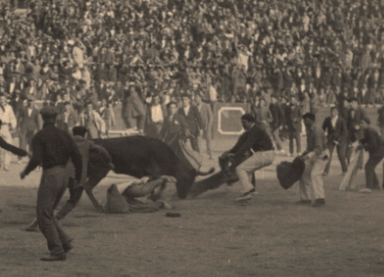
James R. Mellow gives an account of Hemingway's performance in the
bullring in his 'Hemingway: A Life Without Consequences:' 'I appeared in the
bull ring on 5 different mornings - was cogida [tossed] 3 times -
accomplished 4 veronicas in good form and one natural with the muleta,"
Hemingway boasted in a letter to Pound. Writing to Edward O' Brien, he
claimed he had been "gored," a very different thing.' These were chaotic
fights. He also describes another fight, which was more formal. In a
letter to Bill Smith, he wrote that this appearance wasn't a success, even
though the bull's horns were blunted. (Alexander Fiske-Harrison hasn't
denied that the horns of the bull he fought were blunted too, after I'd
raised the issue.) There's no doubt that Hemingway did enter the bullring,
then.
The front flap of this very interesting book includes this: 'There have been
a number of Hemingway biographies since his death, but until now no
biographer has set out to challenge the image that Hemingway fashioned for
himself ... Through much research and new material, Mellow reveals aspects
of the writer's life unexplored by previous biographers, corrects the record
on important matters of chronology and fact, and explodes many of the myths
Hemingway carefully constructed around his life.'
James Owen's complete review furthers Alexander Fiske-Harrison's attempt at
the construction of a mythical persona, a legend to rival
Hemingway's (for people impressed by such things) greater than Hemingway's
to an extent: Hemingway, after all, 'never went into the bullring,'
supposedly. 'Into the Arena' has this: 'Ernest Hemingway is without doubt the greatest writer
in English on bullfighting as it was in the early twentieth century.'
And who is without doubt the greatest writer in English on bullfighting as
it is in the early twenty-first century? Could it possibly be
Alexander Fiske-Harrison?
A much later post, of May 13, 2012, also entitled 'Where Hemingway feared to
tread,' belatedly gives a factually accurate account, one which makes claims
about Hemingway and running, not Hemingway in the bullring.
'Ernest Hemingway never ran in Pamplona despite making it so famous.'
Alexander Fiske-Harrison has done so.
James R. Mellow doesn't endorse the myth-making of Hemingway and he
doesn't endorse the industrious myth-making of the bullfighting industry,
accepted without question by so many writers and commentators. This is from
his account of Hemingway's first experience of a bullfight. He was
accompanied by Robert McAlmon.
'When the first bull chargedhead-on into one of the picador's horses and
tossed it, McAlmon rose to his feet with a yell. He liked it even less when
he saw another horse trotting around the ring dragging its entrails.
McAlmon's memories of that first bullfight were of the unreality of the
scene and the insensitive crowd daring the matador from the safety of the
stands, the cruelty of the kill.'
He discusses Max Eastman's review of Death in the Afternoon in The New
Republic: 'Why. Eastman wondered, did Hemingway indulge in such clouds of
juvenile romanticism whenever he crossed the border into Spain?' The same
question could be asked of Alexander Fiske-Harrison. A comment made on an
article of Hemingway's for the Toronto Daily Star (in this instance without
a direct bullfighting connection but relevant to bullfighting) could be made
of Alexander Fiske-Harrison: 'The article was another instance of his
ability to create a public persona for himself. It read well and was
self-serving ... making it clear to readers of the Star that he was a bona
fide hero.'
By the end of his life, Hemingway had become disillusioned with the
bullfight. This biographer quotes these words, ' ... the whole bullfight
business is now so corrupt and seems so unimportant ...'
Some of the pages of the journal of the Club Taurino, 'La Divisa' are available on the
Web. They make strange reading, although no stranger than 'Into the Arena.' There's jolly sociability, with cheery
photographs of some of the membership, comparisons are drawn between
bullfighting and ballroom dancing, there are entranced and sometimes
strained evocations of the artistry [sic] of the
bullfight, and things such as this: 'After the banderillas, as the
bull stood spurting fountains of blood ... ' there was 'a miserable
excuse for a sword-thrust into the bull’s flank.' And from the same member,
Daniel Hannan: 'I lost count after his twelfth
attempt.' This is a reference to the number of blows to the spine of the
bull with the descabello, after the 'killing sword' had failed to kill. (I
wouldn't know what the record is, but Alexander Fiske-Harrison witnessed a
significantly greater number.) In general, anyone with a clinical interest
in haematophilia will find useful material in 'La Divisa.' I haven't
been able to find a single instance of moral reflection or moral reasoning
in the pages of 'La Divisa' available to me.
Tristan Wood (better known for his book 'How to watch a bullfight') has an article in La Divisa which raises no objection to the
taking of children to bullfights He writes about the kiddies' entertainment in France, which
includes violent death after multiple stab wounds. This is from his account
of
' ... the Feria des Vendanges in Nîmes (about which more in
the next La Divisa). A young mother and her son (probably
around six or seven years old) were sat next to me before the start of one
of the corridas, only for them to give up their seats as the rightful
ticket-holders arrived. It transpired the mother had done what a number of
the locals often do – bought a billet for the unnumbered stone rows at the
top of the Roman arena, only to then clamber down to the more expensive
wooden seating once the plaza band has struck up (some 10 minutes or so
before the paseíllo) and the entertainment has officially begun. They
eventually watched the corrida sat on the tendido stairway, the little boy
sitting between his mother’s knees (ah, to have a mother like that!), or
going excitedly to the fencing at the front of this seating area for a
closer look at events on the sand below.'
What the membership won't do, it seems, is debate bullfighting and
defend bullfighting against objections. I've done my best to
start a debate. In my exchange of emails with one of the officials of the
Club Taurino, I included this (its ultra-polite tone in precarious contrast
with my loathing and disgust.)
'I've revised pages of my site which
used material in emails to me to argue against the sender of the email. I’ve
been removing these sections, because I see the importance of keeping open
lines of communication with people whose views I oppose in one way or
another. So, my page on bullfighting no longer uses the content of emails
addressed to me to argue against the views of the person who sent them. The
primary instance concerns Stanley Conrad of mundo-taurino. I no longer quote
or use material in his emails to me. I now depend only upon printed material
and material on Websites, such as your own Website. [ctol.org] Journalists,
of course, don’t publicize, or shouldn’t publicize, any opinions which are
‘off the record’ and I now regard emails addressed to me as ‘off the
record.’ I want people who contact me by email (or letter) to have the
confidence that the material won’t be used against them. I think it’s
important too to recognize that an email may be composed hurriedly, that it
may or may not represent the considered views of the sender. I’ve no doubt
that your email to me, a very detailed and informative one, and one which
I’ve read very carefully, does represent your considered views, but be that
as it may, I won’t be using the material in your email on my site. If any of
the members of the Club would like to contact me, then so far as I’m
concerned, it falls within the sphere of private debate. As for emails I
send, then obviously the recipients are at liberty to use them in any way
they like, or not to use them.'
There has been a distinct shortage of Club Taurino members stepping
forward to engage in debate - not a single one, despite these guarantees. In
the circumstances, to include the Club Taurino of London in the section
'Some defenders of bullfighting' is to give a very loose meaning to
'defenders.'
Defenders of bullfighting who have emailed me have defended themselves
and / or bullfighting so ineptly that this policy has come to seem
unnecessarily kind. I decided it was better that, for bullfighting at least,
a robust policy of 'email me if you think you can withstand any criticism'
would be better. For defenders of bullfighting, the option of ticking a 'no
publicity' box wouldn't be available any longer.
There's a substantial case to be made against aficionados from the
viewpoint of virtue ethics, the approach to ethics inaugurated by Aristotle.
Aficionados are critical of bulls they perceive as 'cowardly' ('manso' in
Spanish) from their position of complete safety. (The matadors are in
relative safety.) But what of the 'aficionado manso,' who doesn't even have
the courage to defend bullfighting openly? If any courage is
needed at all.
A L Kennedy: including
ALK on the killing of horses
A L Kennedy. Acknowledgments: Abrinsky
These are extracts from my review of A L Kennedy's
On Bullfighting in the reviews section
of the site, providing further evidence of the distortions and
illusions of apologists for bullfighting. I don't indicate the places
where material is omitted or use inverted commas.
The fast approaching death of the bull sometimes seems to bring A L Kennedy
closer and closer to a kind of orgasmic writing. 'Ponce talks to the toro
gently...The faena lasts six minutes: six minutes of coaxing and
pauses...The dust lifts about the pair as they tighten on each other...he
arches his body high and back...As the bull sinks, Ponce faces it...I have
never seen the gesture filled with this tension, this sense of worship and
violation, this naked hunger for a soul.' Later: '...there is something
sexual about the faena' and 'Matadors often liken the faena to making love.'
(From the Glossary: 'The faena is 'The final act of the
corrida
- the Act of the Kill.') Of another bull: 'Rather than tricking
the bull, Ponce gives the impression that he knows what it wants before it
does, that he is here to help. This is the body knowledge of a lover...'
But she's often denied the fulfilment she craves and the death of the bull
is like bad sex, very bad sex. Before the bull can die, though, there's a
kind of perverted foreplay, in which the spears of the picadors and the
banderillas play their part:
'...the picadors spear as much danger as they can out of the bull.'
After the picadors have lanced it '...another bull is left, staggering and
urinating helplessly, almost too weak to face the muleta.' She comments,
prosaically, 'I do appear to be observing considerable distress.' The muleta,
as she has explained in a footnote, is 'The small red cape, stiffened with a
rod, which is used by the matador during the final passes which lead to the
kill.' But before the bull could face the muleta, he still had to endure six
more stabbings from the six barbed banderillas. These would bring him to an
even more helpless state.
This is from the first bullfight she witnessed. After it, she writes, 'I
have to see more corridas.'
And more scenes which didn't bring her to walk out:
'The picadors are, if anything, more brutal in their work...' The picadors
lance the neck muscles of the bull, but she asks for our sympathy not for
the bull but for her own neck muscles: 'Take it for granted that lifting and
travelling still hurt my neck...' Later, she writes about the difficulty of
settling into 'another two hours or so of sitting upright, of trying to make
my neck muscles relax, of thinking the pain away,' the difficulty, that is,
of sitting for two hours or so watching bulls stabbed eight times or more in
the neck muscles.
Again and again she forfeits our sympathy and unwittingly makes clear the
disproportion between the suffering of the animals and her own sufferings.
'At the kill, the young man's sword hits bone, again and again and again
while the silence presses down against him. He tries for the descabello.
Five blows later and the animal finally falls.' The descabello, as the
Glossary explains, is 'A heavy, straight sword' used to sever the spine.
'I have already watched Curro Romero refuse to have almost anything to do
with his bull, never mind its horns. (The severely critical response of a
member of the audience to a cowardly bull or a cowardly bullfighter.) He has
killed his first with a blade placed so poorly that its tip protruded from
the bull's flank...As the animal coughed up blood, staring, bemused,
['bemused?'] at each new flux the peones tried a rueda de peones to make the
blade move in the bull's body and sever anything, anything at all that might
be quickly fatal, but in the end the bull was finally, messily finished
after three descabellos.'
The suffering of the bull 'left, staggering and urinating helplessly, almost
too weak to face the muleta' wasn't ended by a painless and instantaneous
death: 'Contreras...misses the kill...Contreras tries again, hooking out the
first sword with a new one ...Contreras finally gives the descabello.' So,
the sword is embedded in the animal, the sword is pulled out and thrust into
the animal yet again, but it's still very much alive. The descabello is hard
at work in this book. People who have the illusion that the 'moment of
truth' amounts to a single sword-thrust and the immediate death of the bull
are disabused of the notion here. More often, the moment of truth is hacking
at the spine with the descabello.
Even the sexual apotheosis which Ponce has offered is accompanied by this
hack-work: 'He has risked a long faena, working on the bull, steadying it,
but still the kill goes badly and a time warning sounds as Ponce tries to
finish the job and the regulation twelve minutes for the kill expire. Three
times he goes in with the sword, then there is a rueda de peones, then three
descabellos before the animal sways and falls.'
The horses are mentioned very briefly. (For me,
the suffering of the
horses is a central objection to bullfighting.) A
decree of the government of Primo de Rivera ordered that horses should be
given a quilted covering 'to avoid those horrible sights which so disgust
foreigners and tourists.' This was in response not to the concerns of
aficionados but the concern of Primo de Rivera's English wife. A 'horrible
sight' ended by this reform was disembowelling of the horse ('evisceration'
sounds too clinical.) Before this reform, disembowelling was very common.
But the protective mattress didn't end the suffering of the horses. It hides
many injuries. Again and again, horses suffer injuries to their internal
organs and broken ribs. Horses are still gored in areas unprotected by the
mattress.
Bullfighting supporters generally acknowledge these facts. A L Kennedy
admits them: 'Arguments are cited which state, reasonably enough, that the
blindfolded and terrified horse is currently buffeted by massive impacts,
suffering great stress and possibly broken bones.' She might have mentioned
the internal injuries which horses also suffer. The Wikipedia entry for
Picador has this, ' injuries
to the horses often include broken ribs and damage to internal organs.'
This is
a film which shows what can happen to a horse in the bullring.
The picador enters the ring 1:50 into the film and during the next three
minutes, the horse is attacked, with 'action replays.' The crowd responds by applauding. Two women
in the audience are shown at one point, and then a little later. One smiles,
as if the episode is cause for amusement, the other yawns, as if bored.
Members of the audience at this bullfight (Seville, 20.04.12) included
Alexander Fiske-Harrison, his girlfriend - Antalya Nall-Cain - and his
father and mother.
Even if this horse was very lucky and suffered no broken ribs and internal injuries, it can
be imagined what terror it will feel when blindfolded and led out to take
part in the parade before the bullfight, what horror it will feel when forced
to enter the arena to face the bull, what terror it will feel when it hears
and smells the bull.
Some aficionados have
advocated 'kinder' treatment of the horses. Humane aficionados! What is the
reform proposed by these good, kind-hearted people to reduce animal
suffering? This: taking away the protective mattress and returning to disembowelling of the horses! As A L Kennedy puts it, 'a return to the
'kinder' option of evisceration.' She perhaps forgets that death by
disembowelling - evisceration - was often not instantaneous. As Hemingway
admits, a horse might carry on running whilst trailing its intestines behind
it. (If only some of the horse's innards were showing, the gap in the
horse's body could be filled with sawdust 'by a kindly veterinarian.' 'No
sweeter, purer sawdust ever stuffed a horse than that used in the Madrid
ring' according to Hemingway.)
She discusses these things in a strangely detached tone, and, in the same
strangely detached tone, 'It is believed in some quarters that horse-killing
greatly improves the bull's 'spirit' for the remainder of its time in the
ring and is the only fit proof of its 'bravery'. And she goes on attending
bullfights.
She's properly sceptical about the bullfight as art form:
'The corrida can sometimes create the effect of art (as can, for that
matter, a voodoo ceremony, a funeral or a high mass) but it is divided
against itself, because of the unpredictability of the bull, because of the
numerous abuses of its own laws, because it hopes to weaken the bull, but
leave it glorious, to defend the matador, but give him something to
overcome. The corrida, although it has its own rigours and remarkable
individual toreros, currently lacks the overarching discipline, creative
economy and communicative breadth of an art. It could also be said that its
levels of cruelty and violence prevent it being an art, that an art cannot
exceed certain parameters of damage, that it cannot cause death.'
Even so, this is weedy prose, for someone with some reputation as a prose
stylist: 'communicative breadth' is the language of educational bureaucrats
and '...cannot exceed certain parameters' the language of a scientific
paper, necessary in most cases - 'the levels of adenosine triphosphate in
the biosynthesizing cell cannot exceed certain parameters.' I'd have to
claim that my own way of expressing A L Kennedy's last point is far better.
From the section
Bullfighting as an art
form. Bullfighting and tragedy in which, unlike A
L Kennedy, I do grant bullfighting some right to being an art form, although
the most limited and perverted of art forms:
'Hemingway, 'Death in the Afternoon:' 'Bullfighting is the only art in which
the artist is in danger of death.' I would emphasize a different aspect.
Bullfighting is the only art form where the artist inflicts suffering and
death, the only art form which is morally wrong. Bullfighting is the pariah
amongst the arts. Suffering and death have enough power. An art should do
nothing to increase it. In other arts, suffering and death are confronted,
explained, found impossible to explain, raged against, transcended, balanced
by consolation and joy, not inflicted.'
The main weakness of the book, apart from the shocking evidence that this is
someone whose feelings are severely restricted, is the common or universal
failing of those who find excuses for bullfighting, the glamorisation of
danger and the failure to put the danger to the bullfighters in context. I
deal with this at length in
the courage of the
bullfighters.
A L Kennedy makes a grotesque comparison, in connection with the bullfighter
'El Juli,' who, rumours have it, 'will soon attempt to face seven
bulls...within the course of one day... At this level, the life of the
matador must be governed by the same dark mathematics which calculates a
soldier's ability to tolerate combat: so many months in a tour of duty, so
many missions flown, and mental change, mental trauma, becomes a statistical
inevitability. But in the corrida, the matador is not exposed to physical
and emotional damage by duty, or conscription - he is a volunteer, a true
believer, a lover with his love. And there are no limits to love, it is
quite merciless.' This attempt at high-flown language is an abject failure,
a chicken's attempt to soar. At least 'merciless' is accurate, given that in
this case the lover may plunge the sword into his love repeatedly, hitting
bone, or thrust the sword in and take it out with another sword, or the
lover may hack away at the spine of his love with a heavier sword.
In the book, the merging of love and killing is only superficially deep.
Love and killing are insidiously merged, recklessly and dangerously. Lorca's
execution by a nationalist firing squad during the Spanish Civil War,
instead of being a squalid and despicable act, is transfigured. Of Lorca,
'he might almost be aware of the darkness coming, might almost be asking
himself when it will come, when a man who loves his country will be killed
by other men who love it differently.' As an intransigent opponent of
executions I make no exception for the execution of the bullfighting
supporter Lorca, and of the bullfighter who was killed at the same time.
After he was killed, Lorca was shot in the backside. The Falangist Juan Luis
Trescastro: 'We killed Federico Garcia Lorca. I gave him two shots in the
arse as a homosexual.' Does this shatter and make ridiculous the
romanticized vision of A L Kennedy? Or is shooting someone in the backside
an act of love too, like the sword thrust to the bull?
More evidence that she has a fondness for 'transfigurations' which falsify
reality. 'I wonder again why Lorca came back to Granada, why he came home,
why he took that last risk and came looking for extinction.' This
came
looking for extinction is pure supposition, imagined, arising
from that same source as the over-written musings on the death of the bull
at the hands of his 'lover.' In the Spanish civil war, according to Julius
Ruiz, the republicans executed almost 38 000 people and the nationalists
about 100 000 (and about 50 000 more after the war was over). Other sources
give widely differing estimates, but whatever the number, it's likely that
very few of these victims, innocent or far from innocent themselves, were
'looking for extinction' and there's no evidence that Lorca had a death
wish.
The Falange, the Fascist or near Fascist group, were the foremost
executioners in the conflict. The group 'had rapidly developed into the
nationalists' paramilitary force, assuming the task of 'cleaning up'...Their
leader, José Antonio, had declaimed that 'the Spanish Falange, aflame with
love, secure in its faith, will conquer Spain for Spain to the sound of
military music.' (Antony Beevor, 'The Battle for Spain: The Spanish Civil
War 1936 - 1939.')
The republican Lorca and the nationalists were linked as well as contrasted.
They were linked by the cult of death. One nationalist rallying cry was
'Long live death!' Lorca: 'Spain is unique, a country where death is a
national spectacle...In every country death has finality. Not in Spain. A
dead person in Spain is more alive than is the case anywhere else.' Another
republican, El Campesino, again quoted in 'The Battle for Spain' : 'I am not
pretending that I was not guilty of ugly things myself, or that I never
caused needless sacrifice of human lives. I am a Spaniard. We look upon life
as tragic. We despise death.'
Facts and figures can be supplied which make A L Kennedy's 'dark
mathematics' ridiculous. I give just a few of them above. And, ten years
after she wrote about him and his likely demise, El Juli is still with us,
still very much alive, despite the dark mathematics. (And the author's back
problems have also subsided.)
In this book, A L Kennedy is an 'imaginative' writer in the worst sense of
the word, as in 'The matador is at the heart of a strange balance between
the demands of safety and fame [mention of the money at this point would
have spoilt the effect], between the instinct for self-preservation and the
appetite for the ultimate (and therefore
ultimately dangerous [my emphasis]) execution of the
corrida's three traditional acts.'
The matador often has some inducements generally denied to combat troops or
the mountaineers who face death - adulation and high earnings: perhaps 80
000 euros for killing two bulls (much more for El Juli, the most highly paid
bullfighter ever, until the advent of even higher earners) and, as the
matador starts his journey to the ring 'perhaps...admirers and
autograph-hunters.'
El Juli is exposed to danger, from two bulls, for just over half an hour to
earn his 100 000 euros, or whatever it is he earns. Very, very infrequently,
he's faced six bulls - just over an hour and a half in the ring. This is
said to make exceptional demands on stamina. Bullfighting supporters are
lost in admiration for someone who can not only face death but show such
superhuman strength and stamina for an hour and a half.
I'd strongly recommend an immersion in the history of coalmining, and the
present of coal mining in some countries, as an antidote to these particular
delusions, and other delusions of bullfighting apologists: an immersion
which demands, however, compassionate imagination. Witnessing death in the
bull-ring makes no demands on compassionate imagination at all, just the
ability to keep your eyes open and look. To enter into the hidden lives and
deaths of miners (who of course included women and children as well as men)
does demand it.
My poem
Mines
is about child-labour in coal mines. It mentions the rock
falls and explosions which have caused so many deaths and injuries, but
there were other ways of dying horribly, such as drowning when the mine
workings were flooded, or a fall to the bottom of the mine shaft when the
cage fell uncontrollably. A very few statistics (for single incidents, not
the total for the year) from an enormously long list: the 439 deaths at
Senghenydd in Wales in 1913, the 290 deaths at Cilfynydd, the 388 deaths not
far from here, near Barnsley in Yorkshire in 1866, and the 1 549 miners
killed at Benxihu in China in 1942.
As for injuries, in mining as in bullfighting so much more numerous than the
fatalities, it isn't obvious in the least that a horn wound in the leg is
worse than the crushing of legs by a rock fall. And there's a very
significant difference. An injured bull fighter is taken out of the
bull-ring in a minute or two and is immediately treated in the bull-ring
infirmary. The crushed coal miner had, and still has, no such benefit. Even
with modern equipment, reaching the miner after a rock fall may be very
difficult and may take days, or may be impossible. A severely injured
high-altitude mountaineer also faces a prolonged and agonizing wait for
rescue and medical treatment, if rescue and medical treatment are
practicable at all.
A L Kennedy, on bullfighting plazas: '...all first-class plazas have fully
equipped and staffed operating theatres standing ready, next to the ring.'
On the evidence of this book, watching bullfights tends to do nothing for
sensitivity, sensitivity to human suffering as well as animal suffering. The
risk of distorted perspectives is an occupational hazard of pro-bullfighting
writers, the gross distortion involved in singling out one group as
especially fearless - and giving them adulation - whilst ignoring the vastly
greater claims upon our attention of others.
To return to El Juli, and to return to the cheerful prose of A L Kennedy:
'He's seventeen [at the time of writing], has been dubbed 'the Mozart of
Toreo' and is electrifying the corrida.' If there are any further editions
of 'On Bullfighting,' she can feel free to use this comment of mine: 'A book
about love, life, death, danger, glamour, youth, celebrity. She was
thirty-four, at the time of writing, has been dubbed 'the prose stylist in
the Salons of Toreo' and is electrifying the world of corrida propaganda.'
The unchallenged and uncriticized comparison with Mozart, who lived and died
in poverty, a universal genius, is bland and gross at the same time, but to
most bullfight supporters a bullfighter ranks much higher than a universal
genius.
The healthy modern scepticism which, far from being dry and arid, has helped
to reduce or even human and animal suffering in many ways, if not nearly
enough, is completely absent. The book marks no advance on the primitive
level of Hemingway's 'Death in the Afternoon.'
One aspect of the bullfight which should be subjected to very close
examination, but isn't in this book, is the audience and its emotions.
Emotions are far from being self-justifying. The congregation feels - or
many of them feel - extreme emotion at the climax of the mass, when they
believe that the bread and wine are transformed into the actual body and
blood of Christ. This emotion becomes - cold word, but necessary -
problematic if you think, as I do, that no such thing has
happened, that although the emotion seems real, the event which is supposed
to have inspired the emotion, transubstantiation, is non-existent. The
emotions of the bullfighting audience (or bullfighting congregation) are
genuinely felt, no doubt, but they are compromised, and fatally, by the
moral objections to the act and by misinterpretation.
As just one example of misinterpretation, the bull after all is a herd
animal. There are obvious difficulties in inferring the inner life of a bull
from observation of its behaviour. A L Kennedy is very good on the behaviour
of herd animals like bulls. What is very, very unlikely is that the bull is
sharing any of the 'higher' experiences claimed by the bullfighter and the
audience when the bullfight is going well, going well, that is, for the
bullfighter and the audience. The bull's focus will be on the cape (if it
were allowed to live for a little longer, it would learn and attack the man
directly rather than follow the cape). This being the case, so many of the
most intense passages in this book collapse. The higher emotions, the
ecstasies claimed by bullfighting supporters turn out to be based on
insecure foundations, on transcendental appearances, illusory appearances,
rather than inner realities.
As when, in connection with Ortega and bull - wounded, a few minutes before
its death - she writes of '...something which is a celebration of this
moment, these creatures, this breath, this fine time they are having
together.'
She writes, 'Standing in the
medios,
the central area of the ring, Ponce removes his hat and slowly
turns, holding it up for us. This will be our bull, he is giving us this
death.' A death for the price of an entrance ticket costing a few euros!
Such good value! These supreme experiences are remarkably cheap!
¡Afición -
abolición!
Orson
Welles: who changed his mind
Orson Welles, the film-maker, is one defender of bullfighting (and amateur
bullfighter) who changed his mind.
Extracts from the transcript
of his comments to Michael Parkinson in 1974 about bullfighting.
'...the fact is, it has
become an industry which depends on its existence by the tourist trade. So
it's become folkloric, and I hate anything which is folkloric. But I haven't
turned against bullfighting because it needs a lot of Japanese in the front
row to keep going, and it does. But I've turned against it for very much the
same reason that my father, who was a great hunter, suddenly stopped hunting.
He said, "I've killed enough animals and I'm ashamed of myself."
I was a bad torero for awhile myself, and I've seen too many hundreds of bullfights,
thousands of them, I suppose, and wasted a lot of my life ... I began to think
that I've seen enough of those animals die.'
'...wasn't I living and
dying second hand? Wasn't there something finally voyeuristic about it?...By
the way, almost all Spanish intellectuals have been against bullfighting for
the last 150 years. Lorca is one of the few Spanish intellectuals who ever
approved of bullfighting. Was it a waste, waste, waste? you asked me. A waste
because I wasn't doing anything ... what have I extracted from it that's of
any value to anybody?'
Michael Portillo, speaker
I've been
contacting
agencies
which have
for hire
Michael
Portillo as
a speaker.
Included in
the message
is this:
'I've
recently
contacted
Michael
Portillo in
connection
with his
support for
bullfighting.
The time has
come to
publicize
his support
for this
barbaric
spectacle -
for example,
outside a
venue when
he comes to
deliver a
speech (I
oppose
action
within the
venue, for
example,
interruption
of a speech,
interference
with freedom
of speech
and all
action which
is against
the law.)'
Michael
Portillo is
a
Conservative
politician
and is
associated
with the
deservedly
successful
series
'Great
British
Railway
Journeys'
and 'Great
Continental
Railway
Journeys.'
I'm a
Conservative
voter and
I've watched
almost all
the episodes
of these
railway
series. I
take issue
with (I
loathe
completely)
his support
for
bullfighting,
I don't take
issue with,
or loathe,
other
aspects of
his
character
and his work
- although
his work on
the death
penalty has
been very
flawed.
Some opponents of bullfighting
Robert Pittam
Robert is an artist whose work I admire very much (A discussion of his
work is included, as supplementary material.) Here, he's writing
about the campaign of one organization but the points he makes so well
obviously apply to many others:
I believe your campaign against the
bullrun is misguided, despite your honourable intentions.
The campaign against Pamplona - how to lose friends and alienate
people
I think you are making a mountain for yourselves to
climb by targeting a very large group of people who are not engaging in the
brutality of bullfighting itself, but simply taking part in
adrenaline-fuelled silliness in which only humans - of their own volition -
risk serious harm. The aim of stopping this is probably unachievable, a
drain on your resources, and may undermine your credibility with the same
people - who may infact be sympathetic to your anti-bullfight campaign.
Confession: I have been to Pamplona - I drank and danced a lot, and had
one of the most memorable days and nights of my life. It was also the
trigger for a decade of anti- bullfighting activity and writing: I never
attended the bullfight (I saw one on tv in a cafe, and left in disgust) -
being there drew my attention to the ultimate fate of the poor animals
involved.
Pamplona is, and I think will continue to be, a magnet for
young, adventurous people from all over the world; I would plead with you to
use this as an opportunity to demonstrate, talk to, leaflet, etc to make
sure these people NEVER attend the bullfight, and even join you in
campaigning against it.
The bull-run and the corrida are not
inseparable, by conflating the two, don't you make your task far greater,
and the protection of the bulls further away than ever.
Pamplona aside - I would even go so far as to suggest that removing the
cruelty from bullfighting (the lance, banderillas, swords and daggers - and
the poor, terrified horses), rather trying to demolish the entire edifice,
dramatically increases your timescale for success: meaning thousands less
bulls face appalling suffering and agonising death...
Regards, Robert
Pittam.
PH: I didn't decide to 'boycott' the bullfighting town of
Arles. I went there, kicked up a fuss in the tourist offices and wrote
anti-bullfighting messages in the bullfighting arena. I like the idea of
bullfighting opponents descending on Pamplona. Pamplona isn't going to
abolish bullfights until it has to, though. Until that time in the distant
future, the Pamplona bull run is tainted. I know that if Robert ever visited
Pamplona again during the Festival of San Fermin, he would engage in
anti-bullfighting activity. This isn't true of the vast majority of people
who attend the festival. They should stay away from the place. I
congratulate The League against Cruel Sports for organizing a public
campaign to persuade STA Travel to discontinue tours to the San Fermin
Festival. The campaign was successful, as the League's Website explains,
http://www.league.org.uk/news-and-opinion/press-releases/2014/july/charity-applauds-sta-for-terminating-trips-to-pamplona-bull-running-fiesta
The page includes this as well:
'Joe Duckworth, Chief Executive of the League said:
“We commend STA Travel for acting on compassion and ceasing its support of
this abhorrent bull running festival. It’s just a shame that it took a
public campaign, and that they are still to engage with us directly.
“Bull running and bullfighting are sickeningly cruel and barbaric practices
... '
Bullfighting is a sickeningly cruel and barbaric practice. Bull running
isn't.
There are places in Spain and Southern France (and South American
bullfighting countries) which have the chance to attract a great many
risk-takers and party-goers to their own town or city and away from
Pamplona, to enjoy debauchery and riotous living without Pamplona's
cruelty. Barcelona, with bullfighting now banned, is one possibility.
Marseilles is another. The commercial-humanitarian opportunities are there.
The Art of Robert Pittam: Sea of Serenity
Robert Pittam's art can be seen on these Websites, with the
understanding that no Website images can do justice to the paintings.
http://www.watersidestives.com/painting-artist/robert-pittam/
From the site:
'[his paintings show a]
distinctive style in which the very diverse influences of his favourite
painters Vermeer and Edward Hopper can be clearly seen. His still lifes have
a dark intensity and richness in the Dutch tradition and yet his landscapes
and figures draw upon the surreal and polished style of Hopper.'
http://www.hicksgallery.co.uk/artist/robert-pittam/
From
the site:
'Greatly influenced by the work of Vermeer and Edward
Hopper, I too aim for a certain quality of stillness in my pictures. The
still-lifes often include fishes and I believe that they are amongst the
most interesting subjects in nature to study in paint. Possessing colour,
pattern, reflectivity, perfectly evolved streamlined shapes and a three
dimensional form to ‘sculpt’ in light and shade – they might also be read as
metaphors for the sea itself.'
http://www.innocentfineart.co.uk/art/robert-pittam/
http://www.robertpittam.co.uk/
The moon's Sea of
Serenity, like the other large, dark, basaltic plains which are the Seas of
the Moon, is no ordinary sea and Robert Pittam's paintings of the life of
the seas and objects from the sea or by the sea are no ordinary paintings,
and certainly not derivative paintings. Although Vermeer and Hopper are
influences, his individuality is obvious.
His still life
paintings are still but seem permeated by lines of force. The paintings
which show fish in pairs remind me of sources of electrical energy in pairs
where the electric force between them is palpable - a highly-charged
stillness. He has made very fruitful use of the series of paintings. A
mathematical series often goes on to infinity and the series of paintings
which pursue a theme, such as the theme of fish grouped with another fish or
with other objects to do with the sea, suggest, if not infinity, something
vast. The series to be found in his paintings indicates the inexhaustible
interest of the subject.
The development of astronomy and geology and
the study of evolutionary history enlarged our understanding and gave us a
conception of vastly enlarged space and time. Robert Pittam's still life
paintings are far from being exquisite miniatures - although their technique
is superb. So, the fish he paints on a plate are far from limited beings,
whose purposes are mainly culinary. To me, they suggest the living things
which began their history about 530 million years ago, during the Cambrian
explosion, the living things which began the vertebrate odyssey. But this
reminds me of some non-scientific associations, such as the wine-dark sea of
Homer, or, by a paradox, of dark and luminous seas.
I think that
Robert Pittam points the way out of the impasse, or the dilemma, of realism
and abstraction in art, or many forms of realism and abstraction. Both
of these have disadvantages. How to choose between them? Robert Pittam has
presented in many of his paintings to present elements which exhibit clear
cut spatial relationships, for example, two fish at a short distance from
each other. This is an art of clear-cut mensuration, unlike the messier,
more informal world of a reasiltic painting in which there may be an
abundance of elements without such clear mensuration. The placing of the
elements in the visual plane is clearer and simpler than in most still life
paintings, such as those of Cezanne. There seems to me to be a linkage with
formal garden design, where the elements of the garden, such as hedges and
beds, have a clarity of spatial organization which is very different frrom
the more chaotic world of a naturalistic garden.
But the elements of
a Robert Pittam still life, like the elements of formal planting, aren't
abstract shapes, with clear-cut, regular forms, but objects with sensuous
immediacy. They are pockets of naturalism carefully placed in an otherwise
abstract composition. The paintings are composites, natural and artful,
carefully designed, carefully measured, but without loss of the advantages
of realism.
Some opponents of
bullfighting: Links
The list below is
very, very short and gives only a few sites. There are many interesting and
important sites, ones which I appreciate very much, which I've studied
carefully but which I haven't included in this list as yet.
Anti-bullfighting work has become very, very extensive, varied and highly
organized. I can't possibly do justice to it here.
I think it's important to see opponents of bullfighting -
anti-bullfighting organizations and individual campaigners - as a
coalition. We agree on the importance of opposing and ending
bullfighting but we may disagree about other things - the particular
arguments we use, the campaigning techniques we use or advocate, and other
matters to do with animal welfare. So, some of the organizations and people
I list below may not agree with everything on this page, or my other pages
on bullfighting and animal welfare, or may strongly disagree in some cases.
British
anti-bullfighting organizations
Fight
Against Animal Cruelty in Europe
http://www.faace.co.uk
Spanish organizations
ADDA campaigns
against all the main forms of animal cruelty:
www.addaong.org
The page on bullfighting,
in English:
http://www.addaong.org/eng/que_7.html
It publishes an online journal, the Antibullfighting Tribune which is a
very valuable source of information about developments in the
bullfighting world and the movement to end it, in France, Portugal and the
Latin American bullfighting countries as well as Spain.
http://www.thebulltribune.org/
Stop our Shame (In English and Spanish)
http://www.stopourshame.com/
Partido Animalista
http://www.pacma.es/
French organizations
Crac: Europe
http://www.anticorrida.com/
Alliance Anticorrida
http://www.allianceanticorrida.fr/
Other European organizations
CAS International (Comité Anti Stierenvechten (In
English and Dutch / Flemish)
http://www.cas-international.org/en/home/cas-international/
SOS - Galgos
http://www.sos-galgos.net/
The site contains an account by Caroline
Waggershauser of an anti-bullfighting conference in Geneva
which took the form of a trial of the pro-bullfighting case:
http://www.sos-galgos.net/2008-07-04/caroline-waggershauser-pacma-berichtet-vom-stierkampfprozess-in-genf.html
Caroline Waggershauser includes a moving and harrowing account of the
death of a bull, with legs injured, unable to rise, put to death in the end,
as so often, with the descabello sword thrust into the spine, the subject of
a film. It begins, 'The room was dark. On the screen
appeared a bullfighting arena in which a blazing sun sank ...'
She includes an impressive account too of someone who used to be an
aficionado but suddenly saw the cruelty of bullfighting: Antonio Moreno from
Malaga. Aficionados, often people influenced, indoctrinated, by their
background and upbringing, aren't necessarily aficionados for ever. From her
account, which explains very well how the actions of the bull, trying to
defend itself in this artificial situation, this impossible situation,
fighting for his life, are used as evidence against the bull and in favour
of the bullfighters:
Antonio Moreno 'comes from a family that are big supporters and
defenders of the bullfighting tradition. At nine years old ... he
could assign all the bulls to their origin, by reason of their morphology,
coat colour, horn placing. He knew the names of the individual 'passes.' He
knew the history of bullfighting and all the bullfighters. His father raised
him in the belief that the bull was a wild beast, which he had to kill,
because he wanted to harm the bullfighter. The bullfighter was the good guy,
the hero. And the horse of the picador was good, and had to be defended
against the evil bull. If a bull attacked the horse then the Picador's lance
must thrust more firmly in the neck of the bull to protect the horse.
...
'Until, one day. Antonio in the meantime had become thirty years old -
behind the red muleta a bull appeared, an animal he had never seen before,
that he had never perceived as a sentient being. He got up, left the
bullring and has now, after almost twenty years, never entered one again.
'Slowly, he began to get involved in animal welfare ... With his knowledge,
energy and his ability to bring projects to a conclusion, he disarmed
everyone taurino. These people felt uncomfortable in his presence, because
not one of them stands up to his arguments with their own flimsy, threadbare
arguments.'
The political process
Anyone working for legislative change in a democracy should have a rational,
informed knowledge of the political process and one that is as comprehensive
as possible. The site listed below gives invaluable insights into the
political process in this country. Reading records of debates in the House
of Commons - topics which have no linkage with animal welfare provide
valuable information, a well as the ones with a linkage - will make it more
likely that activists avoid wasting time unnecessarily and avoid
counter-productive activities.
http://www.theyworkforyou.com/