
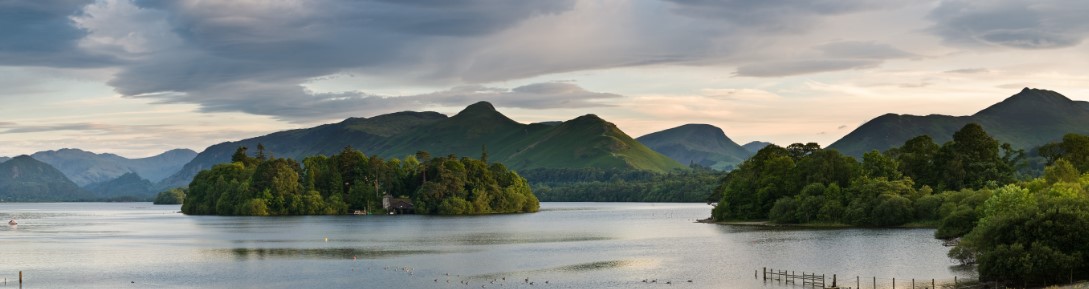
Above, The Jaws of Borrowdale, Derwentwater, the subject of a poem in the region Nature. Below, panorama of Derwentwater.
For 'concrete poems,' please see the page
Poems and poetics: word-image design The page
includes a word-image design based upon the shape of the Matterhorn, the
most distinctive in shape of all mountains.

Regions of this page:
War, the Holocaust, the Troubles in N. Ireland
Child labour
Troubled relationships
Difficult poetry
Nature
Snow
Humour and sarcasm
Miscellaneous
Commentaries are provided on this page for some of the poems.
War, the Holocaust and the Troubles in Northern Ireland
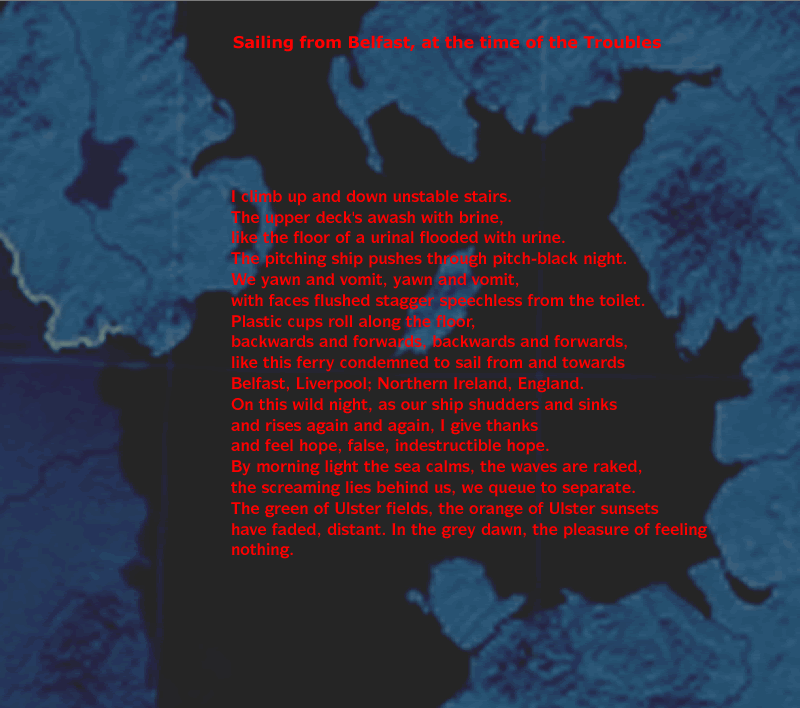
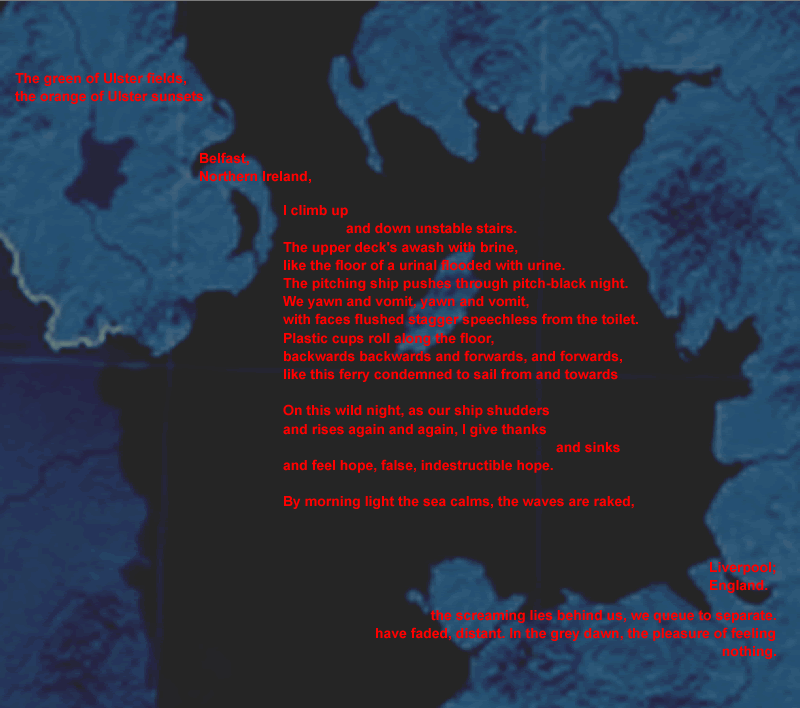
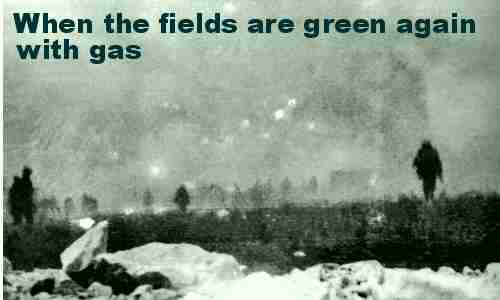
Above, British infantry advancing through poison gas, Loos, 25 September, 1915
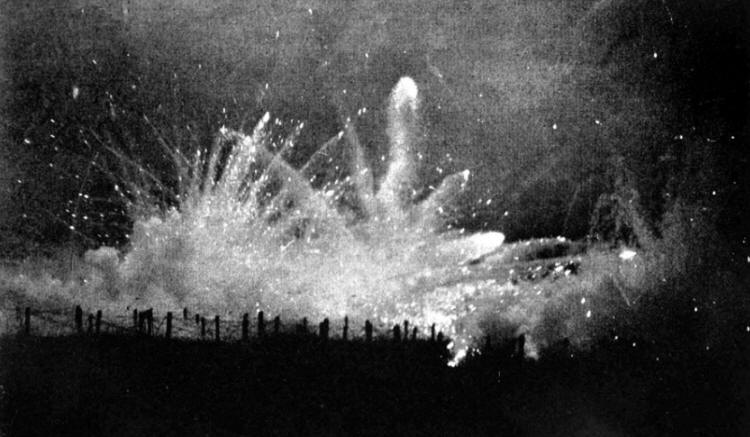
Above, a German artillery barrage falling on Allied trenches at Ypres in
World War 1
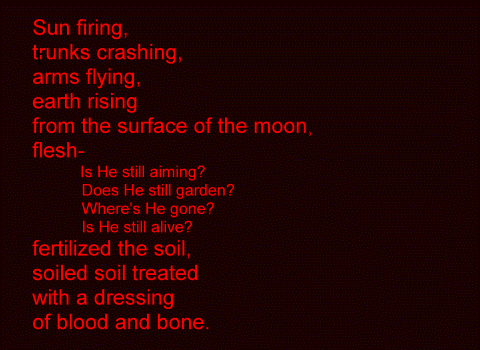
'In this creeping bombardment of the war'
Debris falls like rain these dark days and nights,
impossible the naming of parts.'
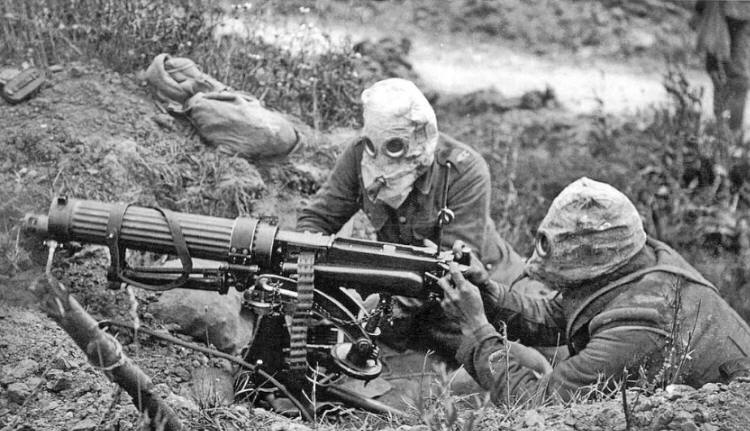
Above, Vickers machine gun crew,
with gas masks
Doubles
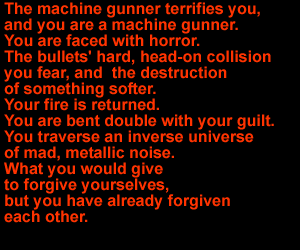
Commentary on 'The machine gunner terrifies you ... '
In this poem, I imagine two conscience-stricken machine gunners from two opposing armies. The reality is that the vast majority of machine-gunners have never been as sensitive as in the poem. The harsh reality is that they could not have allowed any sensitivity to influence their actions. Failure to fire on the advancing troops would have most likely led within a short time to their being shot or bayoneted.
The White War: Life and Death on the Italian Front 1915 - 1918' by Mark Thompson - a magnificent book - gives an account of some machine gunners of the Austro-Hungarian army confronting troops of the Italian army, troops trained, led and equipped to a catastrophically bad standard. On something like half a dozen occasions, occasions probably unique in the First World War or any other mechanized war, the machine-gunners refused to fire on the advancing Italians. "Stop, go back!" one of them shouted on one of these occasions, 'We won't shoot any more. Do you want everyone to die?'
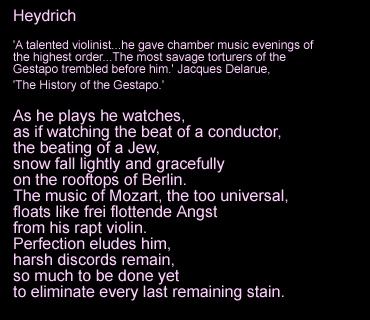
The runway overgrown,
his face
the years have flown
a grimace,
his heavy bomber
like crumbling concrete, old
crashing again and again this summer.
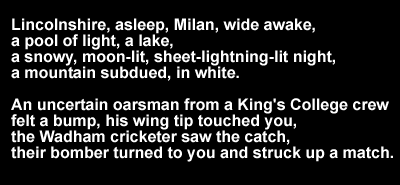
Commentary on 'Lincolnshire, asleep, Turin, wide awake ...'
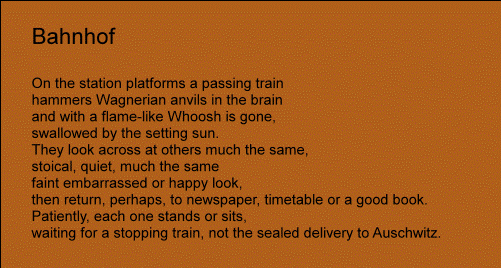
This poem was suggested by a passage in Jack Currie's 'Lancaster Target:' 'At Modane, the railway ran from Grenoble to Turin, deep under the Graian Alps...Our task...was to block the tunnel...We arrived early in the target area, and circled high among the Alpine peaks, gazing at magnificent Mont Blanc, towering massive in the moonlight, with our target to the south and Lake Geneva to the north.' However, there was no collision in Jack Currie's account and the poem is fictional.
'felt a bump.' Collins English Dictionary for 'bumping race:' '(esp.at Oxford and Cambridge) a race in which rowing eights start an equal distance one behind the other and each tries to bump the boat in front.' Collins English Dictionary for 'bump ball,' 'Cricket. a ball that bounces into the air after being hit directly into the ground by the batsman.'
The poem reflects, of course, the social background, including the sports they played, of a significant proportion of the English who lost their lives in the Second World War, as in other wars. King's College is the Cambridge College and Wadham is the Oxford College.
.
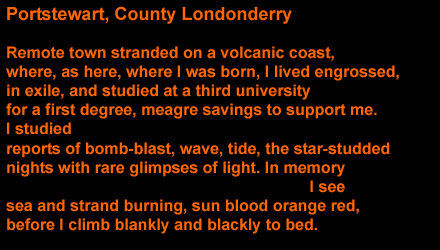
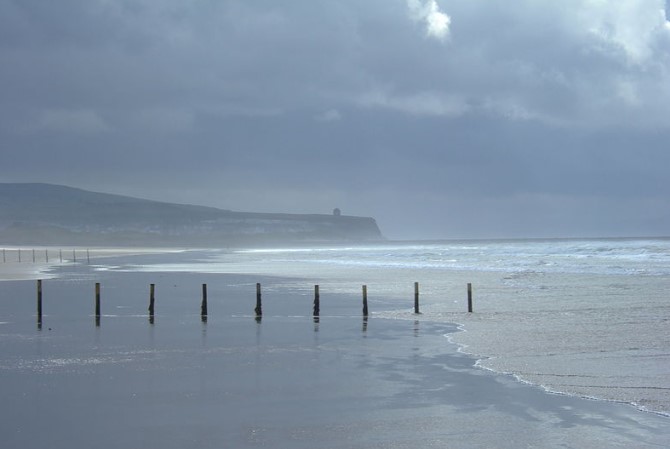
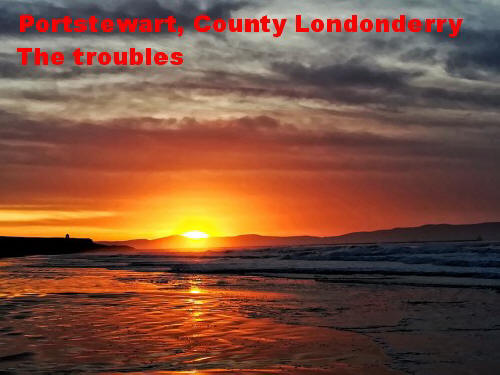
I lived in Portstewart on the North coast of Northern Ireland over a period of two years. As I mention in my page on Ireland and Northern Ireland, this was a happy time for me, if overshadowed by the atrocious events of the Troubles, then at their height. I had the benefit of a remarkable friend. The poem above does not reflect my experiences in the least. This is a poem in the catergory of fictional poetry. It's generally supposed that poetry is essentially non-fictional: the poet writes about the poet's experiences, not about experiences which never happened. My memory of Portstewart isn't of a 'remote town stranded on a volcanic coast' (where 'stranded' refers to the Portstewart strand or beach) but of a very pleasant town in a beautiful setting, with beautiful views.
Below, Portstewart Strand in sombre mood but often, the strand was
golden in the light of the sun.
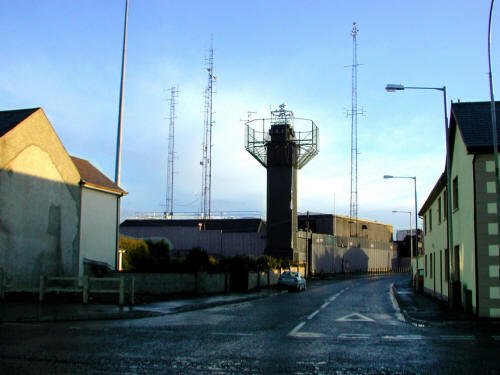
Above, watchtower of heavily fortified RUC (Royal Ulster Constabulary) base in Crossmaglen during the Troubles
If you'd been near this massive gun,
you'd have heard an unfailing flow
of jokes and anecdotes,
clean and smutty,
as the gunners drank their tea.
They looked forward
to the good times after
the war.
The silent one, the odd one, the odd one out, the padre's pet
looked forward
to the good times after
death.
But the others took the piss
out of him for that.
'None of us is going to get the chop,'
said the sergeant.
'Rommel's shower, that's different.
You've had long enough to sup your tea.'
Followed by
Load!
Aim!
Fire!
Child labour
Troubled relationships
in a bed as soft as the half light,
a man turns to a woman,
both near to sleep, the man
mentions his emotions,
she shudders, suddenly emotion-
less, and she says,
"Are we going crazy?"
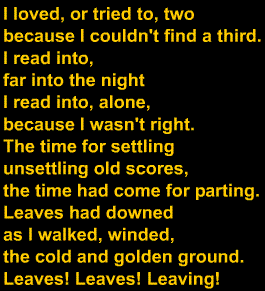
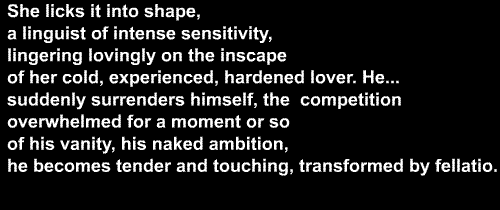
Commentary on 'She licks it into shape ...' Inscape: Collins English Dictionary has 'the essential inner nature of a person, object etc.' as expressed in literary or artistic works.' The word was introduced by Gerard Manley Hopkins. He makes significant use of it in his Journal, eg.1871: 'End of March and beginning of April - This is the time to study inscape in the spraying of trees, for the swelling buds carry them to a pitch which the eye could not else gather - for out of much much more, out of little not much, out of nothing nothing: in these sprays at all events there is a new world of inscape.'
A poem isn't the place for a systematic and exhaustive discussion of anything, the poem 'she licks it into shape...' included. A few remarks about the place of sexuality in human nature (obviously a very big and important topic. Not only is it impossible to do justice to it here, it's impossible to do justice to it anywhere.)
D H Lawrence would surely have accepted Nietzsche's claim 'The degree and kind of a person's sexuality reaches up into the topmost summit of his spirit.' (Beyond Good and Evil 75, translated by R J Hollingdale. I don't accept this claim. I'm sure that Nietzsche liked the sound of this claim but it's isolated in his writings, the rest of his writings do nothing to support it or reinforce it and there's no evidence that Nietzsche was anything other than sexually ignorant, far more so than D H Lawrence - who, in the interesting account by Martin Seymour Lawrence was 'a would-be sex-mage whose practical grasp of his subject was notably imperfect.'
ed relationships
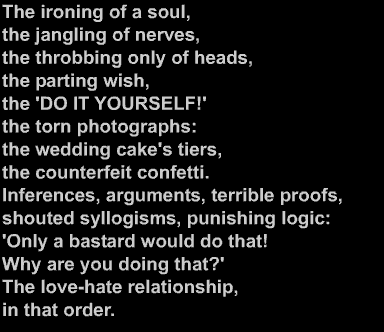
How close they are -
like tissues joined to make a scar.
They need each other -
badly.
They care for one another -
and another..
Tearing apart -
the fear of violence.
Bringing together -
the fear of silence.
Difficult poetry
D-day, the evening beore
The calm, blue sea
of sky
saturated with light
unites the drifting island
of the sun, the particles of sand.
Glittering shoals of stars swim in the
mechanical sky, constantly
replenished and netted and landed,
brought to the land precisely when demanded.
The mass beyond below
is where you may land, outlandish, and so
like landed fish you'll gasp
at what you can't hope or fail to grasp.
Hart Crane and Attila Jozsef
The sea waved
and parted
and hurried along
the long platform.
So long!
He leaped over the rails
and by the track,
as the platform steamed on,
deeper and deeper
he sank,
the sleeper.
Nature poetry
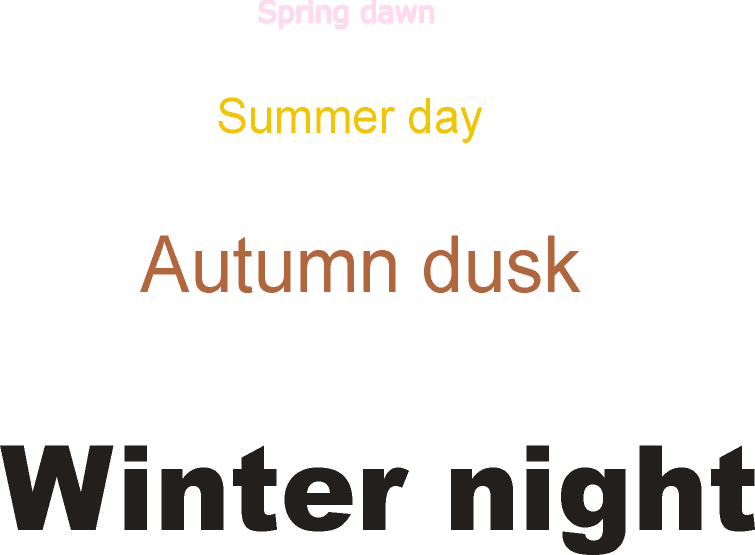
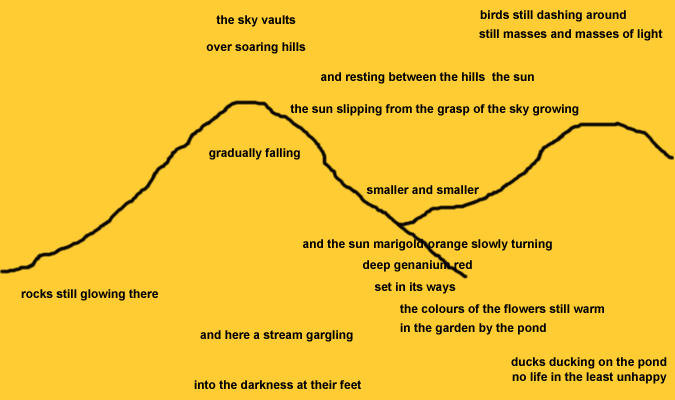
Commentary on 'The/Jaws of/Borrowdale ...'
The poem may be straightforward but the linked poem and image show dissonance. The poem makes the claim that the scene is so compelling, it presents itself with such directness, that it is reality, without the difficulties we face whenever we concentrate upon appearances, the deceptiveness of appearances, the unreliability of our senses. The image which is linked with the poem is, though, very much a distortion of reality. The mound in the centre represents Castle Crag without undue distortion. The fells on the left and right are very much distorted. Our senses impose {adjustment} and so do our memories.
Commentary on 'Bats blinking in the dark wings ...
Obviously, the image in the opening lines of the
poem is theatrical. The 'dark wings' are the wings of a theatre, the moths
are players, that is, actors, playing in the theatrical lighting. 'Playing'
also has overtones of heedless enjoyment - but the moths are threatened by
the bats.
The moon is 'swung' as it passes in its apparent
orbit in the night sky. It's 'a' moon which, like all the other moons in the
solar system, is known to us, but there must be moons too which are not
known to us outside our solar system.
The inner life of the moths that flutter and the bats that flitter isn't known in the same way. They are 'others,' whose inner life we can only imagine.
As for the consciousness of bats, I had in mind the essay of the philosopher Thomas Nagel, 'What is it like to be a bat?' The essay, though, is not about the mysterious otherness of bats but an anti-reductionist viewpoint in the philosophy of mind according to which consciousness, subjective experience, can't be reduced to neurophysiology. I share this viewpoint.
Bats, of course, emit sounds which can't be heard by
us.
The 'unheard shrieking' of people gives a linkage with the opening of
Rilke's First Duino Elegy, 'Who if I cried out , would hear me among the
angels'/hierarchies?'
'Shrieking' suggests something unpleasant. I oppose
views of human life which reduce it to something completely unpleasant,
without denying that there are unpleasant aspects and that 'shrieking' or
similar responses are part of life. I give some other responses: 'shouting,'
that is, the shouting of defiance as well as the shouting of anger and
argument, 'saying,' expressing states which are not intense, such as normal
human conversation, and 'singing,' the creation of beauty. The viewpoint of
the poem is anti-reductionist in a wider sense.
The bats and moths are the first two players on the world's stage in this particular drama. Humanity is the third player, but 'third' refers also to the musical interval.
They
are gone
and at one
with the earth,
beneath turf
or corn or
an airport.
Commentary on 'They are gone ...'
Each of the short lines has 3 syllables.This kind of syllabic verse I call 'syllabic unit poetry.' In concrete unit poetry. (See the examples in the region 'Concrete poetry') there's complete control of the letters, punctuation marks and spaces so as to shape the poem. In syllabic unit poetry there's complete control over the number of unit-syllables. The lines are iambic monometers to begin with but the monometers are varied.
Starry night,
so recondite.
Send your light
into our night.
Lush
leaves, drunken butterflies, great swallows,
the enormity of life, short shadows,
staggering bats,
the glowing path of the endless lake that's
The Milky Way, an
infinity-inwards
the rushes of time, the hordes,
their silent cries,
of fireflies.
The
lake's fullness fulfils me,
mountainous water's overwhelming's
surface deep in the mind.
The sun beats the water,
swaying in the heat -
I feel rather than see -
the water's calmness stirs and excites like a drum-beat,
the sun beats the surface to gold leaf
of the lake with its complex of bays,
molten metal shining sure.
In
disbelief I see
leaves leaving,
unburdened branches groaning
in the wind.
There is still birth,
plants reseed,
but nights are growing,
days recede.
After rowans have berried
everything is hard.
Snow
Sifted,
unfallen snow,
settling and unsettling snow,
snow resting like mortar on the stone
of the cold, unroofed, unfinished home
we call the world,
snow drifting far, and wide.
But we drift, then fall.
Suddenly small,
finding nothing to grasp,
we suddenly gasp
weakly, weakly,
soon silenced, and sleepy.
The huge moor above
these farm buildings huddled like sheep
had waited,
I'd sheltered,
too long.
What would only belong long in memory,
this strong beauty, a wind,
from cutting edge north-easterly
sculpting the snow
to warm, wet, west
would end -
in me trudging and trampling
the mucky moor,
bitterly regretting
the mild and pleasant wind.
Fields unlike fields,
snowed under, in the dark,
stark, staring at, standing snowflake -
near, no other -
watching, watching the whiter than white,
strong, silent fields of another
fielding flakes,
caught out by the cold, the dark
wilderness of the fields.
showering snowy spray
in an effortless display
of bravura descent,
the skier
shot by the dangerous rocks,
skimmed successive massive steep banks,
far and fast from here,
suddenly
a strange blot,
a distant dot
and nothing to do with me.
Humour and sarcasm
A Learning Zone
Your ears are assaulted by the noise,
as if from hundreds - thousands - not thirty
girls and boys,
a seething, shouting, shoving, guffawing mass,
boiling over with resentment, hostile and crass.
Some of them do have a purposive look
but they're writing on the walls, not in a work book.
A helpful youth tries to wash away their crap
with a Bunsen burner connected to a water tap.
Today, the teacher has to assess them on this:
'Learning strategies in formulating a hypothesis.
He pleads for their attention,
mumbling 'extra work' and 'detention'
but the only response is the throwing of a dart -
not the product of the paper folder's art.
This art features in another of theirgames -
a paper aeroplane lit, launched, crashes in flames.
Then it happens yet again, yet again - a boy farts.
Gales of laughter, bless their little hearts.
The teacher loses all self-control: 'Who did that?'
The teacher's pet owns up: 'Me, you twat!'
In the end, the skill, the 187th test
of plagiarism is actually assessed.
The Head writes for Dr Horatio's references
'Pupil-centred: pupil preference's
aims and objectives paramount always ...
Good exam results, some grade A's.'
The bell rings. Dr Horatio hopes a note of quiet authority will impress the inspector, lying there, hit by a missile, unable to see but still recording Learning Performance Indicators. Truly, one of the Learning Inspection Partnership's Classroom Heroes.
'Please try to email Smartphone Learning Outcomes by tomorrow. Smartphone learners, you may go.'
The worst restaurant in
the world
Published in 'Krax,' the magazine of humorous poetry
In this restaurant we serve them
right.
Yesterday, someone asked for wholemeal bread.
I gave him stale, sliced white
and shouted in his ear, 'Did you hear what I said?
Stuff it up your stupid arse.
Now drink that lard-and-leftover soup.'
Whatever will they want next? I ask.
An immensely dignified head waiter with a slight, servile stoop?
That newspaper not acceptable to the lady?
First you demand a knife and fork and now you want a napkin!
You're not enjoying the chef's speciality,
'Limaces étuvées à la margarine.'
You ARE a fussy eater! What's in a name?
Fried slugs taste like snails - exactly the same.
Death and a
salesman
Published in 'Route 57,' the literary magazine of Sheffield University
Sure, gas has
its advantages, but it reeks.
Have you ever thought about the danger of leaks?
Basically, gas and injections are just chemicals,
and we should cut down on chemicals,
you agree? Pollution has to be Public Enemy #1
- after gun control, lefties, liberals and the Theory of Evolution.
Electricity’s no better - anything but clean.
Like using electric shocks in loony bins. I mean!
It may seem modern but it’s too much hassle.
No, true sophistication is to use the best of the past.
Have you considered a method based on renewable resources,
cost-effective, with, worldwide, thousands of satisfied customers?
That’s why the penitentiary should use hanging, Warden.
The rope-makers of America say, ‘Go, Go, Go Hempen!’
He loves reading about
falling snow.
He's usually indoors whenever he does so,
but if any began falling outside as he read,
he would dash outside and let it fall on his head
and only return to reading his text
when fear of frost-bite gave him a pretext.
The Inquisition
On the rack they are highered.
At the stake they are fired.
And all because of
simple, clerical errors.
A
high-pressure salesman, les mains sales,
a poor beggar who beggars
description,
un-suited for his calling,
dandruffed, constipated, taking laxatives on prescription,
has been talking for over an hour now,
or rather listening, more and more forlorn.
His client's a walking encyclopedia
of consumer law and consumer lore
who shows complete contempt for all his pathetic reasoning,
says he has no cash, the miserable git,
and is completely un-pre-possessing -
'I never buy anything on credit.'
An awkward customer.
Who's so pleased (this may come as some surprise)
he's got the better of this bumbling salesman
that he relaxes, and in the end, he buys.
A reasoned response to Luke Wright, poet, who attacked IDS (the Conservative politician Iain Duncan Smith) using only the vowel 'i'
Commentary
This rising Lit-Hit,
this nit-picking Lit-Big,
this Mill-Wright
grinding his lit-bits,
grinning, grinning, grinning,
is insipid in print
[IDS 'ripping ribs in glitz
grills'].
His filmic fighting is
filling in,
his illicit flings
filling in
[IDS: I wish him limp dicks']
idling, tiring, slipping, sliding,
whittling his whims,
signing his sighs.
'If I ... '
'I might ... '
(might is plight).
This Lit-Grit
is grim, grim, grim in print
[IDS 'twisting victims till victims stink ...
']
A reasoned response to Luke Wright, poet, who attacked IDS (the Conservative politician Iain Duncan Smith) using only the vowel 'i'
Commentary
This rising Lit-Hit,
this nit-picking Lit-Big,
this Mill-Wright
grinding his lit-bits,
grinning, grinning, grinning,
is insipid in print
[IDS 'ripping ribs in glitz
grills'].
His filmic fighting is
filling in,
his illicit flings
filling in
[IDS: I wish him limp dicks']
idling, tiring, slipping, sliding,
whittling his whims,
signing his sighs.
'If I ... '
'I might ... '
(might is plight).
This Lit-Grit
is grim, grim, grim in print
[IDS 'twisting victims till victims stink ...
']
A reasoned response to Luke Wright, poet, who attacked IDS (the Conservative politician Iain Duncan Smith) using only the vowel 'i'
This rising Lit-Hit,
this nit-picking Lit-Big,
this Mill-Wright
grinding his lit-bits,
grinning, grinning, grinning,
is insipid in print
[IDS 'ripping ribs in glitz
grills'].
His filmic fighting is
filling in,
his illicit flings
filling in
[IDS: I wish him limp dicks']
idling, tiring, slipping, sliding,
whittling his whims,
signing his sighs.
'If I ... '
'I might ... '
(might is plight).
This Lit-Grit
is grim, grim, grim in print
[IDS 'twisting victims till victims stink ... ']
Miscellaneous
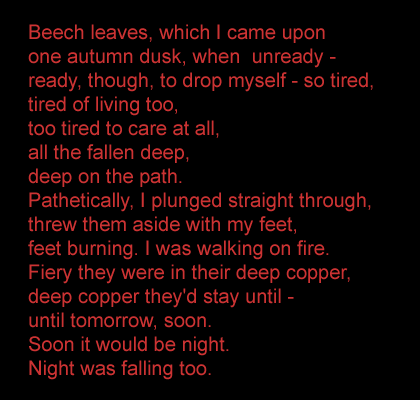
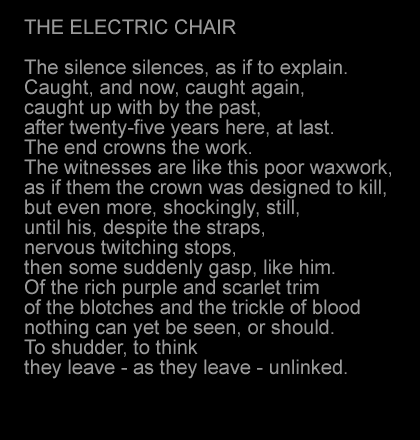
Heimat oder Ausland
Mehr zu sehen
oder besser zu sehen,
reisen
oder bleiben
He
went and saw it often, Lorca:
the bulls' as they stumbled and died
suddenly glazed eyes,
as if no longer able to comprehend
the Spanish arguments for death and torture.
The cathedral aspired.
The
castle towered.
The people cowered.
Not even, evening:
below, a glow,
red, redder, reddest,
above, sky-blue
contracts, expands,
soaring above the lives
in the houses in the forest,
shuttered, almost invisible,
beneath blue-fingered night.
The most intense joy,
the joy that springs from nothing,
the joy of Christians,
of the deeply disappointed,
leaps up sometimes so suddenly,
as suddenly as a sniper's kill,
in the midst of disorder, confusion,
the confused richness of lives
rich in disappointments,
lives lived without or with
insight and skill.
'The most intense joy ...'
Published in
Poetry Nottingham International.
Since revised.
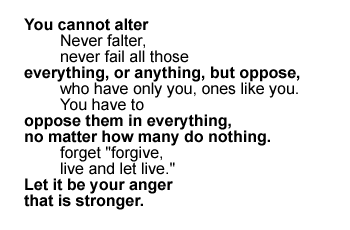
New York City scene
In this neighborhood
loaded with acrimoney,
he's lying in a state on the sidewalk,
attracting no interest at all, do you see, honey?
It's obvious from his bottles and his slurred talk
he's gone into voluntary liquidation.
Doesn't he remind you of something from the stock market,
this citizen of our great and wealthy nation?
A steer, maybe, lying there on bare concrete.
Futures like his are very uncertain,
his corporate survival must now be in doubt,
his financial situation was bound to worsen.
There are so many competitors about.
Your life,
full of chance and finalities,
can have the smiling assurance
of something which never thinks.
Be like nature,
which accompanies wars and killings,
its own discreet or dramatic killings,
with snow settling, winds blowing,
the moon rising or setting with such simplicity,
on such carnage.
Be happy, be contented, be dissatisfied, be many.
Feel the ecstasy of the hunter,
the terror of the hunted,
the anger of the one who acts to stop the killing,
but of course, so rarely can.
The ambiguity of a rope,
which can save life and end it
His sudden
fall
transfixed them all,
as if they had fallen too,
or might fall next
into the darkness near at hand,
pierced by his single call.
Into the darkness
led the rope that broke his fall
and held.
The rope,
falling's double check,
tied around either waist or neck.
Those
dots are men,
those lines are ropes.
If you graph their rise or fall
wait,
hesitate before you extrapolate.
They
look ahead,
troubled by heat and thirst,
aroused, and full of rapt delight
at the course of their journey
and the memories it leaves in its wake,
turbulent at first, then smoothed,
an expanse of calm.
The
trees are restless.
Through the broken window wind whistles,
the wind scours the nettles and thistles
of the clay.
Feebly, like a wasted day,
the low light of the sun,
shining no doubt steadily upon
the clouds, unsteady, blustering,
lights upon this sodden hut sheltering
from the wind and driven rain me.
I can see and foresee
a far more comfortless shelter.
The sky was largely grey.
The stored potatoes turned black.
That winter, all the family starved.
The children were buried in potato sacks.
By the waters of Doo Lough we lay down
and slept,
and all our prayers were answered at once,
Mary, Mother of God, be thanked -
for an end to the sleet,
the unendurable sleet,
an end to the hunger
that gnawed our bones,
the unendurable hunger,
an end to our lives,
their unendurable lives.
Commentary on 'By the waters of Doo Lough ...' (extract from my page Ireland.)
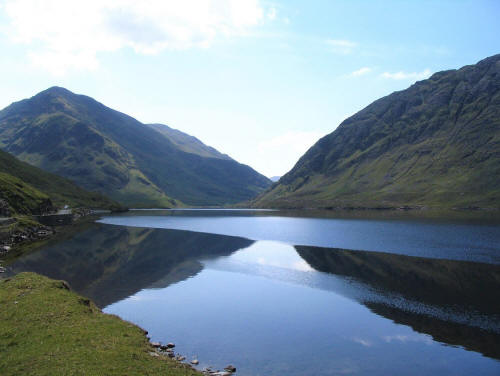
Above, Doo Lough, County Mayo, Irish Republic
On 30 March, 1849, hundreds of starving people applied for famine relief in Louisburgh, County Mayo. They were ordered to report to the Westport Poor Law Union at Delphi, ten miles to the south, at 7 a.m. the next day. They walked through the night, in rain, sleet and snow. They were refused famine relief and began the walk back. By Doo Lough, an unknown number died. An annual famine walk from Louisburgh to Doo Lough commemorates the event. The first line of the poem recalls the first line of Psalm 137, 'By the waters of Babylon, there we sat down and wept ...'
The lines in this poem of mine are spoken by a single person except for the lines in italics, which are spoken by a number of people, perhaps members of an audience. This recalls the words of the priest and the responses of the congregation. The series is intended particularly to give opportunities for performance and interpretation to the people attending a poetry reading, to make their role far more of an active one. There should preferably be practice, rehearsal, directed at changes of tempo, the giving of weight to the words, variations in weight, above all reaching towards the bitterness and tragic intensity of the experience.
Everything they had was tasteful,
made to last,
except their bodies -
so distasteful, ruined so fast.
All day
long
they long
to belong,
they long
for belongings.
'Let's
List ...
Lost
Lust ...
Refuse to be refuse.
Cogs, refuse to turn.
Allowed no other luxuries,
you allow yourself these,
patience and forgiveness.
Lighten your burden,
throw away your illusions,
and if acceptance
must be accepted
accept, but don't forgive.
Dusk filled the air,
and darkness filled the air,
as the sun
beat against the windows of the car.
The pipe that had watered
the flowers of his garden
was the umbilical cord
that linked him with
death.
A puddle or pond or sea-like lake,
natural or man-made, authentic or fake,
ice-cold, warm, hot or scalding,
remote and unexplored or crowded beyond enduring,
mapped or unmapped, famous or obscure,
enhancing life or destructive, pure or impure,
ugly or plain or beautiful as can be,
useful or useless, in the highest degree or slightly -
pick out the words that apply to your soul
(mortal / immortal) from the words describing each water-filled hole.