When a poet writes in iambic pentameters, the length of the lines is determined by the form chosen to a significant extent. In free verse, the length of the lines is not determined by the form but by other considerations, which may be complex. In some free verse, the length of the lines seems arbitrary. The use of lines of different length is obviously a well established technique in poetry, past and present, but variable line poetry introduces some new features, which make the use of a new name justifiable. Variable line poetry, then, is yet another technique which produces contrast, the contrast between shorter and longer. In variable line poetry, the intention is to produce this contrast consciously and to produce a rhythm of shorter and longer lines, like the rhythm of shorter and longer sentences.
These are some possibilities:
Differences of line length on the page OR differences of line length achieved
by sound
Strongly contrasted differences of line length OR subtle or slight differences
of line length.
Differences of line length according to a regular scheme OR differences of
line length which are free and irregular.
An example (differences irregular, achieved by sound)
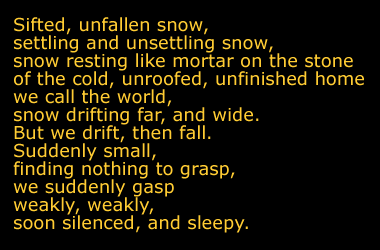
(30s) This is the timing of the poem.
This poem is used in a scene of one of my plays, 'Maestro,' a scene set in the Himalayas.
I feel a particular affinity with Robert Frost's writing about snow, above all in 'Stopping by woods on a snowy evening' and 'Desert Places,' the first line of which is 'Snow falling and night falling fast, oh, fast ... '
The sixth line of my poem, 'snow drifting far, and wide' is one of the wider lines, for an obvious reason. The common phrase 'far and wide,' as in 'to look far and wide' is made longer by the insertion of the comma after 'far.' (This use of punctuation to vary a common phrase is a technique I use in other poems.) The eighth line, 'Suddenly small' is one of the shortest lines, for an equally obvious reason. The eleventh line, 'deeply, deeply' is short and concentrated. The twelfth line, 'soon silenced, and sleepy' is expansive.
This poem, short as it is, gives a number of basic techniques for use in variable line poetry, 'rules' for making lines longer or shorter, and the list can easily be expanded. (See also my discussion of extension-contrast in the page 'Metre.')
When the poem is read, we have to consider not only the length of the lines on the page but also their spoken values, as the voice slows and quickens - in other words, we have to consider the nature of the linkage between the poem on the page and the spoken poem. In many cases, the difference between shorter and longer lines will be more marked. The line 'snow drifting far, and wide' will naturally be given great length, almost as if the listener were being given the chance to imagine the snowdrifts in the winter landscape, and will be followed by a significant pause. The line 'Suddenly small' will naturally be spoken very rapidly. As the final line is spoken, 'soon silenced, and sleepy' there will be a slowing down - a rallentando - which is particularly marked after the comma.
The first line needs some comment. 'unfallen' is a reference to the Christian doctrine of the 'fall of man' (I've no belief whatsoever in this doctrine or other Christian doctrines.) It does give a vivid but erroneous, image of the coming of imperfection into the world. The snow here isn't subject to change, or at least the change that comes from falling. There's a linkage with the corn of the Christian poet Thomas Traherne: 'The corn was orient and immortal wheat, which never should be reaped, nor was ever sown. I thought it had stood from everlasting to everlasting.' The snow too, which had never fallen, 'stood from everlasting to everlasting.' (Although unfallen, it does physically settle - a contrast with its emotional effect, 'unsettling.') The poem is, though, not a Christian one, or a religious one. The world is described as a 'home,' using the word that estate agents like to use instead of 'house,' but a home which is 'cold, unroofed, unfinished.' This is to emphasize the importance of human effort and ingenuity in making the world livable. The theistic stress is upon what God supposedly gives us and upon human gratitude. The secular stress is upon the fact that we are given very, very little which is easily usable.
There are various devices for making the sound value of lines appreciably longer than the 'page' value of lines: (1) caesuras (2) long vowels (3) rallentando.
I regard the use of long vowels as very important. Consonants and short vowels are like the notes produced by a percussive instrument, such as the piano. Long vowels can be sustained, like the long, sustained notes which most orchestral instruments can produce. The long vowels in 'far' and 'wide' in the line 'snow drifting far, and wide' give this line a particularly long sound value. A line may contain contrasts of value. The last line, 'soon silenced, and sleepy' 'soon silenced' is abrupt, 'and sleepy' is expansive so that overall, the line is lengthened. Poetry in English is accentual not quantitative, of course, but I attach great importance to the difference between short and long values - as a way of giving length to lines, not to establish quantitative metre.
In its emphasis upon passivity rather than rage or defiance, the poem gives a partial view, but this is a view of passivity which is dramatic and intense rather than muted.
A second example (differences strongly contrasted, regular, on the page):
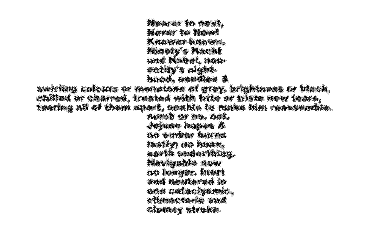
I call this transept poetry. I discuss it on the page on concrete poetry.
Proportion and disproportion are important considerations in the discussion of variable line poetry, as they are in the discussion of architecture. The architectural critic Alec Clifton-Taylor makes the point (in 'The Cathedrals of England') that 'York nave is yet another English Gothic building which is too broad for its height.' A literary critic may make the point that the short lines in a poem of lines of variable length are too short in proportion to the long lines, or that there is a disproportion in the number of shorter lines compared to the number of longer lines. If, for example, the number of shorter lines is insignificant, the contrast may be muted and ineffective. Proportion is important in poetry as in architecture but this is not to say that poems should always be well-proportioned. The deliberate use of disproportion is a valuable technique. It can produce extreme, very modern effects.
In any systematic treatment of variable line poetry, one important distinction is that between lines which vary in length according to a regular scheme, and lines where the variation is free and irregular: pattern by line length may be either formal or non-formal. George Herbert is an example of a poet who often used lines of markedly different length in a regular scheme - examples are 'Discipline,' 'Virtue' and 'Love (III).'
For analysis of poetry where there are different line lengths (this poetry may or may not have the distinctive features of 'variable line poetry') a simple notation is needed. When the lines vary markedly in length, they can be described as L (long) and S (short) Herbert's 'Discipline' follows the scheme LLSL, 'Virtue' is LLS and 'Love (III)' is LS.
I have devised another notation which is useful for poems where the lines are not markedly dissimilar in length. The number of feet in each line can be listed. For example, a poem whose first line is a pentameter, whose second line is a trimeter and whose third line is a pentameter would be described as 5, 3, 5. A length diagram would show this by lines 5 units long, 3 units long and 5 units long.
A different notation is needed for the analysis of the spoken poem. The second line of a poem may contain long vowels and be longer than the first and third line when spoken. This could be shown by using timings for each line.
It may be necessary in contemporary poetry patterned by sound to create rhymes and then to deflect attention away from them. Contrast of line length provides another way of doing this. A poem may follow the length scheme LSLS and be rhymed according to the sound scheme abba, so that long lines are rhymed with short lines and lines of similar length do not rhyme with each other. Sound linkage and length linkage can be shown together by using a length-sound notation. In this notation, this particular poem is La Sb Lb Sa.
A very short line, one consisting of a single word, can be rhymed with a longer line, to emphasize contrast and reduce the obviousness of a linkage. This technique may convey finality. An example from my own poetry:
are fading, distant. In the grey dawn, the pleasure of feeling
nothing.
Another example:
they felt different -
indifferent.
In the poetry of the past, it's more common for length linkage to reinforce sound linkage. To give just one example, Hardy's poem 'Drummer Hodge' follows the composite scheme La Sb La Sb La Sb.
If the lines don't vary markedly in length, then notation will give the number of feet in a line, followed by a lower case letter to describe the sound scheme: for example, 5a 5b 4a 4b.
When is it time to move on? (From one line of a poem to the next line.) Quite often, the decision to move on seems obviously faulty, too soon or too late.
Here, in the first section of 'Tales from Ovid,'
('Creation; Four Ages; Flood; Laocoon') it seems to me that Ted Hughes
should have moved on much sooner in the first line:
No sun
showed one thing to another,
No moon
Played her phases in heaven,
No earth
Spun in empty air on her own magnet,
No ocean
Basked or
roamed on the long beaches.
The first line here is surely too long
and disrupts the pattern. This would have been better word placing and
better patterning:
No sun
showed one thing to another,
No moon
Played her phases in heaven,
No earth
Spun in empty air on her own
magnet,
No ocean
Basked or roamed on the long beaches.
None of the lines here, in both the original and the 'revised' version, are at all long and 'No sun,' 'No moon,' 'No earth' and 'No ocean' are obviously exceptionally short. Outside the world of poetry, shorter forms of communication are often favoured - which isn't to say that the trend should be followed. Resist trends! (except when the trends have arguments in their favour.) Does the trend have an influence on the length of lines in contemporary poetry? This would need a substantial study, which I don't provide here.
There are considerations of readability which are relevant, I think. On this site, I use columns which on average have 10 words on each line. This is for a good reason. Studies of readability show that this is about the optimum. There are many sites which disregard these findings completely. The site www.cosmoetica.com is an example. This is a short extract from one of its pages. I don't comment on the content, I only draw attention to the line length:

Reading lines of this length is very tiring. Lines of poetry which are appreciably longer than 10 words per line is also tiring, although not to anything like the same extent. Even if a poet gives thought to the matter, using lines a little too long for optimum reading may be unavoidable, as when a translator wants to use a long English line to convey a line which is long in the original. Richmond Lattimore, for instance, uses long lines in his translation of Homer's hexameters in his translation of 'The Odyssey,' Book IV, lines 278 - 279:

How do we measure the length of lines in a poem? The lines of a poem which uses iambic pentameters - five feet - are longer than the lines of a poem which uses iambic dimeters - two feet. But it's far more convenient to count words rather than feet and words have meaning, unlike feet, except in cases where a word coincides with a metrical foot.
It's convenient to list the words in a line by number - 1 for the first word, 2 for the second word ... If the word is monosyllabic, this is sufficient, if polysyllabic, then, use a, b ... to refer to the syllables.
If there are three words in a (short) line and the first word has two syllables, the second word has three syllables and the third word has one syllable, then this line is described as
1a, 1b, 2 a, 2b, 2c, 3
The opening lines of Robert Frost's 'Stopping by Woods on a Snowy Evening' are
Whose woods these are I think I know.
His house is in
the village though;
He will not see me stopping here
To watch his
woods fill up with snow.
This is the line length scheme:
1, 2, 3, 4, 5, 6, 7, 8
1, 2, 3, 4, 5, 6a, 6b, 7
1, 2, 3, 4, 5, 6a, 6b, 7
1, 2, 3, 4, 5, 6, 7, 8
This gives a word-syllable linkage between lines which has the form abba. This can be compared with the rhyme linkage scheme abba, the first line linked with the fourth line by sound and the second line linked with the third line.
Compare this example with a very different one, any of the verse paragraphs of Gerard Manley Hopkins 'The Wreck of the 'Deutschland.' '
The first line of each of the verse paragraphs is linked by sound with the last line, the eighth. Each verse paragraph follows this sound-linkage scheme, ababcbca.
The scheme I propose gives a convenient way of specifying and comparing line lengths. In the case of this poem, the most obvious contrast is between the length of the first line and the length of the last line.
For verse paragraph 5, the first line follows the line length scheme
1, 2, 3, 4
whilst the last line of the verse paragraph follows the
scheme
1, 2, 3, 4, 5, 6, 7, 8, 9, 10, 11, 12, 13, 14a, 14b, 14c
For verse paragraph 7, the first line follows the line length scheme
1, 2, 3, 4
whilst the last line of the verse paragraph follows the scheme
1, 2, 3, 4, 5, 6, 7, 8a, 8b, 9, 10, 11a, 11b, 12, 13, 14
Metre, sound linkage and line length are generally studied in isolation, or relative isolation, is understandable but understanding the overall technique of a poem requires a knowledge of the simultaneous use of these separate techniques. Of these separate techniques, the study of line length is the least developed.
The notation which indicates the number of words in the line and the location of monosyllables and polysyllables can be used to indicate the stressed and unstressed syllables. For the lines
Whose woods these are I think I know.
His house is in
the village though;
1, 2,
3, 4,
5, 6,
7, 8
1, 2,
3, 4,
5, 6a,
6b, 7
I discuss aspects of the published poetry of Jared Carter on the page Modulation, and in particular 'Les Barricades Mystérieuses,' which is made up of thirty-two villanelles. He has lately begun to publish brief formal poems with lines of markedly different length, each poem in the regular scheme L-S-L-S-L-S-L-S-L-S-L-S.
The short and long lines are contrasted in metre. In the majority of cases the short (S) lines have the metre unstressed-stressed-unstressed-stressed. The linkage of these lines with the freer, flexible long (L) lines by enjambment is an instructive delight.
There are two components, then, the short lines and the long lines, the two components closely linked. The rhyme-scheme of each component is the same, deeply satisfying in its sameness: aa bb cc. The rhyme scheme of the poem as a whole is abab cdcd efef.
The poems give what Gerard Manley Hopkins called 'inscape.' (Collins English Dictionary has for inscape 'the essential inner nature of a person, object etc.' as expressed in literary or artistic works.') He makes significant use of it in his Journal, eg.1871: 'End of March and beginning of April - This is the time to study inscape in the spraying of trees, for the swelling buds carry them to a pitch which the eye could not else gather - for out of much more, out of little not much, out of nothing nothing: in these sprays at all events there is a new world of inscape.'
This is Jared Carter's 'Dragonfly:’

The line 'a different skill' can be considered as disyllabic in sprung rhythm, another term used by Gerard Manley Hopkins. He gives this example:
March dust, April showers
Bring forth May flowers,
Here, 'showers' and 'flowers' are considered to be monosyllables and the lines are in sprung rhythm.
This poem gives essence rather than appearance, although 'essence' is a cold word to describe Jared Carter's depiction of insects, one facet of his multi-faceted work. See, for example, these poems in his published volume 'After the Rain:' ‘Galleynipper’, ‘Cecropia Moth’ and ‘Cicadas,’ which begins:
Only one, and then many, scissoring
through the summer dusk, neither calling
nor answering but simply singing -
Like Thoreau, he has given insects and other creatures an importance and dignity which are their due. Compare Thoreau’s ardent comments at the end of 'Walden:' ‘Every one has heard the story which has gone the rounds of New England, of a strong and beautiful bug which came out of the dry leaf of an old table of apple-tree wood …’