The Canadian poet George Murray uses a technique which is strikingly similar to the one I use here, although obviously his technique isn't within the context of linkage and {theme} theory. From the Wikipedia entry on George Murray: 'Murray's 2007 book, The Rush to Here, a sequence of 57 sonnets, contributed to the late 20th/early 21st century revival of the sonnet form by reworking a number of traditional forms (Petrarchan, Spenserian, Shakespearian sonnets) into a new rhyme scheme that employs what the poet refers to as "thought-rhyme", conceptual and semantic pairings that work on the level of synonym, antonym and homonym to create intertextual meaning, as opposed to the sound bonding of traditional aural rhyme. This means a word such as "night" could thought-rhyme with "day" (antonym), "dark" (synonym), "knight" (homonym), "soldier" (synonym of the homonym "knight"), "thing" (anagram), etc.' I can easily prove that I'd published information about the technique first. The page About this site gives archiving information and this page was first archived in June 2005. My work on linkage by meaning was done some years before. I've every reason to think that George Murray arrived at what is essentially the same technique completely independently.
Semantic linkage used unsystematically and very occasionally has a long history. From Brennan O' Donnell's excellent 'The Passion of Meter: A Study of Wordsworth's Metrical Art,' P.220 - 221:
'Pointing out "some of the artifices of versification by which Milton produces so great an effect,' Wordsworth cites the following from Paradise Lost (II.486 - 88):
... pining atrophy,
Marasmus and
wide-wasting pestilence,
Dropsies and asthmas, and joint-racking rheums.
'Wordsworth reportedly commented that "the power of the final 'rheums' is heightened by the 'atrophy' and 'pestilence' occurring at the end of the two preceding verses. Certainly there is a kind of semantic rhyme in the example: the three kinds of disease, different and similar, placed in a formally important position, help to give the final word added force by virtue of accretion.'
Brennan O' Donnell adds that 'Wordsworth also was likely to be remarking on a specifically rhythmic source of emphasis here' and amongst his perceptive observations is this, 'Milton's passage uses the "passion of meter" to effect. "Rheums" is felt to be powerful in part because the minute physical tensions that exist at line boundaries even in blank verse allow it to be placed in rhythmic contrast to the semantically similar nounts that precede it.'
The technique I use is systematic and
varied. These are some of the ways in which the final word or
phrase in one line of a poem may be related to the final word or phrase in
another line:
(1) they may be similar in meaning
(2) they may be opposite in meaning
(3) they may be related in an oblique way, the equivalent of off-rhyme
(4) they may be related by some important context. For example, in the poem
discussed below, the words ‘danger’ and ‘valley’ are
connected by the familiar words of the 23rd Psalm, ‘the valley of the
shadow of death.’ I refer to this as ‘linkage by context.’
Alternatively,
(5) the line endings may be part of a progression or modulation.
Using meaning patterns rather than sound patterns a wide variety of subtle, resonant and dramatic effects are possible. Highly organized meaning schemes can be used, and have the advantages of rhyme schemes, such as the satisfactions of creating and finding pattern. There are meaning equivalents of rhymed couplets - the first and the second line, the third and the fourth line, have a meaning linkage - and there are meaning schemes which are the equivalent of the rhyme schemes abba, cddc, and so on.
Most of the poems I have written using this technique are superficially less striking than many of my other poems. In this case, diction isn't as revolutionary as the form (unobtrusive though the form is in these poems.)
In this poem, the meaning scheme is obviously AA BB... (I use upper case letters for the analysis of poems in a meaning scheme, lower case letters for the analysis of poems in a rhyme scheme.) The final line is a quotation from Whitman’s ‘Song of Myself.’ The poem is semi-fictional.
I emerged from a winter without much snow
as unrefreshed as from a night without much sleep,
exhausted but wary, too conscious of the danger
of falling. I looked upon summer as the valley
between two mountains: the effort in climbing
and descending, the way so steep.
My mind was often quite blank. Not the inviting blankness
of Walt Whitman’s open road but the dim sense
that I could not even make something of my weakness,
that the capacity to exult despite every setback
was a reflex I had lost -
'These so, these irretrievable.’
(37s) This is the timing I recommend for this poem.
The poem is written in 'meaning-couplets.' So, 'snow' is linked with 'sleep' and 'danger' with 'valley.'
Another poem which uses semantic linkage. Here, the meaning scheme is ABAB CDCD ... So, 'young' is semantically linked with 'old' and 'threat' is linked with 'danger.'
It's introduced with a quotation from the Bible. I'm a non-believer, but I think that non-believers can enter into the world of believers, can understand its power and appeal, whilst rejecting the beliefs.
'Be sober, be vigilant, because your adversary the devil, as a roaring lion, walketh about, seking whom he may devour.' 1 Peter 5:8
When he was young,
he could ignore any threat.
Now that he's old,
his world far more full of dangers,
and he so much more timid,
he's like a gazelle
listening, whilst drinking, fearful,
for the roaring lion.
Like someone accused of witchcraft,
who anxiously examines
her body for diabolical signs,
he probes.
Once, there was the fear of hellfire.
Now, all that remains
is the fear of death,
when nothing remains.
One of my concrete poems uses semantic linkage:
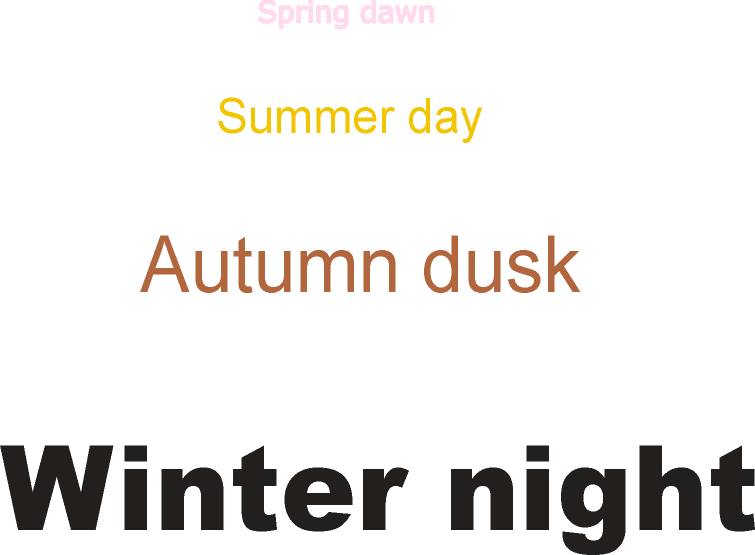
This uses progression.
The progression is dual: the seasons on the left, times of day on the right.
The poem is obviously very simple, or deceptively simple. It offers the reader
the literary equivalent of psychoanalytic 'free association,' 'a method of
exploring a person's unconscious by eliciting...thoughts that are associated
with key words provided by a psychoanalyst.' (Collins English Dictionary.)
The poem obviously should not be read quickly. There has to be time to summon
up images, memories. Timings are given for many of the poems on this site,
including the poem above, but it would be difficult to give a timing for this
poem. The poem qualifies as pictorial poetry - the black of the last line,
in the font Arial Black, represents, of course, the winter night. Other appropriate
colours are chosen for the other lines. I discuss the poem further at concrete
poetry.
There's a progression on both the left and right halves of the poem: from earlier to later times in the year on the left, earlier to later times in the day on the right, but there's also tension between these progressions and the intensity of light, which increases and then decreases: from dawn to the maximum of a summer's day, and then decreases through dusk to the minimum of winter night. The poem, then, uses tensile form.
Basil Lam wrote that ‘Nothing can be more inhibiting
to the artist than total liberty, a truth recognized by those twentieth-century
composers who from Schoenberg onwards have imposed arbitrary disciplines of
one kind or another on themselves to be able to compose at all.’ (‘Beethoven
String Quartets.’) Pattern by meaning is not an arbitrary discipline,
however, but one grounded in the nature of language.
The use of end-meanings, the counterpart of end-rhymes, is not the only way
in which linkage by meaning can be achieved. In free word linkage,
words are linked unsystematically and may be widely separated. The lines of
Milton exhibit free word linkage, but in this case the linked words aren't
widely separated. A careful reader
will notice the linkage of these words. Often, there is repetition of the
same word, which is a characteristic word of the poet.
Use of free word linkage can easily be found in the poetry of the past. One instance is the use of ‘sense’ in The Prelude, which has been analyzed by William Empson in ‘The Structure of Complex Words.’ Empson notes of Wordsworth’s use of the word that ‘in the great majority of uses he makes it prominent by putting it at the end of the line...’ Empson counts these uses: ‘Taking Mr. de Selincourt’s edition of the 1805 manuscript, I found 35 uses of sense at the end of a line and 12 elsewhere; the (posthumous) 1850 text has 31 uses at the end of a line and 11 elsewhere.’
In his essay, ‘The Development of Yeats’s Sense of Reality,’ (‘Southern Review’, vol. 7, Winter 1942) Randall Jarrell compares the words which Yeats uses particularly frequently in his early and his late poetry. The lists which he provides are extensive, but as examples, in the earlier poems of Yeats we find ‘lonely’, ‘gentle’, ‘tender’, ‘quiet’, ‘weary’, ‘desolate’. In the late poems we find ‘lunatic’, ‘mad’, ‘frenzied’, ‘violent’, ‘joy’, ‘hate’. Lists of this kind, containing the characteristic words of a poet, would be important in the study of systematic and free meaning linkage.
The poet, then, has the choice of a formal, regular scheme, or a scheme which is free and irregular: pattern by meaning may be formal or non-formal. There are other cases where the poet has a similar choice, for example in connection with rhyme - free rhyme - and line length. It's important that these varied possibilities should remain within the resources of poetry, that none of them should be regarded as unavailable.