

Alain Robbe-Grillet wrote that 'form in the novel has to move to stay alive.' This is surely true of the novel, and equally true of poetry. I make the point that the artist should 'transform form.' I stress the exhilarating variety of forms available to the poet and the need for a wide variety of forms - free verse as well as strict forms of many different kinds, forms from the past which are still useful and completely new forms. I emphasize form here, but not at the expense of content. As regards content, a significant number of my own poems are concerned with war and conflict, the First and Second World Wars and the conflict in Northern Ireland when the troubles were at their height. As we look back on the twentieth century, a century of unprecedented horrors, I think that this preoccupation can be seen as not at all misplaced or excessive, but the subject matter of poetry is vast. I emphasize variety of tone and subject matter as well as form. Very many of my poems are dark in tone but I've written poems which are relaxed, including humorous poems. The page Poems doesn't include all my poems but it does indicate something of their variety of form, subject matter and tone. The page is an example of Large Page Design. All the poems are on one single large page. Page Home, on the same page, gives access to all the poems, which are grouped in sections. Each section has poems linked by form or tone.
I believe that Linkage Theory offers a good basis for modern poetry - for both writing poetry and its analysis. My approach is in part systematic and rigorous, sometimes at a high level of abstraction, but I see no contradiction between system and rigour on the one hand and on the other, passion, compassion, activism, humour, an intense concern for the health of language and the vitality of culture, a whole range of other concerns. A systematic study can reveal gaps, new possibilities very clearly. The meticulous work of cartographers helped to show explorers what regions were still unexplored, to suggest new areas for risk and adventure.
Of all the creative writers of the past, it may be that Proust comes nearest to anticipating this theory, or the need for this theory. Andre Maurois writes of Proust that he had "many of the virtues of a scientist - accuracy in observation, honesty in dealing with facts, and a determination to discover the nature of certain general laws. For all his mysticism he was a positivist. Of all the many 'persons' who made up his individual self, the one that, in his opinion, clung most tenaciously to life was a certain philosopher 'who is never happy except when he has discovered the common qualities that bind together two works, two sensations, and two beings.' " ('The Quest for Proust.')
The celebrated moment when the taste of cake and tea summon up the world of childhood can be seen as an instance of the linkage brought about by memory, the linkage between the present and the past, which can be brought back to vivid life by a taste, a smell or an object. This overwhelmingly important theme makes 'positivist' not the best word to use of Proust - nor is Linkage Theory positivist. What is common to the Proustian view and Linkage Theory is the emphasis upon structure and form, and at the same time the freedom of art, the freedom of the human mind, to transcend structure and the flow of time.
The great design of À La Recherche du Temps Perdu is a notable example of the power of linkages to create a massive work of literary architecture. As Andre Maurois writes, "The reader...who, having worked through the whole novel, is struck by the secret symmetry of the composition, by the multiplicity of the details that balance one another from wing to wing of the structure, by the toothing stones set in position from the first moment that the work was begun, and designed to carry vaulting still to come, must be filled with wonder that Proust could envisage the whole gigantic edifice so completely."
Even in the case of Tolstoy, a writer more linked with conveying the immediacy of life than patterns, appearances may be deceptive. Italo Calvino writes in 'Leo Tolstoy, Two Hussars:' 'What other fiction writers make explicit - symmetrical patterns, supporting structures, counterbalances, link sequences - all remain hidden in Tolstoy. But hidden does not mean non-existent: the impression Tolstoy conveys of transferring 'life' just as it is on to the page ('life', that mysterious entity to define which we have to start from the written page) is actually merely the result of his artistry, that is to say an artifice that is more sophisticated and complex than many others.' (One of the essays in the excellent 'Why read the classics,' translated by Martin McLoughlin.)
Poetry cannot achieve the massive effects of Proust or of many much shorter works, but, as Wordsworth pointed out, scale is all. The hills of the Lake District are 'inferior to the massive mountains of the Alps in height, but not in beauty or significance.' ('Guide to the Lakes.')
So many human activities reveal a powerful
drive to explore the fullest range of possibilities. This drive can only be
appreciated to the full by taking a systematic approach. Michel Guerard, in
his 'Cuisine Minceur,' gives a systematic treatment of 'The Methods of Cooking.'
Colin Tudge, the writer on science, agriculture and cookery, gives a systematic
treatment of techniques in cookery in 'Future Cook.' In the great cuisines
of the world, for example, potatoes have not simply been boiled, baked or
roasted:
Potatoes may be served as whole, discrete things...They can be broken down
a little, so their surface starches take up the surrounding juices, and leak
out to thicken them. They may be pounded a little more to produce a puree,
usually called mash, or broken up completely to thicken soups, like flour;
or indeed turned into flour, which is sometimes used in bread. At all grades
of comminution the potato will pick up and hold surrounding flavours: of mint,
thyme, young carrot, or (although the potato came late to India) the whole
astonishing pharmacopoeia of Indian spices.
The potato, once mashed, is as pliant as modelling-clay; it can be mixed with
anything and everything and moulded to whatever shape you choose.
Of course, not all possibilities can
be used. It may be that a technique or a form has been used to a great extent
in the past and is now exhausted. The two questions which must be asked are:
(1) What are the possibilities and the possible combinations, revealed by
a systematic approach?
(2) Which of these can be used and justified in artistic terms?
By considering the possible combinations of length, form and subject, it can easily be shown that an epic poem in rhymed couplets concerned with the martial exploits of a great king is one possibility, but it is not one that would be contemplated today. By using systematic methods, we can more easily detect omissions and arbitrary choices, and perhaps develop new techniques.
I distinguish two phases in many human activities, the exploratory and the systematic. These phases are not to be regarded as separate and sequential - exploration can continue after systematization has begun. To give an example from scientific activity, in the exploratory phase, chemical elements were discovered one by one. The Russian chemist Mendeleev drew up a systematic plan for the ordering of the elements, the Periodic Table. Elements continued to be discovered, and one by one, the gaps in the Periodic Table were filled.
In the arts, the pattern is less clear-cut, but the resemblances remain. Innovations are made one by one, one possibility after another is realized, the repertoire of techniques becomes ever wider, more intricate. There follows a phase of conscious realization - there are gaps in the scheme which need filling, the possibilities are not exhausted, new possibilities can be realized. Thinking in systematic terms can lead to new innovations and new discoveries. Alternatively, there may be no obvious ways forward, no innovations which renew the exploratory phase.
In the exploratory phase, creation of new works is less problematic for a time because the artist, architect, writer or composer is working from within a style, which in the end is superseded: so, in architecture, the architect has worked within a succession of styles: Romanesque, Gothic, Renaissance, Baroque, and so on. Later, there was a systematic phase in which innovations were lacking and the architect chose a style, such as neo-Gothic or neo-Classic. The exploratory phase was renewed with the modern movement in architecture, which is now exhausted. An architect today chooses from past styles.
I defend systematic study and I defend too analysis and theory - but not all systematic study, analysis and theory. I argue the case for informed analysis in the page on Linkages with music. But the poem in its wholeness has the final word, and the whole person who created the poem. Brian Lee puts it memorably in his 'Poetry and the System:'
'Every work is a new mystery, coming from the larger mystery of which we are a part. Every poem that is a poem is distinctive: it hangs together differently and so requires special understanding, and not laws. The same must go for the human nature from which it came.'
Variant, linked forms of a poem or other work of art in which the shape is modified. For example, a poem may be in matrix form - almost all poems have been printed in matrix form, the standard way of printing a poem in consecutive lines. Alternatively, the lines may be fractured, opening the texture to some extent, or the poem may undergo fragmentation, opening the texture still further and giving a new linkage with the page or other surface. Another example is a centred poem (the poem is centred on the page rather than having a justified left margin, a way of arranging the lines used by James Dickey) and the same poem with a justified left margin.
Allomorphs have the same words and the same punctuation but differ in the arrangement of the poem on the page or in the size or tone of the lettering.
Allomorphism may give two different textures, close and open. In close texture, there is an effective contrast between the massed black print of the text and the surrounding white space of the paper, the ground, unless other colours are chosen for the print and the paper. In open texture, there's greater interpenetration of print and white space. A faulted poem will have open texture, encouraging the reader to give a more concentrated attention to the words in the interior of the poem, whilst the poem with unfragmented lines in close texture is likely to have a more striking visual impact. The faulted poem in open texture is derived from the allomorphic unfaulted poem in close texture by two operations: opening the lines, to give double spacing, and then fracturing the lines. All these innovations are due to my interest in the morphology of the poem.
The picture poem may be made up of words only, or may include an image in the form of a drawing, painting or photograph, for example, an outline drawing of hills or a fully-realized painting or a photograph of one feature in the picture space. Of course, there's no reason why a design poem should be limited to the size of a page in a book. Large works can easily be produced.
There's a linkage with graphic design, since the technique affects the appearance of the poem on the page. As in the case of other formal innovations, form should not be considered in isolation from content. Powerful emotion, the overwhelming force of the content, can almost compel the adoption of a form, such as the sonnet. Later, I use poetry by Shakespeare to illustrate the argument.
The layout of things far removed from poetry underlies the axis form. Consider a simple set of mathematical equations and the way in which the equations are laid out on the page, or a set of linkage statements in the notation I've devised and the way in which these linkage statements are laid out on the page, the linkage brackets <> in a vertical line. The contents brackets [] and linkage brackets are left blank in this illustrative example.
a = c
- b
b = 2
c = 4
a = - 2
[ ] <> [ ]
[ ] <> [ ]
[ ] <> [ ]
Lines of poetry can be laid out on the page in a similar way. Each line has a linkage of some sort in the centre, a left side of the line and a right side of the line. The linkages in the centre, laid out in an imaginary vertical line, are the axis of the poem. The poem is divided into approximately two halves, left and right. ('Centred rhyme' - for this, please see the page concerned with 'linkage by sound - can also be considered as a form of axis poetry, although in this case there is a horizontal axis and the two halves of the poem are 'upper' and 'lower.') Although the meaning of axis here is completely clear and straightforward, it's worth including here a dictionary definition of axis: 'a real or imaginary line ... about which an object, form, composition, or geometrical construction is symmetrical.' Since axis poetry gives shape to the poem on the page, it's most conveniently classified as a form of concrete poetry.
What linkages may there be along the vertical axis? There are various possibilities. These are only a few:
A space generally shows the position of the vertical axis. The organizing principle which links the left side of the line and the right side of the line and which is, as it were, placed in the space, may be no more than a pause, the space being the visual counterpart of the pause. This is a diversification of the caesura. The caesura is generally applied in a non-systematic way, the space in centred poetry is applied in a systematic way, and is presented in a systematic way on the page. The result is a series of split lines. James Dickey employed split lines in his poetry, sometimes with one space in the line, sometimes with more than one, presenting the spaces unsystematically, without a vertical axis. An excerpt from James Dickey's 'The Firebombing:'
Slants   is woven with wire thread

Levels out   holds together like a quilt

Off the starboard wing    cloud flickers
Another organizing principle is faulting. The linkage is with the geological process called faulting in which layers of rock, subjected to pressure, fracture and move along a fault plane. In faulted poetry, the vertical axis is the fault plane, the lines of poetry are the strata- and the emotional force of the poet is the physical pressure applied to the material.
Another is equality, the linkage being with the equals sign in equations like the ones above. There can't, of course, be strict equality. Mathematically, equality may indicate that the expressions on either side of the sign have the same reference. This can be implemented in lines of poetry, the left side of the line having the same reference as the right side of the line.
The space may simply indicate a boundary, as in the example of an axis poem reachable by a text link from the page on Composite poetry. This poem, 'Derwentwater: Summer and Winter,' is for two voices and the space shows the boundary between the two voices, voice 1 on the left and voice 2 on the right.
Other organizing principles are conjunction and disjunction. Disjunction - disconnection or separation - is suited to many different contents: opposing views, sharply contrasted views, but also a dialogue between different minds, of the kind found in Yeats' 'A Dialogue of Self and Soul,' or Yeats' 'Ego Dominus Tuus,' although the form generally demands more succinct statements than in either of these. Like the other organizing principles, disjunction can lead to poetry which transcends the organizing principle, to a poetry which is not at all abstract. If there should be any doubt about this, consider this very clear and, in fact, systematic example of disjunction, even if the disjunction isn't shown along a vertical axis, from Shakespeare:
CRABBED
Age and Youth
Cannot live together:
Youth is full of pleasance,
Age is full of care;
Youth like summer morn,
Age like winter weather,
Youth like summer brave,
Age like winter bare;
Youth is full of sport,
Age's breath is short,
Youth is nimble, Age is lame;
Youth is hot and bold,
Age is weak and cold,
Youth is wild, and Age is tame:—
Age, I do abhor thee;
Youth, I do adore thee:
O! my Love, my Love is young!
Age, I do defy thee—
O sweet shepherd, hie thee,
For methinks thou stay'st too long.
Setting out a few lines as centred poetry, along an axis:
Youth is full of pleasance   Age is full of care
Youth like summer morn       Age like winter weather
Youth like summer brave      Age like winter bare
Established 'rhyming' techniques include the couplet, which links by sound pairs of lines, to give the sound scheme aa, bb...or the linkage which can be described by the scheme abab cdcd...However, in this field as in others, diversification is possible. (See General Glossary.) The list of techniques is not closed (again, see General Glossary) and there are new possibilities. In centred sound linkage, the first line of the poem is linked with the last, the second line is linked with the penultimate line, and so on, leaving two lines in the centre of the poem which are linked by sound, or, alternatively, a single line not linked with any other. The lines which are linked at the centre of the poem, being very near to each other, have a marked sound effect. The lines towards the top and bottom of the poem (in the border region) are linked by sound but the rhymes are distant. There is a sound gradient, then, from pronounced to faint.
The contrast between consonants and vowels is an obvious one but the linkage between consonants and short vowels is an interesting one, and the contrast between these and long vowels - or vowels which can be lengthened. Consonants and short vowels are like the notes produced by a percussive instrument such as the piano. Long vowels can be sustained, like the long, sustained notes which can be produced by the string, woodwind and brass instruments in the orchestra. In the opening lines of my poem
Blinding
snow,
settling and unsettling snow,
snow resting like mortar on the stone
of the cold, unroofed, unfinished home
we call the world,
snow drifting far, and wide...
the long vowels in the words 'far' (in particular) and 'wide' should be lengthened very much when the poem is spoken.
Poetry in English is accentual not quantitative, of course, but I attach great importance to the difference between short and long value. The 'length value' of a line as a whole can be increased appreciably not only by long vowels but also by caesuras and by a rallentando, a slowing down.
In this short poem in unit form, the units which are controlled are consonants and vowels. There are 4 of these units in each line, with varying numbers of punctuation marks. The units are shown here in bold print and the punctuation marks in faint print. The vowels follow the sequence a, e, i, o, u and the only consonants are an initial 'l' and final 't s,' or the same consonants with {reversal}. 'List' has multiple ambiguities - the ambiguity of noun or verb, and ambiguities of meaning. It refers to leaning on one side, the list which is an item-by-item record (only the beginning of the list, the first item being 'lost lust'), and the archaic / poetic word for 'listen:' 'listen to this ... '
Last
'Let's ... !'
List ...
Lost
Lust.
The contrasts that are so common within single works of music are very instructive. In classical sonata form, the slow movement of a symphony, concerto, string quartet or sonata may be an adagio, the finale very much faster: molto allegro or presto. There may be differences of tone which are equally marked: to give just one example, the second and fourth movements of Beethoven's Eroica symphony. There are analogues in poetry for musical contrasts of tempo and contrasts of tone, but not for contrasts of key.
In general, the use of contrast in music is instructive for students of poetry, but so also is music's use of repetition. This is despite the fact that one procedure in classical music would be unthinkable in poetry: repetition of a sizeable block, the repetition of an entire exposition section in sonata form ('block' including music at its most inspired). Repetition in this one context should not lead us to believe that exact repetition is common in other musical contexts. The classical composer uses such differences as differences in instrumentation and the all-important differences of tonality to deflect exact repetition.
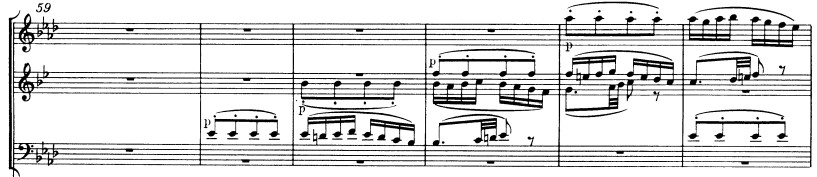
Repeated notes are so common in classical - and earlier and later music - of course. A very few examples from a vast range of possible examples. Here, repetition is diversified repetition, repetition subject to {separation}, repetition of notes of the same pitch, the repeated quavers, the A's in the bassoon part here, the repetition of this same pattern at higher pitches in the flute and bassoon part, the repeated notes of different pitches in the semiquaver rhythm which follows the quaver rhythm of the bassoon part, the repetition of the semiquaver pattern in the flute and clarinet part - all playing a part in this magnificent, moving passage in an overwhelming movement.
From the second movement of Mozart's Symphony No. 39, K 543, Andante con moto:
And a magnificent, moving passage from another overwhelming movement, the second movement of Mozart's Sinfonia Concertante K 364, Andante (into the phrase, not the beginning of the phrase). Shown here, the parts for violin I and II, viola I and II, cello with double bass:
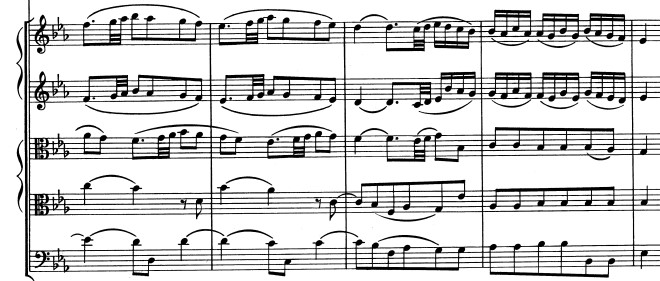
In Classical music, repetition takes very varied forms. Here, the phrase played in unison by violins I and II is repeated by violas I, before violas I join violas II and the cellos and basses to play, in a texture which is anything but plain, some plain repeated quavers, mainly double notes at the same pitch.
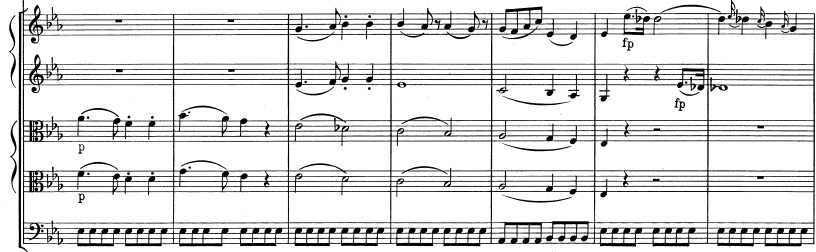
From the first movement of the Sinfonia Concertante, an example of straightforward repetition, but repetition which, in its place in the score, is the product of genius:
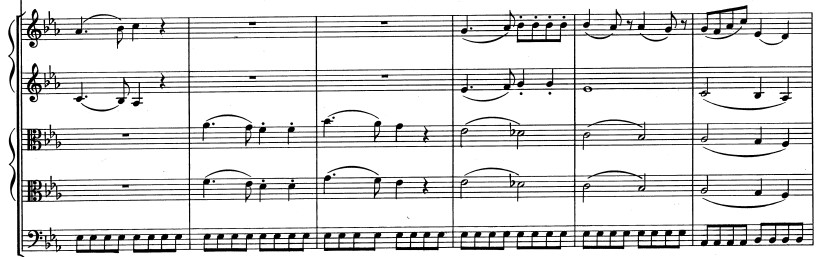
Classical music is strongly directional, the music drawn towards the closing chord as strongly as water drawn towards a waterfall. Repetition of an exposition section has to be understood in the context of directionality. The development section which follows the exposition will be strongly directional. Repeating the exposition makes the listener more fully aware of what the listener knows will be developed and given further direction. This is repetition with expectation.
Repetition in poetry doesn't serve the same structural (and dynamic purposes). In such a directional art, repetition is anti-directional, not, as in sonata form, the prelude to further momentum. This is repetition as a series of reminders of a first occurrence.
The size of the repeated element is less important than the number of repetitions. The exposition section is repeated once. When repetition takes place in poetry, it is often much more than twice. Yeats repeats the line 'Daybreak and a candle-end' seven times in his poem 'The Wild Old Wicked Man.'
I think that almost all repetition in poetry is problematic. To begin with the final stanza of Blake's 'The Tyger.' This is an exact repetition of the first (except for the substitution of 'Dare frame' for 'Could frame.') This repetition cannot be counted a success in this otherwise magnificent poem. (Blake's design for this poem is another weakness - the picture is tame and devoid of power.)
It's difficult to achieve artistic success even with repetition of short elements, such as a single line. In general, the more obvious the repetition the less the artistic success - although the overall success may be very great. In the same way, the more obvious the rhyme, the less the artistic success. Deflecting attention from a repetition in poetry is valuable, as was deflecting attention from a repetition in classical music.So also is naturalness of repetition, the seeming inevitability of repetition. This is one of the reasons why I admire the villanelles of Jared Carter, which I discuss in the page on Modulation.
Few if any great poets have used repetition of lines as much as Yeats, one of the twentieth century poets I most admire, and I think that in every case, the repetition diminishes the artistic success of the poem. Just a few examples:
'Crazy
Jane On God' and repetition of
All things remain in God.
'Crazy Jane Grown Old Looks At The Dancers and repletion of
Love is like the lion's tooth.
'The
Curse of Cromwell' and repetition of
O what of that, O what of that,
what is there left to say?
'The
Wild Old Wicked Man' and repetition of
Daybreak and a candle-end.
'The
Pilgrim' and repetition of
'fol de rol de rolly O' (preceded by 'Is,' 'But,' or 'Was.'
'Long-legged fly' and repetition of
Like a long-legged fly upon the stream
His mind moves upon silence.
Yeats
uses repetition on a larger scale than repetition of one or two lines. In
'Three Marching Songs' there's repetition of four lines in each of the songs.
In the second, there's repetition of
What marches through the mountain pass?
No, no, my son, not yet;
That is an airy spot
And no man knows what treads the grass.
Almost half of the thirty-one lines of the intolerable poem 'I Am Of Ireland' consists of the repeated lines
'I
am of Ireland,
And the Holy Land of Ireland,
And time runs on,' cried she.
'Come out of charity,
Come dance with me in Ireland.'
There are horizontal, vertical and diagonal components of directionality in a poem.
Horizontal direction (or the x-direction): the obvious fact that reading is from left to right, and, also the fact that the line ending may act as a kind of force, increasing directionality.
Vertical direction (or the y-direction): the progress from line to line. Directionality does not, of course, require that the transition from line to line should be uneventful. The movement of the verse from the end of one line to the beginning of the next offers opportunities for surprise, shock, playfulness. Klee wrote of taking a line for walk. His reference was to painting, but poets can put his words into practice. See also the essay by Christopher Ricks, 'Wordsworth: "A Pure Organic Pleasure from the Lines."' (originally published in 'Essays in Criticism,' volume 21, 1971. Reprinted in 'William Wordsworth: a Critical Anthology,' edited by Graham McMaster.) However, the eventfulness in moving from one line to the next may be less important in a poem than the linking of lines by cumulative power and passion, or interest of other kinds, into a seamless whole.
Diagonal direction: the progress from top left to bottom right of the poem. The complete span in reading the poem.
Modification of directionality, counter-directional techniques, may lead to artistically significant results.The use of centred rhyme modifies vertical direction. The placing of the most dramatic material in the first few lines of a poem acts as a backwards pull, reducing the movement to the end of the poem to an extent.
Techniques which increase directionality give rise to intensification. Techniques which decrease directionality give rise to tension. Tensile art makes use of intensification and tension.
Languages too may modify directionality. In a poem in German, the placing of a verb at the end of a clause will act as a pull, increasing directionality, but when the verb arrives, the reader is directed to the subject of the verb, decreasing directionality.
Picture poetry is one kind of design poetry. The lines are freed from their position in the matrix, referring to the environment in which the picture poem has its origin and are arranged in the picture space. (Almost all poetry so far has been in what I refer to as matrix form - the usual way in which a poem is printed, as a continuous block of lines.) In picture poetry, there is fragmentation of the matrix. If, for example, a representational picture poem describes events in the sky, where there is a plane, events near a wood on the left and events near a river on the right, then the line or lines which are about these events are not placed in sequence, in the matrix of a traditional poem, but are placed where these events take place in the representation, high up in the picture space and lower down, to the left and right. Click here for a dynamic page which shows fragmentation of the poem.
In placing the words in the picture space, the designer may take account of considerations which are familiar to artists, such as balance, proportion, deliberate use of imbalance and disproportion, arrangement of masses along horizontals, verticals and diagonals. This is the practice of text design, which offers exhilarating opportunities.
This has important implications for the directionality of a poem and the reading of a poem. The reading of a traditional poem in matrix form is obviously simple: from the left hand side of the first line to the right hand side of the last line. When a picture poem is read, directionality is more complex, as shown by the eye movements of the reader when looking at the picture space. For example, the first lines of the poem may be placed in the lower right hand corner of the picture space. The next lines may direct the viewer to the lower left hand side, to be followed by a shift to top right. There may be frequent pauses, allowing time for concentrated attention on a single part of the picture space and the words in that part of the picture space. Poetry becomes in this way less subject to time. (The non-temporal aspects of poetry and the temporal aspects of visual art interest me very much.)
Faulting in poetry is analogous to geological faulting: layers of rock are fractured and a block of rock may move vertically downwards. In the same way, in faulted poetry some or all of the lines are fractured and a block moves downwards, so opening up the interior of the poem, with significant effects upon poetic texture.
In a poem with an appreciable number of lines and with lines of appreciable length, there is zoning, the contrast between the border region and the interior. Words deep in the interior of a poem may be denied their full force. Faulting opens up the poem.
Composite poetry is poetry in which contrasting elements are combined. A composite poem can be created by inserting the contrasting material into the main text in the form of a block, a technique which has been used quite often. In inter-line poetry, which so far as I am aware is completely new, the lines of the main text are double spaced and the contrasting material is inserted into the spaces between these lines. Many different contrasts are possible between main text and insert. They may differ in tone, in organization (free or formal). The insert may comment on the main text or may even be critical of it. See also the page on composite poetry.
From the page Concrete poetry: More 'advanced' work isn't always the more artistically successful work. Poets have sometimes chosen to describe their work as 'linguistically innovative poetry,' poetry which makes no use of those archaic and outworn forms rhymed poetry, or poetry with a readily grasped meaning. I'd stress the importance of factorization, of an adequate survey, a survey without undue {restriction}. The 'cutting-edge' language of 'linguistically innovative poetry' is only one factor. 'Linguistically innovative poetry' may also be rhythmically inert poetry, emotionally backward poetry, politically innocent poetry, drab poetry, poetry with nothing to say, poetry as technical exercise, routine 'linguistically innovative poetry,' poetry which misuses the word 'innovative' - or it may be the genuine thing, linguistically innovative poetry which is far more than linguistically innovative.
I've written poems myself
in the style, although I would never describe them as 'linguistically innovative.'
Below is one example. It reflects my continuing preoccupation with the allied
bombing campaign during the Second World War. A survey which
is as complete as possible should have the fullest possible range.
It should do justice to the extremes and to the regions within
the extremes. There should be the fewest possible limits to
poetry. Poetry should be concerned with almost imperceptible processes, slight
miscalculations, hesitations, misgivings - and, also, with apocalyptic events,
massive destruction, dangers, loss of life, crushing blows, devastating misjudgments,
heroism - old-fashioned heroism - of the most admirable kind (but inextricably
linked with ethical problems of the most severe kind.)
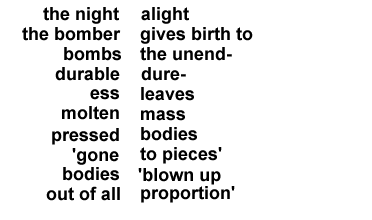
Here, the order of reading, the {ordering}is mainly horizontal, in a subsidiary fashion vertical. There are fragments of sentences and fragments of words: 'dure-' 'ess,' 'de-'
'Night' and 'alight' are linked-antitheses. The splitting of the word 'unendurable' emphasizes the act of going on and on: 'unend' and 'durable.' There was a punishment in this country in past centuries called 'peine forte et dure,' which involved 'pressing' the victim with weights, to make the victim confess. 'Dure,' formed by fragmenting the word 'duress' refers to this punishment, as does 'pressed,' lower in the poem, formed by fragmentation from 'depressed.' Familiar, almost cliched phrases are used to refer to refer to the mutilated victims of the bombing offensive: 'gone...to pieces,' and the more common 'blown up out of all proportion,' here given a literal and concrete meaning.
I regard 'leaves' as more 'free' than 'fixed.' Although it's fixed to the extent that it's clearly a verb rather than a noun in the poem, its associations are in tension. This is a private association, but 'leaves' reminds me of the strips of aluminium, called 'Window,' which were released by the bombers to confuse the German defences. And, 'leaves' suggests human mortality. Homer has 'Men are like leaves,' although it's difficult to translate the original. If these two associations seem very remote from your experience, bear in mind that as a result of fragmentation, 'leaves' is left isolated in the right hand column of the poem, with separation from the grammar of the sentence. The isolated word invites associations, no longer as fully embedded. A further association, not at all obvious, but not arbitrary - the use of leaves in another description of bombing, but here, the bombing of London, in T S Eliot's 'Little Gidding,' a significant and successful sub-region within the Parnassian (artistically unsuccessful) region of 'Four Quartets:'
In the uncertain hour
before the morning
Near the ending of interminable night
At the recurrent end of the unending
After the dark dove with the flickering tongue
Had passed below the horizon of his homing
While the dead leaves still rattled on like tin
Over the asphalt where no other sound was
Between three districts whence the smoke arose
I met one walking, loitering and hurried
As if blown towards me like the metal leaves
Before the urban dawn wind unresisting.
Rhyme is an instance of linkage by sound, as is alliteration. Linkage of lines in a poem by rhyme, shown by rhyme schemes such as aa bb cc...is obviously a very well-established technique. In 'linkage by meaning' (or 'semantic linkage') lines are generally linked according to the meaning of the last word or phrase in each line. (The technique can also be used in a less formal and systematic way.) There are many distinct possibilities. Words, or phrases, may be synonyms, antonyms, near-synonyms or near-antonyms - the equivalent of pararhyme. Alternatively, they may be linked by a significant context, or illustrate progression, development or modulation, as in the example to the right. The words on the left hand side of the poem indicate progression in the seasons and the words on the right indicate progression in times of day.
Meaning schemes can be constructed which have a linkage with rhyme schemes. For example, AA BB CC is the semantic equivalent of rhymed couplets. (I use lower-case letters for rhyme schemes and upper-case letters for meaning schemes.)
Click here to see the page on Modulation and the poetry of Jared Carter.
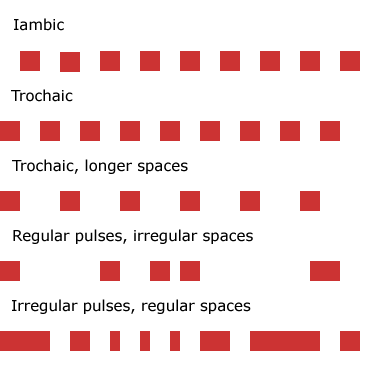
A diagram showing possible arrangements of pulses:
Example: mixed pulses, irregular spacing:
Meter in poetry has a linkage with the pulse of the human body. Both are instances of a periodic alteration. Pulse poetry has a linkage with both of these but a further linkage with a pulse produced by electronic means. If the electronic pulse is displayed on a screen, there may be regular intervals between the pulses, or irregular intervals. The pulses may be fixed in width or variable in width. There are the same possibilities if the pulses are displayed in audible form.
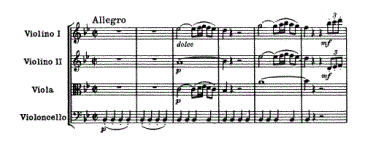
However, the most minute - but perceptible - differences in the pulses are essential to the artistic realization of pulse poetry. A very close analogy, the pulses - the repeated notes in the cello part, in the opening of Haydn's String Quartet Op. 50 No. 1, shown below. The repeated notes in the bass (which continue into the sixth bar - measure) will only be played as if they came from an electronic wave generator by the most insensitive player. The minute irregularities give life to the performance.
In pulse poetry, instead of the alternation of accented syllables and unaccented syllables there's the alternation of the pulses (the accented component) and the spaces between the pulses (the unaccented component).
By making the spaces between the pulses comparatively long, the tempo of the poem can be made very slow, giving the possibility of a true poetic adagio or largo. Or the pulses may be rapid, a poetic allegro. The pulses can be extended, giving a length which it's impossible to implement in the established use of accented syllables. The pulses will never be completely regular in length, but pulses made up of monosyllabic words will give a close approximation. These are the 'simple pulses,' shown in the diagram. Graham Pechey gives a very comprehensive and important discussion of the 'adventures of the Monosyllable in English Verse' in PN review (his articles are available to subscribers on the PN Review Web Site). Pulse poetry provides a new example to add to the very diverse history of the monosyllable.
Words of more than one syllable are examples of 'compound pulses.' Pulses can be very varied in length, since pulses may be made up of single polysyllabic words (of varying lengths), fragments of words and small groups of words. The words within a pulse will show the established rhythm of accented and unaccented syllables, but this rhythm is subsidiary to the rhythm of pulses and spaces. In the spoken form of a pulse poem, the elements making up a compound pulse should be given, so far as possible, similar stress. Often, the elements will be spoken quite quickly. There are a number of examples in the poem above, for example the compound pulse 'far from shooting.'
'too broad' refers not to the width of the avenue but to the composition of the crowds who were found there and will be found there. These crowds include collaborationists and anti-Semites as well as people who resisted the Nazi occupation, actively or otherwise. Similarly, a Christian might describe a Church as 'too broad' which included people with only the slightest Christian belief as well as active believers. In a poem, I describe Mozart as 'the too universal,' because admired by the Nazi violinist Heydrich.
Some further comments on the poem
The small green and red blocks show punctuation marks and not the pulses. Full-stops ('periods' in American English) are shown as small red blocks and commas are shown as small green blocks, to give the effect of festive lights which are in tension with the sombre grey text and black background. In this period immediately after the end of the war, there's austerity but also a great deal to celebrate. The poem is an example of concrete poetry as well as pulse poetry. It offers an example - almost certainly the only example - of a concrete poem which uses the arrangement of punctuation marks only, not the arrangement in space of words and lines, to create pattern. Green blocks show commas and red blocks show full-stops (in American English, 'periods.')
The word 'now' is a 'repeated pulse.' This pulse is repeated at irregular intervals. The avenue is far from shooting now but previously it was not so. Different sensory sensations are separated, for example, 'dark' from 'quiet,' an aspect of light from an aspect of sound. Compressions are used to create the compound pulses, for example, 'for an aftermath.'
Changing the order of lines in a poem or changing the order of individual words in order to give a version with greater impact or interest. Restoration gives an order closer to everyday, non-poetic speech or writing. See the full discussion, with examples, at rearrangement.
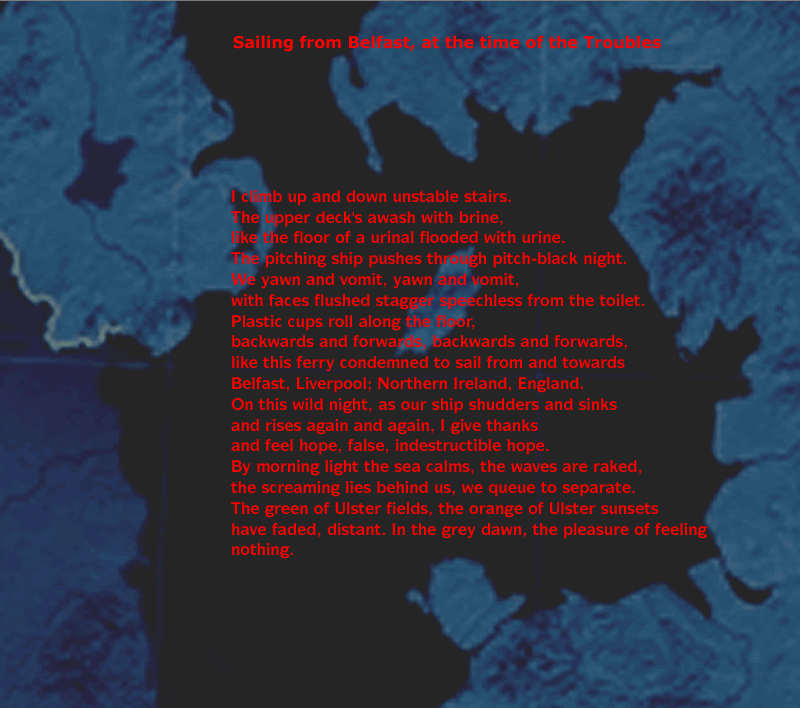
Region poetry is different from the established form of regional poetry, for example the poetry of the English regions or Jared Carter's poetry concerned with Indiana. Regions are contrasted areas within a poem. 'Sailing from Belfast, at the time of the troubles,' the poem below (a record of personal experience, when terrorist activity in Northern Ireland was at its most intense) is shown first in matrix form, the usual form in which a poem is printed as separate lines:
and next in fragmented form, in which lines and part-lines are attached to three regions, the Irish Sea, Northern Ireland and Liverpool:
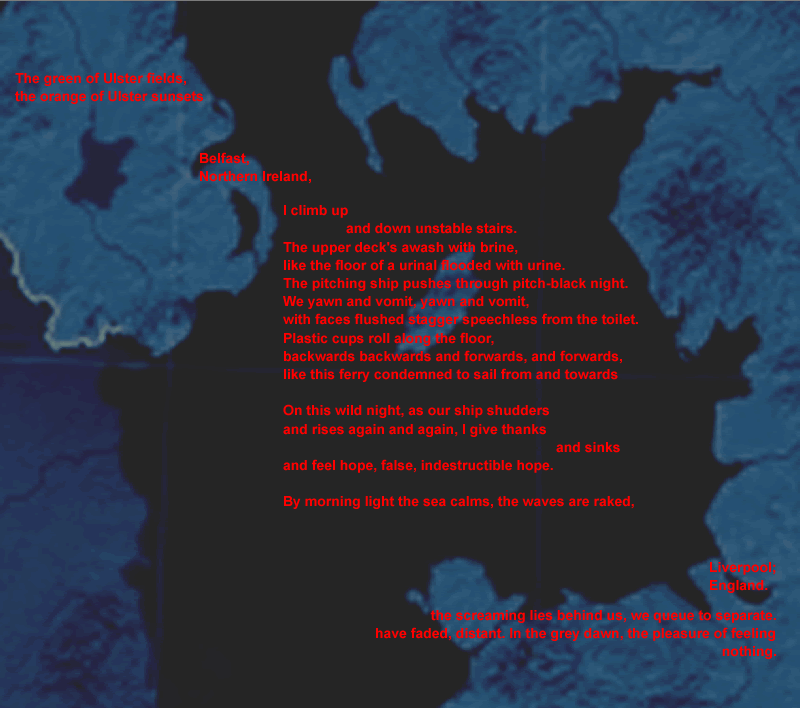
Within the poem there are also different time regions, the memory of 'The green of Ulster fields, the orange of Ulster sunsets' which 'have faded, distant' and of 'the screaming' belonging to a different time-region from present experience.
Regional differences can be shown by various means, for example by typography and background. Even if they are not shown, they can be detected by careful readers. Regional differences can be shown within a poem but also in the display of poetry. The page poems is an example. There are different regions within the Large Page. Poems linked by tone, technique or subject are grouped within each region. The regions are visited: page travel. For regional differences, see also the page on Web design.
Zoning arises from the fact that in a poem which has lines of appreciable length and which has an appreciable number of lines, the first line and the last line will tend to be more prominent than the intervening lines and the beginning and end of each line will tend to be more prominent than the middle of each line. There will be a contrast between two regions of the poem: a border region made up of the first and last lines and the beginning and ends of lines and the interior.
Position in the poem gives emphasis to the exterior but the poem may intensify this emphasis or reduce it -that is, introduce tension between prominence in placing and prominence in effect.
See also my discussion of this poem on the page Concrete poetry.
Phrasing is as important to the interpreter of a poem as it is to the singer, instrumentalist or conductor whose concern is to make the interpretation of the written score as expressive as possible. I've introduced a technique, sectional analysis, for the study of the linkage between the line of poetry, the phrase and the sentence.
I use the term 'sections' to refer to different phrases (present as a whole or in part) in each line, and I use sectional analysis to study the relationship between sections, and in so doing the relationship between lines and phrases. Square brackets are used to enclose phrases. These brackets may be opened and closed within one line, or they may be opened in one line and closed in another. I also refer to 'opening the phrase' and 'closing the phrase.' I apply sectional analysis to some very great lines of 'The Prelude' (lines 452-457, 1805 version) In all the lines except for 454 there are two sections.
452 [And in the frosty
season,] [when the sun
453 was set,] [and visible for many a mile
454 The cottage windows through the twilight blazed,]
455 [I heeded not the summons;] [happy time
456 it was indeed for all of us,] [to me
457 it was a time of rapture.] ...
In this extract, short though it is, there's a very effective contrast of phrase length. Shorter phrases are contrasted with the longer phrase which is opened in line 453 and closed in line 454. Line endings may divide the phrase or not: the phrase. 'And in the frosty season' and the phrase 'when the sun was set' are different in the way in which they are linked with the lines. The first phrase is divided, the second is not.
As regards meaning rather than sound, there are remarkable contrasts to do with the meaning of the phrases, giving to the whole passage an overwhelming sensuous immediacy. Each phrase has a dominant theme. Here, I draw attention to words within the phrases:
"frosty
season" - cold
"sun was set" - light turned to darkness
"through the twilight blazed" - lighting up the darkness
"happy time" and "a time of rapture" - happiness and an
intensification of happiness in the next phrase
"clear and loud" - sound
Sectional analysis and phrase analysis are ways of aiding the appreciation of phrase rhythm in poetry, the counterpart of expressive prose rhythm, and, like the rhythm of stressed and unstressed syllables, contributing to the overall power and beauty of a poem. A close study of phrasing is also useful for the interpreter, who tries to make the spoken poem as effective as possible.
It
would be an interesting study to carry out sectional analysis on a great number
of lines of poetry in pentameters to find out if it's more common for lines
to be divided into sections by the ratio of 2:3 (or 3:2) feet than by the
ratio of 1:4 (or 4:1) This study of poetic ratio belongs to the
neglected field of
quantitative poetry criticism. The study of ratio is well established in architecture and the fine
arts. The best known example of ratio concerns the 'golden section.' The golden
section is defined in terms of a line divided in such a way that the smaller
section is to the greater as the greater is to the whole. It can also be defined
in terms of the proportion of the two dimensions of a plane figure. The golden
section can't be calculated in exact mathematical terms, but is approximately
5:8 (the ratio above of 2:3 is closer to this than 1:4, of course.) A great
many artists and architects have used the golden section, consciously or unconsciously.
The proportion between exterior and interior in a zoned poem is another instance
of poetic ratio. The harmony of a great painting or a great building may be
linked with mathematical relationships.
In general, '...wherever Proportion exists at all, one member of the composition
must be either larger than, or in some way supreme over, the rest. There is
no proportion between equal things.' (Ruskin, The Seven Lamps of Architecture,
IV 26.)
In his discussion of the first paragraph of 'Tintern Abbey' in his book 'The Passion of Meter: A Study of Wordsworth's Metrical Art,' Brennan O' Donnell provides this note (P. 271):
'In Wordsworth's careful structuring both of this introductory verse paragraph and of the poem as a whole - particularly his gradual accumulation of descriptive detail and his amassing of smaller formal structures into larger and more comprehensive structures - Lee M. Johnson has found evidence that Wordsworth constructed the poem according to strict geometrical proportions: " "Tintern Abbey" is a modified Pindaric ode in the form of a double golden section, which is built upon the lesser details of repeated images and the ornamental patterns of multiple binaries" (Wordsworth's Metaphysical Verse, 60).
Words (and concepts) with semantic force are used, heard, or read with an accompanying experience of intensity or forcefulness, for example, in a visceral or sensuous, an elevated or deeply anxious way. Although a person knows the meaning of many words, or can use many words meaningfully, words with semantic impact are particularly 'meaningful.' The primary linkage of 'semantic' here isn't with the very interesting academic study of semantics.
A person's active vocabulary and passive vocabulary are distinguished in linguistics. A person's active vocabulary (words which the person actually uses) is smaller than their passive vocabulary (words whose meaning is known but which the person does not use.) Words with semantic force are few in comparison with the active vocabulary and are subject to change in a more striking way. Words which once had semantic force for the person may no longer possess it. Words may acquire semantic force quite suddenly. Words may be used with semantic force on one occasion and not on another, owing, perhaps, to distraction or preoccupation. Words may be read or heard as well as used with semantic force.
These words are of the most varied kind. Examples are 'danger,' 'snow,' 'poignant,' 'classification' and 'mathematical set.' Where a word has rich connotations - 'danger,' for example - then using it with semantic force involves using the word with its more intense connotations. So attention is focussed on more immediate, real dangers, such as the experience of being in an active war zone, rather than more distant, if still real dangers, such as 'the dangers of smoking.' It may be direct and intense personal experience which gives a word semantic force, such as the experience of being shelled or shot at, but this is not a necessity.
Intellectual excitement may give to words, ideas and such entities as equations, real semantic force. The mathematician who devised the concept of the mathematical set wrote that when he thought of the word 'set' he experienced a chasm. The great botanist Linnaeus, who devised the binomial system of nomenclature, very likely used the word 'classification' in the same way.
In a good poem, words are used with greater semantic force. In a poor poem, they are used with no semantic force, in a routine or inert way. Deviance or deviation (established terms in stylistics, associated with the Prague school of linguistics) is particularly associated with poetic language. However, deviance can characterize mediocre poetry. Semantic force is a better 'indicator' of good poetry than deviance. This is not to imply that the more vivid the language, the greater the poem. There is a vividness in Seamus Heaney's poetic descriptions of growing up on a farm in Ulster, and a vividness in some of Robert Frost's descriptions of rural New England, which cannot be matched in the work of, for example, Rilke.
I don't argue here for the greater stature of Rilke, but I simply state my conviction that a great poet conveys wider semantic force than a lesser poet, or conveys aspects of semantic force which, it can be argued, are more fundamental. It is for this last reason that I myself regard Kafka as so important amongst twentieth century imaginative writers of prose, despite his restricted range. He has given massive semantic force to such an unexpected word as 'unzugaenglichkeit,' 'inaccessibility,' 'unapproachability,' which appears in the section 'Before the Law' in 'The Trial' and which underlies the whole of his novel 'The Castle.' Another, more familiar example in Kafka is 'verhaftet,' 'arrested.' The writer, however, who used words with greater semantic force than any other is, of course, Shakespeare.
The examples I've given vary very much in intensity. There's no necessary positive linkage between intensity and importance or artistic success. In fact, the idea of semantic force has to be extended, to include 'semantic significance.' A linkage with taste: many people crave more and more intense flavours, more and more highly spiced food, and neglect subtleties of flavour. I'm impressed by a passage from John Ruskin, who in Lecture 3 of 'The Queen of the Air' compares a Persian manuscript and a Turner drawing, the Persian manuscript intense in colour, the Turner drawing drab by comparison: 'One of the ruby spots of the eastern manuscript would give colour enough for all the red that is in Turner's entire drawing.' But it's the Turner drawing which he claims has more 'semantic significance.'
Strata poetry uses a linkage between between the lines of a poem and geological strata to form concrete poetry. Strata poems can also make use of what I call 'time strata.' An example is Thomas Hardy's very fine poem, 'At Castle Boterel.' These time strata can be identified:
(1)
The time when he drives 'to the junction of lane and highway' when he has
a memory from the distant past:
(2) himself and his wife climbing the road after alighting from the carriage.
(3) the earlier generations who climbed the same road.
(4) primeval times: 'Primeval rocks form the road's steep border.'
A work of tensile art contains contrasting elements, the elements in tension (please see the General Glossary for further discussion of this term.) 'Tensile' has a primary linkage with the scientific term, as in 'tensile strength' and 'tension' doesn't have a linkage in most circumstances with emotional stress or tension.
The elements which are in tension are very varied. These are only a few:
My 'unit' poems, demonstrated and described in the page on concrete poetry, have a bleak or horrific content linked and contrasted with the serene and symmetrical shape.
I regard Kafka's work as an example of tensile art. There's the tension between the style, lucid and serene, and the baffling or bizarre or mysterious events which are described.
Sustained or significant use of ambiguity will make a work tensile, as in my poem in memory of two poets:
Hart
Crane
who jumped to his death from a ship bound for New York
Attila Jozsef
who threw himself under the wheels of a train at Balatonszarszo
The sea waved
and parted
and hurried along
the long platform.
So long!
He leaped over the rails
and by the track,
as the platform steamed on,
deeper and deeper
he sank,
the sleeper.
The primary linkage is with Hart Crane and the ship from which he jumped. All the words can be applied to these. 'the sea waved' (the sea produced waves), 'parted' (the bow of the ship parted the waves), 'and hurried along/the long platform' (the long platform is the ship), 'he leaped over the rails' (the rails of the ship), 'and by the track,' (the wake left behind by the ship moving through the water), 'as the platform steamed on' (again referring to the ship.)
The secondary linkage is with Attila Jozsef and his suicide. The first four lines also refer to a departure on a station platform. 'He leaped over the rails' now refers to railway lines and 'track' to a railway track.' This reference to railways modifies the line 'as the platform steamed on.' Although the sense is straightforward, 'the ship sailed on,' the line can be taken as surrealistic too: 'the railway platform steamed on.' There's another, naturalistic, interpretation. The platform was shrouded in steam from steam trains. The platform 'went on,' that is, continued in time, unlike Attila Jozsef, whose life had ended.
Tim Love makes an interesting use of a moving platform in his poem 'Paradox,' one where the allusion is to relativity theory. (See his page on 'Allusions,' http://www2.eng.cam.ac.uk/~tpl/texts/allusions.html)
The poem closes with the
lines
until the platform moves
and you are not moving.
Axis poetry introduces tensions of other kinds and can be regarded as a kind of tensile art, for example, the tension between the horizontal and vertical components. Please see the page on concrete poetry for further information about this technique - the page gives an example of a tensile poem - and also the entry in this glossary.
Compare a line of music, played by an instrument which can't produce more than one note at once, with a piece in many parts played by piano, or by full orchestra. Even if they are resonant, lines of a poem can generally be compared with the first of these. By the use of ambiguity and other techniques, resonance can be increased, and there can be the illusion - or more than the illusion - of a work made up of many parts, sounding simultaneously. There is, however, no necessary linkage between resonance and artistic quality.
Tensile art has certainly had precursors, but non-tensile writers have outnumbered tensile writers. A writer may be versatile, encompassing, for example, the comic as well as the tragic, the criminal underworld as well as a world of aristocratic ease, without being a 'tensile writer.' A writer may be limited in range, or comparatively limited in range and write tensile works. The diverse elements in tensile art are presented simultaneously rather than consecutively, so that a work which has an opening passage markedly different from a closing passage will not necessarily be tensile.
In the case of poems I've written, I often give a timing in seconds below the poem. The timing doesn't give information as such about phrasing, the speeding up and slowing down of the voice when the poem is read, but I think that a simple indication of time can give valuable information. Put simply, if the timing I give is 46 seconds, I doubt very much if an adequate reading can be given if the poem is read in 36 seconds or 56 seconds. Even small divergences from the time can be significant, particularly, of course, for shorter poems.
In providing timings, I'm influenced by recordings of Classical music and the timings provided for each track on a Compact Disc. Comparisons between the timings for different interpretations of the same work, coupled, of course, with close study of the different interpretations, can be very instructive.
Tim Love discusses 'Notation in Poetry and Music' at http://www2.eng.cam.ac.uk/~tpl/texts/notation.html and claims, rightly, that in poetry, 'the paucity of auxiliary notation is surprising.' Here, I suggest one simple kind of auxiliary notation: a timing.
Compact disks of recorded music have timings for the individual tracks. In the same way, many of the poems on this site have a timing in seconds (s). The timing provides useful information about the spoken poem.
Of all guides for the interpreter, an approximate timing, in seconds, of the complete poem is the simplest. A timing gives information about the poet's interpretation of the poem, or one of the poet's interpretations. Of course, the timing can be disregarded, like a composer's metronome marking. Different timings for a poem are a clue to different interpretations of a poem. Within the timing are accommodated the surges, the climaxes, the giving of weight to words, the significant pauses. Poems, like pieces of music, have, surely, a 'tempo giusto' as well as interpretations of the spoken poem that are insensitive or ludicrous simply because the timing is arguably faulty.
I have two recordings of Beethoven's Symphony Number 6, the Pastoral. Both interpretations seem to me to be badly flawed, in particular the interpretation of the first movement, which bears the title 'Awakening of joyful feelings on arrival in the country.' One interpretation (by Harnoncourt) conveys very little sense of joy because it's too slow, ponderous, sluggish. The other (by Hans Swarowsky) conveys little sense of joy because the movement is rushed. The timing for the first movement in the first version is 13.07 min. and the timing for this movement in the second version is 10.57 min., a significant difference. I'm sure that an artistically successful interpretation of this movement, one at the 'tempo giusto,' must lie between these two, at something like twelve minutes. A timing, then, conveys a great deal about an interpretation.
It's obviously essential to go beyond the timing and to take account of many fine details. Some performances may reveal depths, or telling details, which other performances and recordings don't bring out at all. A slight, insensitive hesitation at one point may be enough to diminish the artistic impact of the work
A gifted interpreter shapes the poetic phrase as sensitively as a gifted singer, instrumentalist or conductor shapes the musical phrase. A musician won't rely on the inspiration of the moment to interpret the score, but will make a careful study of it. In the same way, the interpreter of poetry must study the text thoroughly. The methods of analysis I propose should be helpful in this preliminary work.
Composers have available a notation to give guidance on such matters as tempo and dynamics - allegro, andante, forte, piano, and so on. A notation - necessarily much more simple than the musical one - to guide the interpreter of spoken poetry would be useful.
I would like to see informed comment on different recordings of poetry - before that, of course, the making of different recordings. Even more important, there's the need to foster poetry readings, and the need to respond to spoken poetry with some of the sophistication and intelligence to be found amongst music critics and drama critics, when they consider different interpretations of the same score or text, finding some interpretations searching and very significant, others, perhaps, mannered or pretentious.
[Supplementary: timing in performances of Mahler.]
Tony Duggan makes a very interesting use of timings in his criticism of a performance of Mahler's Fifth Symphony (not a recording but a performance conducted by Simon Rattle at the Proms in 1999). He compares the timings for the movements in this performance with the timings for a performance of Boulez on Deutsche Gramophon (Boulez' timings in brackets below):
1. 11.42 (12.52)
2. 12.57 (15.02)
3. 14.56 (18.12)
4. 8.15 (10.59)
5. 13.46 (15.12)
The comments of Tony Duggan below relate to Simon Rattle's performance. To produce the timings above he had to use a stopwatch! This is a memorable instance of the fact that a concern for the technical need not be in conflict with a passionate concern for artistic success and failure, in this case with a passionate concern for conveying Mahler's vision.
"The faster tempo effect was clear right from the beginning in tonight's performance. The Funeral March, so important in establishing the mood of tragedy out of which the contrasts that Mahler is setting up to be resolved emerge, sounded at this speed more wistful than tragic. This was even accentuated by the slightly clipped articulation of the strings, beautifully prepared let it be said, but ultimately surely too careful. I know that in these crucial opening bars what I think Mahler intended was something more weighty and overwhelming...
"The second movement was very fast indeed and here I was reminded of Bruno Walter to start with. There is, of course, a case to be made for the vehement sections to go at a furious pace. However, the conductor should know when to contrast this with a slower tempo when needed, notably the great cello lament. It isn't a question of it being pulled around and moulded, this unforgettable passage ought to contrast more with the maelstrom around it and Rattle failed again to mark this.
"I suppose the performance was still capable of redemption at this point. All hinging on the Scherzo. So it is with regret I have to report that here, for me, Rattle finally blew it. Mahler is on record as saying he knew conductors would ruin this movement by taking it too fast and he was surely right. The performances that are a success are surely the ones that can reconcile overall structure with inner detail, making the listener aware of the episodic nature of the piece, the peaks and troughs, the passages of solitary contemplation set against the passages of wild abandon. Alas, at Rattle's breakneck speed any hope of paying more than a passing nod to the narrower paths of this great movement were doomed...
"The tempo for the Adagietto was, for me, perfect. Would that all conductors could take it at this kind of speed and with this kind of simplicity. The nobility and beauty of the movement is surely enhanced at a flowing tempo..."
And he ends with, "Now, where's my Barbirolli?"
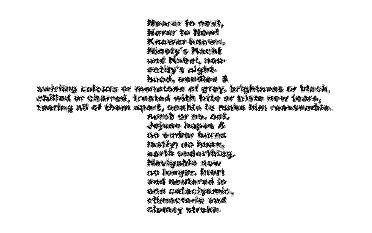
The name is a provisional one. This is a form of axis poetry in which there's a marked contrast between the vertical axis of the poem and the horizontal axis (or axes.) The vertical axis is made up of short, or very short, lines and the horizontal axis, or axes, is made up of long, or very long, lines. The architecture of the poem gives contrasts of spatial experience in reading the poem. The linkage is with the architecture of a cruciform church, which has transepts - wings of the building at right angles to the nave. The example here is blurred deliberately. The content - which would require disproportionate space to explain - is less important than the shape.
Unit
poetry
In Unit Poetry
- a very exacting form of concrete poetry - characters, spaces and punctuation
marks are counted. These units are allotted the same width, as is the case
in a monospace font such as Courier new. (Most typefaces have proportional
spacing, so that, for example, the letter 'm' has greater width than the letter
'i.' ) By exercising complete control over the number of units in a line,
there is complete control over the length of the line. This allows new forms
of concrete poetry. For example, I have written poetry in
which there is the same number of units in each line, giving rise to a poem
which has the appearance on the page (or other surface) of a solid block,
poetry in which the units increase and then decrease in regular steps of four
units, and poetry in which the first and the last line, the second line and
the penultimate line (and so on, to the centre of the poem) have the same
number of units. These lines are not only linked by length but also by sound
('rhyme') and the second line in each pair completes the sense of the first:
This form is a particularly rigorous one.
This is an example of a form in visual art (and visual display in
general) which I call The Set, discussed
at length in the next section. In this section, amongst other things I
establish linkages between the lines of The Set and text lines, an importat
aspect of some Sets.
The lines of poetry on a page (or screen) can
have visual interest as well as verbal interest. Concrete poetry, which is
intended to have visual interest, can make use of lines and fragments of
lines, including single words.
Most visual images aren't presented as
lines, although there are examples, including the one on the left, shown
'zoomed out' on the Home Page. The 'lines' used in visual art may
contain images of varying heights or of the same height. The images in the
image-lines from the Home Page of the site are equal in height, 146 px.
Andy Warhol has used images in the form of image-lines, in my term.
Below, there are reproductions of some examples. Brendan Prendeville's
'Realism in 20th Century Painting' includes a reproduction of the artist's
'Lavender Disaster (Electric Chair) on Page 163. The lines have shocking
immediacy. The images, equal in height, are subtly varied, not quite
identical. Brendan Prenderville's caption:
'Andy Warhol, Lavender
Disaster (Electric Chair), 1964. Other subjects in Warhol's
photo-silkscreened 'Death and Disaster' series included fatal car accidents,
suicides and encounters between police and civil-rights protesters.
Typically, the images are repeated in black, sometimes over a coloured
ground, and are imperfectly and variably printed. Here, a sign over one of
the doors reads 'silence'. Warhol's technique of repetition imparts to even
the most disconcerting image the humdrum beat of the everyday. The electric
chair, as much as Campbell's soup, is seen to be part of the grain of
American life.'
The electric chair isn't embedded in American life
(it's no longer used) and although
the death penalty may seem embedded in American life, it's become
marginal, although not for the few people who are still put to death, in
Texas and other states.
In typography, justified lines are lines that
extend to a specified column width. Andy Warhol's image-lines are justified
lines. Unjustified lines, in typography and in the case of image-lines, have
only one margin where the text or the images are aligned, more often on the
left, sometimes on the right. The other side is 'ragged.' The image-lines on
the left are unjustified. The right side is 'ragged.'
My image-lines
make some use of repetition, but the repetition is never identical or
near-identical. The images have linkages as well as contrasts. When a
linkage is established, this may give an experience similar to the
experience of repetition, but the experience is 'free' rather than
patterned. Compare 'free verse' and patterned verse, which always has some
degrees of relative freedom.
The linkages are very varied. There are
linkages, for example, between the portraits and the landscapes - referring
to the theme, not the relative height and width of the image. There
are linkages of colour or lack of colour - linkages between the
black-and-white images in contrast to the colour images. Linkages between
the coloured images which can be explained by colour theory. Linkages of
theme: a harrowing image linked with other harrowing images, a cheerful
image linked with other cheerful images - and the disturbing contrast
between appearance and reality.
The black and white images include
images which are very varied: in line 1, four heroic women who were executed
at Ravensbrück Concentration Camp, in line 6, a slave after a
flogging, in line 8, the aftermath of IRA bombing which killed six people in
Northern Ireland - and scientific and musical black and white images. In
line 8, an equation which formulates Heisenberg's Uncertainty Principle, in
line 11, an image of a page from Newton's 'Principia Mathematica' and the
structure diagrams of two organic molecules. The uses of the images are very
different: to illustrate some concepts I use, and to illustrate two very
different ideologies. In lines 2 and 4 there are extracts from the scores of
a Beethoven Quartet and a Haydn Quartet.
Linkages of common subject
are strengthened by linkages of colour, for example, in the case of the
crops shown in line 2 and line 11, image 1 - but line 11, image 3 shows
crops which are contrasted in colour and tone, particularly the tall hop
plant, a very dark spire. Clicking on the link gives access to a much larger
image (amongst the images for 2017) which makes the contrast even more
evident.
In line 2, the bluish tone of an extension to a building I
constructed (image 3) is linked with the bluish tone of a smaller
structure some distance away (image 1) and not linked by colour with the
extension of the same building very near to it (image 2.)
By means of
this network of linkages of similar and dissimilar elements, contrasts of
similar and dissimilar elements, I try to increase the richness and
complexity of the composite image.
Some elements which are adjacent
but have a high degree of independence are fused in part. In line 3, a hill
on the right side of image 6 is fused with a hill on the left side of image
7. The darkness in image 4 of line 3 fuses with darkness in the upper area
of the image below it, image 3 of line 4.
Some lines are more
homogenous than others, in subject matter or appearance. Line 3 is made up
of images from the drama section of the site, but the line is heterogeneous
in colour. The last image on the line is contrasted with the colour images.
Very varied organizations and societies can have a predominant ethos:
the outweighing of contrasts. I think that the predominant ethos of the
composite image isn't nearly as tragic or disturbing as would be expected
from the tragic or disturbing tone of many of the images which are part of
the composite.
Below Andy Warhol: Campbell's Soup, not to me, a
memorable work in the least. The tins aren't identical. To make an obvious
point, there are contrasts of labelling, indicating differences in the
contents.
© José Luiz Bernardes Ribeiro / , via Wikimedia Commons

Below, another possibility: a single
image-line which is very long and of variable width. A very effective
presentation of an image line in Bilbao. The presentation is the work of the
museum, not Andy Warhol, who contributed the elements which were fused.
Attribution: Tiia Monto.

Below, an extract from the Bayeux Tapestry, 68.38m long and 0.5m
high. The tapestry can be regarded as a single image-line of constant width.

Single images may be the work of various people, such as the students
who often assisted painters, sometimes producing paintings which were
attributed to the senior painter but without any contribution from the
painter.
In the example from the home page, I was responsible for
the choice of images and the arrangement of images. The images used include
photographs taken by me, including photographs of my gardening designs and
structures and buildings which I designed and constructed. There are
also images of concrete poems I designed and wrote.
The Set is a composite art form. In two-dimensional Sets, works of art are placed on a wall (an entire wall, part of a wall or more than one wall) of a gallery or some other space, or placed on a page of a Web site, so as to establish linkages and contrasts. The section above gives an example of one of these. The Set is made up of separate images, the elements of the Set. The elements are rectangular, equal in height and contiguous. A variant Set could include spaces between the elements, or elements which have a different shape, for example circular or elliptical elements.
Concrete Sets exist in the non-virtual world we experience. Three-dimensional Sets can include sculpture, found objects and other three-dimensional objects. A three-dimensional Set may resemble an Installation, an established form in visual art, but like the two-dimensional Set it makes use of new and dstinctive techniques which have a systematic basis. Like the installation, the Set will very often be large-scale but very small Sets are also possible.
Although Sets have many other linkages, the linkage between the Set and theatre sets is an important one (I distinguish them by capitalizing the Set which is the main subject here.) A Concrete Set can be lit using theatrical lighting or simpler means, and the art form gives new opportunities for curators, whose role in the display of Sets may resemble to some extent the role of a theatre director.
The works which become part of the composite work are the elements. The elements making up the Set can include oil paintings, watercolours, drawings, photographs, posters, prose-text and poem-text. Poems can make use of the forms I discuss on this page. Many of these have visual interest, including fragmented poetry, faulted poetry, unit poetry and other forms of concrete poetry.
Linkages and contrasts within one element - a single independent visual work or within one single visual work within a composite work.
To focus attention upon the sub-elements, the lines and shapes contained within the frame, in this simple example, obviously without artistic value. there are linkages and contrasts within the larger rectangle, the frame, for example of tonal vales (black, dark, white), of shape (geometric areas and a geometric straight line, or non-geometric, freehand areas and a non-geometric freehand line.) This is a non-figurative element, but a single element have have contrast between abstract and figurative.
Linkages and contrasts between the works or elements which make up the Set. A rectangular frame may show the boundary of the Set, which contains these elements, two rectangular elements, a circular element and freehand lines. Linkages and contrasts within each element obviously remain, but the arrangement of elements enables linkages and contrasts to emerge.
In a physical rather than virtual example, the frame which marks the boundary of the Set might be a complete wall of a gallery, or part of a wall. The smaller rectangles and the circular element would be elements displayed on the wall, each with their own frame, rectangular or circular. The wall of the gallery also displays the freehand lines. Here, there are no contrasts of tone, or high key and low key.
If this Set includes works in different media, for example, works in pastels and acrylics, then there are contrasts of medium. These contrasts are also possible within a single element. Klee, for example, sometimes used watercolours and oils in a single work, after taking up oils in 1919.
Each element within a rectangular or circular frame may be figurative or abstract. The outline drawing is intended to be figurative, an outline drawing of hills. There's contrast between the rounded hill and the jagged hill, bu the contrast is slight - the jagged hill has no sharp edges.
The element within the circular frame over the outline drawing of hills may suggest the sun or the moon in this outline diagram. Ian Simpson, in 'Drawing: seeing and observation,' writes:
'A problem that has faced many abstract artists is that while they want to produce work which is removed from the association of objects, this can prove to be almost impossible. If a horizontal line is drawn across a rectangle, we tend to see this as the horizon in a landscape with the lower part of the rectangle a ground plane and the upper part sky.'
The reverse is also true. Some compositions of sea and sky, with not much internal detail, can be read as abstract. For example, some of Paul Nash's landscapes were formalized until they were almost abstract. A realistic element within a rectangular frame is a composite entity, the rectangular frame giving a degree of abstraction.
Abstraction can be introduced into a realistic element or the level of abstraction increased - intensification of abstraction - by various means. One is the technique I call abstract blocking - part of a realistic painting is hidden by a rectangle or other shape. There may be tension between abstraction and realism. Intensification and tension are important aspects of {theme} theory.
Frames may be virtual as well as physical. Virtual frames are the frames used in graphics and other computer programs. I use the term 'frame' for regular geometrical shapes An outline marks the boundary of non-regular areas. Frames have uses other than the frames which are the focus of attention here. For example, the information in the Periodic Table is displayed in frames which are displayed in grid form.
Most physical frames used to display paintings are rectangular but there are obviously other possibilities, for example the oval, often used to enclose the art-works of artists in the Baroque and Rococo periods.
Frames on a computer screen can easily be re-sized. This is obviously not easy or not possible for the frames of a physical Set.
emerged
from a winter without much snowas from a night without much sleep,
exhausted but wary, too conscious of the danger
of falling. I looked upon summer as the valley
between two mountains: the effort in climbing
and descending, the way so steep.
My mind was often quite blank. Not the inviting blankness
of Walt Whitman’s open road but the dim sense
that I could not even make something of my weakness,
that the capacity to exult despite every setback
was a reflex I had lost -
'These so, these irretrievable.’
