
See also the pages
Heaney's poetry: the case against and the
'Harvard Connection,' with
general and specific criticism of Harvard University
Heaney: ethical depth?
Heaney: translations and versions
Heaney's translations and my own translations
Cambridge Companion to Seamus Heaney
Human Chain
Seamus Heaney and bullfighting
Ireland, Northern Ireland:
distortions, illusions
metaphor
metre

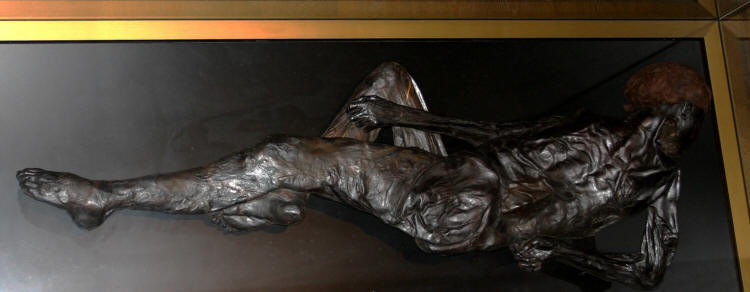
Above, The Grauballe Man
Attribution: Malene Thyssen, CC BY-SA 3.0
<http://creativecommons.org/licenses/by-sa/3.0/>, via Wikimedia Commons
Between my finger and
my thumb
The squat pen rests; snug as a gun.'
This is the only mention of guns in this poem. This is the only mention of guns (or bombs) in this volume, 'Death of a Naturalist.' The volume was published before the Troubles in Northern Ireland began. Date of publication of 'Death of a Naturalist: ' 1966. Date when The Troubles in Northern Ireland began: 1969. This isn't a forerunner of the poems which concern the Troubles in Northern Ireland.
For once, Neil Corcoran shows restraint. He obviously realizes that the poem has nothing to do with violence and he makes no comment on violence. Not so Helen Vendler. She's familiar with the chronology of the Troubles (she gives a short history of the earlier period in the chapter 'Archaeologies: North') and she ought to have realized the complete lack of reference to sectarian violence in this volume, but she still writes, 'The disturbing thing about 'Digging' is that the Irish Catholic child grew up between the offers of two instruments: the spade and the gun. 'Choose,' said two opposing voices from his culture: 'Inherit the farm,' said agricultural tradition; 'Take up arms,' said Republican militarism. And indeed the poet's first thought had been to measure, so to speak, the pen against the sword: 'Between my finger and my thumb / The squat pen rests; snug as a gun.' This is to conceive of writing as, like war, politics by other means.'
This is an apology for criticism, not responsible poetry criticism. To stress the obvious, but not so obvious to Helen Vendler, the Irish Catholic child during the Troubles had many, many more choices - and the agricultural spade wasn't usually an option for the urban Catholics of Belfast and other places. Only a small proportion of Catholic children were tempted to take up arms or did take up arms later. Helen Vendler's simple-minded statement is grossly insulting to the great majority of Catholics who grew up in those years and grossly misguided.
Helen Vendler the critic has Seamus Heaney's endorsement. Quoting from my page 'Seamus Heaney: ethical depth:'
'From the 'Paris Review' interview with Seamus Heaney:
'INTERVIEWER
'What about your critics? Is there one you find especially perceptive?
HEANEY
'Well, reading Helen Vendler is always a corroboration. She is like a receiving station picking up on each poem, unscrambling things out of word-waves, making sense of it and making sure of it. She can second-guess the sixth sense of the poem. She has this amazing ability to be completely alive to the bleeper going off at the heart of it, sensitive to the intimacies and implications of the words and your way with them, and at the same time she has the ability to create the acoustic conditions where you can hear the poem best, the ability to set it within a historical context and to find its literary coordinates. And then there is just the sheer undimmed enthusiasm. Helen has been a friend to me as well as a critic, and the friendship has been tonic because all that critical élan comes out in her social self as sheer exhilarating intelligence. The great thing about Helen is not just her literary capacity, it's her sense of honesty, justice and truthfulness. I value these things deeply in her as a person and, naturally, they are part of her verity as a critic.'
This interview was published in 1994, before Helen Vendler's book on Seamus Heaney's poetry (published 1998) but Seamus Heaney has been constant in his admiration for Helen Vendler. For example, this much later comment in the book of interviews 'Stepping Stones' (published 2008): 'She has intensity, intelligence, perfect pitch - a uniquely gifted listener-in to poems.' This is a very great claim, particularly 'uniquely gifted ...' It's surely a ridiculous claim. Like so much else that Seamus Heaney says in his interviews, these comments have the right sound, to some people, but aren't nearly so impressive when examined carefully.
The gun in the opening
of this poem can be regarded as a 'violation' in poetry of the principle known
as 'Chekhov's gun,' the principle that there should be no unnecessary elements
in a story. Objects which are introduced - a gun is only one example, of course
- must be used later. If they aren't used, they should never have been introduced
at all. Chekhov wrote:
"If in the first act you have hung a pistol on the wall, then in the
following one it should be fired. Otherwise don't put it there." (From
Gurlyand's 'Reminiscences of A. P. Chekhov.')
"If you say in the first chapter that there is a rifle hanging on the wall, in the second or third chapter it absolutely must go off. If it's not going to be fired, it shouldn't be hanging there." (From S. Shchukin, 'Memoirs.')
Although the gun here is part of a simile, there's the same responsibility to make effective use of it. The associations of 'gun' are too potent for it to be mentioned once, as if in passing, and far too potent for its snugness in the hand to count as its only association: the intended {restriction} of association is a completely unrealistic {restriction}. This is the problem of factors, of {restriction} of factors and the unintended carrying-over of a factor.
Seamus Heaney here uses 'gun' too casually, just as 'blood' is often used too casually in poems. Again, 'blood' is a word with very potent associations, although the potent associations are often less - 'blood' has been so over-used that it has become a poetic 'cliché word.' (Not all clichés are phrases.) Poets sometimes use 'blood' gratuitously, including very substantial poets such as Paul Celan.
The first verse paragraph of Celan's 'Matière de Bretagne,' followed by my translation:
Ginsterlicht,
gelb, die Hänge
eitern gen Himmel, der Dorn
wirbt um die Wunde, es läutet
darin, es ist Abend, das Nichts
rollt seine Meere zur Andacht,
das Blutsegel hält auf dich zu.
Broom-light,
yellow, the hillsides
suppurate to high heaven, the thorn
courts the wound, there's ringing
in there, it's evening, Nothingness
rolls its seas to devotion,
the sail of blood is heading for you.
The usual translation of the first word, 'Ginsterlicht,' is 'Gorselight' but this is inaccurate. Giving the botanical names as well as the common names in English, not to be pedantic but because these names give the species without any risk of confusion, no matter what the language of the reader, 'der Ginster' is the plant 'broom,' Cytisus scoparius ssp. scoparius whilst 'gorse,' Ulex europaeus, is 'der Stechginster' in German. Both have golden-yellow flowers. A further reason for being accurate here is this. Celan visited the philosopher Heidegger and they went to Heidegger's hut in the Black Forest. Later, they went walking. Heidegger relates that he was impressed by Celan's knowledge of botany and we have good grounds for thinking that Celan wouldn't have confused broom and gorse.
Martin Seymour-Smith claims that the last line of this verse-paragraph is 'pseudo-expressionist cliché.' I think he's correct. Even though 'the sail of blood' may seem to belong to the same world as what precedes it, the conjunction of 'sail' and 'blood' has a 'literalness' which isn't poetically successful here. See some criticisms which I make of Seamus Heaney's unsuccessful 'literalness' in some cases in the meaningless-pointless-grotesque concrete. However, Paul Celan's poetry can obviously accommodate much more startling effects than the traditional poetry of Seamus Heaney.
Anne Carson gives an interesting discussion of the sail in her 'Economy of the Unlost: Reading Simonides of Keos with Paul Celan.' She mentions the black and white sails of the Tristan legend and a red sail in Simonides, but I think it's very doubtful that Paul Celan took the 'sail of blood' from either of these sources.
At the end of 'Digging' there's a pen instead of a gun. And the poet decides that he'll dig with the pen.
Between my finger and
my thumb
The squat pen rests.
I'll dig with it.
He obviously means that he'll be a writer, using the pen as the implement for his work, just as his father uses the spade as an implement in his work, but the literal and ridiculous image of him using the pen as a digging implement is impossible to dispel. Again, the intended {restriction} of association (to the pen's use as the tool of a writer) is a completely unrealistic {restriction}.
Fran Brearton's interpretation of the pen and the gun (in 'The Cambridge Companion to Seamus Heaney') is dire: 'the implied association of pen, gun and penis.' Did Seamus Heaney actually imply this facile association? Was it in his mind as he wrote? Her method of interpretation allows her to find anything 'implied' which suits her thesis, in defiance often of the clear meaning of a text, common-sense, and sometimes human values.
Compare with this Freud's facile interpretation of a miner's strike - the miners' unwillingness to use their pick-axes (their penises) to penetrate the earth, regarded as feminine. The strikes of miners have generally belonged to a world of almost unimaginable harshness, concerned with very different matters. For example, at a meeting before miners began strike action in Northumberland and Durham in 1842: 'They catalogued the grim conditions in the mines, the bad air and long hours, the unjust system of fines, the payment by measure where the measures were set by the masters. They told of young children in the mines, of pay reductions ...' Or an earlier meeting before strike action began in Northumberland and Durham, in which one of the demands was for 'the reduction of hours for boys down the pit to twelve per day.' (Anthony Burton, 'The Miners.')
Fran Brearton perpetrates something similar. She admits that this is 'to take images out of context,' but she seems completely undeterred, when she writes that '... Digging deeper into the ground simulates the sexual act ...'
Neil Corcoran comments, 'The strain of over-determination ... shows up in the opening lines, where the pen is not only a spade but a gun, which seems at least one analogy too many for such a short poem ...' This seems an excessive criticism to me. There's {separation} of gun and spade. In the opening lines the pen is a gun, in the closing line a spade and there are 28 lines between them. This {distance} isn't too short.
The {distance} between 'analogies' in a poem by Derek Walcott tends to be much shorter, and very often too short. He often uses a torrent of analogies. In these lines, from Section III of 'The Fortunate Traveller,' the short intervals can be justified by the first line here 'There is no sea as restless as my mind.'
There
is no sea as restless as my mind.
The promontories snore. They snore like whales.
Cetus, the whale, was Christ.
The ember dies, the sky smokes like an ash heap.
Reeds wash their hands of guilt and the lagoon
is stained. Louder, since it rained,
a gauze of sandflies hisses from the marsh.
Since God is dead, and these are not His stars,
but man-lit, sulphurous, sanctuary lamps,
it's in the heart of darkness of this earth
that backward tribes keep vigil of His Body,
in deya, lampion, and this bedside lamp.
Like lice, like lice, the hungry of this earth
swarm to the tree of life...
In his essay 'Seamus Heaney's Working Titles,' in 'The Cambridge Companion to Seamus Heaney,' Rand Brandes writes 'In a virtuoso performance ... 'Digging' establishes the poet's most significant and versatile metaphor for the creative endeavour and the search for truth - digging.' This is a product of the word-sphere. The poem offers no basis for this comment. Its focus is almost entirely on manual work, without any suggestion that a spade could have anything to do with 'the creative endeavour and the search for truth.' The pen which is mentioned at the beginning of the poem is linked with a gun. Only at the end of the poem is the pen linked with the spade, in one of Seamus Heaney's forced and unconvincing linkages.
As for the 'virtuoso performance' claimed by Rand Brandes, a performance with 'dazzling skill or technique' (Collins English Dictionary) the poem offers no basis for this comment. It isn't the poetic equivalent of, for example, the 4th movement of Mozart's 41st Symphony.
Stanley Sadie (in his 'Mozart Symphonies') on the 'peroration' of this movement: '[four themes introduced earlier in the movement] are presented simultaneously, several times over in a variety of vertical permutations; it is not only a tour de force of counterpoint - Mozart had, of course, devised his themes with the idea of combining them in mind - but also, far beyond that, a truly magnificent effect, overwhelming in its concentrated display of the movement's material in a glitteringly brilliant fabric of sound.' The sonata rondo which forms the final movement of the Symphony No. 103 is an instance of Haydn the virtuoso composer. H. C. Robbins Landon and David Wyn Jones (Haydn: His Life and Music): 'The finale is a tour de force of thematic and harmonic argument in which the merest scraps of material produce paragraphs of tremendous tension and fire. Behind its dexterity one may again sense, as in no. 95, the stimulus of the last movement of Mozart's 'Jupiter Symphony; two of the main motives have a rhythmic resemblance to those used by Mozart.'
Poetic equivalents of musical virtuosity are difficult to find. I'd claim it, to some extent, for my unit poetry. I write in connection with one of the poems in unit form, ' It's a poem in centred rhyme, the first line rhyming with the last, the second line rhyming with the penultimate, and so on. The first line has exactly the same number of units - characters, punctuation marks and spaces- as the last (15) the second, which is longer, has exactly the same number of units as the next to the last (21) and so on. The lines are linked by sound, linked by length and linked by completion - the later line completes the earlier. The symmetrical poem expands and then contracts - the lines are augmented and diminished.'
The 'dazzling skill or technique' of a virtuoso performance aren't displayed in Seamus Heaney's use of rhyme in 'Digging:' 'thumb' and 'gun' are rhymed in the first two lines. The next three lines are rhymed, 'sound,' 'ground' and 'down.' The pattern so far is aa bbb, then, if it is a pattern. How is the pattern continued? In his use of rhyme, Seamus Heaney shows some strengths, but not here. Showing unrhymed lines by ! the scheme is aa bbb !!!! ... with unrhymed lines to the end of the poem - except that the 17th line rhymes with the 21st and the 29th line rhymes with the 1st. This can't be claimed as an innovation in rhyme schemes. As a comment now, not to indicate a further unrhymed line: (!)
Compare casualty,
which has this 'rhyme scheme' in the first 24 lines:
abab c!c! efef ghgh ijij !k!k
The rhythm of 'Digging' is as faulty as the rhyming. Seamus Heaney's lack of rhythmic sense and his deficiencies in metre are a liability in so much of his poetry, or at least they diminish its impact. 'Digging' does begin with two lines with genuine rhythm, except that the effect is undermined:
Between
my finger
and my thumb
The squat pen rests; snug
as a gun.
(For this method of showing stresses, see scansion.)
The first line sticks out like a sore thumb. It's undermined by 'my' before 'thumb,' which gives three lightly-stressed syllables in a row, shown here as faint print. This second instance of 'my' is superfluous. It isn't needed for the meaning of the line and it blunts the impact of the metre. This is metre and meaning not integrated but going their own way. The light and tripping syllables go on almost to the end of the line. They would be appropriate if the line concerned something held lightly, which could easily be dropped, but the secure hold requires a strong and secure rhythm, one without any unnecessary lightly-stressed syllables. The firm hold on the pen established by the meaning of the first line is in conflict with its metre. The strong second line, separated from the fragility of the first line by the pause of the line ending, comes as a jarring and pointless contrast with the first.
Seamus Heaney is a poor reviser of his work. Simply cutting out the second 'my' would have given a more effective line, rhythmically stronger:
Between my finger and
thumb
The squat pen rests; snug as a gun.
The light syllables before 'finger' and within 'finger' too (the strong stress of the first syllable of 'finger' isn't as strong as the strong stress on 'thumb') would have given an effective contrast of meaning as well as metre: a finger isn't as broad or as sturdy as a thumb.
As the poem proceeds, some authentic strengths do emerge, strengths in the simple description of people as well as nature, of people in nature:
Once I carried him milk
in a bottle
Corked sloppily with paper. He straightened up
To drink it, then fell to right away
Nicking and slicing neatly,
heaving sods
Over his shoulder ...
This isn't nearly as good a poem as the next one in the book, 'Death of a Naturalist,' which is very strong, though far from being the only very strong poem in the volume, also called 'Death of a Naturalist.' All the same, anyone reading 'Digging' at its publication would have realized, or should have realized, that this was a gifted poet, despite evidence of carelessness. For a long time, the vivid language masked the evidence of carelessness for a large number of readers. It still does, amongst many admirers.
Confining attention only to 'Digging' and 'Personal Helicon,' Rand Brandes is wide of the mark when he claims that 'From the opening poem of the book, 'Digging', to the closing poem, 'Personal Helicon', the poems are driven by the tensions between childhood innocence and insecurities and the adult realities and reconciliations.' This is a product of the word-sphere. The claim sounds good and impressive, but 'Digging' doesn't depict childhood innocence or insecurities, or adult realities and reconciliations. 'Personal Helicon,' a strong poem, depicts childhood enthusiasms or passions rather than innocence. It does depict insecurities, but not in any way adult realities and reconciliations. Seamus Heaney's adult world is adult to an extent, but comparison with a prose writer such as J M Coetzee exposes its drastic limitations. I discuss this further in my comments on St Kevin and the Blackbird.
In his essay 'Heaney's Classics and the Bucolic,' the editor, Bernard O' Donoghue writes of 'the terrifying vision of the mature toads' in 'Death of a Naturalist, the title poem of the volume 'Death of a Naturalist.' In my pages on Seamus Heaney, I give many examples of his inaccuracy of language but here, the language is accurate, with, of course, the virtues of more than accuracy. He refers to the 'blunt heads' of the slime kings, so characteristic of common toads.
Unfortunately, these toads began life as 'frogspawn,' developed into 'nimble- / swimming tadpoles,' and after metamorphosis, using the word in its strict biological sense, into frogs. There's information about frogs (the least effective section in the poem.) 'The daddy frog' is called a bullfrog. 'The mammy frog / Laid hundreds of little eggs and this was / Frogspawn.'
Then, the poem becomes very involving: 'angry frogs / Invaded the flax dam.' A further metamorphosis, not biological but akin to the metamorphosis of Kafka's short story, was needed to convert the frogs into toads. It's this second kind of metamorphosis which Bernard O' Donoghue was referring to in 'the metamorphosis of the frogspawn which was collected with such delight into the terrifying vision of the mature toads ...'
With a few changes, it would have been easy to avoid any risk of confusion, by giving the animals the narrow heads of frogs. The frogs could have been given almost all the grossness of the toads, even if narrower heads are less gross than blunt heads.
What is going on here? Bernard O' Donoghue writes as if this metamorphosis was a conscious artistic choice on the part of the poet. He seems unable to recognize that Seamus Heaney has made a mistake here, perhaps as a result of not knowing the difference between frogs and toads - he may well have thought that he really was describing frogs in this section of the poem. If Seamus Heaney had written about swallows and swifts, it can't be guaranteed that he would have distinguished the two. Although he writes often about nature, he doesn't write as a naturalist, someone immersed in nature and knowledgeable about nature. (Of course, this kind of knowledge doesn't guarantee good poetry.)
This is a fault in the poem, because it leaves readers who have knowledge of the differences between frogs and toads, not at all advanced knowledge, uneasy. There are mistakes of continuity in films: as a blatant example, someone who speaks with an Irish accent in an early scene speaks with a Welsh accent in a later scene, for no obvious reason. Film studios have continuity specialists whose job it is to ensure continuity and consistency. This mistake in 'Death of a Naturalist' is a continuity mistake.
This is a superb poem in large part. The first eight lines, up to 'the warm thick slobber' are wonderful. 'clotted water' in the next line isn't nearly so good. It repeats, to an extent, 'thick slobber.' and the phrase 'grew like clotted water' suggests that water can grow, grow whilst clotting. From here until the end of the first verse stanza, the tone is matter of fact, not in effective contrast with the first eight lines but in an obvious contrast of artistic success. But the first eight lines really are good.
With the second verse paragraph, the poem becomes wonderful again, the continuity mistake a minor matter by comparison. These lines, like the opening lines, have been praised, and justifiably.
Then one hot day when
fields were rank
With cowdung in the grass and angry frogs
Invaded the flax-dam; I ducked through hedges
In 'the air was thick with a bass chorus,' the 'thick' brings to mind the 'thick' of 'warm, thick slobber' but the whole phrase is superb. The 'gross-bellied frogs' [or toads], their 'loose necks,' in fact everything in this paragraph is superb.
This is a strong poem, but even so, the poem has many faults. Even if all the faults had been removed by intelligent revision, the achievement would still have been a limited one. The achievement is, after all, in a limited genre, the one which includes Laurie Lee's prose descriptions of his childhood in the Cotswolds. The achievement is to do with expression rather than feeling or insight. There are many non-poets who feel and have felt more deeply and interestingly than Seamus Heaney, the far greater poets likewise.
The poem belongs to prose-poetry, which I distinguish from prose poetry, even though the poem has an obvious rhyme scheme. There are direct rhymes, such as 'clot' and 'knot' and effective pararhymes (Seamus Heaney has distinct talents in pararhyme) such as 'jam-pots' and 'boots' but there comes a point when {distance} becomes excessive: 'pots' part-rhymed with 'boots' can be accepted, and even, perhaps, 'sweets' part-rhymed with 'in it' but surely not 'peppered' part-rhymed with 'Bluebeard's.' This is surely a non-rhyme, and the rhyme scheme of the whole poem, indicating non-rhymed lines by ! is:
aa bb cc dd ee ff gg !! hh ii jj kk
The opening may inspire confidence in many readers, who may feel, mistakenly, that this is a poet who knows what he's talking about, but I'm sure that the notion of Seamus Heaney the knowledgeable countryman should be treated with scepticism.
Late August, given heavy
rain and sun
For a full week, the blackberries would ripen.
At first, just one, a glossy purple clot
Among others, red, green, hard as a knot.
'Late August' is a poor way to begin a poem.
'Death of a Naturalist' begins with a similar indication of time, information which has not nearly enough poetic force for an opening.
All
year, the flax-dam festered in the heart
Of the townland ...
'All year' is also distracting. What about the previous year? If the flax-dam didn't fester then, why not? What caused it to fester this year? If it was the weighting of the 'huge sods' how did they come to be here this year but not previously?
Removing the information would have given an opening with far more power and without the risk of distracting questions,
The
flax-dam festered in the heart
Of the townland ...'
Better still would have been this:
The
flax-dam festered
in the heart of the townland ...
'Late August' in this poem is far from accurate. The ripening doesn't depend only upon the weather and is very variable, no matter what the weather. The claim seems to be that 'heavy rain,' unlike light rain, speeds up the ripening of blackberries. This isn't so. The 'heavy rain' and 'sun ' are obviously incompatible: it's possible for it to be raining lightly whilst the sun is shining (hence rainbows), but not for it to be raining heavily whilst the sun is shining, and certainly not for a full week. Heavy rain for a full week in Ireland in August can't be fully guaranteed but sun for a full week in late August is generally expecting too much. Anyone who has ever picked blackberries knows that there won't be 'just one' in the ripened state at the time when all the others are unripened.
'hard as a knot' gives an awkward ambiguity - a knot in a rope or string, or a knot in wood? If a knot in wood, then the surrounding wood is just as hard as the knot. This is ambiguity in specifying the referent of the simile. Ambiguity of referent can be intended and successful, giving resonance, but not here. It's essential to distinguish the ambiguity of the spoken poem from the ambiguity of the written poem, where the spoken poem is heard without reference to the written poem. The spoken poem has a further degree of ambiguity: with 'hard as a not' a possibility, referring to negations which are hard, such as 'You are not to go out.' This would have been surprising in such a traditional poem, but it could have been very effective in a more adventurous contemporary poem on the same subject.
The phrase 'red ones inked up' is only effective if it's assumed that ink is of one shade. There's black ink, blue ink, red ink, and other shades. Do the red ones, after 'inking up,' become blue or black or some other colour? The faulty assumption here is of one referent rather than multiple referents.
The 'tinkling bottom' (of the cans) becomes covered with blackberries. 'Tinkling' is only appropriate if hard, almost metallic, objects land on the hard bottom of the cans. Not even hard blackberries would make this sound. This is faulty factorization. The factors of the blackberries are taken to include metallic hardness rather than softness and the hardness of the hard blackberries.
In the remainder of the poem, the virtues are more prominent than the faults. I like, for example, 'the sweet flesh would turn sour.' Since 'Sweet' and 'sour' are two of the primary factors in taste, the phrase is satisfyingly basic. But
a rat-grey fungus, glutting on our cache
isn't so good. There are black rats and brown rats in the British Isles, and 'grey' isn't exact but an arbitrary choice of colour. Here, there is {direction} from 'grey' to more than one referent. 'glutting' is transitive in ordinary English, as in 'to feed or supply beyond capacity' (Collins English Dictionary.) This use would be acceptable if there were some evidence of Seamus Heaney as experimenter in language, innovator in language. As it is, it seems an instance of the inaccuracy of Seamus Heaney the traditionalist in the established use of language.
There isn't the least risk that Seamus Heaney will be missing from future histories of Anglo-Irish literature (and probably, despite his disapproval, from some histories of British literature as well.) This poem is one of the many reasons why. Here, matter-of-factness is raised to an inspired level. These are quiet, patient and thoughtful explorations, as childhood activity so often is, with none of the impetuousness of childhood, and the rat is 'scaresome' not terrifying. The poem is all the more effective because there is no irruption of terror into the poem. Terror would have been excessive in scale here.
The poem isn't perfect but seems so, or almost so, whenever I read it, after getting past the dangling modifier in the opening line,
As a child, they could not keep me from wells
As almost always, poetic rhythm is lacking but the succession of wonderful image-terms compensates (or, expressing it less charitably, deflects attention from the lack of strong rhythm.)
Most of Seamus Heaney's most impressive poems about childhood and country life read like re-workings of a prose passage, adapted prose. This piece of prose, from 'Mossbawn 1, Omphalos,' could easily have been adapted, to give a 'poem' the equal of many in 'Death of Naturalist.' The opening recalls Personal Helicon, 'I loved the dark drop, the trapped sky ....'
'I loved the fork of a beech tree at the head of our lane, the close thicket of a boxwood hedge at the front of the house, the soft, collapsing pile of hay in a back corner of the byre; but especially I spent time in the throat of an old willow tree at the end of the farmyard. It was a hollow tree, with gnarled, spreading roots, a soft, perishing bark and a pithy inside. Its mouth was like the fat and solid opening in a horse's collar, and, once you squeezed in through it, you were at the heart of a different life ... Above your head, the living tree flourished and breathed, you shouldered the slightly vibrant bole, and if you put your forehead to the rough pith you felt the whole lithe and whispering crown of willow moving in the sky above you.'
Later, there's a passage which recalls the 'scaresome' in 'Personal Helicon' or the threat from the frogs in 'Death of a Naturalist:'
'Scuffles in old leaves made you nervous and you dared yourself always to pass the badger's sett, a wound of fresh mould in an overgrown ditch where the old brock had gone to earth. Around that badger's hole there hung a field of dangerous force.'
I regard Seamus Heaney as a gifted writer, although not nearly as often as is usually supposed, but not a writer with the distinctive gifts of a gifted poet, except intermittently, such as the ability to create metrically, in distinctive poetic rhythms, not prose rhythms.
The vision of 'Personal Helicon' can be traced much further back than this passage. The English painter John Constable wrote long before this, 'The sound of water escaping from mill dams, willows, old rotten planks, slimy posts and brick-work, I love such things.'
The poem is historically simplistic, but a poem which is historically simplistic may be artistically complex and artistically successful. I discuss the poem and its artistic success first, and then the historical background.
Requiem for the Croppies' is a flawed poem, but one with great pathos. Much of the pathos and feeling come from the poet, but not all. The bare historical record has overwhelming pathos, but is more complex and also more disturbing than the poem would have us believe.
This is a poem which doesn't increase in stature with many readings, with living with the poem, with entering into the world of the poem again and again. The poem is too careless in language, matters of fact and rhythm to be anything like a masterpiece. The poet's consciousness can never give the experience of deep feeling directly to another consciousness, obviously, but is totally dependent upon words, their choice and arrangement. This poem, despite its impact, doesn't have 'the best words in the best arrangement.'
The poem is compiled, to an extent, as well as created. So, for example, the tactic mentioned in the poem of stampeding cattle into infantry is the 'transfer of fact' into the poem: the rebels stormed into the town of Enniscorthy - Vinegar Hill lies just outside the town - by overwhelming the defenders with stampeding cattle. The transfer of fact isn't completely successful in 'We'd cut through reins and rider with the pike.' The rebels did use pikes to cut through the reins of cavalry, inventive tactics, but in this line, it's claimed that the pikes were used for 'cutting' the rider as well, the usual, uninventive tactics - or more exactly, 'cutting through' the rider, chopping the rider in half. This is careless language. The language of 'We found new tactics happening each day' is weak and weedy. 'Happening' doesn't do justice to the desperate inventiveness of the rebels.
The opening line
The pockets of our greatcoats full of barley
and the closing line
And in August the barley grew up out of the grave
are contrived. They belong to the world of 'self-consciously significant details' which are routine in many war films, in films of all kinds. I think of a detail in the film 'A Bridge too Far' where a soldier plays the flute. Towards the end of the film, after the fighting, he's shown with bandaged hands - no longer able to play the flute. The rebels are shown throughout externally, descriptively, without any searing insights into the consciousness of any of them - but this fault is general in Seamus Heaney's poetry. The rebels seem almost like film extras on location, in a place resembling Vinegar Hill. Seamus Heaney as director is sensitive to an extent, but obviously lacks the gifts of Tolstoy, directing his characters in the battle scenes of 'War and Peace.'
Dennis O' Driscoll, in 'Heaney in Public,' (a chapter in 'The Cambridge Companion to Seamus Heaney') gives the valuable information that in a (very poor) poem written in 1972, 'The Road to Derry,' Seamus Heaney wrote, in connection with the shootings on Bloody Sunday:
And in the dirt lay justice
like an acorn in the winter
Till its oak would sprout in Derry where the thirteen men lay [dead.
And that Neil Corcoran has pointed out the similarities between this ending and the last line of 'Requiem for the Croppies.' The acorn that would sprout is far more contrived than the barley of 'Requiem,' but they belong to the same world.
The metre of
And in August the barley grew up out of the grave
would undermine even a completely uncontrived line: instead of a majestic, weighty closing line, the fussiness of the syllables 'up out of the,' not all of them unstressed, but none of them with the strong stress of 'grave.' Seamus Heaney is an undistinctive and undistinguished metrist, and this line is more evidence.
My approach to lines of poetry gives great emphasis to scale, a generalization of Aristotle's conception of 'megethos.' In this link, I explain scale in connection with Seamus Heaney's poetry. This line, like the line 'We found new tactics happening each day' doesn't have enough weight, it's without sufficient scale, and 'up out of the' is mainly to blame.
So much of the 'factual' information in the poem doesn't carry conviction. This is a poet I'm prepared to trust, but not to a very great extent. Doubts multiply, great and small. Barley is more or less inedible until cooked. It has to be converted into bread, gruel or soup. So, despite, 'No kitchens on the run,' the need for cooking. Moving 'quick and sudden' is out of the question when the only means of getting around is walking. 'in our own country' is unnecessary and ineffective.' 'on the hike' introduces a false note. Hiking is recreational, hiking is for pleasure. It doesn't belong to the dangerous world of the croppies. 'Tramp' is there surely for the rhyme. Tramps are untypical, very marginal members of society. This was a a society with large numbers of the destitute. Retreating through hedges is usually impossible, unless the hedges are hardly hedges at all. Fast moving cavalry would be able to stop the retreat of the slowly moving rebels without any difficulty.
This is a sonnet, of a kind, with a very effective volta or 'turn of thought and feeling,' when the partial successes of desperate, fugitive people against an organized army, described in the first nine lines - in regular sonnets such as the Italian, the turn usually comes at the end of the eighth line - are ended and their hopes are crushed on Vinegar Hill, 'the fatal enclave,' where
Terraced thousands died, shaking scythes at cannon.
It could be said that after the volta, 'shaking scythes' at cannon is concentration on 'scythes' purely for effect - another instance of contrived 'filmic' significance. The rebels had weapons - pikes - too, but scythes opposed to cannon are more poignant. I'm sure, though, that the wording can be defended. I'm sure, too, that weighing up the merits and disadvantages of wording can be defended. The suffering of these people doesn't make disagreements about wording irrelevant. As I wrote earlier, 'The poet's consciousness can never give the experience of deep feeling directly to another consciousness, obviously, but is totally dependent upon words, their choice and arrangement.'
'The hillside blushed, soaked in our broken wave' is bad. Blushing is to do with embarrassment and only minor shame. Neil Corcoran comments, 'the verb's [that is, 'blushed'] vividly peculiar but appropriate personification dramatizes the sense of shame taken into the land itself by the atrocity committed on it.' This can't be defended. He quotes the full phrase but concentrates attention on 'blushed,' ignoring 'soaked' - soaked in blood. Blushing is colouring of the skin which is drastically different from the colour of human blood. 'Our broken wave,' though, is superb, as is 'terraced thousands' in the previous line.
The line
They buried us without shroud or coffin
is more straining for significance. A little thought or knowledge shows its near sentimentality, at odds with the stronger aspects of the poem. These are the more rigorous aspects of the poem, the poem's insights into the harshness of reality. (But historical fact is far more horrific, far harsher.) In battles in this period of history and throughout history the defeated have never had shrouds or coffins, or the victors either. Try to imagine armies transporting coffins before battles, for the proper burial of the dead, when the time came.
My page Ireland and Northern Ireland: distortions and illusions gives a discussion of the historical background.
'The rebels themselves committed atrocities, like their opponents. The ferocity of the rebels was more than matched by the reprisals against them. Tony Geraghty describes atrocities 'against unarmed Protestant captives and civilian hostages. At Sullabogue, a barn crowded with 200 people, including children, was torched.
'Musgrave, piercing the evidence together three years later, concluded that 184 Protestant prisoners were burned inside the barn and thirty-seven shot in front of it.'
'Tony Geraghty describes further atrocities at Wexford, including this: 'With the rebels in retreat, they had to abandon the town of Wexford. Their parting gesture was a massacre on the bridge across the River Slaney, near its estuary, on 20 June ... The historian Lecky (supported independently by Musgrave) concluded that ninety-seven people died, stabbed with pikes and flung into the river.' ('The Irish War.')
'Desperate people don't, usually, have a wide choice of potential helpers, from the very enlightened to the very unenlightened. The rebels chose France. France was aggressive and militarist, if in a more high-minded way than than some other aggressive and militarist states have been. France declared war on Austria and Prussia in 1792 and on Britain and Holland in 1793. In his essay, 'Place and Displacement: Recent Poetry from Northern Ireland,' Seamus Heaney writes, 'When England declared war on Revolutionary France, Wordsworth experienced a crisis of unanticipated intensity ....' but this is incorrect. It was France that declared war on Britain, on 1 February 1793.
'France was not only the enemy of Britain, it would also have been, in time, the enemy of Ireland. There's no indication at all that a victorious France would have been more enlightened in its relations to Ireland than Britain. The suffering that Napoleon brought to Europe was incalculable. Napoleon was an aggressive invader of other countries. Britain feared invasion by Napoleon and prepared against it. If Napoleon had not been defeated, it's very likely that he would have invaded Britain and that if he had been successful, he would have added Ireland to his list of conquests. The rebels of 1798 looked for help to France and the rebels of 1916 looked for help to Germany. Both appeals, for a Britain with survival at stake, amounted to treachery. All these considerations of international power politics are uncomfortable but inescapable. Many nationalists have preferred illusion to facing them.
'The rebels were following the lead of a secret society, the United Irishmen. From 'Ireland's Holy Wars,' by Marcus Tanner: '... while radical Protestants were thick on the ground among the intellectual leaders of the United Irishmen, they were thinly represented at the other end ... The leaders might preach the secular nationalism of the French Revolution. The ordinary pikemen were motivated by an age-old hatred of Protestants of all classes ... the rebels called their prisoners 'heretics.' '
If the English had failed to defeat the rebels, historically almost impossible, and failed to defeat Napoleon, not at all impossible, if the rebels had set up a nationalist Roman Catholic state, it's historically probable that Napoleon, the secularist and enemy of such states, would have turned his attention to it and invaded. The armed forces of this new Irish state would have opposed him and been crushed in battles, or a battle, with the carnage of Borodino. Napoleon would probably have opposed and curtailed Roman Catholic belief and practice more forcefully than the English.
'David A Bell, in his very impressive book 'The First Total War: Napoleon's Europe and the Birth of Modern Warfare' has a chapter on the rebellion in the Vendée in 1793 - 1794. He mentions the killing in Southern France after the Protestant revolt of 1702 - 4 and in the Highlands of Scotland after the Jacobite rebellion of 1745, but he writes 'the Vendée, however, occupies a different dimension of horror.' It occupies a different dimension of horror from the rebellion of 1798 as well. In the Vendée, 'According to the most reliable estimates, from 220 000 to 250 000 men, women and children - over a quarter of the population of the insurgent region - lost their lives there in 1793 - 94. The principal campaign against the Vendée's "Catholic and Royal" peasant armies, [Compare the predominantly Catholic, peasant armies of the Irish rebellion] which lasted from March to December of 1793, set a new European standard in atrocities. Then, at the start of 1794, the Republican general Louis-Marie Turreau sent twelve detachments of two to three thousand soldiers each marching across the territory in grid fashion, with orders to make it uninhabitable. These "hell columns" burned houses and woods, confiscated or destroyed stores of food, killed livestock, and engaged in large-scale rape, pillage, and slaughter. In some cases they killed only suspected rebels. In others, as at La Frocelière, they liquidated men, women and children indiscriminately, including "patriots" who had remained loyal to the Republic, on the grounds that no one still living in the Vendée could truly be loyal. In the port city of Nantes, the Republican authorities devised appalling new methods of mass murder to eliminate the "brigands" more efficiently and to reduce stress on the killers. Most hideously, they lashed thousands of prisoners into barges and lighters, which they then towed out into the Loire estuary and sank.'
' 'Writers favorable to the Revolution, meanwhile, while deploring "excesses," have insisted that horrors were committed on both sides and that the insurgents did, after all, side with France's enemies during wartime.' I'm not in the least an apologist for the Britain which quelled the Irish rebellion of 1798 but it's true that horrors were committed by both the British and the Irish and that Irish insurgents sided with Britain's enemy, France, during wartime. The France they sided with was the state which had perpetrated these atrocities.
'The relevance of this to Ireland, not just the action taken against Roman Catholicism but the pikes and scythes of the peasants will be obvious: 'In many of the more isolated areas, the Revolution's subjection of the Catholic Church to secular state authority cut deep into the tissue of communal life, with villages enraged at the dismissal of long-serving priests. In reaction, bubbles of anxiety and rage burst angrily on the surface of rural life. The most serious rioting took place after the fall of the monarchy in the fall of 1792, when crowds of peasants armed mainly with pikes and scythes occupied several towns in the region, leading to fighting that left up to a hundred dead.' The parallels extend too to the tactics of the rebels. 'Even after capturing several cannon, they rarely managed to stand in formal, pitched battles against the Republican forces. They preferred ambushes in the broken up and overgrown terrain and sudden, frenzied charges ...'
' 'What sustained them, above all, was religion. Witnesses described them marching in solemn silence, telling rosary beads, stopping for prayers, and crossing themselves before charging into combat. Priests accompanied them and before battles gave out remissions of punishments for sin.'
'Like the croppies, the rebels in the Vendée committed atrocities themselves. 'Both sides routinely put captured enemy soldiers to death. Each side justified its conduct by reference to the other. The Irish rebels looked for help from France, the enemy of Britain. The French rebels looked for help from Britain, the enemy of France. They retreated towards the English channel, in 'a forlorn attempt ... to open a French port to the British navy, which had been seeking one since France and Britain had gone to war in the spring.'
' 'The remnants of the Catholic and Royal Army made a futile last stand near the village of Savenay, on December 23, and were annihilated.' This was the rebels' battle of Vinegar Hill. Westermans wrote to the authorities in Paris, 'I do not have a single prisoner with which to reproach myself.' But the killing of the rebels went on and on after the annihilation of the rebels' army.
'English misrule In Ireland was a fact, but it's easy to forget - Seamus Heaney certainly finds it easy to forget - that enlightened rule was very scarce in the eighteenth century, as in other centuries.
'In 'Irish Freedom: the History of Nationalism in Ireland,' Richard English writes, 'Much of the old orthodoxy regarding eighteenth-century Ireland has now been reconsidered in scholarly analysis: stark assumptions concerning the supposedly appalling oppression of Catholics, the antagonism between aristocracy and peasantry, the idea of English misrule as the cause of Irish economic problems, or even the colonial quality of the Irish-English relationship itself - all of these have been questioned to some degree.' '
This poem has hardly any weaknesses. Its characterization isn't a characterization in depth but is satisfying, and it achieves something rare in poetry - making machinery the subject of poetry.
Although some poets in the 1930's wanted to make pylons poetic, there's an immense gulf between 'mentioning' and 'showing.' 'Showing' goes beyond bare mention. 'Showing' does justice to machinery. I'd stress the dependence of people on machinery for the comforts and conveniences and necessities of life, the dependence of people on machinery to lift them from material deprivation and suffering to the possibility of experiencing something better, but at the very least, 'showing' in poetry has to present machinery as having as much concrete importance as any other subject in poetry, and this is achieved in 'The Wife's Tale.'
There are only a very few lines in the poem and in Seamus Heaney's poetry as a whole about mechanical matters, but they have all the qualities of his best poetry about nature:
The hum and gulp of the
thresher ran down
And the big belt slewed to a standstill, straw
hanging undelivered in the jaws.
And, after '... the half filled bags,' 'the bags gaped / where the chutes ran back to the stilled drum.'
These lines are just about enough to suggest what might have been: Seamus Heaney as one of the best contemporary poets of the machine age.
We have no prairies
To slice a big sun at evening -
This is the vivid opening of one of Seamus Heaney's strongest and least flawed poems - so vivid that the image persists and it's difficult to avoid seeing a big sun sliced by the bogland as well as the prairies. (If the implication is that the Bogland can't have this slicing effect on the sun, then it's obviously mistaken.) The prairies are big, extensive. They intensify the bigness of the sun and the big sun intensifies the bigness of the prairies: mutual intensification.
'at evening' in the second line is surely unnecessary information about time. Compare the references to time in the openings of the poems 'Death of a Naturalist' and Blackberry-Picking. At sunrise, the sun isn't 'sliced' by the land but seems gradually to emerge from it. It's obvious that the reference is to sunset, which is just before evening or marks the beginning of evening, so that 'at evening' adds nothing but takes away something of the impact of the lines - more so, of course, if the reader is aware that the phrase is superfluous.
The sun over the Bogland is like an absentee landlord, seen only rarely in these sombre expanses. 'the sights of the sun' is very effective here:
... Our unfenced country
Is bog that keeps crusting
Between the sights of the sun.
On the other hand,
Everywhere the eye concedes
to
Encroaching horizon,
sounds well but is generic. It could fit most landscapes.
'the eye ... is wooed into the cyclops eye / Of a tarn' is excellent, for its use of 'cyclops eye' as well as for 'wooed.' The gentle coaxing of 'wooed' may seem not to fit this landscape, but later, the ground is described as 'kind.' The fact that landscape may be neither harsh, uncompromising nor gentle but both is well conveyed in this subtle and varied poem.The use of 'tarn' is surprising. Tarns are small lakes or large pools in the mountains.
They've taken the skeleton
Of the Great Irish Elk
Out of the peat, set it up
An astounding crate full of air.
The only obvious flaw in this verse paragraph, very effective in its placement in the poem, something of a discovery for the reader after the first two verse paragraphs, like the discovery of the Elk itself, seems to me a comma missing after 'up.' And the usual flaw, the lack of effective poetic rhythm.
In the next stanza, the 'white' of the recovered butter and the 'black' butter of the ground itself are vivid in their contrast.
The ground itself is kind, black butter
Melting and opening underfoot,
In the next two lines
Missing its last definition
By millions of years.
'definition' is an inert abstraction and 'millions of years' would be inert too, a vague and generalized statement, except that 'millions of years' forms an effective contrast with the butter, 'sunk under / more than a hundred years'
The poetry becomes memorable again immediately, with the contrast between 'They'll never dig coal here,' familiar human activity, and the unexpectedness of things which are soft, not hard like coal.
Only the waterlogged trunks
Of great firs, soft as pulp.
The contrast between soft and hard, like the earlier contrast between white and black, is deeply satisfying, but both coal and the waterlogged trunks are reminders of a past which is remote, they remind us of the strangeness of existence, in which cheering warmth can be given by something formed in a remote geological era and in which hard trunks are softened: the mystery of metaphysical change and transformation.
The 'striking' in 'Our pioneers keep striking' abruptly reasserts the associations of hardness after the softness of 'soft as pulp,' a momentary but effective intrusion into the softness which dominates the poem as far as the superb closing lines:
The bogholes might be
Atlantic seepage.
The wet centre is bottomless.
The unending 'bottomless' is an unexpected, audacious and completely successful end to the poem.
Helen Vendler makes some excellent comments on 'Bogland:' 'Bogland' does not envisage horrors to be found within it. Resisting the usual image of bog-discovery - medieval gold objects - Heaney clearly seeks either domestic ordinariness (butter) or evolutionary astonishment (the giant elk) ... All this changes when archaeology ceases to be interesting and beneficent, and instead is interrogated for an explanation of violence.'
But I do question the effectiveness of such distant relics of violence in arousing feeling, the vivid feeling for the horror of violence. Exhuming the victims of violence in a Balkan conflict from a few decades ago or victims of violence on a First World War battlefield can elicit intense emotions of horror, but not, surely, such remote victims as the bog people. Far more likely is the emotion of astonishment, that the remains can be so well-preserved. This is one objection. Another is that Seamus Heaney is using {substitution}, which deflects attention from present-day sufferings in favour of a less harrowing, more congenial archaeological world. Yeats resorted to {substitution} too, of a very different kind, escaping into his private mythology, which did, though, have important artistic advantages. The artistic advantages of Seamus Heaney's artistic archaeology are real, but to claim that they offer great insights into suffering is surely mistaken.
This poem of great clarity and freshness has been found wanting
by the academic critic David Lloyd. He found the poem ideologically
deficient, failing to pay homage to post-colonial theory, although he
would put it differently. (My page
Ireland and Northern Ireland: distortions and illusions shows why
interpretations in terms of post-colonialism can't possibly account for
the realities of Irish and Northern Irish history.)
David Lloyd
does his best to explain his view in the well-known - too
well-known - not-in-the-least seminal essay 'Pap for the Dispossessed'
(later 'colonized' - incorporated into the empire of - his book
'Anomalous States: Irish Writing and the Post-Colonial Moment.' Compare
the excellent 'Theory's Empire,' edited by Daphne Patai and Will H.
Corral, the essays of which 'question the inflated claims, facile
slogans, and political pretensions that have in our time turned theory
into a ubiquitous orthodoxy.' From the back cover.)
David Lloyd
criticizes the 'cultural nationalism' of the poem, 'since language is
seen primarily as naming, and because naming performs a cultural
reterritorialisation by replacing the contingent continuities of an
historical community with an ideal register of continuity in which the
name (of place or of object) operates as the commonplace communicating
between actual and ideal continuum.'
David Lloyd's
interest is in ideological success and failure, as he sees it, rather
than artistic success and failure but my priorities are different. Hhe
last verse-paragraph of the four which make up the poem is markedly
lower in its artistic success than the first three. Although it's
evocative, to an extent, it's matter-of-factness does nothing to advance
the poem or to bring it to a satisfactory conclusion.
The first
verse paragraph:
My 'place of clear water',
the first hill in
the world
where springs washed into
the shiny grass
The
lack of a comma after 'world' is the main fault here. The first line is
arresting. It has rhythmic distinction, to an extent. The second line is
arresting too, and again, with rhythmic distinction, to an extent. The
first line and the second line would form an obvious pair, the second
line consolidating the effect of the first, if only there had been a
comma at the end of the second line, to create a pause. As it is, the
second line is only the start of a progression which takes attention
away from the first line and away from itself.
'where springs
washed into / the shiny grass' give the impression that the grass is
shiny independently of the effect of the springs, but of course it's the
water from the springs which make the grass shine. The preposition
'into' is clumsy - yet another instance of Seamus Heaney's inattention
to superfluous and distracting syllables. 'into' should have been
removed. I think this would be an improvement:
where springs
washed,
the grass shone.
The softness of the Irish language is
a counterpart to the softness of this poem, which lacks all harshness.
The poem does use the word 'soft:' 'Anahorish, soft gradient
... '
This poem, a very appealing one, deserves better than
ideological mauling. There's nothing in the poem which makes the point
that Irish is the language of the colonized whereas English is the
language of the colonizer, for which we may be duly grateful.
'Gifts of Rain' survived the process of selection used to compile the 'New Selected Poems 1966 - 1987: ' not an instance of Survival of the Fittest. Neil Corcoran painstakingly explores the allegory of the poem. In general, allegory has many pitfalls, allowing anything to mean almost anything, or so it seems, sometimes. To earnest and ingenious commentators, allegories provide many opportunities for the exercise of their skill, and artistically bad allegories just as many opportunities as artistically good allegories - but I'd question if allegories now are as likely to be artistically good as in the past. The allegory form may now have reached exhaustion.
Sections I and II consist of the routine writing I refer to, following Gerard Manley Hopkins, as 'Parnassian,' without a single strong line, a single word with semantic force. But this description flatters the poetry. Sections I and II are worse than routine. For example:
... So
he is hooped to where
he planted
and sky and ground
are running naturally
among his arms
that grope the cropping land.
Section III starts much more strongly, full of anticipation:
When rains were gathering
there would be an all-night
roaring of the ford.
But then a succession of abysmal lines, such as
Their world-schooled ear
and, after the significant pause between one stanza and the next, an opportunity and a challenge which Seamus Heaney habitually makes nothing of, as here (see enjambment.)
could monitor the usual
confabulations, the race
slabbering past the gable,
Here, the concrete (self-consciously concrete, too obscurely concrete, routinely concrete) 'slabbering' is almost as ineffective as 'confabulations. Similarly, 'blood' is as ineffective as 'shared calling' in the lines
in the shared calling of blood
arrives my need
for antediluvian lore.
after the very poor lines
I cock my ear
at an absence -
There are random number generators. The phrases in these lines read like the product of a 'phrase generator' which combines random words. Neil Corcoran is oblivious to their poorness, too intent upon his insight that 'The 'absence' which the poet's ear picks up is that of the older native 'lore' of pre-colonial Gaelic civilization ('antediluvian', presumably, because prior to the flood of colonization).' His allegorical interpretation of 'antediluvian' is reminiscent of those theological interpretations which made Noah's flood the basis of some very surprising and far-fetched claims.
The first three lines of this section turn out to be the only strong lines.
Section IV
The beginning of this section raises hopes,
The tawny guttural water
This line loses much of its concrete force if it's subjected to the allegorical treatment, but Neil Corcoran isn't deterred. It represents, allegedly, 'a new political possibility for Ireland: one which, in some harmonizing and reconciling way, will 'pleasure' the poem's 'I', making him a 'Dives', the paradigmatic biblical rich ...' This is Neil Corcoran as theologian rather than Neil Corcoran as critic.
These are the lines which are supposed to support this interpretation. Moyola, the river,
bedding the locale
in the utterance,
reed music, an old chanter
breathing its mists
through vowels and history.
A swollen river,
a mating call of sound
rises to pleasure me, Dives,
hoarder of common ground.
He misses the point that this is surely very poor poetry. For example, the conjunction of 'vowels and history' is meaningless. (If a word which is meaningless or almost meaningless in the context sounds convincing enough, Seamus Heaney is often happy to include it. Dylan Thomas did the same thing but with more impressive results.) How could he possibly justify these lines artistically? What was Helen Vendler playing at when she overlooked or evaded the challenge of lines like this? A responsible scientist who is faced with observations which potentially falsify a hypothesis put forward by the scientist examines the matter closely, and, if need be, abandons the hypothesis, no matter what the sacrifice. These lines, like so many others, are a challenge to Helen Vendler's conviction of Seamus Heaney's near perfection.
The claims made for Seamus Heaney are often very radical, stopping well short of the power of miraculous healing but including miraculous gifts of language and in the world of ideas. Dennis O' Driscoll, in 'Heaney in Public,' one of the essays in 'The Cambridge Companion to Seamus Heaney' claims that 'Every idea is examined afresh, as every word is coined anew.' Every idea is examined afresh! Every word is coined anew! Are all five words in 'could monitor the usual / confabulations' coined anew? Bernard O' Donoghue, the editor of this volume, ought to have had a few words with Dennis O' Driscoll, and made it clear that this claim couldn't possibly be justified and shouldn't appear in any self-respecting book, and certainly not one published by the Cambridge University Press. The Press had its reputation to consider, and so did he, as editor, and an academic at Wadham College, Oxford University.
'This claim of Dennis O' Driscoll's is 'falsified' very quickly, with a quotation from Seamus Heaney just a few lines later, one without any freshness or originality in wording or in the idea, 'no poetry worth its salt is unconcerned with the world it answers for and sometimes answers to.' (This quotation comes from 'The Peace of the Word' in 'The Sunday Times Culture Supplement.')'
Human lives, human achievements, human societies which impress so much are so often accompanied by severe faults. The same indulgence, the same sympathetic understanding, can often be extended to poets - but with nothing remotely condescending in the 'understanding.'
'A New Song' triumphs over its faults: the grave beauty of its first ten lines. The second section (not marked as such in the poem, of course) should be read, of course, but it can be ignored. It contributes next to nothing. The faults of the first section amount to next to nothing. Although most of the discussion that follows is concerned with these faults, the grave beauty is unimpaired, to a large extent.
I met a girl from Derrygarve
and the name, a lost potent musk,
Recalled the river's long swerve,
A kingfisher's blue bolt at dusk
The claim is completely convincing: 'Derrygarve' is a beautiful name, and predisposes the reader's mind to find beauty in what follows, an expectation which is fulfilled.
This is an occasion for wording, and metre, which are flowing rather than abrupt, so it's cause for regret that 'a lost potent musk,' with the hiatus between 'lost' and 'potent' isn't 'a lost and potent musk,' which would give an expansive iambic rhythm - or an expansive iambic flow.
The birds which frequent the river, such as the kingfisher mentioned, can swerve in flight. To use the word for the river's course, the 'long swerve' of the river, is superb. The movement of the kingfisher is mentioned, in fact, with 'blue bolt.' Although colours fade at dusk, the blue of the kingfisher is still very vivid: a last display of blueness before colours fade.
In the second stanza, 'stepping stones like black molars' is a very poor simile. This is a simile with an unfavourable ratio of contrast to linkage. Molars are small in size compared with the stepping stones and they aren't easily abstracted from their position in the mouth cavity to their very different location in the river. The associations of 'molar' are far too obtrusive here. The {modification} of colour, from white to black, is obtrusive as well.
Fortunately, the poem is rescued by the strong phrase 'sunk in the ford,' where 'sunk' has weight and rightness. The next lapse is just as momentary - the connotations of the word 'glaze' are completely wrong. The fixity isn't in fruitful contrast with 'the whirlpool.' The word is inert in this context of flux.
Poets who write about nature can gain from a knowledge of botany and natural history. The poem is very much enhanced by the mention of alder trees, trees of the river bank.
After 'twilit water,' at the end of the second line of the third stanza, inspiration failed, to be replaced by classical allusions without any resonance here, 'libation' and 'vestal,' then by recourse to linguistic allusions without any resonance, such as 'vowelling embrace' and at the close of the poem by exotic words without any resonance, 'rath' and 'bullaun.'
This is surely one of Seamus Heaney's most perfect poems, a delight from beginning to end, even if not as great as some of his far less perfect poems. Its metrical lightness compares well with the heavy unmetrical tread of so many of the poems. Its characterization is very attractive. The Protestant neighbour, Johnny Junkin, is a 'flat,' not 'round' character in the poem but perhaps E M Forster's terms 'flat' and 'round' are in need of replacement, given that so many 'flat' characters have such vivacity or charm or memorability.
The distinction was introduced in the chapter 'People' of E M Forster's 'Aspects of the Novel.' He writes of flat characters, 'In their purest form, they are constructed round a single idea or quality ... The really flat character can be expressed in one sentence ... we must admit that flat people are not in themselves as big achievements as round ones, and that they are best when they are comic.'
The distinction seems a useful one even though poets in general are denied the opportunities offered by the length of a novel, or short fiction for that matter. Round characters remain in the reader's mind 'as unalterable for the reason that they were not changed by circumstances ... ' but in general, poems are too short to show this in any detail. Even so, I would maintain that round characters are possible in shorter forms of poetry, shown in potential.
If characterization can be important in poetry as well as in the novel, so too can dialogue, obviously important, very often, in its contribution to characterization.
'As poor as Lazarus, that ground,' are his first words in the poem, and of course tell us a great deal about this Protestant neighbour, about his farmer's eye and his familiarity with the Bible. His own reverence for the Bible is contrasted with the very different place of the Bible in Roman Catholic homes:
'Your side of the house, I believe,
hardly rule by the book at all.'
His brain was a whitewashed kitchen
hung with texts, swept tidy
as
the body o' the kirk.
In general, poets don't gain a heavyweight reputation by writing light verse, and 'The Other Side' is light verse rather than profound poetry, even if light verse that shows how gifted a poet Seamus Heaney is. His gifts include versatility of tone and poetic technique, even if these are subject to significant {restriction}.
Philip Hobsbaum wrote an early essay, 'Craft and Technique in Wintering Out' which is particularly interesting for its comments on the variability of Seamus Heaney's achievement in this volume and later ones.
His appreciation for this poem is obvious: ' ... what insight into the relationship between two distinct cultures is shown here!' But Seamus Heaney is depicting one form which the relationship took. The relationship between the two distinct cultures has taken very different forms, of course. In depicting this relationship, Seamus Heaney has written well within his comfort zone. The most bleak forms of the relationship, including the murderous forms, are well outside his scope. He can convey the harshness of events rather better than the harshness of people. There, his powers of characterization fail.
Philip Hobsbaum writes 'If there is an influence in this poem, it is not the indulgence in Hopkins or Hughes that wins plaudits from the critics, glad to recognise once more what they have recognised already.' There's a linkage of theme between Seamus Heaney, Gerard Manley Hopkins and Ted Hughes, but otherwise, the linkages are weak, except in a few poems, such as 'Trout' and 'Otter.' Philip Hobsbaum writes of 'an influence so absorbed that, as Leavis said of Eliot reworking Laforgue, it amounts to originality:
He stands in the doorway of his house
A ragged sculpture of the wind
...
'This is Heaney's true predecessor, Patrick Kavanagh ... Heaney's eidolon of the Black Protestant has learned from Kavanagh's description of Maguire, the Monaghan hill-farmer; however, to learn this is to be not an apprentice but a master. When Heaney writes in this mode, the poem seems to come at the reader from inside his psyche.
''Yet such quality is intermittent ...' Later in the essay, after examining some metrical faults in the poetry - not in this poem - he writes, 'What I have suggested is that this poet, always good by current critical standards, has moments which transcend his established norm.'
The poem's success is compromised most of all, but not seriously, by its use of its stanzas, including stanza-enjambment. This is a term not in common use, although John Lennard uses it in his excellent 'The poetry handbook.' The study of enjambment is one of those fields which would benefit from a more systematic approach. I outline my approach in Linking metre and meaning (which explains 'image-term'):
'The established term 'enjambment' includes what I refer to as 'line-enjambment' and 'stanza-enjambment.' This is a classification which refers to the boundary which is crossed, the end of a line or the end of a stanza. My classification also refers to the material which is carried over. In the case of 'metrical unit line-enjambment,' for example, there's carrying over from one line to another of a metrical unit. All the references to enjambment on this page are to line-enjambment, so I can simply use 'metrical unit enjambment.' A short list showing some of the things which may be carried over:
Metrical unit enjambment
Image-term enjambment
Sentence enjambment
Phrase enjambment'
I discuss Seamus Heaney's use of line- and stanza-enjambment in the page 'The poetry of Seamus Heaney: flawed success.'
One substantial advantage of the stanza form is that it aids readability. A poem of any length which is divided into stanzas is easier to read than one which is undivided, just as prose divided into short paragraphs is easier to read than prose which is undivided, or divided into very long paragraphs. Theodor Adorno's 'The culture industry' is one of those books which would have benefitted from greater paragraphing.
But stanzas, like the line divisions of a poem, provide challenges to a poet's technique. Poems are sometimes criticized as being 'chopped up prose.' The reference is to arbitrary line breaks, but they may also have arbitrary stanza breaks.
In 'The Other Side,' the stanza breaks seem generally arbitrary and the use of stanza-enjambment is generally poor. Using '//' to indicate stanza enjambment, the transition 'vouching // 'It's poor ...' ' between stanza 1 and 2 of Section I is much better than the transition 'Solomon // and David and Goliath' between stanza 1 and 2 of Section II or the transition 'the gable // though not until' between stanza 1 and 2 of Section III.
In 'Craft and Technique in Wintering Out', Philip Hobsbaum rightly claims that 'his frequent adoption of a set quatrain is a limiting factor ... the form, as Heaney uses it, is too pre-set, too compartmentalized.' By comparison, 'The loose quatrain frees Kavanagh: he can play more tunes on it than any but the greatest poets have ever managed in free verse. But in Seamus Heaney the loose quatrain all too often circumscribes itself into a four-line stanza, and the effect is that of a good poet on his best behaviour.'
It's cause for regret that Seamus Heaney hasn't made far more use of verse paragraphing, as in 'The Strand at Lough Beg.'
Neil Corcoran's discussion of this poem (in 'The Poetry of Seamus Heaney: A Critical Study) is ingenious, to an extent, accomplished, to an extent, plausible, to an extent, but deeply unintelligent and radically misguided. He has a familiar failing, amongst his other failings - he can't resist the opportunity to pursue a concept, a theory, a word, with the instincts of a single-minded, simple-minded hunting dog rather than the complex judgments of a critic. What lies before him, the given, the poem itself, often seems to take second place to his explorations of concepts, theories and words, as in his discussion of this poem, when he pursues the ramifications of the word 'tongue.' His book is subtitled 'A Critical Study' but again and again he abandons the critical attitude.
In the poem, the poet imagines himself driving in Denmark
Saying the names
Tollund, Grauballe, Nebelgard,
Watching the pointing hands
Of country people,
Not knowing their tongue.
Pointing out that he doesn't understand Danish whilst driving in Denmark is something uninteresting, not worth mentioning, as well as slack in expression.
'Tongue' surely, has no more currency in living English than 'pulchritude,' meaning, of course, 'beauty.' In the living contemporary language (not the living 'tongue') the word refers only to the thing inside the mouth cavity, not to speech or language. Seamus Heaney's reference in 'The Tollund Man' to not knowing the 'tongue' of the country people is an archaism. Perhaps, as an extenuating circumstance, 'tongue' wasn't quite such an archaism at the time that Seamus Heaney wrote as now.
Neil Corcoran's discussion is extended and fatuous: English, the 'tongue' used by Seamus Heaney, isn't 'native or original to the land he comes from - Ireland' - that's true enough. Neil Corcoran's claim that English is 'the imposition of the colonial oppressor' is far more vulnerable. This is Neil Corcoran as shrill advocate of tired theoretical platitudes. Surely Seamus Heaney should be speaking Irish and writing in Irish by choice? But there are good reasons why he doesn't. It isn't due to weakness on his part. As a matter of strict fact, Seamus Heaney isn't at all fluent in Irish. He has a restricted knowledge of the language. He obviously hasn't thought it important to learn the language well. The language is interesting and obviously very significant for an understanding of Ireland and Irish literature. I myself bought a textbook of Irish and studied it for a short time. But Neil Corcoran's comments are excessive.
It's a relief to return to 'The Tollund Man,' even though it is written in English, the language of 'the colonial oppressor' rather than Irish.
This is the first verse-paragraph:
Some day I will go to
Aarhus
To see his peat-brown head,
The mild pods of his eye-lids,
His pointed skin cap.
The second line is fairly humdrum (it requires very little inventiveness for Seamus Heaney to use the imagery of peat) the third and fourth lines are memorable. As for the first line, even if 'some day' is a disappointing way to start a poem, its vagueness is defensible. It gains by being contrasted with the very specific 'to Aarhus.'
The next lines
In the flat country near
by
Where they dug him out,
there's the routine giving of information, before the far more interesting
His last gruel of winter
seeds
Caked in his stomach,
'Caked' is excellent, the lines in their entirety are excellent.
Then, even the specific 'Naked except for / The cap, noose and girdle' are ineffective, and more so all the lines up to but not including,
Now his stained face
Reposes at Aarhus.
This is dignified and more than dignified, majestic.
There follow inconspicuous, unsuccessful lines until the final verse-paragraph
Out there in Jutland
In the old man-killing parishes
I will feel lost,
Unhappy and at home.
Here, 'Jutland,' like 'Aarhus,' is an evocative place-name. Seamus Heaney has been condemned for making sectarian killing seem almost natural. Here, 'at home' has to be condemned and the attitude of Seamus Heaney has to be condemned. Poets have very often been outsiders, on the margins of society, alienated from the customs and ways of life of their society even when they cause no great harm. Seamus Heaney, though, feels 'at home,' not alienated, even in the midst of sectarian killing. In general, I very much prefer the alienated poets, the outsiders, such as Baudelaire, Verlaine and Rimbaud, to the non-alienated poets, which is not the same as saying that I always prefer their poetry.
This is an uncharacteristic poem. Exposure has an authentic note of disillusionment and weariness which are uncharacteristic of his poetry but not at extreme {distance}. Wedding Day is different. There are notes of hysteria and uncontrolled emotion - the emotion in all his other poetry is safely under control, even tame, with exceptions - or missing completely. The later part of the poem is more measured, but for just a few moments, the poet allows his defences against emotional anarchy to slip slightly. He might have a reputation by now as a fearless poet of immense range, including extreme emotion as well as quiet, tender emotion (which he conveys wonderfully well in a few places) if he had gone beyond these beginnings.
The poem begins
I am afraid.
As in the case of 'How did I end up like this?' in 'Exposure,' a seemingly unexceptional statement is significant here.
The next lines are intrinsically strong but they could have been improved very easily.
Sound has stopped in the
day
And the images reel over
And over ...
The images continue but the sound stops. This is arbitrary. The whole scene is presumably imagined and in imagination sound and images can both continue. The impact is far more powerful if, instead of sound ending, sound is imagined as so forceful that
Sound has stopped the day
The rhythm of 'Sound has stopped the day' is more forceful than the fussy rhythm of 'Sound has stopped in the day.'
The end of a line and the beginning of a line are the points of maximum exposure in a poem and give the opportunity for maximum emphasis. Yeats had the sense to put the powerful word 'reel' at the beginning of a line, in 'The Second Coming:'
Reel shadows of the indignant desert birds.
The lines
And the images reel over
And over ...
give undue prominence to 'And' and not enough prominence to 'reel.' 'over and over' is a forceful phrase but the phrase is split, with poetically disastrous results.
Instead,
The images reel
over and over
would have had improved word distribution within the lines. Now, 'reel' and 'over and over' have full effect.
Despite, supposedly, the sound stopping -
You sing behind the tall
cake
Like a deserted bride
- irrational behaviour, no doubt, but very interesting. What follows is just as interesting. The bride is 'demented' but 'goes through the ritual' although 'goes through' is obviously improvable.
Tension is relaxed in the last verse paragraph. The 'skewered heart' and 'legend of love' are interesting in their banality, more to be expected in a Philip Larkin than a Seamus Heaney poem. 'airport' has associations of drab utility now rather than a place where voyages of discovery begin. The highly charged events are over very quickly. Is this relaxation of tension effective? I think it is. Intensity and duration often have a reciprocal linkage. Intense events are often brief. This gives an effective close to an unusual poem, a poem I rate highly. If he doesn't have a particularly high reputation as a varied and versatile poet then this poem is evidence to the contrary.
When I went to the gents
There was a skewered heart
And a legend of love. Let me
Sleep on your breast to the airport.
This is one of those poems which end well after beginning badly and continuing badly. The better part is confined to the last of five verse paragraphs. I discuss in detail the last line of all 'Our love calls tiny as a tuning fork' on the page concerned with metaphor (and simile).
I've tuned a string instrument, of one kind or another, countless times using the tiny, plaintive note of a tuning fork. This line is a very effective end to the poem. It has a strong appeal for me, even though I recognize that it's the tiny sound of the tuning fork, not the tiny tuning fork itself, which Seamus Heaney obviously intends here.
The rest of this final verse paragraph is one of those select places in his poetry where he shows that he's imperfect, human, in a human world which like the wider natural world is imperfect. (Compare, for example, the fungus on the blackberries in 'Blackberry-Picking' and the rotten flax in 'Death of a Naturalist.')
In the first line of this verse paragraph, 'My children weep out the hot foreign night,' 'weep out' isn't so good, mainly because 'weep,' like the 'tongue' I criticize in connection with The Tollund Man, is becoming archaic. But 'the hot foreign night' is unexpectedly successful, ordinary enough words with great impact. The impact of 'my foul mouth' is as great: again, the use of ordinary enough words, but part of the impact comes from this glimpse of Seamus Heaney in a very unfamiliar role. The measured and prudent observations of Seamus Heaney the Politician of Poetry are at the furthest extreme from these candid words.
' ... we lie stiff till dawn' is superb, or would be superb, if the impact hadn't been lessened by the next line. It turns out that this isn't a self-contained phrase with huge impact but only the first part of this: 'we lie stiff till dawn / Attends the pillow, and the maize, and vine // that holds its filling burden to the light.' The continuation isn't nearly so good, but the continuation of this continuation is quite different:
Yesterday rocks sang when
we tapped
Stalagtites in the cave's old, dripping dark -
The tapping of the rocks, the singing of the stalactites are a good but far from perfectly judged introduction to the tiny ringing of the tuning fork in the last line. 'Singing' amounts here to hyperbole and the rocks are treated as separate from the stalagtites. They wouldn't sing just because the stalagtites were tapped. The description of the dark as 'old, dripping' is too obvious, but at least provides a suitably neutral context for the more vivid phrasing before and after it. The importance of providing a neutral, low-key context in poetry in some circumstances has been underestimated.
Poetry, like music, need not always be full of incident or have obvious impact. In the trio of his First Symphony, Beethoven made an important innovation, 'the use of almost empty spaces in harmonic architecture.' 'The section after the double bar begins with no fewer than eighteen bars in which nothing happens except an airy exchange between first violins and horns and clarinets ...' (Basil Lam in 'The Symphony, 1: Haydn to Beethoven' edited by Robert Simpson.)
The opening of the poem may seem impressive:
Was it wind off the dumps
or something in heat
dogging us, the summer
gone sour,
a fouled nest incubating somewhere?
These lines are Shakespearean rather than contemporary - but not, of course, anything like authentically Shakespearean. They have a concreteness and vigour, but they are undermined by thinking which is closer to Shakespearean than contemporary. 'Was it ... ?' implies that the disharmony which is the subject of the poem was caused by 'wind off the dumps,' 'something in heat / dogging us,' 'the summer gone sour:' a world in which events which are unlinked in any modern conception are linked and have spurious significance here.
In isolation, 'wind off the dumps' and 'the summer gone sour' are good, but 'something in heat / dogging us' is poor because the reference is obviously to a dog in heat and so the vagueness of 'something' is contradictory. 'a fouled nest incubating somewhere' is a defect of scale. The line is excessive in itself, but even if it could be justified in itself, by this time, the accumulation of things rotten in the state of this holiday home has become excessive. The disharmony which is related later isn't of a scale to justify it.
'inquisitor / of the possessed air' suggests very strongly the poetry of Geoffrey Hill. Here, I don't think it has an obvious meaning, or any of the remaining lines in the first section.
This section, like the second and the third, is made up almost entirely of two-line verse paragraphs. These make the lines seem portentous. The fourth and fifth sections are made up of four line verse paragraphs. These are more effective.
At the beginning of the second section, 'Bushing the door' reads like a printing error for 'Brushing the door.' Collins English Dictionary gives for 'bush,' used transitively, 'to cover, decorate, support etc. with bushes.' It seems an unlikely action to decorate a door in a holiday home with 'wild cherry and rhododendron.' 'Brushing' against the door whilst carrying the wild cherry and rhododendron indoors seems far more likely.
The 'lost' in 'her small lost weeping' is poor, adding nothing to 'small' - the word seems 'lost' in the line - and 'small' isn't as effective as 'tiny' in the last line of the poem.
The rest of this section isn't improved by the intrusion of references to Roman Catholic practice, the 'May altar' and even more so the 'sweet chrism,' 'chrism' being a mixture containing oil used in Roman Catholic (and Greek Orthodox) churches. The flowers 'taint' to a 'sweet chrism,' a contradiction very hard to justify.
In the third section, 'under the homely sheet' contains an obvious contradiction. The sheet, just one sheet, suggests the hot foreign night but 'homely' not at all. Summer nights are rarely hot enough in Ireland for one single sheet to be practicable. The phrase isn't an evocative one.
The 'cold' in '.. and lay as if the cold flat of a blade / had winded us' contradicts the heat but is otherwise effective, except that it seems all too obviously included for effect.
More and more I postulate
thick healings
is very poor - as is the whole of the fourth section.
In some poems, major faults seem insignificant, in other poems minor faults are a stumbling-block. This poem isn't good enough to triumph over its faults, but good enough for the strengths to deflect attention from the faults, to an extent.
The title is weak, an instance of Seamus Heaney's inaccuracy of language, of Seamus Heaney as the less than effective guardian of language. He isn't the kind of poet who generates neologisms with abandon, an audacious remoulder of language. Here, it seems overwhelmingly likely that he intended to follow an established use but inwittingly gave to the word 'westering' a meaning of his own. The entry for 'to wester' in the Oxford English Dictionary, omitting the illustrative examples:
1. intr. Of the sun or other celestial object: to travel westward in its
course; to decline towars the west. Also fig.
2. Of the wind: to change
to a more westerly direction; to blow more strongly from the west.
3.
intr. To move (further) west; in later use esp. with reference to migration
westward across North America.
By the dictionary definition, 'westering in California' means to move westwards in California from somewhere more easterly, for example from Sacramento to San Francisco. He uses the phrase to mean something like 'spending time in California' having previously travelled westwards from a more easterly place, Ireland.
One of the reasons why commentators miss so many of the faults in Seamus Heaney's poetry, including his inaccurate language (there are far less creditable reasons) is one given already - he's sometimes so good, or good enough, for attention to be deflected from the faults. The opening stanza is
I sit under Rand McNally's
'Official Map of the Moon' -
the colour
of frogskin,
Its enlarged pores held
Open ...
The image of the poet sitting under a map of the moon is interesting. It arouses expectation, the expectation of an interesting poem. It arouses good-will towards the poem.
'The colour of frogskin' is a flaw. Frogs come in many colours, of course, including red. Seamus Heaney will almost certainly be thinking of the colour of the Irish frog, which is Rana temporaria (the British species too.) The direct statement 'the colour of frogskin' isn't poetically effective, even if the moon in the map was similar in colour to this species of frog. A far more exuberant and flamboyant poet such as Dylan Thomas would have probably have made more of it. The 'enlarged pores' are more than good enough for us to forget any quibbles about colour. This linkage of texture is successful. The word 'pores' is the strongest component, far more so than 'enlarged' and 'held open.'
He recalls distant Donegal. 'Neat' is scrupulously exact and not in the least inaccurate. The linkage between the cobbles of the yard and eggs is their paleness, but an unwanted association, fragility, is carried over. My page on Metaphor and {theme} gives a technical discussion of metaphor and figurative language in general and includes a discussion of Summer Home, also in 'Wintering Out.' The discussion is relevant to this poem.
The first three stanzas of the poem have a favourable ratio of good to less good, the last three stanzas have a very unfavourable ratio, with only one strong line, 'Bikes tilting to a wall.' Amateur photographers who are ambitious and who obviously have an appreciation for photographic aesthetics have given many images of parasols in an empty landscape, boats tied up by the clean lines of harbour walls, the sides of corrugated iron farm buildings, and bikes tilting to a wall, or stylishly arranged in some other way. I think that the poetic achievement here transcends the achievement in photographic aesthetics, such as it is. Otherwise, the last two thirds of the poem aren't as notable an achievement as the parasols, boats, farm buildings and bikes of the photographers.
'What nails dropped out that hour?' (referring to the 'studded crucifix') is wearisome, a cross we have to bear when we read the poem, and not obviously a higher achievement than the crux in Edith Sitwell's turgid 'Still Falls the Rain:'
Still Falls the Rain -
Dark as the world of man, black as our loss -
Blind as the nineteen hundred and forty nails
Upon the cross.
Whatever the interest of the better parts of the poem, it lacks intensity. I'd tentatively suggest that the kind of travel has influenced the kind of poem. Travel which has involved acute hardship or even danger, exhaustion caused by more than jet-lag, is more likely to give intensification of the writing, although this isn't a travel poem but a poem of experience which happens to include travel. So also the poem 'Western Wind,' an anonymous lyric of the fifteenth century, an incomparably more intense poem:
Western wind, when will thou blow,
The small rain
down can rain?
Christ, if my love were in my arms
And I in my bed again!
Seamus Heaney has written here a poem approaching perfection.
There was a sunlit absence.
The helmeted pump in the yard
heating its iron,
water honeyed
in the slung bucket
and the sun stood
like a griddle cooling
against the wall
of each long afternoon.
The conjunction of concrete and abstract in 'a sunlit absence' is a very successful paradox. 'honeyed' is very evocative, and very effective. I stress the importance of considering factorization in examinations of metaphor and simile. The factors are the relevant characteristics. Sometimes many factors are relevant, sometimes only one. The skill of the writer lies in excluding all the factors but this one and sometimes this factor is unexpected. Often, an unwanted factor is carried over, distractingly. The factors of 'honey' include thickness - honey is more viscous than water - sweetness and colour, golden or golden-brown. The factor of colour is carried over successfully, the irrelevant factors of thickness and sweetness are successfully excluded. The griddle, the evocative utensil of Irish cooking, heating potato cakes over peat fires, is compared with the sun by a masterly simile. The factors carried over, successfully, are shape and heat.
For once, Seamus Heaney's use of stanza enjambment is superbly memorable, not so much in the transition 'water honeyed // in the slung bucket' as in the transition 'against the wall // of each long afternoon' (using '/' for the transition from line to line and '//' for the transition from one stanza to another.) Place and time are separated but conjoined.
At this level of achievement - and much lower levels of achievement - the contribution or otherwise of single words and single punctuation marks is important and sometimes a matter for conflicting opinions. (When the interpretations of very gifted instrumentalists is discussed, then subtleties become very important - can a slight stress upon one note be justified? Compare Oscar Wilde, who worked for hours on some writing and removed a single comma. This wasn't all he did in that time. After further reflection he replaced the comma. Writing demands perfectionism.)
I think that the line 'and the sun stood' would have been better as 'the sun stood.' The use of 'and' may perhaps suggest, even if only slightly, an afterthought here. This is debatable, but the phrase 'in the yard' is surely superfluous. It's clear enough that the pump was outside, and 'yard' gives a little information but is completely lacking in concrete specificity. This topographical information is unnecessary. It's no more important to state where the pump was - in the yard - than to state that it was in the yard a short distance from a boundary wall and a slightly greater distance from the wall of a cottage. Here, the poetic sculptor hasn't removed everything extraneous, to convey his beautiful vision with the utmost simplicity. Removal of 'in the yard' would have shortened the {distance} between the 'h' of 'helmeted' and the 'h' of 'heated' so that the linkage of sound would have been more effective. So, I think that this version would have been even finer:
There was a sunlit absence.
The helmeted pump
heated its iron,
water honeyed
in the slung bucket,
the sun stood
like a griddle cooling
against the wall
of each long afternoon.
'by the window,' in the lines
... where she stood
in a floury apron
by the window.
can be compared with 'in the yard.' It too lacks concrete specificity. It's too plain. This window demanded an adjective, or more than one adjective, but certainly not removal. Helen Vendler makes the comparison with Vermeer. This is very high praise, but it can perhaps be justified, if the comparison is with 'the world of Vermeer' rather than the artistic achievement of a particular painting. Although the world of Vermeer is very different from what is often supposed - for example, moral lessons are there, intended by Vermeer but hidden by changes in outlook - its beauty and serenity is unchanged. Windows are very prominent in so many of the paintings of Vermeer, of course, but here the window resembles not at all the windows in Vermeer. Like 'the yard,' it's simply information about positioning, the positioning of the human subject. An adjective or two might have established a deeper significance.
What follows gives a necessary animation to break the spell of the first section of the poem. It doesn't destroy the Vermeer-like scene (which is also Vermeer-unlike in so many ways). Norbert Schneider writes of Vermeer: '... his strongly individualized figures tend to appear alone or almost alone, busy at everyday tasks, reading letters or pouring milk. There is no bustle, tension or agitation of the kind typical of Dutch narrative genre paintings of the period.'
There are no miscalculations in this scene of transformed and extraordinary ordinariness, except, I think, in the lines
here is a space
again, the scone rising
to the tick of two clocks.
There seems to be no justification for the line break after 'space.' Lines can't be expected to be always 'self-sufficient' and to contain complete phrases or clauses, but this seems to me better, less awkward in its distribution of poetic material within the lines:
here is a space again,
the scone rising
to the tick of two clocks.
It also removes the unwanted impression that 'again' refers to 'the scone rising' rather than the space.
Although the final verse paragraph sounds very well, it's far less accomplished. The word 'love' gives ardency to the 'tinsmith's scoop,' rather than receiving illumination and fresh insights from the tinsmith's scoop. Reflection - not in the least cold, clinical reflection - shows that the simile is forced, in fact, that there's no significant linkage between love and a tinsmith's scoop. 'In the meal-bin' is far more justifiable than 'in the yard' and 'by the window,' poetically inert specifications of place. The scoop belongs with the meal-bin, after all, but 'in the meal-bin' ends the poem quite slackly. There are many other poems of his with slack endings, which have to be distinguished from quiet and undemonstrative but effective endings. In general, how to end a poem poses great problems, just as the final movement posed great problems even to Beethoven. (If any movement of a Beethoven work is comparatively weak, it's most likely to be the final movement.)
This isn't nearly as important a poem as 'Sunlight.' The strong lines are the opening
They seem hundreds of
years away. Breughel,
You'll know them if I can get them true,
and
They are taking their
time. Each sharp knife goes
lazily halving each root that falls apart
In the palm of the hand: a milky gleam,
And, at the centre, a dark watermark.
Although 'goes' is weak and redundant, if the second sentence is amalgamated with the first. A line ending is the opportunity for a degree of decisiveness and incisiveness, or for a significant transition to the next line. Better:
They are taking their
time, each sharp knife
lazily halving each root that falls apart
As for the other lines, doubts accumulate, niggling matters of fact and accuracy.
They kneel under the hedge in a half-circle
but although people can kneel under trees, they can't kneel under a hedge, only very close to a hedge.
I'm confident that despite any reputation Seamus Heaney may have as a countryman and someone with a knowledge of farming, he's lacking in knowledge even of basics and 'The tuck and frill / Of leaf sprout is on the seed potatoes' is further evidence. It's only a long time after seed potatoes are planted that leaves appear.
This is another poem which ends ineffectually, far more ineffectually than its companion poem:
... compose the frieze
With all of us there, our anonymities.
'Under the broom' (broom being the yellow-flowered hedging shrub) refers to the imperative 'compose.' It wouldn't be possible to do that. The lines are obscure and 'anonymities' is a weak abstraction.
The use in this poem of what I call time-strata is interesting, effective, even memorable. The linkage of 'time-strata' is with geological strata and the strata which archaeologists uncover when they unearth successive human habitations:
[time-strata] < > [geological strata, archaeological strata]
Time-strata are prominent in Thomas Hardy's 'At Castle Boterel.' The strata concern:
(1)
The time when he drives 'to the junction of lane and highway' and he remembers
(2) the time when and and his wife were climbing the road after 'the sturdy
pony' 'sighed and slowed' and they alighted from the carriage.
(3) The earlier generations who climbed the same road.
(4) Primeval times: 'Primeval rocks form the road's steep border.'
The time-strata in 'Funeral Rites' are the present and the prehistoric. Seamus Heaney moves from present to prehistoric and back again in a natural and assured way.
The present in Section I is concerned with funerals and the description is very accomplished, except for the intrusion of 'the black glacier:'
...
the black glacier
of each funeral
pushed away.
I comment in the section The meaningless-pointless-grotesque concrete 'he has a thing about those massive rivers of ice, white, more or less, flowing, but very, very slowly, called glaciers. In his work they become black, are easily moved or speeded up. This might work in a surrealist poem, but not in this traditional poetry.'
The prehistoric time-stratum makes its appearance in Section II, which begins,
Now
as news comes in
of each neighbourly murder
we pine for ceremony,
customary rhythms:
the
temperate footsteps
of a cortège, winding past
each blinded home.
I would restore
the
great chambers of Boyne,
prepare a sepulchre
under the cupmarked stones.
Out of side-streets and by-roads
The opening of this second section, though continuing the theme of death in Section I, marks a new dimension: sectarian murders. 'Now as news comes in' would be slack, undistinguished writing, taken out of context. Here, its ordinariness is completely in harmony with the ordinariness of 'neighbourly,' in the next line - but this is in conjunction with 'murder,' and so forms a marked, a poetically superb, oxymoron. The note of moderate ordinariness is resumed, with the words 'customary' and 'temperate' and the slow pace of 'winding past,' until the further shock of 'blinded.'
This brings us to the transition to the second time-stratum. The line 'I would restore' falls at the end of a stanza, separated from the next stanza by significant space. I criticize Seamus Heaney's failures in stanza enjambment. He fails to make use of the opportunities of stanza enjambment in this poem as well, but his use of the opportunities in two places is noteworthy, perhaps more than noteworthy, momentous, except that the slightly humdrum tone here is a {restriction} on artistic success.
The line
I would restore
arouses our curiosity and expectation: what would he restore? But it's too humdrum. After the significant pause between the verse paragraphs, we find that it's
the great chambers of Boyne,
which is a phrase which derives its power not so much from the poet as from its own intrinsic sound and associations. But 'the great chambers of Boyne,' like the word 'sepulchre' in the next line, form a very effective contrast, for all that, with low-key ways of marking death, even violent sectarian death - at least in terms of outward monuments. Suddenly, we are plunged into a world of archaic, dramatic, massive, unfamiliar monuments. It's a pity that the line
under the cupmarked stones.
diminishes rather than intensifies the effect. The sepulchre is made up of the stones rather than lying under them, so that this is yet another example of his inaccurate language, and 'cupmarked' will require a visit to a very comprehensive dictionary or the internet for most readers. It refers to a form of prehistoric art.
There's an abrupt, effective transition back to the present of the poem with
Out of the side-streets and by-roads
and a little later the second effective use of stanza enjambment (although not nearly so effective as the first):
... the muffled drumming
of ten thousand engines.
Here, 'drumming' has ready associations for anyone familiar with the ways of Northern Ireland: the Protestant parades, whose sound-world is dominated by flutes and drums (although the note of the Lambeg drum isn't at all muffled.)
imagining
our slow triumph
towards the mounds.
is a transition back to the prehistoric time-stratum which is fairly ineffective but what comes next is much stronger. The procession compared with a serpent, the procession dragging its tail whilst the head enters 'the megalithic doorway' is memorable.
Section III isn't at all memorable, although the first verse paragraph is better:
When
they have put the stone
back in its mouth
we will drive north again
past Strang and Carling fjords,
The rest is routine, in different ways, 'the cud of memory / allayed for once' 'arbitration / of the feud placated' and the uninteresting posthumous experiences of Gunnar:
Men
said that he was chanting
verses about honour
It seems there were four lights burning in his chamber, but the exact number is completely unimportant.
Heather O' Donoghue gives background information about Gunnar in her useful and interesting essay 'Heaney, Beowulf and the Medieval Literature of the North' ('The Cambridge Companion to Seamus Heaney.') The mourners imagine 'a scene from the Old Norse Njáls saga, in which the dead hero, Gunnarr Hámundarson, is seen chanting verses inside his burial mound, and 'even the saga's detail that Gunnarr had 'turned round to face the moon' is echoed in the poem's conclusion: '... he turned / with a joyful face / to look at the moon.' But this is only background information, irrelevant to the artistic success or otherwise of this section of the poet. Reading an Old Norse Saga and using a near quotation from an Old Norse Saga are obviously no guarantee of complete or partial artistic success.
Heather O' Donoghue quotes Nicholas McGuinn's comment, 'the final section of this poem makes it the most positive and life-affirming work in North'. ('Seamus Heaney: a Student's Guide to 'Selected Poems 1965 - 1975') This is criticism of an abysmal standard. 'Positive' is very often used as a term of approval by people with no critical capacities whatsoever, to commend works of facile uplift, stories that end happily, comfortable and comforting plays. Works which reflect the harshness to be found in reality are presumably 'negative.' 'Life-affirming' is a term just as characteristic of such people. Even on its own terms, granting some residual meaning to these words, the comment is bewildering. Gunnar's face is described as 'joyful,' agreed, but he is 'dead by violence // and unavenged.'
In his Introduction to The Cambridge Companion, Bernard O' Donoghue (not generally an adequate critic, at least of Seamus Heaney) writes that 'The Spirit Level' has 'notably positive qualities' despite 'the power of some of the poems.' 'In the volume's finest poem 'Keeping Going ... two tragic events, understated as they are, dominate the poem ... but the poem's title, and its conclusion, manages to win an optimistic message from the tragedy.' If simple-minded and optimistic 'messages' are all that he has in mind, then a suitable title is the easiest way to achieve it. Call a poem about mass killing 'Renewed Life,' for example. Bernard O' Donoghue mentions an optimistic conclusion as well. 'They all lived happily ever after' is one possibility, but if a poet can come up with something more individual, all the better.
I respond to the opening lines with excitement and anticipation:
I
returned to a long strand,
the hammered curve of a bay,
Which bay and which strand Seamus Heaney had in mind is unclear but the 'hammered curve' is eloquent, the power of nature bending the bay like the imagined iron bar in Ted Hughes' poem 'Wind:'
The
wind flung a magpie away and a black-
Back gull bent like an iron bar slowly ...
But I think 'the hammered curve of a bay' is finer. This is the version found in 'New Selected Poems 1966 - 1987.' In 'Selected Poems 1965 - 1975' the second line is 'the hammered shod of a bay,' which Patrick Crotty prefers. 'Further evidence of the toil that goes into Heaney's makings can be gleaned from the large number of revisions he offers in New Selected Poems. Some of these involve no mor than punctuation [in this poem, 'ocean deafened' in the fifth stanza becomes 'ocean-deafened'], others entail insertion or removal of lines and stanzas, while others again attempt a greater hardness and clarity of phrase than the originals ... It cannot be said that all the amendments are improvements ... a tame "curve" supplants the robust if ungrammatical "shod" of "North's" opening stanza.' His essay, 'All I Believe That Happened There was Revision: Selected Poems 1965 - 1975 and New Selected Poems 1966 - 1987' is printed in 'The Art of Seamus Heaney,' edited by Tony Curtis. I think that 'shod' is far less effective than 'curve.' Puzzlement generally blunts impact, and the obscurity of 'shod' is likely to lead to puzzlement. There's a satisfying poetic contradiction in the revised version of the line. 'Curve' has associations of grace and elegance - to find that a curve is 'hammered' is unexpected and original, without any loss of power.
'The Art of Seamus Heaney' has a section, 'The Manuscript Drafts of the Poem North' which gives a very valuable, and an accessible, look into Seamus Heaney's revisions of this poem. There are handwritten versions and typescript versions with handwritten changes. At the end of the section there's 'North' in the version given in 'Selected Poems 1965 - 1975,' with 'shod' instead of 'curve.' There are certainly many improvements from the earliest version given, but not nearly enough. The process of revision left many weaknesses.
To return to analysis of the most recent version of the poem. The power of the Atlantic thundering and the power of the gales are what hammer the bay. (In my memory I add to the bay of Portstewart memories of places where the Atlantic is usually harsher in its impact on the land, such as Bloody Foreland in County Donegal. For all such places on the Irish coast, these few lines of 'North' are the most evocative evocations in poetry known to me.)
Seamus Heaney relates that he
...
found only the secular
powers of the Atlantic thundering.
This is good but oddly deflating, unnecessarily deflating in its use of 'only.' There was surely a case for intensification of what was already intense, not for reduction of intensity. 'Secular' has a rightness, even though the associations of the word for most people, the opposite of 'sacred,' have to be consciously put aside. The intended meaning here is almost certainly 'lasting for a long time.' This is one instance when sound and meaning can be allowed to be very unequal. 'just' would be better than 'only,' less limiting, with the ambiguity of 'just' meaning 'appropriate' as well as 'only.' It would also give a sequence of monosyllables before the object of 'found,' with all its polysyllables, 'the secular / powers of the Atlantic thundering.' 'Power' would be better than 'powers:' the plural disperses the ocean's power to an extent. This power would still have allowed the poet to prepare for his real subject, 'those fabulous raiders.'
Seamus Heaney has a long-standing interest in the poetry of Mandelstam. At the time of writing, he may well have known, or even had in mind, these lines of Mandelstam:
The
sea, and Homer - all is moved for love.
To which shall I listen? And now Homer's silent,
And the black declaiming sea roars up my bed,
Reaches my pillow with a thunderous crash.
What comes next is very deflating:
I
faced the unmagical
invitations of Iceland,
the pathetic colonies
of Greenland ...
The Northern coast of Northern Ireland is evocative of distant countries further to the North - not specifically Iceland or Greenland, but countries further North encountered after distant voyages. 'Unmagical' is good - Iceland fails to stir the imagination of the poet but 'unmagical' doesn't altogether dispense with the associations of 'magical' despite being a negation - but 'pathetic' could hardly be worse in taking away the high emotion produced by the opening lines. The deflation here and earlier, when attention was deflected from the power of the Atlantic, is intended to make the contrast overwhelming when the reader comes upon this:
... suddenly
those
fabulous raiders,
those lying in Orkney and Dublin
measured against
their long swords rusting,
Excitement is restored, but for me only partly, after this deflation. Emotion which had remained more intense from the beginning of the poem might have been made still more intense, almost unbearably intense. These raiders voyaged over the wild Atlantic, not the Mediterranean, so that it was important not to limit the Atlantic by the earlier use of 'only.'
After this, yet again there's deflation, and this time its effect lasts until the end of the poem. All of it is routine, but these are some specific faults.
'Viking Dublin,' also in 'North' has 'a swimming nostril.' This poem has 'The longship's swimming tongue' and it's no more successful. See my comments on the meaningless-pointless-grotesque concrete in his poetry.
Compose
in darkness.
Expect aurora borealis
in the long foray
but no cascade of light.
Here, the factors of 'darkness' include the darkness of ignorance, which can't be intended but is carried over just the same. The advice to 'compose in darkness' is pointless, but darkness is simply in preparation for what needs darkness to appear, the aurora borealis. This, one of the most magnificent of all natural spectacles, it would surely be wildly presumptuous to expect, as an equivalent insight or revelation. The aurora borealis is a curtain rather than a cascade of light, but he isn't excluding a cascade of light because the aurora borealis is far more like a curtain than a cascade. In fact, this is simply confused writing.
The poem isn't improved by Seamus Heaney having ransacked the dictionary, or his very wide vocabulary, for 'the bleb of the icicle.' This is sound divorced from meaning. 'bleb' isn't in the vocabulary of most readers and the meaning isn't made clear by the context. The word means a blister on the skin or a small air bubble. The second meaning is the appropriate one, although the other factor is distracting here - but anyone looking closely at ice realizes that there are innumerable tiny bubbles in the ice, not just one, so that 'bleb' is faulty. The word's main function is to be superficially impressive. It does give local colour, but here an isolated splash of local colour can't lift lines which are drab. In general, colouring by obscure words is difficult to achieve successfully in poetry. The 'thawed streams' amount to a lapse in simple accuracy, the climate of Orkney and Dublin making the freezing of streams completely implausible, then as well as now. Lines such as
exhaustions
nominated peace,
memory incubating the spilled blood.
may not defy the ingenuity of analysts determined to believe that Seamus Heaney could never write rubbish, but I think that they can exhaust the patience of very receptive readers. 'North,' this title poem, is in general an intense disappointment after the first three stanzas.
'It is, or at least
once was, a standard joke among English-speaking scholars to recall the
words of a headmaster to his pupils: 'Boys, this term you are to have
the privilege of reading the Oedipus Coleneus of Sophocles, a veritable
treasure-house of grammatical peculiarities.' The humour, of course, lay
in the perversity which overlooked literary greatness in favour of
matters of much less importance.' (Malcolm Davies, 'Folk-tale Elements
in the Cypria,' The Centre for Hellenic Studies, Harvard University,
edition of December 21, 2010.
'Bone Dreams' is a veritable
treasure house of some Heaneyan peculiarities, some of them discussed in sections of
my page The poetry of Seamus Heaney: flawed success,
The distractions of literary greatness are absent but to compensate, we have the privilege of reading such peculiarities as these, fine examples of the meaningless-pointless-grotesque concrete
the vallum of her brow
The scholarly Wikipedia entry for 'vallum' begins 'Vallum is a term applied either to the whole or a portion of the fortifications of a Roman camp. The vallum usually comprised an earthen or turf rampart ... with a wooden palisade on top, with a deep outer ditch (fossa).' The resemblance to a human brow is slight.
And
the Hadrian's Wall
of her shoulder, dreaming
of Maiden Castle.
' ... visits to Maiden Castle and the Dorchester earthworks' were 'among the inspirations for 'Bone Dreams.' (Dennis O' Driscoll, 'Stepping Stones.') The 'inspirations' resulted in spectacularly uninspired poetry.
Wikipedia again: 'Hadrian's Wall was 80 Roman miles or 117.5 km (73.0 mi) long;[3] its width and height were dependent on the construction materials that were available nearby. East of the River Irthing, the wall was made from squared stone and measured 3 metres (9.8 feet) wide and 5 to 6 metres (16 to 20 feet) high, while west of the river the wall was made from turf and measured 6 metres (20 feet) wide and 3.5 metres (11 feet) high.' The resemblance to a human shoulder is slight.
This is how he describes the experience of touching the shoulders of a dead mole:
I touched small distant Pennines,
The Pennine hills, which extend northwards from the Peak District of England to the Cheviot hills on the border with Scotland, have been described as 'the backbone of England,' a comparison which is apt and which reflects their importance. Here, the Pennines are reduced to the negligible, insignificant dimensions needed to fit the experience of touching the shoulders of a dead mole.
The ineffectual abstract (discussed in the section Seamus Heaney's abstractions) is represented by this specimen:
I push back
through dictions
There are many other faults in 'Bone Dream,' for example the faults I discuss in Lines, scale and Aristotle's 'megethos:'
'Considering the linkage between a poem and a piece of structural engineering - of course, a poem is far more than a structure - then many Seamus Heaney poems are made up of very strong and sturdy beams and very weak and flimsy members.
Some poems are made up almost entirely of these weak and flimsy members and to that extent defective as examples of structural poetics. 'Bone Dreams' in 'North' is an example. Most of the lines are lacking in scale. Lines of Seamus Heaney's beginning with 'of' tend to be lacking in scale, as here:
As dead as stone,
flint-find, nugget
of chalk,
and later
There was a small crock
for the brain,
and a cauldron
of generation
swung at the centre'
The only moderately striking verse paragraph in the entire poem is this one:
to the scop's
twang, the iron
flash of consonants
cleaving
the line.
Graham Pechey obviously found 'the scop's twang' striking. He used it as the title of two articles in 'PN Review' (The scop's twang: Adventures of the Monosyllable.' A 'scop,' in Anglo-Saxon England, was a bard or minstrel, whilst the more familiar 'twang' is 'a sharp ringing sound produced by or as if by the plucking of a taut string.'
The phrase is much better than the rest of the verse paragraph, almost as striking but collapsing on closer examination. Iron is a dull-looking metal rather than a flashy one (anything but dull in its uses, of course.) Consonants occur often, repeatedly in a line, in a way which rarely resembles a 'flash' and never resembles cleaving, splitting or causing to split.
The badness of this poem has this in its favour at least: it's a very
distinctive Heaynian badness. Randall Jarrell wrote in 'Some lines from
Whitman' ('Poetry and the Age')
The interesting thing about
Whitman's worst language ... is how unusually absurd, how really
ingeniously bad, such language is.' He gives as an example
O culpable! I acknowledge. I exposé.
The verse paragraph in 'Bone Dreams'
and ossify myself
by gazing: I am screes
on her escarpments,
a chalk giant
is ingeniously bad.
The Bog Queen, unlike the the people who are the subjects of the other bog poems, was found in Ireland, specifically Northern Ireland, in 1781 on the estate of Lord Moira in County Down. A strong linkage between these people (the ones found in Denmark were sacrificial victims, according to P.V. Glob, who wrote 'The Bog People) and the victims of violence in Northern Ireland is commonly claimed. The claim is fanciful, forced, factitious. Heather O' Donoghue endorses the claim in 'Heaney, Beowulf and the Medieval Literature of the North' ('The Cambridge Companion to Seamus Heaney'). It's no more plausible than her claim of 'similarities between saga society and the domestic violence of the Ulster troubles.' The claim is obviously of strong or fairly strong similarities. Weak linkages are all that can be claimed.
When a poet claims a strong linkage in a poem written by the poet, the claim may be fanciful, forced, factitious. Poets, like readers, may be mistaken. Still, Heather O' Donoghue, like many other commentators, may find Seamus Heaney's own view surprising and disconcerting. In answer to the question. 'Was the difficulty with 'Punishment' political more than literary?' he said in reply,
'That's not how I would put it, because that makes it sound as if I were 'addressing the situation in Northern Ireland'. Admittedly I 'addressed the situation' when I introduced different bog poems at readings and so on, although I now realize that it would have been better for the poems and for me and for everybody else if I had left them without that sort of commentary.'
Denis Donoghue has an interesting discussion of ideological
interpretation of Yeats's poetry, in particular the poem 'Leda and the
Swan' in the Chapter 'Yeats: The New Political Issue' of his book 'The
Practice of Reading.' For more on my own understanding of ideology,
including differences between ideological and non-ideological
interepretations, see
What is an ideology? in the page 'Religions and ideologies.'
See also my discussion of the contributions of two ideological
interpreters: Guinn Batten and the drowned sheep
and Fran Brearton: Bowdlerizing and Breartonizing
Denis Donoghue writes,
' ... in more recent work on
Yeats' poem, we find many instances of a disabling ideological turn in
criticism. Yeats is not allowed to have his theme: he must be writing
about something else. What else but Ireland and England? This turn is
effected, for the most part, by Irish critics or by visitors to Ireland
who feel obliged to interpret Yeats in the murky light of the violence
in Northern Ireland since 1968 - 1969.
...
'In the
process, much of Yeats's work is ignored. We hear nothing of his
relations with Blake, Shelley, the French Symbolists, the Upanishads,
the neo-Platonic tradition, or the Noh theater. He might never have
written "Lapis Lazuli." We hear of nothing but Ireland and England. The
resultant confusions are dismaying. Said reads "Leda and the Swan" as an
act of decolonization and regards Yeats as an inspiring figure in the
first phase of liberation. But Deane claims that Yeats's "so-called
fascism is, in fact, an almost pure specimen of the colonialist
mentality."
...
'Kiberd applies to modern Irish literature
and culture - and to "Leda and the Swan" - the postcolonial vocabulary
of Fanon's The Wretched of the Earth. This procedure might be considered
bizarre, but it issues from one of the most disabling prejudices of
postcolonial studes, that all empires are the same. Local conditions in
Algeria, India, Ireland, South Africa, the Belgian Congo, and other
colonies don't affect the paradigm of empire. One theory of hegemony
fits all, apparently. So a theory that emanated from Algeria under the
French will serve well enough to explain Ireland under the
British.'
If the differentiae are very important in the
understanding of Algeria and Ireland, the differentiae are even
more important in understanding societies and practices with very great
{separation} of time and {separation} in other respects, such as the
societies which produced the bog people and the societies in which the
violence in Northern Ireland occurred (divided 'societies' rather than a
single society.)
In 'The Hollow Men,' T S Eliot wrote, not
The Shadow falls
Between the idea
And the
reality
Between the motion
And the act
but used a line-{ordering} with far more impact
Between the idea
And the reality
Between the motion
And the act
Falls the
Shadow
Seamus Heaney begins 'Bog Queen' not with
Between turf-face and
demesne wall
between heathery levels
and glass-toothed stone
I lay
waiting.
but a line-{ordering} with far less impact
I lay waiting
between turf-face and demesne wall,
between heathery
levels
and glass-toothed stone.
This is followed by
My body was braille
for the creeping
influences:
which is completely successful, except for 'influences.' The four syllable word after a two syllable word 'creeping' almost feels like a six syllable word. At least the abstraction of 'influences' receives {modification}. In Chapter VIII of 'Articulate Energy: An Enquiry into the Syntax of English Poetry,' Donald Davie claims, rightly, I think, that 'When abstractions appear in the plural they are no longer to the same degree abstractions.' Even so, the line offers pallid pleasure at best.
After the syntactical ineptness of the opening lines there's this syllabic and semantic ineptness:
dawn suns groped over my head
where
dawn suns groped my head
would have been preferable: omission of the clumsy 'over.'
'dawn suns' refers to a dawn sun on one day followed by a dawn sun on
another day or a succession of days - these suns have {separation} which
involves lack of the interaction necessary for 'groping' each
other, which is the obvious and unfortunate meaning of the line as it
stands.
In the line 'through my fabrics and skins' 'skins' has a
slightly awkward ambiguity. The plural 'skins' can't refer to the body's
natural covering of skin, although mention of the body's natural skin
after mention of what covers the skin, the fabrics, is a natural
progression. The meaning is obviously 'animal skins.' Rearrangement of
content, sending 'the heavy / swaddle of hides' in the tenth
verse-paragraph to this third paragraph, together with other
{modification}, would have given {substitution} of 'hides' for
'skins.'
With 'the cavings / of stomach and socket' the poem becomes less flat
and more eventful, in a topographic sense, grotesquely so in the case of
the 'black glacier.' (I discuss this and similar blunders in
The meaningless-pointless-grotesque
concrete (the page 'The poetry of Seamus Heaney: flawed success.')
Most of the poem is satisfyingly dense and more or less
successful, although it ends with a 'whimper,' not a 'bang,' with
the disappointing line
small gleams on the bank
which is at odds with everything that precedes it, successful, such as 'My diadem grew carious' and unsuccessful, such as these lines of suet-pudding-heaviness,
who [referring to a turfcutter] veiled me again
and packed coomb
softly
between the stone jambs
at my head and my feet.
Here, the second 'my' is awkward and superfluous.
This is immediately followed by a line which is awkard and incomprehensible,
Till a peer's wife bribed him.
'The Grauballe Man' isn't a representative poem of Seamus Heaney's. If time allows, then a reading of many of the other sections on this page, along with this one, and my other pages on Seamus Heaney, will give a much better idea of Seamus Heaney's strengths, limitations and flaws, as I see them.
'The Grauballe Man' ('North') is a strong poem. Helen Vendler claims that 'The Grauballe Man' reveals 'Heaney's gift for stunningly exact description better than any other poem in North'. In her discussion of 'The Grauballe Man,' Helen Vendler's enthusiasm - passion - are very much to her credit, but she doesn't show here and in the book as a whole any consistent abilities in close reading. She observes many things, but misses far too much. In fact, even so successful a poem as 'The Grauballe Man' has marked contrasts of success. Helen Vendler is obviously oblivious to these. And 'stunningly exact description' can co-exist with poetic weaknesses.
The poem begins,
As if he had been poured
in tar, he lies
on a pillow of turf
and seems to weep
the black river of himself.
Line enjambment is used very successfully here. At the end of the first line, with 'poured,' we wonder for a moment, 'what was poured?' The tar is viscous but it can be poured. But in itself, as a unit in the poem, the line 'in tar, he lies' is meagre. It lacks scale.
In the third line, 'pillow of turf' illustrates Seamus Heaney's gifts in poetic imagery and his weakness in poetic thought. To make turf into a pillow is wonderful, but for all that, 'pillow' isn't well chosen. The whole body lies on a mattress, only the head lies on a pillow, but the whole of the Grauballe Man is described as lying on this 'pillow.'
I'm not enthusiastic about Seamus Heaney's uses of self-reference, such as this from 'Station Island,' 'Often I was dogs on my own track / Of blood on wet grass that I could have licked,' described for some reason as 'perhaps Heaney's most visceral, and visibly incorporative, self-inwoven simile' by Guinn Batten in 'Heaney's Wordsworth and the Poetics of Displacement,' ('The Cambridge Companion to Seamus Heaney.') Here, there's 'weep / the black river of himself.' 'Weep' is emotionally strong, but otherwise lacks the scale for linkage with the massive river, the fault very common in his poetry: see also my discussion of his faulty concrete language. The disproportion is compounded by the fact that the 'river' follows the very significant pause between verse paragraphs. 'to weep...' what? The massive river, described as 'black' but not in conflict with the other colours of this poem, brown, the colour of peat, rust and red. 'black' can be interpreted as referring, powerfully, to inner realities.
The next lines seem to me completely successful. The short lines are simple but have majestic scale, the lines unified by the gentle insistence of alliteration, the linkage of the 'b' sound in 'bog,' 'ball' and 'basalt.'
The grain of his wrists
is like bog oak,
the ball of his heel
like a basalt egg.
The lines of this third verse-paragraph and the fourth verse-paragraph are individually very impressive and impressive cumulatively, except that the piling up of very different allusions leads to The Grauballe Man becoming too much of a hybrid: 'swan's foot,' 'swamp root,' ridge...of a mussel,' 'an eel.'
The fifth verse paragraph is beyond praise. Apart from the wonderful description - but far more than description, reconstruction at a very high imaginative level - it has two surprises, or shocks. 'The head lifts,' a movement not in the still body but in the mind of the viewer and reader, and 'his slashed throat,' a sudden irruption of human violence into the natural world of the poem.
The poem is at great {distance} from optical realism. The poem is descriptive only in a limited sense. The photograph at the top of this page shows an almost photogenic Grauballe Man. Not so this view of his face.

The next lines sound superb, the powerful (but not perfect) diction of each pair of lines made even more effective by the parallelism of the lines and wording, the two questions, the two words 'corpse' and 'body' and the two words 'cast' and 'repose':
Who will say 'corpse'
to his vivid cast?
Who will say 'body'
to his opaque repose?
But the response of 'vivid cast' is contradicted by the simultaneous response of opaque repose.
Seamus Heaney has the reputation for many people of being a direct, straightforward poet but I think that the reality is more complex and less reassuring. I think that in these lines he distorts. Poetry which is intended to be unrealistic can't be criticized, usually, for being unrealistic. Poetry which is intended to distort, such as expressionist poetry, can't be criticized, usually, for distorting. In these lines, he distorts not through lack of skill or actual incompetence (which explain many of his mistakes) but by following, single-mindedly, almost fanatically, an obsession. As often with the obsessions of poets, this had artistic benefits - in this case, a wonderful poem - and ruinous costs, in this case, a {restriction} of human sympathy, all-too-obvious {substitution}. He gave too much attention to photographs of bodies in bogs. 'It was through P. V. Globb's celebrated book The Bog People, with its extraordinary photographs of the excavated bodies, that Heaney first encountered these bog bodies.' (Heather O' Donoghue, 'Heaney, Beowulf and the Medieval Literature of the North,' in the 'Cambridge Companion.)
Whilst I was staying near Frankfurt, I went to see an exhibition in Mannheim: a comprehensive display of mummification and preservation of bodies, including preservation in peat bogs. The last exhibit, just before the exit, was chilling, giving rise to bleak reflections about mortality - a large blue canister, with the accompanying machinery and instrumentation, used to preserve a corpse in liquid nitrogen for resuscitation later, if technology ever finds a way to achieve it. Seamus Heaney would have found it difficult to transform this canister, to give it 'poetic uplift,' to write a 'positive' poem. Poetry's ability to transform, to find good or sublimity in ugliness and harshness, is subject to {restriction}. I myself found that the mummies from the peat bogs exhibited at Mannheim were resistant to Seamus Heaney's poetic alchemy. When I looked at them and into them, chilling bleakness was for me the authentic emotion and poetic transformation, I thought, gave an inauthentic emotion: the inauthentic emotion not sentimental, but all the same a distortion.
Poetry is made up of words but should give us mind - above all human mind, although some poetry gives us animal mind, some 'divine mind,' and some, as with Wordsworth, a mind in nature. Many of Seamus Heaney's poems give a sense of a presence or power within nature, too, not pantheistic, but all the better for not being pantheistic, and a reason for valuing these poems highly.
In this poem, we shouldn't expect to find mind in the Grauballe Man, but this is for obvious reasons. In attending to a body, it's the absence any longer of mind which is the predominant, bleak, inescapable feeling. By asking his explicit questions, Seamus Heaney confuses vivid appearance - which he's able to render superbly - with the completely illegitimate: the Grauballe Man still has mind.
The eighth and ninth verse-paragraph are very accomplished, although the lines 'a mat unlikely,' 'as a foetus's' and 'in a photograph' lack scale. 'I first saw his twisted face // in a photograph' is the giving of information, not poetically effective, but 'twisted' compensates. The adjective is inspired. 'bruised like a forceps baby' is a reminder that Seamus Heaney's poetry at its best is far from being simply 'description,' and that the comparison with an old-fashioned realist painter is unjust. The poetry is a triumph of invention. In its imagery, it puts a sphere of human life, the baby at birth in this case, in close linkage with the The Grauballe Man himself. Seamus Heaney in 'The Grauballe Man' and some of his other poems is writing 'chordally,' to produce poetry of great richness and resonance. (Lines of poetry, like the music for unaccompanied violin in Bach's Partitas and Sonatas, aren't inherently chordal or polyphonic. Bach gave chords to the violin and the strong impression of polyphony, so that often the one line has the richness of other implied lines.)
The transition from the majestic and serene
but now he lies
perfected in my memory
to the everyday detail
down to the red horn
of his nails,
is an unsuccessful use of abruptness. 'of his nails' is yet another line lacking in scale, the usual weakness when Seamus Heaney begins a line with 'of.' The words 'down to' are insignificant and banal.
Compare a very successful use of 'red' contrasted with white (and beef contrasted with string) in a much later poem, 'The Nod,' in 'District and Circle,' and a reminder of Seamus Heaney's painterly gifts. (In other respects these lines, and the poem as a whole, are surely unsuccessful.)
Saturday evenings we would
stand in line
in Loudan's butcher shop. Red beef, white string,
'The Grauballe Man' is routine, Parnassian in its last two verse paragraphs, I think: 'beauty' and 'atrocity' are two potentially rich words but they act as ineffective abstractions here. If they are on the two sides of the scales, how is anyone or anything to be 'hung' with them? On which side of the scales?
In the closing verse paragraph, 'actual' in 'with the actual weight' surely belongs with the well-known misuses of 'literally.'
'each hooded victim / slashed and dumped' is good, but the slashed here isn't nearly as good as the incomparably more vivid 'slashed' in the earlier 'above the vent / of his slashed throat'
This may be too severe, but to me, 'and dumped' seems almost an afterthought and an anti-climax, almost as if the poem has been suddenly abandoned ('dumped.')
Although Seamus Heaney's achievement in this poem is a triumph of invention rather than realism, description of what he saw, or poetry-painting, an equivalent for this poem in painting can be imagined. It would be a painting in oils, not watercolours, a very impressive painting mostly, but still a 'flat' painting, for all that, a painting which makes no use of the possibilities in the picture plane of perspective. E M Forster, in 'Aspects of the Novel,' introduces the distinction between 'flat' and 'round' characters. I think of a distinction between 'flat' and 'perspective' poetry. Perspective poetry gives readers the experience of different planes, resonance on a wider scale than the local resonance of the forceps baby, the vistas extending far beyond the 'poetry plane,' whereas Seamus Heaney's effects are within the poetry plane.
I'm grateful to John Newman, who has drawn my attention to the significance of the title. Seamus Heaney has taken the title 'Strange Fruit' from that of the poem by Abel Meeropol, about a lynching carried out in 1930 in Indiana, a Midwestern state (lynchings took place outside the states of the American South.) The victims, Thomas Shipp and Abram Smith, shown above, were severely beaten before being lynched. John Newman perceptively contrasts Abel Meeropol's poem and Seamus Heaney's poem: 'Passion and compassion as opposed to artifice.'
Seamus Heaney's poem, like so many others, has attracted the attention of the mythologizers, the contemporary critics whose criticism is a strange hybrid, on the surface contemporary, often referring to contemporary or recent theory, but archaic at the core. Many of these critics have found Seamus Heaney's poetry of archeology, including this one, very congenial. I make an urgent case for demythologization, after examining the poetic success of 'Strange Fruit,' (poetic success is one of the many aspects of responsible literary criticism often neglected by mythologizers.)
Edna Longley, a very good critic of Seamus Heaney's poetry, is far from being at her best in her discussion of this poem, in her often quoted essay 'North: "Inner Emigré" or "Artful Voyeur"?' I find almost all of the discussion mistaken, but there are faults of omission as well as commission. She writes,
'Only 'Strange Fruit' questions its own attitude, challenges inevitability:
Murdered, forgotten, nameless, terrible
Beheaded girl, outstaring axe
And beatification, outstaring
What had begun to feel like reverence.
'The frank adjectives capsize what has previously been rather a decorative dawdle of a sonnet ("Pash of tallow, perishable treasure"; "Diodorus Siculus confessed / His gradual ease among the likes of this"). They also capsize a good deal else in North. Heaney told John Haffenden: "['Strange Fruit'] had ended at first with a kind of reverence, and the voice that came in when I revised was a rebuke to the literary quality of that reverent emotion". '
One fault of omission is lack of any amplification for 'sonnet.' Critics of poetry, supposedly guardians of language, or at least responsible for ensuring that the important terms they use aren't used indiscriminately, can be expected to explain the claim that a poem like 'Strange Fruit' is a sonnet. It's far from being an obvious sonnet. It has 14 lines, which is a start. It doesn't use any of the different rhyme schemes - or sound-linkage schemes - of traditional sonnets, such as the Shakespearean, abab cdcd efef gg. The 'scheme' of 'Strange Fruit' amounts to abcdefghijklmn.
Unrhymed sonnets (such as sonnets by Robert Lowell) have extended the form, or undermined the form, in the opinion of some. Sonnet-like patterning is possible in an unrhymed form but there's practically no sonnet-like patterning in this poem, apart from a clear volta, at the beginning of what would be the third quatrain, if it made any sense to divide the poem into quatrains: a marvellous turn to the very different subject of Diodorus Siculus after the fine human and humane archaeology of the first eight lines.
Seamus Heaney's understanding of sonnet form underlies, of course, the poems he has chosen to call sonnets. An examination of the 'Glanmore Sonnets' (Field Work) is instructive. All of the ten sonnets have a sound-scheme. The use of pararhyme as well as rhyme is often very impressive. Seamus Heaney's versatility is a versatility in aspects of poetic technique but not many aspects of poetic technique) as well as tone (even if the tones beyond his reach are significant ones.) His versatility is astonishing, despite any of these reservations.
The pararhymes are sometimes very attenuated such as 'line' and 'tune' (aa) in IV where bb comprises the direct 'sound' and 'ground.' Sonnet IX provides another example, 'rat' and 'not' as aa and the audacious 'fruit' and 'to it' as bb. Pararhyme and attenuated forms of pararhyme can be regarded as quantification:- (rhyme) where quantification obviously has indeterminacy. In {theme} interpretation, pararhyme is {distance}:- sound {linkage}.
The seven sonnets of the sequence 'Glanmore Revisited' in 'Seeing Things' are instructive too, and impressive in their handling of rhyme and pararhyme. Poem 3, for example, has 'name,' 'them' for aa and 'bark-,' 'berserk' for bb.
The most important contrasts in a poem aren't contrasts of theme or subject-matter or any of the preoccupations of thesis critics but contrasts of poetic success. Edna Longley finds the transition from less successful to more successful at the list of adjectives: 'Murdered ...' This list is surely very trite. 'Murdered' is a word without very much strong individuality now, often overused and misused. 'Forgotten' doesn't say anything very distinctive about the girl - after thousands of years, the vast majority of people are forgotten. 'Nameless' goes without saying, almost. Again, very few people from that era are known to us by name. 'Terrible' is overused and misused so very often, and here is Seamus Heaney, contributing to the overuse, if not the misuse. 'Beheaded' does tell us something not readily apparent from what comes earlier, but any shock is dissipated almost at once by the compound inertness of 'beatification.' (The inert compound is made up of abstraction and Seamus Heaney's routine reliance on Roman Catholic rituals and practices which are living to him, in a routine way, but will be anything but living, completely routine, to many readers.)
If a deeply felt poetic utterance is interrupted by contrasting material, and if the contrasting material is post-modern or ironic or if it 'subverts' something or other, the thesis critic may well be delighted, but the contrasting material may well be poetically inferior to what has come before. This is the case here, I maintain. The poet himself approved of it, but Seamus Heaney is very often a thesis poet as well as a thesis critic. In the range and frequency of his comments on his own poetry, he has gone well beyond what's appropriate, by trying to control interpretation of his poetry.
Seamus Heaney's adjective list has none of the cumulative power or momentousness of the list which opens Gerard Manley Hopkins' 'Spelt from Sibyl's Leaves,'
Earnest, earthless, equal, attuneable, vaulty, voluminous, ...
stupendous
Evening strains to be ...
Even though Gerard Manley Hopkins' list is diminished by closer attention.
The first eight lines of 'Strange Fruit' lack cumulative power too, but not significance, even momentousness. This was, after all, one of the more extraordinary exhibits in a glass case, even if Seamus Heaney fails completely to establish contemporary relevance for this exhibit. The contemporary relevance of Abel Meeropol's poem, and the image which inspired the poem, are much greater.
Ednay Longley misses or isn't impressed by the sound linkage in 'Pash of tallow, perishable treasure.' I react differently. The 'sh' sound is quite neglected in sound linkage in English and I think this is a successful use. 'Treasure' is very often gold, silver, diamonds - the notion of 'perishable treasure' is wonderful.
The first eight lines offer such a density of strong and vivid words, the verbal equivalent of superb building materials that I find myself regretting that Seamus Heaney didn't take greater care to reduce the materials which reduce the impact. Small words like 'the' and 'is' can often be eliminated in poetry, if not in prose, but that would require a poet very unlike Seamus Heaney, who uses the resources of English so effectively when it's a matter of choice of word, but who neglects many of the opportunities open to poets, such as radical reshaping of syntax.
I do claim that in the line
Her broken nose is dark as a turf clod,
the word 'is' amounts to a blemish. A poem can sometimes be a 'wall of words,' towering and overwhelmingly impressive, if the inessentials can be removed, such as the word 'is.' This poem can't possibly be a wall of words in its entirety, since the contrasts of tone are too pronounced for that.
The two lines which begin with 'Diodorus Siculus' are quite successful. Not many readers will have any knowledge of Diodorus Siculus, but the unexplained reference is intriguing rather than puzzling and 'gradual ease' is an instance of unerring choice and placing of an adjective.
In the course of my criticism of Guinn Batten, one of the contributors to The Cambridge Companion to Seamus Heaney, I outline objections to mythologizing critics, who mythologize freely and arbitrarily, without regard to plausibility or any considerations of conflict. I write, ''In Guinn Batten's essay 'Heaney's Wordsworth and the Poetics of Displacement' as in Fran Brearton's feminist essay irresponsible suppositions multiply unchecked, unchecked, that is, by any responsible notions of evidence or plausibility. These academics seem to assume readers with almost unlimited credulity.'
One critic may interpret in phallic terms, another critic may interpret the same phenomenon in feminine terms. Any plausibility these interpretations have can be partly explained in terms of the human desire for a consoling world, a world of illusion.
Henry Hart, the author of 'Seamus Heaney: Poet of Contrary Progressions,' is a mythologizing critic. An extract:
'The beheaded girl "outstaring axe / And beautification" in "Strange Fruit" becomes for Heaney an emblem of the martyr, who witnesses (murtus in Greek means witness) historical tragedy but remains independent of those who act as belated witnesses on her behalf. For Anne Ross, whose Pagan Celtic Britain Heaney quotes in "Feeling into Words," what "sums up the whole of Celtic pagan religion and is as representative of it as is, for example, the sign of the cross in Christian contexts ... is the symbol of the severed head". For the Celts "the head was seemingly the centre of the life-force, capable of continued, independent life after the death of the body". Sacks contends that the severed head as well as the other figures of martyrdom and dismemberment in Heaney's elegies could be symbolic of castration. In Greek fertility cults, which underpin the whole Western tradition of elegy, "castration was thought to defend the individual against mortality by conserving his psyche." The castrated head was also associated with the mutilated totem, the sacrificed god or goddess who rose from the dead, as well as the consoling tropes of elegies that guarantee the deceased's immortality. Sacks explains, "Just as the child performs a voluntary symbolic castration, and just as the vegetation deity suffers a particularly castrative martyrdom, so that the phallic principle of fertility may be renewed, so, too, the griever wounds his own sexuality, deflecting his desire, in order to erect a consoling figure for an ongoing, if displaced, generative power". Heaney's erotic attachment to the dead and the fertility goddess (Ireland) also has to be severed in order for him to continue as a poet. The bog victims through a paradoxical apotheosis become the icons of his own poetic power, and of the Irish psyche in general. They are abjured through a sacrificial process that makes possible their longevity in the sublimated form of art.'
Rudolf Bultmann was one of the foremost New Testament scholars of the twentieth century. He called for demythologizing of the New Testament, the removal of the first-century 'mythical world picture' which no longer had power to convince. 'A blind acceptance of New Testament mythology would be simply arbitrariness ...'
As a non-believer, I don't accept in the least that after removal of the accretions, what's left is a compelling Christian gospel suitable for an age of science. I do think that the mythologizing of so many contemporary critics, in the service of ideologies rather than religion, is in urgent need of demythologizing.
In this discussion, I make use of my concept of poem-planes. A written poem has a linkage with a painting: in particular, the page-plane (in the case of poems presented on a page, the majority) has a linkage with the canvas or other medium used to present the painting. In a painting which was created before the development of perspective, there's a flatness. After the development of linear and aerial perspective, artists could give the illusion of a receding from the picture plane. The innovation gave new expressive possibilities, including enhanced possibilities for suggesting mysteriousness. Before the development of perspective, vivid and lively portrayal could give the strong suggestion of movement away from the canvas or other medium, towards the eye of the viewer.
In a painting which makes use of aerial perspective and in natural
scenery where aerial perspective can be seen, there are tonal changes from
foreground to background. {completion} seems to take place beyond the
picture plane.
This poem, like the collected poetic works, shows no sign of a poetic version of aerial perspective. The reading eye, or the listening ear, has no experience of tonal depth. The differences of tone and the depth to be found in the poems make use of different definitions of tone and depth. In 'The Ministry of Fear,' 'the lights of houses ... / Were amber in the fog,' but this certainly doesn't contribute to any effect of aerial perspective.
I'd claim that a significant proportion of Seamus Heaney's poetry is page-bound. The poem lies inertly in the page-plane. Some of his poems, and individual lines and images seem to leap up from the page, or at least to emerge from the page-plane. I'd also claim that there are no instances in his poetry which have a linkage with artistic perspective and that these expressive possibilities lie beyond his reach. His poetry is like pre-perspective painting, flat in one sense but not necessarily flat in another. The poetry and the painting may have qualities such as vivacity which seem to go beyond a plane, but always in one direction, never in the other - into the canvas or other medium, into the page.
In the case of Seamus Heaney's poetry, as with other poetry, apparent impressions may not be well-grounded impressions. The linkage with optical illusions is at some {distance} but has significance.
'The Ministry of Fear' is a lively poem throughout most of its length but thought casts doubt on some of the apparent liveliness. The policemen ' ... crowding round / The car like black cattle' is superb. The pejorative associations of cattle, including low intelligence, may not have been intended and the phrase is better if taken with less complexity, purely giving a visual image. Not all complexity enhances a poem. Complexity may divert attention and dissipate an effect.
What follows is much less successful. ' ... pointing / The muzzle of a sten-gun in my eye' is striking but poor. Knowledge of the fact that this was an absolutely routine event on the roads of Northern Ireland during the Troubles (although sten-guns in my experience weren't pointed at eyes.) The fact that a name, such as 'Seamus' could instantly identify a person as Catholic is a simple one. Elaborating a thesis to do with discrimination, oppression, occupation, colonialization has been simple enough too for critics who think in terms of broad categories, without regard for complexities. Lines and part-lines which offer opportunities like these may still be poetically poor or poetically null.
Similarly, the line
Then Belfast, and then Berkeley.
offers opportunities, in this case opportunities for explaining some biographical facts, but isn't enhanced by them. The line is admittedly superior to the poetic miscalculation of the truncated line
In September 1951
which is a specimen example of inert, page-bound material, the giving of information in a form which is very weak. Lineation is quite arbitrary at various points in the poem. Another example of arbitrary lineation is 'Fair / enough,' with 'Fair' the sole word in one line, at the end, and 'Enough' the only word in the next line, at the beginning.
In his first week at St Columb's College, the poem tells us, he threw his biscuits over the fence - an act which is well described, except for the statement 'In September 1951. The account isn't improved by the addition of 'It was an act / Of stealth,' and not only for the reason that it's 'archly literary,' in the words of Edna Longley, in 'North: "Inner Emigré" or "Artful Voyeur"?'
The words are quoted from Wordsworth's 'The Prelude,' Book First, line 361. In the case of this episode, Wordsworth's borrowing of the boat and his intense experience as he rowed at Ullswater, the 1850 version (lines 357 - 400) is superior to the 1805 version, which is weakened by the giving of unnecessary information, like Seamus Heaney's poem. The quotation omits part of the phrase in In 'The Prelude,' ' ... It was an act of stealth / And troubled pleasure,' which is reasonable, since Seamus Heaney's throwing away of the biscuits was no act of troubled pleasure, but he's left with a scrap of a very great passage, used unnecessarily. There were many other ways of expressing stealth available to him, of course. Wordsworth's lines are very much superior to this poetry of Seamus Heaney's or any other poetry of his but amplification to demonstrate this is unnecessary here.
One quotation was enough or too much, but the poem begins with a near-quotation, of course:
Well, as Kavanagh said, we have lived
in important places ...
The opening lines of Patrick Kavanagh's sonnet 'Epic:'
I have lived in important places, times
When great events were decided
...
How could this poem not appeal to Seamus Heaney, with its political ignorance? In the poem, as in the 'political thinking' of Seamus Heaney, there's ignorance in connection with matters which demanded the least ignorance and the greatest engagement with reality, in connection with Nazi barbarity. This is Irish romanticism in full flow, consigning the matter of Munich to unimportance:
I heard the Duffys shouting 'Damn your soul'
And old McCabe stripped
to the waist, seen
Step the plot defying blue cast-steel -
'Here is
the march along these iron stones'
That was the year of the Munich bother
...
This is very poor poetic romanticism, not to be compared with Yeats's far more harmful, far more interesting and far more attractive romanticism.
The poem is quoted in full in the introduction to Peter Fallon and Derek Mahon's 'The Penguin Book of Contemporary Irish Poetry,' an introduction third-rate or thirteenth rate in its critical standards.
In the case of Seamus Heaney, technique is rarely as impressive as inspiration. In this poem, 'I gazed into new worlds' is followed not by transcendental visions or insights but the floodlit greyhound track of Brandywell,' superb in its unexpected contrast, but 'I gazed into new worlds' would have been better as the end of the line so that the contrasting material belongs to the next line.
I discuss Seamus Heaney's use of line- and stanza-enjambment and issues concerning the transition from line to line, including unexpectedness, on my page 'The Poetry of Seamus Heaney: flawed success.'
Robert McLiam Wilson (a Catholic) has written about Seamus Heaney and 'unpoetic stuff,' 'Those who would maintain that in writing about hedges and blackberries, Heaney has actually treated the manifestations of political violence in a different manner are entirely fraudulent. Anyone who has actually read Seamus Heaney's work can only conclude that, in the main, he has left out that unpoetic stuff, that very actual mess. Some of Heaney's adherents might claim that this is because he rises about the fray. To which one might profitably enquire why a writer would want to attempt such an ascension.'
This poem is an instance of the Northern Irish troubles touched upon in passing, a token gesture. It begins,
'While the Constabulary covered the mob
Firing into the Falls,
and hurriedly turns to 'the bullying sun of Madrid, the smells, some of the familiar picturesque sights to be seen in Spain, not forgetting familiar sights of televised Spain - 'bullfight reports / On the television.' I've written at some length on Seamus Heaney and bullfighting, in the pages Seamus Heaney: ethical depth? and Crap and credulity. I won't repeat my criticisms here.
Leaving out life in the raw, leaving out naked violence, is better than writing about that 'unpoetic stuff' in an unpoetic way. A poet's treatment of unpoetic stuff may have to be, not decorative or evasive but oblique. If he had treated the troubles in the perfunctory manner of this poem, Seamus Heaney could be strongly criticized, but he has written enough to make it obvious, to me at least, that of all the Northern Irish poets, he has written the best poetry of the Troubles. 'The Strand at Lough Beg' (Field Work), about the murder of Colum McCartney is an achievement of a high order. 'Casualty,' also in Field Work, is a highly oblique poem on the violence of the Troubles. Its flaws are not to do with its obliqueness, its {distance} from violence, but to do with poetic technique.
In general, it would be a bad mistake to look to poets for the best, the most truthful account of war, violence, any more than for the best guidance on how to live. It would be a very bad mistake to take Seamus Heaney's line and a half on an event in the summer of 1969 as an undistorted or adequate account. In the poem, the 'Constabulary' are the RUC and the mob are Protestants who are protected by the RUC as they attack Catholics in the Falls Road area.
Tony Geraghty's 'The Irish War: The Military History of a Domestic Conflict' is an excellent account of the conflicts of the time, as of the whole course of the Troubles. After describing an incident in Armagh, he turns to Belfast:
'Worse, much worse, was to come in Belfast. Again, the catalyst was a wolfpack of youths apparently beyond the control of the IRA or other stewards at a time when their intervention might have cooled the situation. Using rocks and petrol bombs, they attacked the police station (or barracks) at Hastings Street in the Catholic Lower Falls Road area. The RUC over-reaction was more than any agent provocateur had a right to anticipate. The RUC drove Shortland armoured cars at the crowd threatening the police building.
'The rioters now shifted their attacks to another police station, half a mile away at Springfield Road, and shots were exchanged. More than one person in the crowd was armed. Meanwhile in Republican Leeson Street, Lower Falls, a grenade was thrown at RUC men using batons to repel and attack. The authorities were now certain that a full-scale, pre-planned IRA uprising was in progress ...'
The next day, the Prime Minister Harold Wilson and his Home Secretary, James Callaghan, 'gave their consent for troops to intervene.' If Seamus Heaney gives the impression that Catholics were being terrorized, with the active help of the police, the truth is very different. Northern Ireland was now in anarchy and the police couldn't control the situation. 'Each community believed the other had a massacre in mind.'
The poetic account always needs supplementing, at the least. Anyone whose reading is mainly of poetry is reading a partial account, of course. Anyone who reads Euripides' insights into war and neglects the insights into Thucydides is missing a very great deal. It would be a mistake to depend on the poets of the First World War too exclusively and to neglect historians and works of oral history. Most wars have been far less well served by their poets.
From my page on Feminism:
'Wittgenstein wrote in 'Philosophical Investigations,
' 'A main cause of philosophical diseases - a one-sided
diet: one nourishes one's thinking with only one kind of example.'
(Eine
Hauptursache philosophischer Krankheiten - einseitige Diät: man nährt sein
Denken mit nur einer Art von Beispielen.' (Section 593.) )
'This seems applicable to non-philosophical as well as philosophical expression.'
Very many discussions of poets and poetry do seem to me to show the influence of a monotonous diet, not sufficiently invigorated by non-poetic influences or even anti-poetic influences, in the sense of influences which are difficult or impossible to treat in poetic terms. I regard the subject matter of humour as subject to {restriction}. Jokes can't or shouldn't be made about anything. The Holocaust should be excluded, for example. Poetry doesn't have unlimited possible subject-matter either, even if it's scope is far wider, far less subject to {restriction} than the Georgians and some other schools have supposed.
Poets have often looked steadily at death and violence, despite La Rochefoucaulds' maxim (No. 26), 'Neither the sun nor death can be looked at steadily.' ('Le soleil ni la mort ne se peuvent regarder fixement.') Commentators on poetry have often preferred to concentrate entirely on what a poet writes about violence, without examining the violence, taking the poet's treatment of violence on trust. (As with a commentator who takes Seamus Heaney's account of one instance of the violence during the Summer of 1969 in Northern Ireland.)
This may amount to taking refuge in the aesthetic. Seamus Heaney's account of some paintings by Goya in the later part of this poem is far from distancing aestheticism: a heartfelt and convincing account, strengthening the poem rather than weakening it and the strongest part of the poem, except for the last two lines, which are the weakest.
The transition to this emotionally heated section after the poorness of
... celebrities
Arrived from where the
real thing still happened.
is achieved in startling, understated fashion,:
I retreated to the cool of the Prado.
If only the poem had ended with
For honour's sake, greaved in a bog, and sinking.
'Sinking' would have been 'a dying fall,' (Shakespeare, 'Twelfth Night,' I, 1, 4), a cadence to end the poem convincingly. Goya had a strong interest in bullfighting. I discuss the matter not on the page Bullfighting: arguments against and action against but in the section 'Goya and violence' on the page {adjustment}. In this poem, the portrayal of Goya as a matador is unconvincing, unformed, imposed. The image of Goya painting with his elbows would be enough to undermine this close, but a very little thought given to Goya's supposed opponent, the bull, seals the fate of the lines. History is supposed to be the charging bull and Goya is sundered from the history of which he is part. Since the matador goes on to kill the bull, it has to be supposed that Goya goes on to kill history.
One of my aphorisms: 'After giving birth to a new poem, after the mysterious experience of creativity, the poet has to decide whether or not to commit infanticide.' This is applicable to lines in a poem as well as to complete poems. It would have been kinder if the last two lines of 'Summer 1969) had not have been allowed to survive.
Seamus Heaney makes some comments about the background to this poem in 'Stepping Stones,' Dennis O' Driscoll's book of interviews with the poet.
He mentions the influence of Lorca and Lorca's essay on 'duende:' 'I ... remember being lifted by the glamour and drive of his essay on the duende.' My own view of Lorca's duende is very different. I discuss it in the section Bullfighting and 'duende' in the page 'Bullfighting: arguments against and action against.'
In answer to the question, 'In 'Summer 1969', you view the Goyas in the Prado while the Troubles are brewing back home. Was your interest in a painter like Goya given an additional impetus by the fact that he confronted political violence head-on?' he says, amongst other things, 'I wasn't there to study examples of art in a time of violence, I was there just to look, to be in the presence of masterworks that stood their ground and, in that way, steadied you and settled you.' This is a far from fatuous comment, but before that, he had said of Goya's painting 'The Shootings of the Third of May' that 'it was Bloody Sunday avant la lettre.'
On 2 May 1808, a rebellion began in Madrid against the French occupation and about 150 French troops were killed. The rebellion was easily crushed. The next day, hundreds of Madrid citizens were shot by the French in retaliation and there were other reprisals in other parts of Spain. Resistance was strengthened rather than weakened and the Spanish turned to guerilla warfare against the French.
What are the objections to the linkage claimed by Seamus Heaney between the French firing squads which executed citizens of Madrid and the British troops which shot 26 people in Londonderry / Derry in 1972?
In the Peninsular War, the British army, regarded by Seamus Heaney and other nationalists as agents of oppression, can be regarded as liberators. The Peninsular War was a conflict between France and the alliance of Britain, Spain and Portugal. It began when French and Spanish armies invaded Portugal in 1807. In the following year, France turned on its ally Spain. The war ended with the defeat of Napoleon in 1814.
In 1798, the Irish rebels had turned for help to Napoleon. I discuss some aspects of the rebellion - ones which present difficulties for nationalists - in the section The rebellion of 1798, the Vendée and Napoleon in the page 'Ireland and Northern Ireland: distortions and illusions.'
'Desperate people don't, usually, have a wide choice of potential helpers, from the very enlightened to the very unenlightened. The rebels chose France. France was aggressive and militarist, if in a more high-minded way than than some other aggressive and militarist states have been. France declared war on Austria and Prussia in 1792 and on Britain and Holland in 1793. In his essay, 'Place and Displacement: Recent Poetry from Northern Ireland,' Seamus Heaney writes, 'When England declared war on Revolutionary France, Wordsworth experienced a crisis of unanticipated intensity ....' but this is incorrect. It was France that declared war on Britain, on 1 February 1793.
'France was not only the enemy of Britain, it would also have been, in time, the enemy of Ireland. There's no indication at all that a victorious France would have been more enlightened in its relations to Ireland than Britain. The suffering that Napoleon brought to Europe was enormous. David Gates estimated that about 5 million people were killed during the Napoleonic wars (in his book 'The Napoleonic Wars.') Charles Esdaile estimates that between 5 and 7 million people, troops and civilians, were killed. (Napoleon's Wars: An International History.') Napoleon was an aggressive invader of other countries. Britain feared invasion by Napoleon and prepared against it. If Napoleon had not been defeated, it's very likely that he would have invaded Britain and that if he had been successful, he would have added Ireland to his list of conquests. The rebels of 1798 looked for help to France and the rebels of 1916 looked for help to Germany. Both appeals, for a Britain with survival at stake, amounted to treachery. All these considerations of international power politics are uncomfortable but inescapable.'
If many nationalists find it difficult to imagine a more brutal and oppressive military machine than the British army, then extending their reading beyond Irish history would be very helpful. About 300 000 Spanish people were killed during the Peninsular War. If the French had invaded Ireland and occupied the country and the Irish had resisted like the Spanish people during the Peninsular War (Napoleon's hostility to the Roman Catholic Church would have alienated the Roman Catholic Irish on a massive scale), it's likely that the bloodshed would have been immense.
The British army caused harm during the Troubles, and Bloody Sunday is by far the most serious example, but surely saved many, many lives, preventing bombs from being detonated and protecting Catholics from Protestants as well as Protestants from Catholics. I give a fuller account in the page 'Seamus Heaney: ethical depth?' Seamus Heaney and the British army 1: The Toome Road and 2: From the Frontier of Writing.
In many of the cases where the army of a liberal democracy kills innocent people, there are extenuating circumstances, overlooked by commentators who have the advantage of not facing acute danger, in a situation where momentary miscalculations can have lethal consequences. Seamus Heaney got out of Northern Ireland during the Troubles and went to live in Eire, a much safer place. His judgment delivered against the British army was from a place of safety but not from a morally impregnable position, surely.
Unlike the British army, the army of the Irish Republic has behaved 'correctly' at all times, but it has never been tested like the British army, it has never known a baptism of fire and its record is no cause for undue pride. Some soldiers of the British army failed on 'Bloody Sunday' but the record of the British army during the Troubles is cause for justified pride, despite this failure.
This is an important poem in Seamus Heaney's work. In much of his poetry, he's an observer and recorder, responding to people and places, nature and events, almost as if he had no direct means of expressing the self, apart from mentions of his pleasure in observing and recording. In his poetry there's no trace of a very complex self or a very troubled self, one with crushing disappointments, disillusionment, experience of fragmentariness, the limitations of life. There are glimpses, no more, of such feelings. In 'The Ministry of Fear' ('North'), of his time at St Columb's College, there's
...In the first week
I was so homesick I couldn't even eat
The biscuits left to sweeten my exile.
'The Harvest Bow' ('Field Work') has
Me with the fishing rod,
already homesick
For the big lift of these evenings...
People whose life is generally unclouded, optimistic to a fault, can be troubled by a funeral or by personal experience of violence, but this isn't to say that they have the tragic sense of life or that they have looked into the void or that their experiences have been so shattering and bitter as to give rise to profound reflection. (If they had been, they would no longer be optimistic to a fault.) Seamus Heaney hasn't shown in the least that he's a poetic Dostoevsky. His poems aren't unclouded, obviously, but in their insight into suffering they are products of relative normality, a tame normality, despite the appearance of the Troubles in some of them.
Rand Brandes, in 'Seamus Heaney's Working Titles,' ('The Cambridge Companion to Seamus Heaney') writes 'An underlying sense of tragedy informs much of Heaney's work; even in the most quotidian of poems one feels the presence of Anglo-Saxon doom and Greek catastrophe in the disappointments and disillusionments.' This is a product of the word-sphere and very much wide of the mark.
It would be impossible to apply to any of Seamus Heaney's poems the words of Kornei Chukovsky in connection with Dostoevsky's 'Notes from Underground,' and the failure of Constance Garnett's translation to do justice to the book: 'In reading the original, who does not feel the convulsions, the nervous trembling of Dostoevsky's style? It is expressed in convulsions of syntax, in a frenzied and somehow piercing diction where malicious irony is mixed with sorrow and despair.' (Quoted in the excellent piece by Orlando Figes, 'Tolstoy's Real Hero.') Of course, Dostoevsky's experiences were far more extreme than Seamus Heaney's. Dostoevsky was accused of plotting against the Tsar and led out to execution but pardoned, and sent to exile in Siberia.
It's disappointing that the critic James Wood (British born but resident in the Land of the Lethal Injection) should write this, under the title 'Scruples,' in the London Review of Books (Volume 18, No. 2), in a review of Seamus Heaney's 'The Redress of Poetry: Oxford Lectures' and 'The Spirit Level': 'Heaney’s poetry is loaded with anxiety and self-tormented power. At times this is truly powerful, and at other times merely self-tormented. But this is nevertheless the grimace of a major poet.' I find his fiction reviewing nearly always interesting but this again belongs to the word-sphere, with no basis in reality. (The strengths and limitations of his work are very well discussed by William Deresiewicz in his How Wood Works: the Riches and Limits of James Wood.)
'Exposure' contains no remarkable revelations. If Seamus Heaney does after all have a very complex and interesting self, it's still well concealed in this poem, but the traces of sadness in the poem are endearing and emerge naturally and very effectively from the reflections on nature - although this is yet another poem which is flawed, as if after writing it in an inspired state he saw no need for revision and did nothing else but have it published, flaws and all. As a variant of the well-known glib phrase, 'After inspiration, perspiration!'
How to begin a poem is surely a topic well worth considering. In music, the poles are beginning in a striking or very powerful way, as with the opening of Beethoven's Eroica Symphony or Fifth Symphony, or starting in a quiet and understated way, as with the opening of his Pastoral Symphony.
'Exposure' begins
It is December in Wicklow:
The poem begins in a quiet and understated way, a good opening, I think. 'December' has associations - some knowledge of Irish winters is helpful, associations which are important in the poem. There are three weak accents before the strong accent on the second syllable of 'December.' A very wide ((survey)) of poem openings shows the rarity of an opening which delays for so long the first strong accent of the poem. The accents in the first two bars of Beethoven's Pastoral Symphony - the theme played by the first violins - are the same as in the first line of 'Exposure:'

The rhythm of the first stanza is effective, unlike the flaccid rhythm usual in his poetry:
It is December in Wicklow:
Alders dripping, birches
Inheriting the last light,
The ash tree cold to look at.
This is very evocative too. Thought isn't perfectly co-ordinated with the portrayal of atmosphere, though. As the alders, birches and ash tree are exposed to the same rain, the same fading light and the same cold, it's arbitrary that it should be the alders that are dripping, the birches inheriting the last light and the ash tree cold to look at.
The Seventeenth century gave us a view of the universe which is very compelling and which offers great scope to the imagination - of the universe as a vast, predictable mechanism. The predictability of comets has displaced any Shakespearean notion of them as portenders of evil. Seamus Heaney has
A comet that was lost
Should be visible at sunset,
Those million tons of light...
Seamus Heaney's comet isn't at all majestic and impressive, a piece of lost property but one which 'should' be found again, with any luck. It conveys neither the Shakespearean menace nor the bleakness of Pascal's infinite spaces. Poets have no responsibility to convey detailed and accurate scientific knowledge but should be expected to use language responsibly, including scientific language. There are many readers of the poem who will know that measuring the light in millions of tons is ridiculous in this poem. The closing line of the poem, which has the comet 'pulsing' and pulsing like a rose, dispenses with scientific reality for no gain at all in poetic power. This is a line with nothing to offer. To end a poem with quiet understatement is one thing, to end it half-heartedly, pretentiously and erroneously is another.
The line
If I could come on meteorite!
should have been revised / excised. It forms a very poor progression to the strong
Instead I walk through
damp leaves,
Husks, the spent flukes of autumn,
although 'spent' is arguably superfluous.
The next stanza sounds good but has no clear meaning at all, unless there is some allusion from Irish history or mythology or some other source which explains it.
Imagining a hero
On some muddy compound,
His gift like a slingstone
Whirled for the desperate.
The line
How did I end up like this?
sounds low-key, but in the context of Seamus Heaney's poetry it's very prominent - almost unprecedented in its note of authentic doubt and weariness.
The 'anvil brains of some who hate me ' is a declaration that he can be less than universally liked - unique in his poetry, I think. 'Anvil' is surely the meaningless concrete. The associations of 'anvil' are usually to do with being struck by a hammer. If this is intended here, who is doing the striking?
Rain comes down through the alders
is again arbitrary in its mention of alders and not birches or the ash tree.
He is
An inner émigré,
grown long-haired
And thoughtful...
...feeling
Every wind that blows;
Who, blowing up these
sparks
For their meagre heat...
Even if these lines are made less effective by the proximity of inferior lines and part-lines, they are eloquent.
they The writer Al Alvarez reviewed 'Field Work' for 'The New York Times.' The review is published in his book 'Risky Business,' which contains essays about non-literary topics (such as 'The Worst Journey in the World,' about Apsley Cherry-Gerrard's exceptionally gruelling journey towards the south pole) and literary topics, such as this review and his best-known essay, 'Beyond the Gentility Principle.'
He claims that, contrary to the usual assumption, 'Heaney is not rural and sturdy and domestic, with his feet planted firmly in the Irish mud, but is instead an ornamentalist, a word collector, a connoisseur of fine language for its own sake.' I'd say that Seamus Heaney is both of these, but that the ornamentalist, word collector and connoisser is often obtrusive, and never more so than when he's quoting Latin.
Al Alvarez continues, 'The exception is North, his fourth and best book, which opened with an imposing sequence of poems linking the grim Irish present with its even grimmer past of Norse invasions and ancient feuding.' The greater grimness of these Norse invasions and ancient feuding which is claimed here has less solidity and savagery than a fairy tale. The Brothers Grimm were far more successful.
With 'Field Work,' he's back with the seductions of fine language, the verbal showman's charming sleights of hand. Consider, for example, the first stanza of 'Oysters,' the opening poem of the book:
Our shells clacked on the plates.
My tongue was a filling estuary,
My palate hung with starlight:
As I tasted the salty Pleiades
Orion
dipped his foot into the water.
He comments, 'First there is verbal discovery, 'clacked,' the right and precise word to set the scene; then a precise evocation of the seawater taste of the creatures, 'My tongue was a filling estuary'; after that, Heaney takes off into graceful, expanding variations onthe same theme. In other words, the poem does not advance into unknown territory, it circles elegantly around and around on itself until it ends where it began, with language: 'I ate the day / Deliberately, that its tang / Might quicken me all into verb, pure verb.'
This is poor analysis. Only the first line is comprehensively successful. He's right to praise 'clacked' but wrong to find the line 'My tongue was a filling estuary' and the succeeding lines successful. A reading of my page Metaphor will make this clear. The linkage claimed is between the salt water in estuaries and 'the saltwater taste of the creatures.' Al Alvarez seems not to know that there are freshwater estuaries as well as salt water estuaries. The linkage Seamus Heaney finds between the tongue, small and solid, and an estuary, large and liquid, is tenuous. My page The poetry of Seamus Heaney: flawed success explains why a linkage such as this is such a failure, in the section The meaningless-pointless- grotesque concrete: 'One recurrent failure is the grotesque linkage of massive natural features with human anatomy.'
'My palate hung with starlight' is ridiculous, for the same reason. The confined space of the palate is a completely inadequate setting for the vastness of starlight. 'As I tasted the salty Pleiades' may impress people who like the sound of 'Pleiades' but will not people who have a more substantial appreciation of the Pleiades as part of the night sky. There's nothing in the least salty about the Pleiades.
The line 'Orion dipped his foot into the water' is a much finer failure. As an independent observation, it's superb. The context is its only undoing. It has nothing at all to do with eating oysters or any other aspect of oyster studies.
Al Alvarez' claim that 'the poem does not advance into unknown territory, it circles elegantly around and around on itself' is mistaken at first sight and for once, Helen Vendler, on the other hand, makes a case for an advance:
'At first all is well, as the poet reacts in pure sensuous delight. (Heaney's senses often transmit themselves with an ecstatic acuteness.)' But 'ecstatic acuteness' is out of the question, given the blundering linkages claimed with the Pleiades and Orion. The language of this first stanza, except for the first line, is over the top, excessive, too much, de trop ...
' ... the tranquil stanzas one and three are contradicted by the guilty stanzas two (concerning sexuality) and four (concerning class privileges). It will remain for the fifth stanza to try to resolve this inner quarrel.' Helen Vendler is easily pleased. The guilt here is an approximation. Seamus Heaney here is amiable, slack and completely unable to convey anything as heart-rending as real guilt. The guilt he claims in the poem is play acting. As for oysters as the food of privilege, Helen Vendler - and why not Seamus Heaney? - would be expected to know about Sam Weller's opinion in 'Pickwick Papers:' 'Oysters and poverty always seem to go together.' They may be a more exclusive food today but a food such as foie gras would have been a far more suitable topic for a poem about guilt than oysters. Al Alvarez is right about elegant circles, to an extent, although the language of the fourth stanza has more than elegance.
Helen Vendler obviously fails to notice the disastrous shortcomings of the fifth stanza. It begins with the very, very ordinary, or very, very inept
And was angry that my trust could not repose
In the clear light, like
poetry or freedom
Leaning in from sea.
It ends with 'verb, pure verb' which et least sounds good. The meaning is a very different matter, the successe is a very different matter.
It's adverb rather than 'verb, pure verb' which reveals the poorness of the poorer parts of this poem as of so many other poems. The poet did x or claims to have done x - verb. How successfully did the poet do this, or claim to have done this? The claim that the poet explored sexuality or class privilege - so what? Did the poet explore them mechanically, predictably, dutifully, or in an original or sensitive way?
On the last page of his essay, Al Alvarez puts forward a powerful and I think convincing set of objections to the poetry of Seamus Heaney. He claims that his work 'challenges no presuppositions, does not upset or scare, is melliflluous, craftsmanly [but Seamus Heaney is very often careless and incompetent] and ofter perfect within its chosen limits. In other words, it is beautiful, minor poetry [I regard 'beauty' and 'beautiful' as words to be employed very sparingly - Seamus Heaney's poetry isn't beautiful very often] like Philip Larkin's, though replacing his tetchy bachelor gloom with something sweeter, more sensual, more open to the world [the poetries of the two poets address very different aspects of the world, despite some overlap - it makes no sense to say that Seamus Heaney's poetry is more open to the world] - more, in a word, married.'
...
'In the circumstances, his current reputation amounts, I think, to a double betrayal: it lumbers him with expectations which he may not fulfill and which might even sink him, if he were less resilient; at the same time, it reinforces the British audience in their comfortable prejudice that poetry, give or take a few quirks of style, has not changed essentially in the last hundred years. If Heaney really is the best we can do, then the whole troubled, exploratory thrust of modern poetry has been a diversion from the right true way.'
Michael Parker in 'Seamus Heaney: The Making of the Poet' misinterprets on a grand - or rather grandiose - scale, converting a slight poem which strikes a pose into something of moral grandeur: 'The first poem, 'Oysters', sets the agenda, and asks whether it is appropriate for the poet to exercise the gift of his lyric art, his free-ness, in the midst of the unfree, the oppressed, the dying. While innocent children, men and women are being crushed, shot or blown to bits, might not song constitute 'a betrayal of suffering?' Song can't possibly be ended for such reasons, since innocent children, men and women have been killed in every age, and to wait for the ending of these atrocities before song can be undertaken would be to wait for ever. He continues, 'By reflecting upon the exemplary conduct of other poets who lived through and responded to the viciousness of their times - such as Wilfred Owen, W. B. Yeats, Osip Mandelstan, Zbigniew Herbert, Miroslav Holub - and by celebrating the sacral in his day-to-day experience, Heaney began to answer such questions and to learn to trust 'in the clear light'.
'Celebrating the sacral' is an irresistible sentiment to some people, but there are many objections to the celebration. The enlightenment stress on secularism and secular freedoms, which reduced the impact of so many cruelties and superstitions, has been antagonistic to celebrations of the sacral. Giving time and attention to the sacral has been a far from obvious good.
Of the names on his list, Michael Parker's apparent ignorance of W. B. Yeats' response to his times is astonishing. George Orwell's essay on Yeats is very well known, although not by Michael Parker. (Itt was published in 'Horizon,' January 1943.) George Orwell writes,
'Translated into political terms, Yeats' tendency is Fascist. Throughout most of his life, and long before Fascism was every heard of, he had the outlook of those who reach Fascism by the aristocratic rouse. He is a great hater of democracy, of the modern world, science, machinery, the concept of progress - above all, of the idea ofhuman equality. Much of the imagery of his work is feudal, and it is clear that he was not altogether free from ordinary snobbishness. Later these tendencies took clearer shape and led him to 'the exultant acceptance of authoritarianism as the only solution ...'
Conor Cruise O' Brien wrote, in 'Pasion and Cunning: Notes on the Politics of Yeats,' ('In Excited Reverie,' N. Jeffares and K. G. W. Cross, editors), another essay which is not in the least obscure:
' ... we see, I believe, that Yeats the man was as near to being a fascist as his situation and the conditions of his own country permitted. His unstinting admiration had gone to Kevin O' Higgins, the most ruthless 'strong man' of his time in Ireland, and he linked his admiration explicitly to his rejoicing at the rise of fascism in Europe ... Ten years later, after Hitler had moved to the centre of the political stage in Europe, Yeats was trying to create a movement in Ireland which would be overtly fascist in language, costume, behaviour and intent.'
Even if Seamus Heaney were the poet of moral grandeur imagined by Mirhael Parker, and he's far from being that, it wouldn't transform his poetic success into anything approaching the poetic success of Yeats. I don't think that anybody has ever claimed that Seamus Heaney is the greatest Irish poet there has ever been, although many people have claimed that Seamus Heaney is the greatest Irish poet since Yeats (which is my opinion too.)
Miroslav Holub's record is far from being an exemplary one. 'In 1973, the acclaimed poet and scientist Miroslav Holub publicly recanted, confessing his regret for having signed the Two Thousand Words manifesto and for having failed to see "during the fateful crisis ... the counterrevolutionary danger"; he now confirmed his "respect" for "the constructive effort of the new party and state leadership." He declared, in other words, his willingness to support the communist control of Czechoslovakia, including its literary life. (Paulina Bren, 'The Greengrocer and his TV: The Culture of Communism after the 1968 Prague Spring.') .The Two Thousand Words manifesto was written by a Czech reformist writer during the period of political liberalization which began in early 1968 and which was ended by the Soviet invasion later in the year.
This poem hasn't attracted very much critical attention. It's difficult to understand why. I think Seamus Heaney was mistaken to single out two poems to represent 'his lifetime's achievement in poetry.' Be that as it may, the poems he chose were this one and a less impressive poem, 'The Underground' ('Station Island.')
The simile in line two is very successful
Like an old bat staggering up the field
quickly making concrete the generality of 'She' in the first line. 'Old bat' is an established description which hasn't lost all its vividness, but 'staggering' is an excellent description of the flight of a bat, and of the effort needed to walk up the field, against gravity.
A poet should not only use language but do something to language, achieve {modification} of language. This is achieved in the third line, which breaks up the compound 'whooping cough' into its elements: 'a cough which is also whooping.' The 'bucket's clatter,' by contrast, is much more ordinary. In the next line, 'diminuendo' does correspond to the diminishing of sound as a bucket is filled with water, but only in approximate terms. The descriptive power of the language is maintained, if not in such a radical way.
A sudden, abrupt and wonderful transition is made from the setting of the pump in the morning to the sky at night:
Nights when a full moon lifted past her gable
but there's a very quick return to water, 'the water set out on the table.' There's a clumsiness in the wording at one point, though. The moon itself is described as falling back through the window when obviously it's moonlight which goes through the window but this is only a momentary reservation. It's made clear that it's the reflection of the moon which lies on the water. 'On' the water would be much better than the word actually used, 'into the water.'
Seamus Heaney regards the woman as a kind of Muse. He drinks the water as if receiving inspiration. I doubt if he regarded her as a muse in a very wide sense. If she was a muse for this poem only, that was important enough - the poem is a wonderful achievement.
This is the best of Seamus Heaney's poems on the Troubles in Northern Ireland, I think. The poem is about the leaving behind of the everyday world of lights glowing and shining in the dark, about climbing and entering a bare and stark world, one of tragic intensity, the darkness broken by the stars, the lights of the car and the lights of those who intend to kill the driver. The narrative is compressed but conceals its compression. In Sophocles' 'Oedipus the King,' the narrative of the questions and answers leads to Oedipus' tragic discovery that he had killed his father. Here, the compressed, flawed narrative leads to the discovery of the body of Colum McCartney.
I only wish that in this poem, one I admire so much, Seamus Heaney had been able to avoid his recurrent faults and tendencies - inaccuracy of language, misjudged wording, confused imagery, the intrusion of mythological and other allusions which add nothing and take away so much of the force of the poem. As almost always in his poetry, the achievement is fragmentary. The fragments are poignant and powerful, as fragments so often are, they fuse in the mind into a poignant and powerful whole - but this fusion is a favourable distortion of the actual poem.
The tragic setting is reached with the fifth line,
Along that road, a high, bare pilgrim's track
(but 'track' and 'road,' wrongly identified here, are distinct: a track is much rougher than a road). The previous lines prepare the way, the high track reached by leaving the glow of lights and lamps and then climbing the hills. This is a stark and memorable picture but its impact is reduced. The 'lonely streetlamps among fields' in the second line can be faulted. Fields can be very close to country roads but 'streets' generally have an urban setting, apart from the long Roman roads such as 'Watling Street.' (No poem could ever allude to Roman roads in Ireland.) Fields can be very close to the streets on the outskirts of a town or city, but the image of streetlamps among fields is an incongruous one.
The third and fourth lines,
You climbed the hills
towards Newtownhamilton
past the Fews Forest, out beneath the stars -
are fairly prosaic giving of information, the phrase 'out beneath the stars' just as much as what comes before, despite any of the associations of 'stars,' but these fairly prosaic lines begin the quiet building of dramatic intensity, after the glow of filling stations and lamps have been left behind. They're far superior to these lines:
Where Sweeney fled before
the bloodied heads,
Goat-beards and dogs' eyes in a demon pack
Blazing out of the ground, snapping and squealing.
This is vivid, routinely vivid, too vivid. After the quiet and the building of dramatic tension, like a false alarm the lines anticipate, spoil the effect of, disrupt - 'Blazing' is particularly faulty - the intended climax of this part of the poem, the first ominous event in the unfolding tragedy, and far more important than the mythology and literary allusion of 'Sweeney fled ...'
What blazed ahead of you?
A faked road block?
The red lamp swung, the sudden brakes and stalling
Engine, voices, heads hooded and the cold-nosed gun?
Sweeney is the Ulster poet who appears in the medieval Irish poem Buile Suibhne. He's a distraction here. So are the demon pack, who appear 'out of the ground,' not awkward to the medieval mind, which viewed hell as literally underground, but more than awkward in a contemporary poem. This is Seamus Heaney as archaic allusionist. The demon pack is no more effective and convincing than the avenging furies from Greek mythology who pursue Harry in T S Eliot's 'The Family Reunion.'
To return to the important lines, beginning with 'What blazed ahead of you? A faked road block?' some inaccuracy of language is the only fault. This was a real road block, not a faked road block: the driver was prevented from driving on. It was the reason for stopping the driver that was faked. These were paramilitaries, not the security forces who operated official road blocks.
Mystery and uncertainty aren't prominent in the poetry of Seamus Heaney, but they are here. We'll never know the exact circumstances of Colum McCartney's murder. It may have been the paramilitary roadblock, or it may have been this:
Or in your driving mirror,
tailing headlights
That pulled out suddenly and flagged you down
Where you weren't known and far from what you knew:
Both possibilities, the lights in front and the lights behind, are lights on the dramatic stage of an ominous and then terrifying night.
The lines about duck shooting are an anticipation of the shooting of Colum McCartney:
But still were scared
to find spent cartridges,
Acrid, brassy, genital, ejected,
The first line here, with its 'scared' and 'spent' is beyond praise. In the second line, only 'Acrid' should have stayed after revision: a superb choice of word. Cartridges are made of brass, 'brassy' means 'insolent,' but whether the reference is to insolence or the metal used, the associations are too commonplace to follow 'scared' and diminish its effect. 'Genital' disrupts the effect far more - a dismal choice of word - and 'ejected' is redundant after 'spent' cartridges.
The lines from 'For you and yours and yours and mine' to 'the burial ground,' which end the second verse-paragraph, are poor, Parnassian: 'an old language of conspirators,' for example, and 'Slow arbitrators of the burial ground' are useless in maintaining dramatic tension.
Not so the unexpected peacefulness of
Across that strand of
yours the cattle graze
Up to their bellies in an early mist
and the 'unbewildered gaze' of the cattle'
By that time, dawn or early morning, no doubt, the murder has already taken place. All that remains is the discovery of the victim. The setting is atmospheric, in superb and harrowing contrast with the description of the victim,
... to find you on your
knees
With blood and roadside muck in your hair and eyes,
But these lines are the only good lines in a closing verse paragraph of sixteen lines. (Neil Corcoran claims that the last ten lines are 'the most moving Heaney has written.') The whole scene is imagined, the imagined actions are contrived and the references are contrived. One reference is to gathering up 'cold handfuls of the dew / To wash you, cousin.' This refers to the occasion in Dante's 'Purgatorio' when Virgil washes the grime of Hell from Dante's face with dew. The other reference is to 'green scapulars.' Scapulars are part of the habit - clothes - worn by members of some Roman Catholic religious orders.
The demands made of the reader here are excessive. Without knowledge of the references, the lines will seem puzzling, a feeling which makes impossible deep appreciation. A writer is entitled to assume that a reader has knowledge of the cultural heritage which underlies a contemporary poem, but not a detailed or exhaustive knowledge. Even readers who are familiar with Dante's Inferno often have no knowledge of the Purgatorio or Paradiso, and even readers who have a knowledge of Roman Catholicism shouldn't be assumed to have a detailed knowledge of the clothes of Catholic religious orders.
Seamus Heaney's 'Casualty' is about a man who was 'blown to bits' in an explosion. Although 'Casualty' is about violence and the Troubles in Northern Ireland, in part, I think that the strength of this poem is completely in characterization. Seamus Heaney's strengths in vivid natural description have deflected attention from some of his other strengths, such as characterization, although characterization of a fairly simple kind.
Characterization is an important factor in most ((surveys)) of artistic success in drama and prose fiction. Most ((surveys)) of artistic success in poetry aren't concerned with it. To give just one example, the 'Princeton Encyclopedia of Poetry and Poetics' has no entry for characterization. A degree of specialization has been assumed. Shakespeare was a poet, stronger in characterization than any poet before or after his time, but primarily a dramatic poet, not the poet of the sonnets. It's assumed that non-dramatic poets shouldn't be expected to show any particular strength in characterization.
The characterization here and in other places, such as Section III of 'The Other Side,' ('Wintering Out') is vivid and convincing but 'flat' , not 'round,' to use the distinction of E M Forster in 'Aspects of the Novel:' Chapter 4, 'People (continued).' The characters of Seamus Heaney have no real complexity.
Not all of the poem is at a high artistic level. In sections I and II I think that the verse paragraph beginning with
But he would not be held
At home by his own crowd
is Parnassian. But almost everything up to then is wonderful - forgetting any quibbles, everything up to then is wonderful - and what follows in section II is wonderful too:
He had gone miles away
For he drank like a fish
Nightly, naturally
Swimming towards the lure
Of warm lit-up places,
The very short line 'Nightly, naturally' has ample scale - a very successful line. 'lure' is intensely vivid. There are revealing contrasts between this warm lit-up place and Van Gogh's 'The All-night Café' in Arles. Van Gogh wrote, 'In my painting of the 'All-Night Café I've tried to express the idea that the café is a place where one can ruin oneself, become crazy and criminal. Through the contrast of delicate pink, blood red and dark red, of mild Louis-XV and Veronese green against the yellow-green and stark blue-green tones - all this in an atmosphere like the devil's inferno and pale sulphurous yellow ... I've tried to convey the sinister power of such a place.'
This belongs to the word-sphere, not the sphere of the painting. In general, trust the painter's or the writer's work, rather than what the painter or writer has to say about the work. The painting shows people who are defeated or passive in an alienating place which does offer light and a little comfort, preferable, obviously, to the dark and comfortless world outside the café.
Seamus Heaney's 'warm lit-up places' have genuine cheer, are much warmer and more welcoming, so that the bleakness of what has come before
He was blown to bits
Out drinking in a curfew
Others obeyed...
and what follows at the beginning of Section III, the pathos of
I missed his funeral
form an effective contrast.
The rest of Section III is disappointing, deeply disappointing. Seamus Heaney's weakness in revision is obvious here. Pruning, like the pruning which makes a plant so much more productive or beautiful, would have been very beneficial. But even the unpruned poem, in all its tangled strength and weakness, is impressive.
The rhyme scheme of Section I of the poem is instructive - regular, but with seemingly random unrhymed lines. (Was Seamus Heaney unable to think of rhymes for all the lines, or can sympathetic commentators find some 'deeper' explanation?)
Showing unrhymed lines by ! the scheme is, for the first 24 lines:
abab c!c! efef ghgh ijij !k!k
Compare Digging, which has the 'rhyme scheme' aa bbb !!!! ... with unrhymed lines to the end of the poem, except that the 17th line rhymes with the 21st and the 29th line rhymes with the 1st.

Copyright Yvonne Wakefield and licensed for reuse under a Creative Commons Licence
A lone figure is waving
From the thin line of a
bridge
Of ropes and slats, slung
Dangerously
out between
The cliff-top and the pillar rock.
The spectacular setting - the Carrick-a-Rede bridge at Ballintoy, County Antrim, shown above - is evoked by less than spectacular poetry. Fortunately, the poetry improves after this opening, even if it deteriorates markedly as well.
Subtitled 'In memory of Sean Armstrong.' Seamus Heaney gives a good portrait of Sean Armstrong and a plausible reason for his murder in 'Stepping Stones,' the impressive book of interviews with Dennis O' Driscoll:
'He had spent time in communes of one sort or another in California, and turned into a wonderful, colourful, original man, half hippy, half artist, wholly committed to trying to do some good in Belfast. He became active as a social worker, and was moving between the factions, crossing the peace line from Shankill to Falls; for that reason, we have to presume, he began to be regarded by the hard men as some kind of spy and was shot.' Kevin Myers the journalist did something very similar, with a blithe disregard for safety, and was lucky not to have been shot by A Catholic gunman from the Falls or a Protestant gunman from the Shankill. His book 'Watching the Door: Cheating Death in 1970's Belfast' is the record.
Seamus Heaney's poem belongs to one of those hybrid or impure forms which are very interesting in their own right. It may not be an elegy on the same level as 'The Strand at Lough Beg' (it's moving in passing) but its humanity is impressive. In 'The Strand at Lough Beg,' Colum McCartney is a shadowy figure but here the victim is very much alive, despite the occasional clumsiness of the poet:
You were the clown
Social worker of the town
Until your candid forehead stopped
A pointblank
teatime bullet.
Here, the sound-linkage 'clown' and 'town' are surprisingly inept, given Seamus Heaney's expertise in rhyming. The other two lines can be taken to be moving in passing or inept, like the figure familiar from Gestalt psychology which can be taken as either a duck or a rabbit.
The no-nonsense order to the victim
Get up from your blood on the floor.
is like an admonition to a patient who has just died, 'No shirking!' The line is crass, crude, cruel.
The poem contains chilly, ineffectual lines such as
A nineteenth-century wind.
which is followed by an attempt at local colour
Dulse-pickers.
Sea campions.
Here, the mention of just one plant from the flora of
the coast is arbitrary.
The wind is a poetic instance of 'Alternatives and
Counterfactuals,' the sub-title of the book 'Virtual History,' edited by
Niall Ferguson. The alternative wind in this poem is poetically ineffective.
Seamus Heaney is far, far better at rendering the actual than the
alternative, usually. This belongs to a different order of achievement:
Fifteen years ago, come this October,
Crowded on
your floor,
I got my arm round Marie's shoulder
For the first time.
"Oh, Sir Jasper, do not touch me!"
You roared across at me,
Usually, but not always. This is Seamus Heaney the routine list-maker rather than poet:
And Old Bushmills,
Soda farls, strong tea,
New rope, rock salt, kale plants,
Potato-bread and
Woodbine.
Woodbine is the honeysuckle, one of the most evocative of
the plants of the British Isles, but the reference may be to a brand of
cigarette. He miscalculated by including the name here. Honeysuckle is one
of the emblematic plants of English cottage gardens and a cigarette smoked
by working class people in Orwell's time and after. The confusion as to
which is meant is unnecessary. He ought to have removed the name. In the
list of picturesque Ulster specialities which he seems to have intended
here, only Old Bushmills, Soda farls and potato-bread are examples of the
authentic cliché.
This is the best of the 'Glanmore Sonnets,' a superb poem. It begins,
Thunderlight on the split
logs: big raindrops
At body heat and lush with omen
Spattering dark on the hatchet iron.
'Thunderlight' compresses sound and light, thunder and lightning, the gap between thunder and lighting, the big raindrops convey omen, the ominous feeling that a storm is about to break when here, by compression, the storm has already broken, the lightning rapidly alternates with darkness, when the raindrops spatter dark, the lightning captures for a split second the split logs, split not by a hatchet made of iron but the compressed 'hatchet iron.'
Which is succeeded abruptly by the jerky steps of the magpie, inspecting the horse asleep, motion and lack of motion not compressed but close in their contrast. 'dew on armour and carrion' sounds like a modern version of the anonymous poem about a dead knight, 'The twa Corbies.' The 'dew' suggests a morning after the bloody combat, when nature had resumed its course after human violence.
'How deep into the woodpile sat the toad?' is far more abrupt. How is it to be understood? This line, without an immediately obvious meaning, is immensely effective - if only every contemporary poem which has lines without an immediately obvious meaning were as effective.
The lines
Do you remember that pension
in Les Landes
Where the old one rocked and rocked and rocked
A mongol in her lap, to little songs?
are another abrupt transition, just as unexpected, just as successful. It would be hard to explain why, but the transitions have a rightness, as much rightness as any of the ones in Eliot's 'The Waste Land.' Will there be any further abrupt transitions? Just one, the sexuality of
Come to me quick, I am
upstairs shaking.
My all of you birchwood in lightning.
where 'lightning' is a wonderful, not at all contrived, linkage with the first word of the poem.
This poem isn't a summation of Seamus Heaney's strengths and weaknesses, just one example among many. All the same, I think of it as more than representative. It has a verse-paragraph so devoid of inspiration as to form a glaring contrast with the other verse-paragraphs, which do have flaws of their own, the one beginning,
Hands that aged around ashplants and cane sticks
Here, the spurs are the sharp devices fastened to the feet of the cocks designed to cause death and injury to the competing cocks in cock-fighting - like the 'drawn snare' at the end of the poem not in effective contrast with the gentle tone of the rest of the poem but obtrusive, unexplained, pointlessly contrasting. (The two lines which follow the 'drawn snare' are very poor too: 'Slipped lately by the spirit of the corn / Yet burnished by its passage, and still warm.) Although snares do belong to this rural world, cock-fighting is imposed and arbitrary. But the 'snares' are almost as arbitrary, introduced for their superficial aura of menace, without contributing anything to the poem.
The poem has a line in marked contrast with the artistic qualities of the other lines in the verse paragraph it belongs to (these other lines aren't magnificent in artistic quality but the contrast is still very marked - the line is so poor by comparison with the other lines.) This is the line
You implicated the mellowed silence in you
in the verse paragraph
As you plaited the harvest
bow
You implicated the mellowed silence in you
In wheat that does not rust
But brightens as it tightens twist by twist
Into a knowable corona,
A throwable love-knot of straw.
Here, 'knowable' and 'throwable' are surely dispensable.
But between the poor first stanza and the last three lines, forgetting such anomalies as the second line of the second stanza ('And lapped the spurs on a lifetime of game cocks') the lines are relaxed but memorable, wonderfully conveying the ease and tenderness of experiences which are ordinary but more than ordinary. They make us temporarily forget any imperfections of the poem. These resemble the human imperfections of a good person:
I see us walk between
the railway slopes
Into an evening of long grass and midges,
and
... your stick
Whacking the tips off weeds and bushes
The main fault here, or only fault, which we have to remember after temporarily forgetting, is that this is prose-poetry. 'I see us walk between the railway slopes into an evening of long grass and midges' is poetic but isn't poetry.
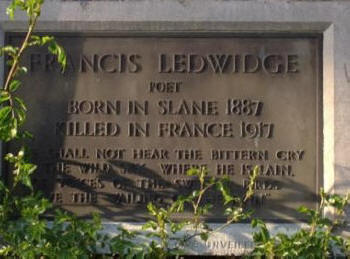
Plaque at the Ledwidge Cottage Museum, Slane,
Irish Republic. Acknowledgments: Open Heritage. www.openplaques.org/plaques/9824
Seamus Heaney may have seen this plaque at the Ledwidge Cottage Museum in Slane, the Irish Republic. The poem mentions ' ... the leafy road from Slane.' It may have been the source of his mistaken view that Francis Ledwidge was killed in France. The title 'In Memoriam Francis Ledwidge' is followed by 'Killed in France 31 July 1917.' Whether the plaque was the source of his mistake or not, it wasn't an easy mistake to make. It was an inexcusable mistake.
Francis Ledwidge was killed not in France but in West Flanders, Belgium. As the Website of the Ledwidge Cottage Museum correctly states, he was killed during the Third Battle of Ypres - by a shell near the village of Boezinge, North West of Ypres. Ypres is mentioned in the poem: ' ... a big strafe puts the candles out in Ypres.' Did Seamus Heaney believe that Ypres is in France? Ypres is the French name but the town isn't Francophone but Flemish-speaking and the Flemish name of the town is 'Ieper.'

A photograph of some of the devastation in Ieper / Ypres taken in 1919
There were two previous battles of Ypres. The concluding phase of the third battle is commonly referred to as 'Passchendaele,' a name which, like the Somme, is one of the most evocative in the history of twentieth century war. The placing of these battle is a central fact, not a matter of minor importance. The devastation of Ypres and the devastating battles which raged around Ypres deserve scrupulous remembrance, not casual remembrance. The death of Francis Ledwidge deserves scrupulous remembrance, not casual remembrance.
There may be deliberate transpositions in a poem, as in the staging of a play, so that a death takes place far from the actual historical place, but otherwise, accuracy is often of very great importance. My page 'Seamus Heaney: flawed success' has a section Seamus Heaney's standards of accuracy in which I discuss accuracy of language and factual accuracy in the poetry.
Francis Ledwidge is buried in Artillery Wood Cemetery, a Commonwealth War Graves Commission cemetery and near to Boezinge.
The grounds of all these cemeteries were assigned in perpetuity by King Albert I of Belgium in recognition of the sacrifices made in the defence and liberation of Belgium during the war - in general, Irish nationalist views of history have never taken much account of such matters as the defence and liberation of Belgium. The first sentence of Chapter 1 of 'Passchendaele: The Sacrificial Ground' by Nigel Steel and Peter Hart is, 'The Ypres Salient was an accident of history that became the most potent symbol of British resistance to the German invasion of Belgium.' It follows a quotation from a soldier who fought in the battle, Captain Harry Yoxall, 'The Third Battle of Ypres, someone has called it: but there is only one battle of Ypres. It has lasted from October 1914 and, with Verdun, it is the biggest battle of all.' And later in the chapter, 'The beleaguered city of Ypres thus became a symbol of British resolve to honour their pledge to restore the national integrity of Belgium and defeat Imperial German ambitions.'
Every evening since 2 July 1928, except during the German occupation of the town during the Second World War, as a mark of gratitude Belgian buglers have sounded the last post at the Menin Gate Memorial in Ypres, which records the names of over 54 000 British and Commonwealth forces who fought in the area and have no known grave. The ending of this German occupation owed a very great deal to British and Commonwealth forces again, of course. Commentators who unthinkingly follow Irish nationalist interpretations need to make a much wider historical ((survey)).
Not one of the discussions of the poem which I've read has mentioned Seamus Heaney's inexcusable mistake. Commentators who have failed to detect it may well be calling upon a completely inadequate knowledge of the First World War and the very complex conflicting and competing and complementary views of historians about issues which are relevant to their commentary. Fran Brearton discusses the poem in her academic study 'The Great War in Irish Poetry from W B Yeats to Michael Longley.' She is one of the commentators who have failed to point out the error.
The requirements even for academic commentators on poetry tend to be very relaxed ones - if the specialism is Irish poetry, make sure that you write in the approved academic style and provide enough citations and footnotes and a long enough bibliography in works to do with Irish literature. If the subject concerns the intersection of two very different fields, Irish poetry and the history and historiography of the First World War, then again, the full academic apparatus need only be concerned with Irish poetry - adequate knowledge of the history of the First World War is apparently not a requirement. To a significant degree, academic work in poetry may involve thoroughness in one field and primitive standards in a field which is relevant to it. Hence the many, many commentators on poetry who are content with something much less than total immersion in another field, such as the history of the Northern Irish Troubles.
As a corrective to the lazy-minded commentators who paste standard views of the First World War into their books and essays, one of the works which can be strongly recommended is William Philpott's 'Bloody Victory: the sacrifice of the Somme.' (This work too, like Nigel Steel and Peter Hart's work on Passchendaele, has to be read with care, of course, and an awareness of contrary views.) In the chapter, 'Engagement,' he writes that 'Churchill's widely read nostrums and cavils have become the familiar staples of First World War literature, recycled again and again to a credulous public ...
'Churchill did not understand the First World War, or the central place of the Somme within it. As Gary Sheffield recently commented, Churchill's analysis of the Somme 'combines a blithe disregard for what was possible in 1916 with an astonishing lack of understanding of the realities of combat on the Western Front.' Churchill showed no appreciation of the military skill, strength of purpose and moral courage required to fight and win such a battle and such a war: a battle and war of attrition ... It is wrong and morally reprehensible to dismiss this human phenomenon on the grandest scale as a futile engagement in a futile conflict, as so many do.'
'Earlier, in his comments on Churchill's 'The World Crisis,' William Philpott writes of 'familiar clichés, the product of a self-absorbed refusal to investigate the bigger picture: unimaginative and callous generals; ill-planned and futile offensive operations; high and unnecessary casualties; atrocious battlefield conditions; technophobic cavalrymen failing to appreciate the potential of new war-winning weapons, notably the tank. Churchill thus set the agenda for subsequent generations' perception of the Battle of the Somme, and the war of which it mas the defining and pivotal event.'
Gary Sheffield's 'Forgotten Victory, The First World War: Myths and Realities' is a shorter but very comprehensive work which makes a powerful criticism of the established view of the British conduct of the war as marked above all by futility, incompetence and suffering which achieved nothing, except for such achievements as British war poetry. He comments on what he calls the 'cultural' view of the war, which 'dominates so much of the British media and popular culture ... one should no more rely solely or even principally on literary sources to understand the First World War than base one's entire knowledge of fifteenth century Anglo-French relations on Shakespeare's Henry V. Still less should one imagine that the War Poets represent 'typical' British soldiers. The poems of Sassoon, Owen and the like provide, at best, a very limited and skewed view of both the war as a whole and the experience of the frontline infantryman.
In a very significant passage - but there are many more - Gary Sheffield gives reasons for a linkage between the First and Second World Wars:
'In the aftermath of the Second World War, democratic West Germany was readmitted to the family of Western states. West German historians were understandably anxious to stress the discontinuities of German history, to argue that Hitler and the Nazis had been a uniquely evil phenomenon. It is easy to understand the fury that exploded in the 1960s when the Hamburg historian Fritz Fischer published books arguing that Germany deliberately planned and executed a war of aggression in 1914. Perhaps worse, Fischer drew attention to the similarities between the German war aims under the Kaiser and those of the Third Reich ... By implying continuities between some aspects of the policy of Wilhelmine and Nazi Germany, he caused Germans to question the comfortable notion that Nazism had been an aberration. Forty years later, Fischer's thesis is still at the centre of the debate of the origins of the First World War ...
'One factor common to both Imperial and Nazi Germany was militarism, here defined both as 'a veneration of military values and appearances in excess of what is strictly necessary for effective defence' and as a situation where the armed forces have a strong degree of political influence and even power within the state.' He stresses that militarism 'was rife in Europe in the decade before the outbreak of war, but in Germany it was particularly virulent.'
Seamus Heaney's view of the history of the First World War and Second World War is rudimentary and unformed. The poetry couldn't possibly be expected to give a rounded, comprehensive account of the issues but his voluminous prose writing and interviews have made it very clear that his view is isolationist and completely inadequate. The uncritical critics who have been just as lazy minded have no excuse. Poetry critics have often supported their interpretations by invoking the history of the Irish Troubles and earlier Irish history, and the history of the First and Second World Wars, but with no attempt at a responsible ((survey)).
Poetry critics' discussion of geo-political matters and military matters has often been amateurish. Poetry critics' discussion of poetry has often been amateurish, including some academic poetry critics.
Jim Haughey's 'The First World War in Irish Poetry' can be strongly recommended for its comprehensive and fair-minded treatment of the issues. Extracts, omitting the references contained in the text:
' ... history has not been kind to the memory of the thousands of Irish nationalists who fought in the Great War. They are an uncomfortable reminder that Irish republicans did not represent the political views of the majority of Irish people during the war years ... Even more complicating is that many of those nationalists who went off to fight in the war were also self-divided in their reasons for enlistment. In his elegy for Irish soldier-poet Francis Ledwidge ("In Memoriam Francis Ledwidge") Seamus Heaney explores the reasons why nationalists like Ledwidge supported the war effort ... Ledwidge, Heaney implies, represents an historical enigma: that of an Irish Catholic nationalist who goesto an "ambivalent death". Heaney's portrait of Ledwidge as the Celtic bard who followed a "sure, confusing drum" overlooks the fact that there were many Irish Catholic nationalists, like Tom Kettle, who were committed to the war and who saw no contradiction between serving Ireland and the empire. Heaney's implication that allegiance to Ireland and loyalty to empire were mutually exclusive illustrates the extent to which Ireland's past continues to be laundered for selective narratives by nationalist as well as unionist apologists ...
... there were other more immediate incentives to enlist. First of all, there was already a storied connection between the British army and Irish Catholics. When men like Francis Ledwidge and Tom Kettle enlisted in their respective Irish regiments, they were actually taking part in a tradition that had existed for generations ... Catholic Relief Acts and eventual emancipation (1829) enabled Irish Catholics to obtain commissions in the army as soldiering offered economic opportunity. In fact, "by 1830, over 40% of NCO's and below of the British army was composed of Irishmen". This tradition of soldiering was still popular among Irish youth during the decade before the Great War as many small Irish provincial towns were known as "soldiers' towns."
...
"Ironically, Kettle was in Belgium negotiating for firearms for the Irish Volunteers when the war broke out. His eyewitness account of German atrocities in Belgium convinced him and many others that the war was a moral issue ... Kettle regarded German aggression as a "challenge to civilization". Not surprisingly, most of his war poems seek to whip up support for the war by portraying the conflict as a battle between freedom and tyranny.
'Whether unionists or nationalists enlisted for political reasons or not, ultimately it appears that many "other Irishment joined for the more traditional reasons of a steady wage, adventure ... foreign travel, [and] family tradition". Sometimes, however, the chief motive as nothing more than a mementary whim. Summing up his own reasons for enlisting, Monk Gibbon spoke for many in the crowd who were not inspired by any grandideal: instead, "The war was just something that one went to".
...
'At the front, troops from both sides of the political divide did generally respect each other. One veteran from the Thirty-sixth Division acknowledged this mutual regard years later ... in individual cases, hard-line attitudes were altered somewhat, particularly when Irish troops from both persuasions were given the chance to fight side by side. In Major Bryan Cooper's account of the Gallipoli campaign, he notes how the Irish Tenth Division consisted of men from different creeds and political factions. Furthermore, Cooper claims that "old quarrels" and "inherited animosities" were often "forgotten". Belfast shipyard poet Thomas Carnduff also recalls how one of his brothers who served with the Thirty-sixth Ulster Division bore "an extraordinary antipathy towards all his southern countrymen," but after the Battle of Messines Ridge, where the two largely loyalist and nationalist Irish divisions bore the brunt of the frontal assault together, Carnduff's brother held a "fierce admiration for the courage and comradeship of the Connacht men that remained with him through all the croubles that followed". '
Keith Jeffery, the author of the important 'Ireland and the Great War' gives a brief account of 'Ireland and World War One' on the BBC History Website which describes the many varied reasons for the enlistment of Irishmen and includes this, 'By some accounts, Francis Ledwidge, poet, nationalist and trade union organiser, enlisted on the rebound from an unhappy love affair.'
British policy has been motivated by self-interest to a very high degree. This is as it should be, to an extent. States which neglect self-interest face destruction or very severe consequences. But British policy has sometimes been guided too by a strong and active concern for the interests of other states. Concern for the plight of Belgium, invaded by the Germans during the early period of the First World War and Second World War, was strong, even if it was very much outweighed by other concerns. During the First World War, almost all of Belgium was occupied by the Germans, as well as a sizeable area of France. The French were determined not just to drive the Germans from this occupied land, which included very important industrial assets and sources of raw materials, but to recover Alsace-Lorraine, taken away from France following an earlier German invasion, which led to the Franco-Prussion War of 1870-1.
The determination to drive the Germans out was actively assisted by the British, whose forces included substantial numbers of Irish. In contrast with the British motivation, a mixture of self-interest and interest in the fate of others, Irish nationalism has been to a far greater extent autocentric, the term I use to refer to self-centredness in the behaviour of individuals as well as states.
The historical background in Fran Brearton's book should, of course, amount to much more than mere background, and is in any case now out of date and is presented in a misleading way. Any future discussions of British and Irish poetry and the First World War will need to take account of such works as Gary Sheffield's 'Forgotten Victory, the First World War: Myths and Realities' and William Philpottt's 'Bloody Victory: The Sacrifice on the Somme.'
Fran Brearton's book is very flawed, but throughout, the discussion is on a very much higher level than her contribution to the Cambridge Companion to Seamus Heaney. Her discussion of this poem doesn't amount to much. It's at its worst in the simple-minded, schematic distinction she draws between 'rural, pacifist, and Catholic on one side; Protestant, urban, and militaristic on the other.' This ignores the importance of 'criss-cross' in the poem, a welcome note of complexity: 'In you ... all the strains / criss-cross in useless equilibrium.'
Nationalism has been urban as well as rural, of course, flourishing in Dublin and Belfast as well as rural South Armagh, and nationalism has resorted to violence frequently. The crude alignment she claims makes no more sense when applied specifically to the poem.
In Seamus Heaney's poem, nationalist politics is intrusive only to a limited extent, as in the short section beginning 'To be called a British soldier ...' A poem which actually has little to do with nationalist interpretations has attracted far too much comment which exaggerates this aspect and which very much distorts the poem.
One very common way of exaggerating the importance of a poem is to give undue importance to subject-matter. How can a poem not be important if it deals with important subject-matter? This is an instance of {substitution}. Seamus Heaney's poem is about the First World War and the difficulties faced by an Irish nationalist who fought in the First World War - these are major topics, and so a major poem is likely to result, supposedly, all the more so as the poet is Seamus Heaney.
Whereas poetry often gives an intensification of the emotions we experience in our lives, it should be obvious that Seamus Heaney's poem gives a weak, commonplace and inadequate rendering of emotion, without any adequate compensation. The infant Seamus Heaney's walk along the Portstewart prom and passed the memorial is charming and well-conveyed, but belongs to minor reminiscence rather than to major poetry.
I lived in Portstewart and my poem 'Portstewart, County Londonderry' is concerned with experience at the time. The poem is in the section War, the Holocaust and the Troubles in Northern Ireland on the page 'Poems: a Large Page Design.' The poems in each section are displayed horizontally and the poem is reached by horizontal scrolling.
Before long, we're subjected to the mildly picturesque rigmarole of traditional Catholic piety - faded, not at all fresh, poetically inert: 'the May altar,' the 'Easter water sprinkled in outhouses' and the 'Mass-rocks.'
But some of the better lines in the poem also belong to the detour which takes us far from the monument and far from the sombre personal history of Francis Ledwidge, such as 'A farmer stripped to his studs and shiny waistcoat.'
One line which does belong to the main subject of the poem seems a very fine one to me:
A haunted Catholic face, pallid and brave,
The connotations of 'haunted' and 'pallid' conflict with 'brave,' setting up an internal conflict which is very intense. The next line throws away the poetic advantage and dissipates it, to some extent:
Ghosting the trenches like a bloom of hawthorn
Obviously, 'ghosting' isn't in fruitful contrast with 'pallid' but more of the same. Trenches were stark and bare, unsoftened by nature. Hawthorn, whose blossom is rich and rapturous, pleasing the eye and lifting the spirits, is nothing like his pallid face.
As for the bronze statue which is the starting-point for the poem, it's depicted with fleeting memorability. The contrast between 'imagined wind' and 'real winds' is far from effective, the intrusion of abstraction. (Wordsworth's towering account of his ascent of Snowdon in Book Thirteenth of 'The Prelude,' 1805 version, has hardly any weaknesses but one of them is the mention of 'the real sea:'
A hundred hills their dusky backs upheaved
All over this still ocean,
and beyond,
Far, far beyond, the vapours shot themselves
In headlands,
tongues, and promontory shapes,
Into the sea, the real sea, that seemed
To dwindle and give up its majesty,
In this poem of Seamus Heaney's 'the real winds' is followed immediately by the much stronger action of the winds, which 'buff and sweep ...' The achievement of the poem, like the achievement of virtually all his poems, is a fragmentary one.
Yeats' poem, 'An Irish Airman Foresees his Death' gives instructive linkages and contrasts with this poem of Seamus Heaney's:
I know that I shall meet my fate
Somewhere among the clouds
above;
Those that I fight I do not hate,
Those that I guard I do
not love;
My country is Kiltartan Cross,
My countrymen Kiltartan’s
poor,
No likely end could bring them loss
Or leave them happier
than before.
Nor law, nor duty bade me fight,
Nor public men, nor
cheering crowds,
A lonely impulse of delight
Drove to this tumult
in the clouds;
I balanced all, brought all to mind,
The years to
come seemed waste of breath,
A waste of breath the years behind
In balance with this life, this death.
Major Robert Gregory wasn't an Irish nationalist. From 'W B
Yeats: A Life Volume II: The Arch-Poet 1915 - 1939' by R F Foster:
'By early 1918 feeling in Ireland was setting hard against the
endless war; this would be sharply exacerbated by the government's move
towards imposing conscription on Ireland in the autumn. Since the
executions of 1916, opposition to the British war effort had spread
widely even among political moderates, while the tone of nationalist
propaganda was vitriolic. These feelings were not shared by Robert
Gregory; his views had long been anti-Sinn Féin and he seems to have
fully supported the war effort, joining the Royal Flying Corps with
alacrity early in the war.'
In his Everyman edition of the poems,
the editor, Daniel Albright, includes in his notes on the poem this
quotation:
'Major Gregory [said] ... that the months since he
joined the Army had been the happiest of his life. I think they brought
him peace of mind, an escape from that shrinking as from his constant
struggle to resist those other gifts that brought him ease and
friendship. Leading his squadron in France or in Italy, [he was killed
in Italy] mind and hand were at one, will and desire.' This is quoted by
the editor Daniel Albright, who adds in his note to the poem, 'Yeats
thought that Robert Gregory, whose paintings were full of subjective
moodiness, had welcomed military service because the life of common
action helped him to flee from his solitary world of reverie ... But in
this poem his military mission seems less and escape from solitude than
the epitome of it.' (Uncollected Prose by W. B. Yeats, vol. II, ed. John
P. Frayne and Colton Johnson (1975), P. 431.)
Daniel Albright's
notes are very detailed and informative in general, but not as useful as
they could be in the case of this poem, despite the provision of this
quotation. His annotation for Yeats's words 'Those that I fight' is 'the
Germans, in Italy.' Robert Gregory was fighting against forces of
Austria-Hungary. His annotation for 'Those I guard' is 'the English, in
whose army he fought.' This is the common blurring of 'England' and
'Britain.' At this time, Ireland was a constituent part of the United
Kingdom. Robert Gregory was a member of the Royal Flying Corps, which
was a part of the British army.
Marion Witt comments on the poem:
'So instantly palpable a poem seems to demand no exegesis; but the
process by which it came into being and the elements united in it are
extremely complex.' (Modern Philology, Vol. 48 No. 2).
Sandstone Keepsake (Station Island)
Some of the commentaries on this poem are classic examples of
academic alchemy, which can convert a poem more slight than good
into a very weighty poem. Seamus Heaney's is culpable to an extent. He
provides a starting point for the extravagant claims of theorizing
thesis-commentators - he's a theorizing thesis-poet, after all,
sometimes - but many commentators put his modest efforts to shame.
The poet is in Inishowen, in the Republic of Ireland. He can see 'the
camp.' This is Magilligan Camp, across the border in Northern Ireland.
(When I was in this area, I was on the Northern Ireland side of the
border.) He picks up a stone and various allusions come to mind. As for the
camp, now a medium to low security prison, it had held and still held
some very, very dangerous men. T
The commentator
Frederick Marchant claims that 'guardians in prison watchtowers are
antithetical to art and its cognates.' The simple answer to the
accusation is that their duties are very demanding and although they may
have time for the poetry of stones when they are off duty, when they are on duty, they
can't reasonably be expected to give very much time to stones.
Speculations about stones were none of their business. At that time -
still - most people not geologists or poets similarly inclined who
gave any thought to stones would think about the stones flying through
the air aimed at heads and bodies. Common sense is
apt to be deflating.
This is the opening of his essay, 'A Held
Balance' in
Harvard Review, No 10, Spring 1996, pp 116 - 121.
'I. One of the Venerators
'I have always been drawn to a
complexity of tone in the ending of Seamus Heaney's "Sandstone
Keepsake," from Part I of Station Island (1985). The poem's speaker is
walking an estuary beach in Ulster, near an internment camp. Picking up
a ruddy stone from the water's edge, he is on the verge of an elaborate
poetic reverie. First he associates the stone's redness with one of the
rivers of hell. Then steam rising from the cold water on his hand makes
him think the stone resembles a heart, presumably just pulled from a
body.
This makes the reverie seem far more dramatic than it was. He overlooks the counter effect of what follows the words ' ... as if I'd plucked the heart / that damned Guy de Montfort to the boiling flood,' the deflating ' - but not really ... '
He continues,
'On the surface, the poem seems clear
enough: guardians in prison watchtowers are antithetical to art and its
cognates. However, consider the tonal complexity of "one of the
venerators." How one hears these words depends on whose point of view
one wants to adopt. If it is the strolling poet's, there is decency and
praise attached to such veneration. On the other hand, "one of the
venerators" is not an unallayed self-compliment. For a split second -
and the poem encourages this - we imagine the guardian's mind behind the
binoculars uttering the phrase with his own kind of dismissive disgust.
As a result of an overlay of two opposed points of view, honorific and
contemptuous tones inhabit the phrase simultaneously. The effect of this
tonal complexity is a composite image, one where the speaker has
absorbed and reflected antithetical points of view.'
To imagine
the man in the prison watchtower actually 'uttering the phrase' 'one of
the venerators' and 'with his own kind of dismissive disgust' (his claim
that 'the poem encourages this' is completely false) takes estrangement
from reality to rarified heights. Tonal complexity, composite images and
antithetical points of view are immensely important in poetry, but not
all claims which make use of these ideas can be justified. This is the
case here. Not all poetic musings are poetically compelled. Very often
they are fanciful and casual rather than poetically compelled.
Seamus Heaney may not have been 'antithetical to art and its
cognates' but a concern for art and its cognates have sometimes
led him very badly astray. I discuss the most serious example in
Seamus Heaney and the
hunger strikers on the page 'Seamus Heaney: ethical depth?' Seamus
Heaney gives the information in the book of interviews 'Stepping Stones'
that 'Station Island' was written at the time of the hunger strikes and
he specifically mentions 'Sandstone Keepsake.'
This is from Barbara Hardy's
discussion in 'Meeting the Myth: Station Island:'
'The
most difficult detail, which many readers will need to look up, comes as
the speaker remembers the heart of Guy's victim "in its casket, long
venerated". Heaney's note here is puzzlingly incomplete, referring us to
Dorothy Sayers' note in the Penguin translation of Dante in almost as
many words as could have said that the heart of Henry, son of Richard,
Duke of Cornwall, nephew of Henry III, was supposed to have been
contained in a casket or held in the hand of his statue, on London
Bridge. Henry was killed by Guy de Montfort at High Mass in a church at
Viterbo, in an act of revenge. The full implications of veneration
utterly destroy the innocence of the stone, and complicate the
conclusion. Veneration is made political and contemplation is implicated
in history. The "free" image is bound to history by association with a
national and military memorial to a victim of sacrilegious revenge: the
murderer's father was killed at the Battle of Evesham in a civil war.
Guy is one of the spirits who were "violent against their neighbours".
(Inferno, Canto XII).
It's a pity that the family tree wasn't treated far more
extensively - it would have added a further dimension of extra-poetic
baggage and made it even more obvious that this is commentary as
overkill - but even so, ' ... Henry, son of Richard, Duke of Cornwall,
nephew of Henry III' is a creditable attempt. She continues,
'
... The poem asks a question about veneration, perhaps several
questions: is the camp across the border right to write off veneration?
Is it possible to pick up a stone and simply wonder? are keepsakes
arbitrary? can the poet meditate, praise, remember and look without
being political? how is the innocent eye implicated in history?'
Answers to the questions.
Is the camp across the border right to
write off veneration?
In the middle ages and later, all kinds of
objects were venerated, such as alleged splinters of Christ's cross and
the alleged crown of thorns, but veneration is a very problematic
emotion now. Whether all or most or many of the staff of the prison have
never paid any attention to veneration and the alleged need for
veneration is unanswerable. As for their interest in objects which is
poetic or akin to the poetic, that is unanswerable too. It may be that
some of the staff can gaze at a flower or a leaf or a stone for that
matter and achieve an intense emotion, but who can know?
Is it
possible to pick up a stone and simply wonder?
Yes, it is.
Are
keepsakes arbitrary?
Not in general, far from it.
Can the poet
meditate, praise, remember and look without being political?
Of
course the poet can, even in a society where politics has such
ramifications, such as Northern Ireland.
How is the innocent eye
implicated in history?
There are many, many forms which the innocent
eye takes and many, many forms which history takes. The question is
hopelessly naive in its phrasing.
The grand thesis makes
unnecessary any attempt to arrive at a wider understanding of the poem.
Humdrum details are a distraction from the glorious interpretation. All
the same, a plodding insistence on some smaller scale successes and
failures is very useful, since poets are rightly expected to have a
concern for words and care in using words.
It is a kind of chalky
russet
solidified gourd, sedimentary
and so reliably dense and
bricky
I often clasp it and throw it from hand to hand.
The
last line here is too long, surely - out of scale with the preceding
lines and a sign of carelessness. The last line of the fifth stanza is
as long, but there's no attempt at patterning based on line length in
the poem, which gives an impression of casualness in lineation.
Of the adjectives and nouns here, 'chalky' is the first miscalculation. Chalk is a different kind of rock altogether, and to describe sandstone in terms of chalk is a miscalculation. 'Russet' is excellent in isolation but 'chalky russet' is 'white russet.' . As all the rocks around him are solid, 'solidified' is another miscalculation and a solidified gourd is off-putting in its wrongness. Gourds take the poem, even if only momentarily, into poetically inert places. As all rocks are 'reliably dense,' apart from such rocks as pumice stone, 'reliably dense' is yet another miscalculation.
My objections concern particular words, not the phrase type. I think that 'chalky russet / solidified gourd' is successful use of 'restrained nimiety.' (For 'nimiety,' see my page Linkage by Sound: 'The term 'nimiety' is used by Coleridge. It's applied by Basil Lam in his study of the Beethoven String Quartets, with reference to a repeated phrase in the Quartet Opus 135. It can be applied to the whole of Beethoven's Grosse Fuge, Opus 133.) The phrase is interesting but undermined not just by the choice of words but by metrical weakness to an extent: the skipping motion of the four syllable 'solidified,' which holds back rather than furthers the bold advance of the phrase.
A phrase in 'The Pitchfork' (Seeing Things) has a similar bold advance, but unchecked:
Smoothness, straightness, roundness, length and sheen
Although here 'and' in the poem-list adds smoothness - the phrase
isn't angular in the least - smoothness is obviously apt.
The fact that the camp lights came on 'silently'
isn't surprising and the first mention of 'light' is in 'the estuary
light,' liable to give the impression that the light is associated with
the estuary. ('Estuary light' is in quite commonly use amongst amateur
landscape painters.)
Then there's a sudden reliance on the Golden Treasury of
Literary Allusion (the Dante section.) The literary allusions
are contrasted effectively with the unpretentiousness (and bathos) of
a silhouette not worth bothering about,
out for the evening
in scarf and waders
but these commentators fail to register the
importance of the contrast. Barbara Hardy writes, 'The trained
binoculars spot him, then discard his unimportant and unthreatening
image.' That's fine, but followed by, ' ... to be seen seeing changes
the act of seeing and forces a recognition of an uncertainty principle.'
That word 'forces' is completely wrong. Recognition of an uncertainty
principle, and not just an analogue of Heisenberg's, isn't forced in the
least.
Widgeon (Station Island)
'Widgeon' is 'the shortest
poem in Station Island, and one of its most perfect,' according to
Neil Corcoran.
'Widgeon' after line-removal:
'It had been badly shot. While he was plucking it he found, he says, the voice box like a flute-stop in the broken windpipe - and blew upon it unexpectedly his own small widgeon cries.'
The blowing on the voice box to produce 'his own small widgeon cries' is non-expressive. Compare the expressive, the vastly superior authentic poetry of Wordsworth's boy imitating owls on the shore of Windermere in 'The Prelude.' (Book Fifth, lines 364 - 388, 1850 version, superior to the 1805 version in this passage.) This example is instructive for more than one reason. Only a small proportion of 'The Prelude' is at this poetic level, although some is equally fine or finer. There are vast amounts of routine writing, 'Parnassian,' in 'The Prelude,' as in Wordsworth's poetry as a whole. Parnassian is far more prominent and obtrusive in the later poetry than in the earlier. The proponderance of Parnassian in Seamus Heaney's poetry, particularly his later poetry - critics such as Bernard O' Donoghue claim otherwise - is nothing special.
The passage in which the voice of mountain torrents is heard is this:
...
and, when a lengthened pause
Of silence came and baffled his best skill,
Then sometimes, in that silence while he hung
Listening, a gentle shock of mild surprise
Has carried far into his heart the voice
Of mountain torrents; or the visible scene
Would enter unawares into his mind,
With all its solemn imagery, its rocks,
Its woods, and that uncertain heaven, received
Into the bosom of the steady lake.
Seamus
Heaney quotes these lines in his essay 'The Indefatigable Hoof-Taps' but quotes
very inaccurately. The first lines in the 1805 version are different from
the 1850 version above,
... And when it chanced
That pauses of deep silence mocked his skill,
Seamus Heaney gives as his version
...
And, when there came a pause
Of silence such as baffled his best skill:
He distorts in some of his comments too, so that the 'the voice / Of mountain torrents' and 'the visible scene' are forgotten: 'As he stands open like an eye or an ear, he becomes imprinted with all the melodies and hieroglyphs of the world ...'
As I've observed often, most often on the shores of Windermere or Derwentwater, sound by a lake carries far. In these lines from 'The Prelude,' the imitated sound of the owls is carried far and the 'voice of mountain-torrents' is carried 'far into his heart.' In expressive poetry, what is expressed is carried far. This poem of Seamus Heaney's carries nothing far. It seems confined to the page-plane. 'Carrying far' isn't a criterion of success for all poetry. There are many kinds of poetry - such as hermetic poetry, the poetry of great inwardness, the poetry of interesting complexity of language, the poetry primarily of the page, where carrying far isn't a criterion. But there are poems like 'Widgeon' where carrying far is obviously attempted but fails, and poems of other poets where carrying far is attempted and succeeds.
Neil Corcoran again: 'The bird is 'badly shot', as some of the shades in 'Station Island' have been badly (wickedly, cruelly) shot, in Northern sectarian murders. The primary meaning of 'badly,' meaning 'incompetently' shot (according to the standards of those people who are shooting) is almost certainly the only meaning. This is Neil Corcoran determined to interpret a poem innocent of Northern Irish violence in violent terms. Compare the determination of Helen Vendler in her comments on Digging. Even if there were the secondary meaning claimed, 'wickedly, cruelly,' the primary meaning tends to displace the secondary meaning, since the subject 'bird' is actively present, the sectarian victims at great {distance}. The primary meaning, or only meaning, as I see it, dominates and is non-expressive. It amounts to giving information, without giving any resonance or complexity to the poem.
Titles can make all the difference to a poem. Not, of course, to the artistic success of the poem, only to something far less important, the attention the poem receives. The Haydn symphonies which have titles, such as the 'Oxford,' 'Surprise,' 'Military,' 'Clock' and 'Drum Roll' have generally received much more attention than such wonderful works as the Symphony No. 88, Symphony No. 97 and Symphony No. 102. If the 'Drum Roll' Symphony were known only as Symphony No. 103, it would probably have received less attention - but it would still be as wonderful.
This poem, known only as 'Station Island VII,' ought to be far better known. By {diversification} being well known can be artistically deserved, or undeserved. This poem should be far better known because, after the opening lines, it's a very good poem. It would be better known if only it had been given a title with individuality.
In his Introduction to 'The Cambridge Companion to Seamus Heaney,' Bernard O' Donoghue writes of 'the Dantesque power and anger ... of the great narrative of William Strathearn who was treacherously gunned down in his shop ... the most fully Dantesque piece Heaney has ever written.' The poem has nothing like 'Dantesque power,' an excessive claim. 'Dantesque power' is something which is distinctive as well as intense and Seamus Heaney doesn't achieve it here. 'Anger' isn't a notably Dantesque emotion. Dante observes torments and the depravities or the unexceptional acts (in our contemporary perspective) which led to the torments with a steady gaze, as if these things couldn't be otherwise, not with any great degree of anger. After the medieval poetry of Dante, poetry moved on. After the achievements of medieval architecture, architecture moved on. Later works of poetry or architecture weren't necessarily superior to the medieval works in artistic quality, but neo- often amounts to derivative- or inferior-.
The opening of 'Stations VII' is hesitant, not in the least a Dantesque vision:
I had come to the edge
of the water,
soothed by just looking, idling over it
as if it were a clear barometer
or a mirror, when his
reflection
did not appear but I sensed a presence
entering into my concentration
'or a mirror' surely can't be justified. The comparison between reflective water and a mirror is hackneyed. The 'clear barometer' on the other side of the dividing white space is equally inept. It's difficult or impossible to find any merits in the linkage between the two phrases in the two verse paragraphs. Water has been compared with a mirror very often. I doubt if it's been compared to a barometer before this poem, for a very good reason. Everything here is remote from Dante, above all the ineffectual abstraction of 'a presence / entering into my concentration' and the ineffectual rhythm. As frequently (see also Digging) one problem is to do with too many weakly stressed syllables, which adequate revision could have solved very easily. But this would have required talents in rhythm beyond his scope.
The only remotely Dantesque lines in the entire poem occur very soon after these lines:
... And though I was reluctant
I turned to meet his face and the shock
is still in me at what
I saw. His brow
was blown open above the eye and blood
had dried on his neck and cheek.
But Dante would never have have allowed the obvious mistake of stating that the 'brow' was blown open 'above' the eye - obviously, a brow is above the eye - or stating that the blood had dried on his neck and cheek whilst we wonder what had happened to the blood obviously left when his brow was blown open.
There follows an extended passage, nothing like anything in Dante, nothing like anything else in the poetry of Seamus Heaney, in which his superb narrative gifts - if only he'd used them more widely - are apparent. None of the lines are memorable in themselves. Their language is ordinary enough. The force of the narrative gives force to ordinary lines.
The narrative flow leads to a victim and the victim slows down and stops the narrative flow. Once the narrative flow is halted and we have more time to observe closely, we perhaps become more attentive to the ordinariness of the language, such as 'an athlete's cleanliness / shining off him ...' and the habitual prosiness, the lack of poetic rhythm:
There was always an athlete's
cleanliness
shining off him and except for the ravaged
forehead and the blood, he was still that same
rangy midfielder in a blue jersey ...
In the last line, the victim ' ... trembled like a heatwave and faded.' 'Trembled' suggests someone perhaps feeling cold in a heatwave but certainly not the heatwave itself, which is strong and assertive even when it varies and seems as if it could end. In the tempo of the poem, 'and faded' happens fast. It's a suitable continuation after 'trembled' but the trembling of a heatwave suggests more a slight alteration, not an ending of the heatwave. This last line seems to me confused in its imagery, too confused to count as a successful ending to an intermittently strong poem.
'The Haw Lantern' is an attractive and endearing poem. It can be placed in that very broad category of poems which are inventive and which aren't slight, but which aren't momentous. I discuss Helen Vendler's opinion that this is a momentous poem.
The poem begins 'The wintry haw is burning out of season / ... a small light for small people.' The gap at the beginning of the second line is filled by 'crab of the thorn' which is poetically inert giving of information. The first stanza ends with the word 'illumination' which is Latinate and ineffective. (At least there are no words or quotations actually in Latin.)
The second stanza begins
But sometimes when your breath plumes in the frost
it takes the
roaming shape of Diogenes
with his lantern.
Diogenes is the ascetic philosopher who is reputed to have used a jar as accommodation. According to Diogenes Laertius (no relation), 'He lit a lamp in broad daylight and said, as he went about, "I am looking for a man." ' (Book 6, Chapter 2.) The wintry haw is that lantern in the poem, before which 'you flinch.'
Floyd Collins criticizes Helen Vendler's allegorical interpretation in 'Seamus Heaney: The Crisis of Identity,' "Vendler contends that the berry represents 'an almost apologetic flame, indirectly suggesting his [H's] own quelled hopes as a spokesman for his fellow men." But to read "The Haw Lantern" in such blatantly allegorical terms is perhaps misleading." If the interpretation is 'blatantly' allegorical then it's almost certainly misleading. I'm sure that it is.
The poem has its flaws, but only the misjudgment in the last line is of any great consequence. The haw 'scans you.' This has an evident linkage with the scanning which goes on in the poem before it in the volume, From the Frontier of Writing. I discuss the poem not on this page but on the page 'Seamus Heaney: ethical depth?' it contains nationalist exaggeration and falsification and 'The Haw Lantern' would have been better without the least reference to that world.
This is from Helen Vendler's book on Seamus Heaney. She's also the author of an essay on the volume 'The Haw Lantern,' printed in 'The Art of Seamus Heaney' edited by Tony Curtis. It includes this: 'The social, historical, and religious perceptions of The Haw Lantern, if they should become general in Ireland, would ... create a new psychic reality there.' This is grossly inflated. This comes after she has mentioned George Herbert, Milton and Mandelstam. 'The Haw Lantern' has now been classified as an emblem poem rather than an allegory. The poet writing in both genres, according to Helen Vendler, 'positions himself at a distance from daily events.' Since poetry isn't a branch of journalism, this distance from daily events isn't so very surprising. 'Such analytic, generalized poetry hopes to gain in intelligence what it loses in immediacy of reference.' This is already hopeless, even before the reference which comes next: 'The greatest example of such an aesthetic choice is Milton's decision to write the epic of Puritan war, regicide, reform, and defeat by retelling Genesis.' The fortunes of Ireland and the wider world won't be determined by this poetry. For Helen Vendler, the poem 'The Haw Lantern,' like other poems in the volume 'The Haw Lantern,' 'reflects a new despair of country and self.' This amounts to misuse of words, above all the word 'despair.' If there's despair here, it's the least corrosive, least painful, least harrowing kind of despair that can be imagined. Any linkages of great weight - George Herbert, Milton, Mandelstam, or Leopardi, Trakl and Kierkegaard - wouldn't be in the least appropriate for the light verse, ponderous verse, pretentious verse, attractive verse and very unattractive verse which makes up this collection.
There are many poems by Seamus Heaney which will seem very impressive if you read some of the commentators, disappointing or disastrously poor if you read the poems. These commentators have read the poems themselves, of course, but they are negligent, culpably negligent, in overlooking the most blatant faults. This poem is an instructive example.
Neil Corcoran doesn't find any faults in 'From the Land of the Unspoken,' or none he finds serious enough to mention. The poems whose titles begin with 'From,' including this one, have this in common, '... their strict moralism seems very much the air this volume breathes. They are all, indeed, 'dislocated geopolitical phantasmagorias', even if the island of Ireland and the configuration of Northern Ireland seem within hailing distance of their political and topographical nowheres ...' I think it can be demonstrated very easily, by a close examination of the poem, that this is verbiage, perhaps verbiage of a classy kind but verbiage divorced from critical values, verbiage which pays practically no attention to the actual text.
'From the Land of the Unspoken' has as its first verse paragraph
I have heard of a bar
of platinum
kept by a logical and talkative nation
as their standard of measurement,
the throne room and the burial chamber
of every calculation and prediction.
I could feel at home inside that metal core
slumbering at the very hub of systems.
In various places, I point out that Seamus Heaney is a very poor reviser of his own work, but no amount of revision could possibly make these abysmal lines into anything resembling even poor poetry. The scientific accuracy is just as unimpressive.
Here, the 'logical and talkative nation' is France (other nations aren't characterized in this maddening way in his poetry, so he never refers to The Republic of Ireland as the 'less logical but even more talkative nation.') He's referring to the platinum bar which was constructed in France when the metre was introduced in France as the unit of length in 1801. By the time he was writing, the metre had long before been adopted as the unit of length in the S.I. system (Système Internationale) and was no longer 'their' standard of length, the standard of France, but the standard of the whole scientific community, and the platinum bar had long before been abandoned as the method of measuring the metre. (In 1960, the metre was defined in terms of the wavelength associated with a particular line in the spectrum of an isotope of krypton.) The platinum bar was only ever the standard of the metre, not the standard of other physical quantities, such as mass and time, so it was never the basis 'of every calculation and prediction' as Seamus Heaney claims. And in any case, there are innumerable calculations and predictions which don't make any reference to physical quantities, such as calculations using numbers only and the prediction that the sun will rise tomorrow. A few moments' thought should have made this obvious.
As for 'the throne room' and the burial chamber' having anything to do with 'every calculation and prediction,' then this is evidence of impaired thought processes, which also allowed him to write, and have published, these references to him 'slumbering' and 'at home' inside the platinum bar of the standard metre - which, again, was only ever a means of measuring one quantity, and which was never 'at the very hub of systems.'
In the second verse-paragraph, Irish history is described as 'a sensation of opaque fidelity,' not a good way of describing such vivid events as The Great Famine, The Easter Rebellion, The Civil War and The Troubles.
The third verse-paragraph offers an opportunity for critical comparison:
After 'we fall in step / but do not altogether come up level,' not poetry at its most sublime or significant, there's
My deepest contact was
underground
strap-hanging back to back on a rush-hour train
This, of course, is an anticipation of the underground theme in the poem 'District and Circle' in the volume 'District and Circle.' This may be an anticipation but it's more important to recognize the artistic badness.
The final lines are
Meanwhile, if we miss
the sight of a fish
we heard jumping and then see its ripples,
that means one more of us is dying somewhere.
This could be described as either pseudo-profound or truly pointless. The poem ends, not at all resoundingly, with the vagueness of 'somewhere' but the vagueness may even come as a relief after the metrology of the opening.
The 'volta' in a sonnet is the 'turn,' a turn of subject or thought. The turn very often occurs at line 9. In this poem, there's a turn at line 9 of a different kind, from relative artistic success to clear failure. This is line 9:
The searching for a pulsebeat was abandoned.
I'm deeply suspicious of this line, I hope mistakenly. It seems contrived, fictional, fake, not a moving rendering of actual events.
The poem is concerned with the death of Seamus Heaney's mother, 'the last minutes' and the moment of death. The death was fully expected, inevitable. I find it almost impossible to believe that in 'the last minutes', there was any searching for a pulsebeat at all, any attempt to verify that life was still there. The circumstances were different in the case of the accident described by Robert Frost in 'Out, Out -' Here, it wasn't certain that the boy would die, a doctor had been called, someone was monitoring the pulse:
And then - the watcher
at his pulse took fright.
No one believed. They listened at his heart.
Little - less - nothing! - and that ended it.
No more to build on there ...
This is artistically, emotionally, dramatically at a far higher level than Seamus Heaney's plain and bland, not at all searing line 'The searching for a pulsebeat was abandoned.'
The line
The space we stood around had been emptied
is worse. The living person wasn't 'the space.' The emptying of death isn't the emptying of something almost a void to begin with, the space, but the emptying of a living person. This is abysmal. The abysmal standard is fully maintained in the final line,
High cries were felled and a pure change happened.
The 'high' is simply to confirm a linkage with high trees, when they are felled, perhaps, and 'a pure change happened' is a reminder that his justified reputation as a maker of vivid, sensuous concrete language is one-sided. In his later work, again and again there are inert abstractions and inert vagueness, as in 'pure change' and 'happened'
These lines by Isaac Rosenberg from 'Dead Man's Dump' on the moment of death are far more powerful, a different order of artistry. Only the first two lines here are directly comparable with the lines from 'Clearances.' The other lines reflect the circumstances, action during the First World War. The third line here is less successful than the others:
None saw their spirits'
shadow shake the grass,
Or stood aside for the half-used life to pass
Out of those doomed nostrils or doomed mouth,
When the swift iron burning bee
Draining the wild honey of their youth.
In 'Clearances 7,' the lines before the turn are moving, wonderful. The poem begins
In the last minutes he
said more to her
Almost than in all their life together.
The 'Almost' at the beginning of the second line is poignant word-placing. The first 8 lines of the poem are poignant poetry. They remind me of the poems about the life and death of his father by Tony Harrison, an unjustly neglected poet. Yeats's poetry was on a plane far above everyday things such as everyday death - a limitation.
The opening of this poem and the opening of a poem by the German expressionist poet Georg Heym, 'Die Gefangenen I,' 'The Prisoners I,' are revealing in their linkages and contrasts. This is Seamus Heaney:
I thought of walking round
and round a space
Utterly empty, utterly a source
Where the decked chestnut tree had lost its place
In our front hedge above the wallflowers.
This is Georg Heym, in my translation:
They tramp in circles
round the prison yard.
Their look roams to and fro in empty space,
searching for a field, a tree,
and crashes back from walled and empty white.
Like a mill wheel turning,
so turn the black tracks of their steps.
And like a monk's tonsured head,
the centre of the yard is empty, bright.
Sie
trampeln um den Hof im engen Kreis.
Ihr Blick schweift hin und her in kahlen Raum.
Er sucht nach einem Feld, nach einem Baum,
Und prallt zurück von kahler Mauern Weiss.
Wie
in den Mühlen dreht der Rädergang,
So dreht sich ihrer Schritte schwarze Spur.
Und wie ein Schädel mit der Möchstonsur,
So liegt des Hofes Mitte kahl und blank.
'Clearances 8' follows immediately after the description of the death of his mother in 'Clearances 7.' There was every reason why the poem should be just as stark as Georg Heym's poem or even more stark. 'Clearances 8' is obviously a continuation of the previous poem. What it shows is how starkness, bareness, barrenness, and the desolation of a soul, or mind, are alien to Seamus Heaney - his tame and commonplace vision or lack of vision, in so many poems. Desolation lasts hardly any time at all in his poetry, as here. Almost immediately, we have a reassuring return to the normality of 'our front hedge above the wallflowers.' In the poem - not at all, I'd think, in the experience which gave rise to the poem - the period of darkness, numbness, emptiness is far too short.
Only 'utterly empty' gives any feeling of desolation. 'Utterly a source' adds nothing. It subtracts from 'utterly empty.'
'I thought of walking round and round' is another of his abysmal openings, the half-hearted 'I thought of ...' suggesting something aimless, something which might or might not take place. It's clear enough that it wouldn't take place and didn't take place. Walking round and round would be pointless and eccentric, with none of the compulsion under which Georg Heym's prisoners walked round and round. The fact that the hedge remained after the tree had gone leaves us wondering how much space there would be to walk round anyway.
The nearness of the hedge is in conflict with the bare, geometrical associations of 'space,' in this context. Georg Heym's prisoners were confined in a bare, geometrical space, yearning for the sight of nature but denied it, in poetically successful tension.
It's clear enough that all this amounts to no more than an idea. This is confirmed by almost identical lines in Section III of 'Station Island,' the title poem of the volume 'Station Island.'
I thought of walking round
and round a space utterly empty,
utterly a source, like the idea of sound.
The philosopher David Hume distinguished 'impressions' and 'ideas.' His discussion is relevant to poets and relevant to this passage, even though this is only the starting point for a philosophy of some complexity. From Book I, Part I of 'A Treatise of Human Nature:'
'All the perceptions of the human mind resolve themselves into two distinct kinds, which I shall call IMPRESSIONS and IDEAS. The difference betwixt these consists in the degrees of force and liveliness, with which they strike upon the mind, and make their way into our thought or consciousness. Those perceptions, which enter with most force and violence, we may name impressions; and under this name I comprehend all our sensations, passions and emotions, as they make their first appearance in the soul. By ideas I mean the faint images of these in thinking and reasoning ..'
I only take from this passage the stress upon the lesser vivacity of ideas. I discuss semantic force in my page, 'The poetry of Seamus Heaney: flawed success.' I'd add these comments to make the discussion relevant to such a phrase as Seamus Heaney's 'the idea of sound' and his chestnut tree.
'Intellectual excitement may give to words, ideas and such entities as equations, real semantic force. The mathematician who devised the concept of the mathematical set wrote that when he thought of the word 'set' he experienced a chasm. The great botanist Linnaeus, who devised the binomial system of nomenclature, very likely used the word 'classification' in the same way.'
I think that 'the idea of sound' and a chestnut tree no longer present in fact but only as an idea, have hardly any poetic vivacity, are poetically ineffective.
Neil Corcoran claims that the chestnut tree 'must owe something of its symbolic associativeness here to Yeats's visionary chestnut tree in 'Among School Children.' ' Symbols often do require some background knowledge to understand them, but not comprehensive knowledge of the work of other poets to animate the symbol. Seamus Heaney may or may not have intended the chestnut tree to be a symbol but the text is more important than the intentions of the author. If the author fully intends an effect then the text should reflect the intention more clearly than here. Yeats's chestnut tree is far, far richer in its presence:
O chestnut tree, great-rooted
blossomer,
Are you the leaf, the blossom or the bole?
The depiction of a rich presence is needed to give semantic force to the absence, the taking away of the rich presence.
He explains the circumstances in which the tree was cut down in the essay on Patrick Kavanagh in his prose work, 'The Government of the Tongue.' The cutting down of the chestnut tree is described in some of the remaining lines. The use of a tool as small as a 'hatchet' rather than an axe to cut down the tree is very surprising. Its 'differentiated / Accurate cut' is perhaps misjudged, suggesting a scientific accuracy in an action which has none of these qualities but the 'collapse' and 'wreckage of it all' are effective. 'Deep planted' is misleading to anyone who knows anything about planting trees. 'Its heft and hush become a bright nowhere,' is an example of the ineffective linkage of ineffective concrete and ineffective abstract in his work.
The poem ends, referring to the chestnut tree,
Its heft and hush become
a bright nowhere,
A soul ramifying and forever
Silent, beyond silence listened for.
Seamus Heaney turned far too quickly from human extinction to the extinction of of the chestnut tree. The equation of the two is false and worrying.
Helen Vendler refers to 'The sensual tactility of 'heft' and 'hush', the irradiating force (after these softnesses) of the vivid vowel in 'bright' ...' but to anyone without the Vendlerian sensitivity to language, 'heft' and 'hush' will seem completely lacking in 'tactility' and the 'vivid vowel' in 'bright' will seem far less significant than the fact that 'bright' has forceful initial and final consonants, which do contrast effectively with the softness of 'heft' and 'hush.' 'Bright nowhere' is an ineffective oxymoron.
She commends the 'infinite participial extension of 'ramifying'' in the last lines of the poem,
A soul ramifying and forever
Silent, beyond silence listened for.
'Ramifying is a wonderful word, I think, but not to be linked with 'soul.' The isolation and nakedness of a human soul without a body, without the ability to act on the world through a body (a Cartesian conception) is what makes it one the most unramifying things that can be imagined. We have no reason to think that the 'soul' of a chestnut tree, the subject of these lines, is any more ramifying than a human soul. As for 'forever / Silent, beyond silence listened for' the chestnut tree was 'forever silent' whilst it was living! It's no more silent now that it's no longer living. But these speculations on the soul of a chestnut tree will seem ridiculous - faintly ridiculous or grossly ridiculous - to everyone but 'tree-huggers,' believers in the wisdom of trees, and commentators who are easily pleased.
There are also commentators like Neil Corcoran who wilfully misread the perfectly clear text, which, to repeat the point, is about the soul of a chestnut tree not a human soul. He thinks that 'forever / Silent, beyond silence listened for' is 'a refusal of any traditional Catholic Christian consolation, where 'forever' would carry the assurance of an eternal afterlife ...'
No matter what good lines or part-lines may have gone before, often amounting to a vein or two of precious metal amidst the dross, most of Seamus Heaney's poems end lamely. This isn't one of the exceptions. The last verse-paragraph is instantly forgettable.
What comes before deserves a place only in short-term memory. The unexpected conjunctions and similes are striking only momentarily.
'Hazel stealth' opens the poem. Despite any appearances to the contrary, it's not an intriguing opening. A large number of other conjunctions would have given just as effective, or ineffective, an opening. 'Stealth' is 'the act or characteristic of moving with extreme care and quietness, esp. so as to avoid detection.' (Collins English Dictionary.) As the hazel is incapable of movement, and as the hazel is in sunlight, not in the last able 'to avoid detection,' this conjunction is abortive for more than one reason. This isn't the kind of poem which blurs categories in an interesting way, which makes kinetic things which are immobile. This is Seamus Heaney going through the motions.
In this same opening stanza, we read 'athletic sealight ... on the sea itself.' The 'athletic' recalls the equally crass 'athletic glacier' in 'Waterfall' ('Death of a Naturalist.') A natural, not over-literal question to ask is, 'Why exactly is the light 'athletic?' It's unlikely that Seamus Heaney had in mind the speed of light - so much quicker than any associations of 'athletic' - or any changes in the light. With the 'athletic glacier' to hand as an example of Seamus Heaney's all too common arbitrariness and casualness in his use of words, it seems most likely that he simply liked the sound of 'athletic sealight.' He was oblivious to the ineffectiveness of the conjunction just as he was oblivious to the obviousness of 'sealight' falling on the sea. (Compare the not in the least surprising description of the 'winter-evening' as 'cold' in 'Glanmore Revisited,' '1, 'Scrabble' in this same volume.) The {ordering} of 'on the sea itself,' placed before 'on silent roofs and gables' is surely faulty. 'On the sea' itself involves a great broadening, maximum expansiveness, but 'on silent roofs and gables' involves a jarring contraction. The phrasing isn't at all natural, and it isn't incisively and interestingly unnatural either.
In the second verse paragraph, 'Hedges hot as chimneys' isn't based on observed, natural fact (hedges aren't as hot as chimneys even when there's no fire) and isn't incisively, interestingly unnatural either. This is more botched phrasing. The best phrase in the poem, genuinely striking, is what follows, 'Chairs on all fours' but 'fossil poetry' in the next line is another conjunction which isn't obviously more vivid, profound, interesting or exciting than any of innumerable random conjunctions.
In the third verse-paragraph,
'desire' is 'like a gorged cormorant.' Desire is unsatisfied, hungry, not
at all like a 'gorged cormorant,' The qualification 'within its moat' is intended,
it seems, to qualify 'desire' so that the simile applies, but the associations
of the concrete 'moat' make it very difficult to understand how this is possible.
Squaring
xxiv (Seeing Things)
This, in 'Seeing Things,' is like one of those amateur paintings of coast and harbour scenes - significantly, almost always depictions of reassuring calm and stability, technically unadventurous, confining themselves to routine realism or impressionism, with no trace of individual vision.
Deserted harbour stillness.
Every stone
Clarified and dormant under water,
The harbour wall a masonry of silence.
Word-painting of considerable skill, certainly, but a little thought demonstrates that despite the skill, this is piling words on words. 'Deserted harbour stillness' is nothing much. A computer program, a Poetic Phrase Generator, could easily produce it. Of the stones making up the harbour, some will be below water, some above - not 'every stone ... under water.' 'Clarified' and 'dormant' may impress, but water reduces light intensity compared to air, particularly when the water is as murky as it is around the British Isles, and the stones can't be 'clarified.' They will always be less clear in water than in air. 'Masonry of silence' is redundant. It follows from 'deserted harbour stillness.'
The next two stanzas are better, in part, the high point before the relapse into abstraction (See the section Seamus Heaney's abstractions on the page, 'The poetry of Seamus Heaney: flawed success') and a poetic standard which is abysmal:
Air and ocean known as
antecedents
Of each other. In apposition with
Omnipresence, equilibrium, brim.
Helen Vendler discusses this poem and other Squarings poems in her book 'The Breaking of Style: Hopkins, Heaney, Graham,' in the chapter 'Seamus Heaney: The Grammatical Moment.' Her discussion contains interesting observations but is thesis-discussion, the work of someone who is far too often a thesis-critic. The theses she uses are often impressive enough, elaborated with flair, but are inadequate, even if not nearly as inadequate as the grand theses of ideological thesis-critics. The recurrent difficulty is the inability of theses-critics to detect and account for degrees of poetic success, {restriction}:- (poetic success). Thesis critics tend to treat all the elements of the poem which illustrate the thesis, excellent, good, middling, poor and disastrously poor, in critical-egalitarian terms. This is an uncritical approach to poetry whether the thesis is a good one or not. Thesis critics also distort by attempting to extend the thesis to elements which don't illustrate the thesis.
Helen Vendler's thesis is a good one, but she notices none of the faults in this poem.
'I have been deeply struck by the apparent bareness and simplicity of some recent poems in Seeing Things (1991). When I was looking into that bareness, I realized that in some instances it sprang from a poem's concentration on a single grammatical element. This gave me the springboard I needed to investigate how Heaney changes his style from poem to poem; and so I want to take up, in turn, four different "parts of speech" (as they used to be called) which have generated, in Heaney, different sorts of poems.
'The first is the noun (in which I include the nominal phrase), and my example of a noun-poem is Poem xxiv from the forty-eight-poem, four-part sequence "Squarings" found in Seeing Things ... Poem xxiv is taken from the subsection of "Squarings" called "Settings" - a word implying life's backdrops, scenes which remain static while various dynamisms take place in front of or within them.'
The thesis is presented clearly and seems to offer a promising approach to these poems. She goes on to give the theory of "Settings," which is less theory than thesis. This is 'announced in Poem xix:
Memory as a building or a city,
Well-lighted, well laid out, appointed
with
Tableaux vivants and costumed effigies.'
This too is very clear, but its poetic value is questionable. This is surely not important poetry, and its value as thesis-poetry doesn't compensate.
She goes on to give thesis-criticism of Poem xxiv:
'Verbs, under the sway of this poetics' ['a poetry of the noun'] become nouns themselves (gerunds), or they attach themselves, as past-participle adjectives, to nouns. Instead of "genuine" or well-formed narrative sentences, exhibiting their unavoidable temporality in the verb, we find sentences composed almost exclusively of nouns or noun-phrases.' She goes on to quote the poem.
...
'Such is the pressure of nounness on this poem that even its adjectives are mostly nouns: "Harbour stillness," "harbour wall," "boat boards," "cockle minarets," "bottle glass," "shell-debris." '
This is illuminating, as thesis-criticism so often is, but 'a small light' (to quote 'The Haw Lantern') and incomplete. If nouns are a feature of this poem, and they are, is there any danger of excess? To me, there are nouns which play an important part in the poem but not a poetically successful part: 'antecedents,' 'apposition,' 'Omnipresence,' 'equilibrium,' 'brim.' This last noun is as inert as the previous abstract nouns.Helen Vendler claims that these are 'nouns of almost paradisal balance.'
This particular thesis, of 'nounness' is far from being markedly original, of course. Poetic use of nounness belongs to the repertoire of standard poetic technique. It required no innovative daring, no imaginative leap, to employ it, and it needed no critical innovation for Helen Vendler to point out the use of nounness in this poem. Helen Vendler ought to have examined the degree of poetic success in Seamus Heaney's handling of this standard technique. It was flawed success, surely.
There are only three poems of 'nounness' in this section 'Settings,' xiii, xix and xxiv. Her schematic thesis of adjectival, verbal and noun phases in the poetic career of Seamus Heaney is untenable. She writes, 'If the most recent Heaney is a poet of the noun, if the sensual Heaney is a poet of the verb, the earliest Heaney seemed, to me, a poet of the adjecitive.'
Helen Vendler's discussion makes use of linguistic terms but she uses them very carelessly. She refers to 'different "parts of speech" (as they used to be called)' but as an academic, writing for a readership likely to contain many academics, a mention of the current term 'lexical category' wouldn't have made her discussion forbiddingly technical. She claims that ' ... the most static part of speech is the noun ...' which is ludicrous. Are the lexical categories pronoun, preposition and conjunction less static? In her discussion of this poem, she concentrates on the noun '(in which I include the nominal phrase). Far from the nominal phrase being included in the noun, a nominal phrase has a noun (or indefinite pronoun) as its 'head word.' The head word determines the syntactic type of the phrase. The other elements have the effect of modifying the head.
Helen Vendler's is nothing if not determined. She's determined to press on with her linguistic exploration of the poem, despite her seeming lack of knowledge of linguistics. When she applies her philosophical acumen, the results are far worse:
'The command behind Heaney's poems of settings is an epistemological one: know. One knows first a phenomenology perceived through the senses, a "setting." But that does not complete knowledge: one must also know the portent. This portent is not known through a deduction which succeeds phenomenological perception. Nor is the portent known emblematically, through the setting, but sensuously, in the setting. The task Heaney has set himself is not one of allegory but one of what we might call clairvoyant perception ...'
It would take a long time to uncover and present the multiple confusions and aberrations of this account. I only give a few here.
The italics, used spuriously in many a wrong-headed academic discussion, are significant pointers to less-than-significant stresses and distinctions in Helen Vendler's discussion. In view of the meaning of 'epistemological,' Helen Vendler's emphatic know is empty. Epistemology offers no 'commands,' such as the command to know. Epistemology is an enquiry into the grounds and nature of knowldege, not a command. Phenomenology is far from being something perceived through the senses, whether known 'first,' second or in n-th place. This amounts to a complete misunderstanding of empiricist epistemology as well as phenomenology.
Helen Vendler would need to have given a much, much fuller account of phenomenology before she could possibly have claimed the application here. Here, as throughout her discussion, she simply assumes what should have been demonstrated, or, more accurately, been the subject of argument.
Phenomenology's aim, summed up, inadequately, of course, by Husserl's 'zurück zu den Sachen selbst,' 'back to the things themselves, ('Logische Untersuchungen,' 'Logical Investigations') was to bypass the presuppositions of psychology, epistemology and other fields and to examine experience prior to reflection. In my terminology, experience has prior-{ordering} here. Intentionality is taken to characterize every form of consciousness: consciousness is always of or about something. Husserl distinguished between 'noesis,' the intentional act, and 'noema,' the 'object-as-meant.' Even an account as concise and elementary as this will make it obvious, I think, that Helen Vendler fails completely to give any kind of phenomenological reading of the poem.
The claim that knowledge can be completed at all in this context is astonishing. The claim that it can be completed if one knows 'the portent' is farcical. 'Portent' and 'clairvoyant perception' are concepts radically different from the other terms in the discussion and required a very great deal of discussion. It would have been much easier to have excised the terms. It would have been much better to to have removed all trace of this passage, if she was unwilling to argue the case properly. One of the many extreme difficulties which she would have faced if she had taken the decision to argue the case properly concerns epistemology and the portent - the claim that the portent can be known sensuously, in the setting.
Her understanding of 'setting' isn't in the least helpful: 'life's backdrops, scenes which remain static while various dynamisms take place in front of or within them.' So, the portent could be regarded as one of the 'various dynamisms' which take place within the setting. How does this take us any nearer to knowing the portent and to arguing against skeptical claims to the contrary?
I criticize another instance of Helen Vendler's philosophical discussion, concerned with Spinoza and the geometrical method, in the section concerned with The Frontier of Writing.
Recycling Dante had a disastrous effect on the achievement of The Strand at Lough Beg, increasing the proportion of poor to wonderful poetry. Recycled Dante is the basis of this poem, a far less wonderful one. Seamus Heaney was under the illusion that what was created centuries ago could retain its power and could form the basis of a contemporary poem with something of the same power. He was mistaken.
The introductory verse-paragraph is all his own work, though. There's the mention of 'danger.' What kind of danger? The only clue given is 'the march dispersed.' Was this a march of the Protestant Orange Order? Not 'in darkness,' surely. Even readers very well informed about Northern Ireland will be left puzzled, as well as indifferent, probably. The very short sentences in this stanza are straining for significance and don't intensify the feeling of danger in the least:
Once. In darkness. With all the streetlamps off.
Why were the streetlamps off? Probably as a result of a simple electrical fault.
As in the case of The Toome Road and From the Frontier of Writing, which are about the routine experience of being stopped by soldiers (routine in the conditions of Northern Ireland during the Troubles), there's no reason for supposing that the experience in this poem was anything but routine. Craig Raine criticized Don Paterson (in Areté Issue 22): 'a grandiose pretence, a self-aggrandising weakness for talking things up. In a word, exaggeration, a kind of immodesty that relies on no one calling your bluff.' Similimente, as Dante would have written, 'in the same way,' Seamus Heaney very often does much the same.
There follows some half-hearted comparison of policemen's torches to 'fireflies, say ...' in Dante.' This march, whatever form it took, was obviously policed, like most marches in Northern Ireland. Even if the police were seen as sectarian, any march with police present was likely to be far less dangerous to onlookers than any march without police present. Onlookers could generally ensure that they were in even less danger by simply keeping their distance. But a simple comparison with genuinely dangerous experience, such as the experience of correspondents in Iraq and Afghanistan, shows the ridiculous weakness of making so much of the 'danger' here.
In this, from Hölderlin's 'Patmos'
Wo aber Gefahr ist, wächst das Rettende auch
But where danger is, rescue grows too
danger is given no concrete illustration. Seamus Heaney's poem supplies some concrete illustration, even if inadequately. Why is the danger, then, so much more poetically effective in 'Patmos,' so much more highly charged - at least in the original? The line from Patmos belongs to a dynamic force-field.
As an analogy, a rock resting on the ground belongs to a physical force-field, the downward weight of the rock opposed by an equal and opposite force, a static equilibrium with dynamic implications. A rock which is hurled is acted on by opposing but not equal forces, the force propelling it much stronger than the force opposing it. A rock which is slowly moved by the force of water in a river is part of a force-field too, acted on by dynamic, opposing, unequal forces.
Seamus Heaney's poetry hardly ever seems part of a dynamic force-field, which is part of the reason why so often it seems so flat. I'm not referring here, of course, to the wonderful lines but the force of these too is non-dynamic. Opposition and contrast are central to the creation of a poetic force-field, such as the opposition or contrast of ambiguity, ambivalence and paradox, almost entirely absent from his poetry.
Using 'safety' now rather than 'rescue,' danger is intensified by or brought into sharp contrast with safety. A climber in desperate danger sees a tiny handhold almost within reach, which would give the relief of safety. An explorer lost in a hostile environment is conscious of safety, but safety at great {distance}.
In this poem, it isn't safety which seems at great {distance} from danger but danger which seems at great {distance} from safety. As almost always in his poetry, the reassuring is much more prominent than the disturbing, the unreassuring.
The poet and his companion are then described as 'herded shades' who went to their car, now compared with Charon's boat. For readers not too familiar with Dante, his translation of some lines from The Inferno in this same volume is helpful (I discuss his translation at length), helpful in showing that none of the details in this episode in Dante's Inferno have a linkage with this obscure episode in Northern Ireland, in making clear how contrived the whole poem is.
In Dante's 'Inferno,' it's the damned who are herded into Charon's boat. In this Squarings poem, for Seamus Heaney to describe himself and his companion as the damned should give rise to healthy ridicule, not to solemn admiration. There's no Charon the boatman. Either Seamus Heaney or his companion will turn the key in the ignition, engage first gear, release the handbrake and move away. Whereas Charon's boat crosses the Styx, the poet and his companion cross something more mundane, perhaps a car park, before getting into the car.
Cars are generally resistant to being linked with anything that isn't mundane, useful, flashy, superficial. In general, cars are resistant to being given a metaphorical function. This attempt to give resonance and transcendental significance to driving a car, from Chapter 23, 'Excurse,' of D H Lawrence's 'Women in Love,' seems obviously a failure: ' ... with a sort of second consciousness he steered the car towards a destination. For he had the free intelligence to direct his own ends. His arms and his breast and his head were rounded and living like those of the Greek, he had not the unawakened straight arms of the Egyptian, nor the sealed, slumbering head. A lambent intelligence played secondarily above his pure Egyptian concentration in darkness ... The car crept slowly along, until he saw the post office.' And perhaps Seamus Heaney's car, after standing in for Charon's boat in the Inferno - not Dantesque but fake-Dante - came to some ordinary road-works.
'Scene from Dante,' Seamus Heaney claims: a claim for the prestige of Dante. All it amounts to is a 'scene from Seamus Heaney,' in his role as the derivative recycler.
Seamus Heaney chose to read this poem at the offices of Faber, his publisher, on the occasion of his 70th birthday: incomprehensible.
In Ulsterectomy, Andrew Waterman compared the literary culture of Northern Ireland and England: 'England sustains a literary culture that, with all its faults, is vastly more serious, diversified, intelligent, and capable of relating its achievement to serious standards.' I think this was, and is, too harsh. in its poetic achievement - in relation to the size of its population, then Northern Ireland has achieved a very great deal, even without considerations of size of population.
I think that Andrew Waterman's words can be reinterpreted and heavily modified. Contemporary writers of prose fiction and contemporary critics of prose fiction - and contemporary historians - have cultures that, despite any faults, are vastly more serious, diversified, intelligent, and capable of relating achievement to serious standards than some prominent poetry and poetry criticism.
I think that 'St Kevin and the Blackbird' and Helen Vendler's commentary on the poem can't be related to serious standards.
Some remarks before I discuss the poem and Helen Vendler's commentary. My estimate of Seamus Heaney's poetry owes nothing, I think, to what Helen Vendler calls 'thematic' considerations. It owes nothing to the fact that I'm an atheist and Seamus Heaney, although not a practising Catholic any longer, has respect for Catholicism, and that Catholicism is a strong influence in many places, including 'St Kevin and the Blackbird.' I place him above Shelley, who was an atheist and wrote on the necessity for atheism. I place poets with a strong Christian faith such as John Donne, George Herbert and Gerard Manley Hopkins much further above Shelley. The poetry of the atheist Shelley shrinks into relative insignificance compared with the poetry of the Catholic Dante.
The first part of 'St Kevin and the Blackbird.' ('The Spirit Level.') is very charming, very attractive, and very slight. Seamus Heaney demonstrates, if only in a very small portion of the poem, his strength in concrete language - 'the warm eggs, the small breast, the tucked neat head and claws.'
The second part is far less accomplished, more evidence that Seamus Heaney has only the most limited abilities in revision. Any poet with any critical abilities would have eliminated the second part and published only the first, even though the first part too is weak, despite appearances. The inability to go beyond appearances explains very many critical blunders, including very many in Helen Vendler's book. Anyone who judged people just by appearances would very likely be in deep trouble. The second part begins with some poetic rubbish, which Helen Vendler is obviously on too high a plane to notice. In fact she applies the same processes of 'analysis' as for the first part.
And since the whole thing's
imagined anyhow,
Imagine being Kevin. Which is he?
Self-forgetful or in agony all the time
From the neck on out down through his hurting forearms?
Helen Vendler devotes very nearly four pages to an analysis of the two parts of this poem. The most grotesque part of the analysis, and shockingly condescending, is a set of questions and answers which recalls elementary, unimaginative instruction in the humanities, or an earnest bureaucrat standing by a computer in a darkened hall before a captive audience, projecting on a screen inane questions: 'Change. Which departments will manage change? Which key personnel will manage change? What resources are needed to manage change? What is the time scale for change?'
This is from the first part (Line Removal would show more clearly than the original lineal form just how prosaic it is), followed by some of Helen Vendler's questions and answers. The answers make it clear, for example, to anyone unsure of the facts, that rather than standing, sitting, lying down, lounging around, eating or drinking St Kevin was kneeling.
Kevin feels the warm eggs,
the small breast, the tucked
Neat head and claws and, finding himself linked
Into the network of eternal
life,
Is moved to pity: now he must hold his hand
Like a branch out in the sun and rain for weeks
Until the young are hatched and fledged and flown.
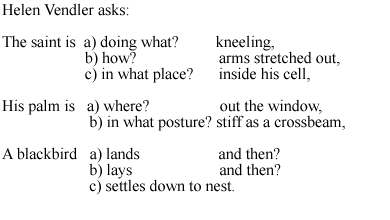
Helen Vendler does turn to more technical matters, as if realizing that her
readership isn't predominantly made up of young secondary school pupils or
people on a training day. She points out 'the maintenance throughout of the
present indicative until the 'must hold' of modal obligation (line 10) replaces
it.' 'Modal obligation' sounds very impressive, but before prostrating ourselves
before it, we ought to consider.
'Must' requires {resolution}. One very important use is the spurious 'must' or arguable 'must,' the 'must' which needs healthy critical scrutiny, not the 'must' to be acted on automatically. As in the 'justification' for the death penalty, 'whoever sheds a man's or woman's blood must die.' Seamus Heaney's must is spurious. It isn't being over-literal to say that St Kevin had alternatives to the ridiculous notion of holding out his arm for weeks. The whole notion of someone confining himself to a narrow cell for the sake of holiness, of becoming a hermit, demands scrutiny. (St Kevin became a hermit after his ordination.)
Richard Dawkins and many others have put objections to Christian belief and practice which are very substantial but which have a long history. No matter what was possible for Dante, George Herbert, John Donne and, late in the day, Gerard Manley Hopkins, any poetry which completely ignores these objections is frivolous. In the nineteenth century, Matthew Arnold, in 'Dover Beach' recognized the force of objections to Christian belief.
But the objections to St Kevin and similar saints go well beyond objections to Christianity as a whole. Discounting a recalcitrant fringe, Contemporary Christianity has discarded most of its most ridiculous and most objectionable features, such as the notion in the dark ages and the middle ages that someone can seek holiness by becoming a hermit, by having nothing to do with the opposite sex, by hardly ever speaking - whilst ignoring active persecution of unbelievers, the killing of fellow Christians with a different understanding of theology, believing in the eternal damnation of unbelievers, believing that medical advances and common cleanliness are completely unimportant, believing that monks and nuns and seekers after holiness to the exclusion of all else are the most important of all people, whilst active reformers and relievers of suffering are unimportant.
The claim in the poem that the saint finds himself, like the blackbird, 'linked into the eternal network of life' is wide of the mark. This was an age which denied that animals have immortal souls. Any consideration for animals was to do with spiritual benefits to the person, as St Thomas Aquinas made clear. The saint who refused to kill the lice who infested his body, because he was better off than the lice - he had an immortal soul and the lice did not - belonged to the same world as St Kevin.
A contemporary writer of a minor poem about the saint need pay no attention to such considerations of these. A contemporary writer of a major poem about the saint should attend to them, but without any guarantee, of course of artistic success. Richard Dawkins, so far as I know, has never written poetry. We can be grateful.
Lightness, charm, lack of strenuousness, like bluntness and coarseness, make a writer's work more varied. A writer who can include them is giving a wider survey of life. Basil Lam, in 'Beethoven String Quartets,' in connection with the last movement of Beethoven's last quartet, Opus 135, wrote of 'the true Mozartean tradition by which the most serious things could, after all, be said without solemnity or portentousness.' Seamus Heaney's poetry is more often heavy and portentous, turgid even, than light or fleeting. He has far too little talent for poetic rhythm to propel his verse nimbly and gracefully, with exceptions. This is one of the exceptions, and a delight, section VI of 'Viking Dublin: Trial Pieces' ('North'):
'Did you ever hear tell,'
said Jimmy Farrell,
'of the skulls they have
in the city of Dublin?
White skulls and black
skulls
and yellow skulls, and some
with full teeth, and some
haven't only but one,'
This is a poem which has great impact. Here, Seamus Heaney was obviously fully engaged. In a great deal of his later poetry, he hasn't been fully engaged. (A distant but useful standard of comparison: the intensity and concentration of sporting achievement at a high level, such as a downhill skier hurtling down a mountain. By this very high standard, too much of his later poetry is half-hearted.) His commitment here gave a poem which, for once, has greater urgency of rhythm in some places, or the illusion of an urgent rhythm.
The overall impact of the poem amounts to an illusion, not the necessary theatrical illusion of a compelling theatre production but the dramatically effective illusion of a production which works despite a script with many flaws. This is a 'poem-script' which despite appearances contains only a small number of strong lines and a very large number of his recurrent faults, such as carelessness in the use of language. The different moods, tones and registers - this is a poem with great variety - are successfully conveyed by very imperfect means.
'Before 'The Watchman's War,' there's a short quotation, presumably from Aeschylus' 'Agamemnon,' the source which lies behind 'Mycenae Lookout.' He translates it as 'The ox is on my tongue.' If so, 'is' is a weak and colourless translation of βέβηκεν in the phrase in lines 36 - 37:
...
βοῦς ἐπὶ γλώσσῃ μέγας
βέβηκεν:
'a great ox stands on my tongue.' He's not offering a translation or even a 'version' of Aeschylus in the rest of 'Mycenae Lookout' and he could have made far more of this ox: instead of the inert, static weight of the animal in Seamus Heaney's translation, the weight of the animal in motion, clumsy, blundering, or unable to avoid stepping on the tongue or treading on the tongue, far more vivid.
I'm using 'translates' and 'translation' here very loosely. The fact is that Seamus Heaney doesn't have a knowledge of Greek, any more than Romanian ('The First Words,' the poem after 'Mycenae Lookout,' is described as 'from the Romanian of Martin Sorescu.') It was unwise of him to give a translation, or a 'version' or a paraphrase of the proverbial expression of the ox and the tongue, let alone a version or paraphrase of Sophocles' 'Philoctetes' in 'The Cure at Troy.' This is Seamus Heaney as dilettante.
Seamus Heaney has over-extended himself in the use he makes of texts in foreign languages other than Irish or Latin, as translator, writer of 'versions' and even as critic. (He has a knowledge of Irish but not an extensive knowledge.) Justin Quinn writes in 'Heaney and Eastern Europe' ('The Cambridge Companion to Seamus Heaney) that ' ... his engagement with Slavic poets was superficial because Heaney has neither reading nor speaking proficiency in any Slavic language, and this fact should not be passed over too quickly.'
In the twenty-two lines of the first verse paragraph, there are only three and a half lines which are good:
I'd dream of blood in
bright webs in a ford,
Of bodies raining down like tattered meat
and
... on that line
Where the blaze would leap the hills when Troy had fallen.
The lines
... and me the lookout
The queen's command had posted and forgotten,
aren't poor. All the other lines are poor, but they still have impact. Like planes which can sustain catastrophic damage but still fly, the poem flies, against all the odds. It will fly in the first reading and perhaps in a few more readings, but sooner or later, the poem's essential poorness tells against it, decisively. Then, it's obvious that it's stricken after all, rather than strong.
Any expectations of Aeschylean weight and grandeur are disappointed by the flat and ordinary opening line,
Some people wept, and not for sorrow - joy
and in the second line, 'the king had ... upped' confirms the impression that this isn't going to be in the least a 'neo-Aeschylean' poem. We can be relieved that it isn't. 'Neo- ' generally amounts to 'inferior to.' No neo-Gothic building has the rightness of the best Gothic building and no neo-classic building has the perfection of the Parthenon.
From faults in tone to more clear-cut faults in accuracy of language:
But inside me like struck sound in a gong.
He's referring to the memory of killing remaining in his memory, 'That killing-fest ... still ... endured.' Most instruments can sustain a sound, but not percussion instruments such as a gong. Once the gong has been struck, the sound begins to die away and very quickly has gone. He could hardly have chosen a worse linkage. The image of an ox somehow blundering against a gong - possible but very improbable - compounds the blunder: 'And then the ox would lurch against the gong / And deaden it ...'
These lines are ridiculous:
... I would feel my tongue
Like the dropped gangplank of a cattle truck,
Trampled and rattled, running piss and muck,
Whereas 'the ox is on my tongue' is much too plain, these lines aren't plain enough. They're vivid but pathologically vivid. They sustain the illusion of the illusion (compare Plato's 'imitation of an imitation') that significant events are taking place, unlike 'swimmy-trembly,' which would be fatal to the illusion except that it's followed immediately by something more effective, 'the lick of fire.'
A victory beacon in an abattoir ...
illustrates very clearly the gulf between sound and sense in this poem. The sound is very good, but victory beacons are always constructed in places where they can be easily seen, in places where they can have an impact. They are never hidden away indoors, as in an abattoir.
The lines
Exposed to what I knew,
still honour-bound
To concentrate attention out beyond
The city and the border ...
are routine ('Parnassian.')
In the second verse-paragraph of twenty-three lines there are five good lines (including a half-line):
... clouds bloodshot with
the red
Of victory fires, the raw wound of that dawn
and
The agony of Clytemnestra's
love-shout
That rose through the palace like the yell of troops
Hurled by King Agamemnon from the ships.
But the stanza has such momentum that the flaws seem less serious.The stanza seems - is - quite powerful in its impact. The first stanza's lack of momentum now seems less flawed. It's essential preparation for this stanza. This first section, The Watchman's War, begins to seem like a poetic success, of a kind, even after sceptical examination of the details: a very unlikely success, an undeserved success, but definitely not a failure.
It may help that not many of the lines are dire. This line is pretentious as well as dire:
Flawed the black mirror of my frozen stare
If 'black mirror' was intended to be an effective oxymoron, the intention wasn't enough. Like 'black glacier' in 'Funeral Rites' (North) it's an unsubtle contrast. Given Seamus Heaney's blunders when a concept in Physics is introduced, I don't think for one moment that he had in mind the physical fact that a mirror reflects the incident radiation, black absorbs all the incident radiation.
As for 'the god of justice' hanging his 'scale-pans' on the Watchman, because he was 'tensed,' this might have been plausible if the Watchman had tetanus, in which the body is exceptionally rigid, the muscles in a state of extreme contraction - but here, the claim is ridiculous. This fails the 'literalness test,' simply imagining the image being actually enacted, a test which isn't usually appropriate but surely is here.
The 'raw wound of that dawn / Igniting and erupting, bearing down / Like lava on a fleeing population' again fails the literalness test. What has happened is that an image, the raw wound of the dawn, which I think is excellent in itself, has become far more than an image. It has taken on an independent life of its own, it has become literally intended. So, the wound is free to ignite, to erupt like a volcano, and, most ridiculously, the wound can even pursue a fleeing population. Even if a dawn has dramatic impact, a dawn which bears down 'like lava' is excessive, exaggerated. This goes well beyond poetic licence.
'No such thing / as innocent / bystanding' has the disadvantage of being obviously false, like the later lines 'No such thing / as innocent.' When poetic licence actively falsifies, then it's better to do without the poetic licence.
'Her soiled vest' is a recycling of 'soiled.' The word appeared in much earlier poems, 'Summer' (North), has '... flourished / The stained cape of his heart as history charged.' 'Punishment' (North), has 'her blindfold a soiled bandage.' By now, the word was less vivid, on the way to becoming a Heaneyan cliché word.
The relative urgency of the very short lines doesn't conceal the familiar faults, such as ineffective abstraction, as with 'trueness' in 'People / could feel // a missed / trueness ... ' On the other hand, the momentum does conceal some of the faultiness of 'the gene-hammer ... of the roused god.' It requires some protracted examination of the phrase and some ingenuity to give a convincing meaning to this phrase. But a critical opinion can be given of 'gene-hammer' as soon as it's heard or read: a contrived and ineffective conjunction of microscoptic-macroscopic.
Against all the odds, this section does succeed. The very coarse and direct lines are effective. There are effective throwaway lines such as '.... 'A wipe / of the sponge, / that's it' but this completely original: a clear reference to lines 1328 - 1329 of Aschylus' 'Agamemnon
... If misfortune strikes,
the stroke of a wet sponge destroys the drawing.
,,,
εἰ δὲ δυστυχῇ,
βολαῖς ὑγρώσσων σπόγγος ὤλεσεν γραφήν.
This section provides an effective contrast with the previous section in tone and length of line, but now that the lines are no longer fluid and fast-moving, the faults are more apparent. This section is predominantly tedious.
Our war stalled in the pre-articulate
is ineffective abstraction again, and my whole being / rained down on myself is ineffective reflexivity.
'I felt the beating of the huge time-wound / We lived inside' recalls 'the raw wound of that dawn / Igniting and erupting, bearing down / Like lava on a fleeing population' ' but now the wound is seemingly linked with a heart ('the beating of the huge time-wound), very unsuccessfully.
But the last three lines are very effective, the effective concrete:
Small crowds of people
watching as a man
Jumped a fresh earth-wall and another ran
Amorously, it seemed, to strike him down.
This is very good. Later, it becomes fluid, shifting, uneasy, obscurely vivid, beginning to abandon meaning, very successfully, an effective contrast with the explicitness of the first verse-paragraph of this section. The main flaw is that a rhythm hardly exists.
The loft-floor where the
gods
and goddesses took lovers
and made out endlessly
successfully, those thuds
and moans through the cloud cover
were wholly on his shoulders.
And,
High and low in those
days
hit their stride together.
When the captains in the horse
felt Helen's hand caress
its wooden boards and belly
they nearly rode each other.
But in the end Troy's mothers
bore their brunt in alley,
bloodied cot and bed.
The war put all men mad,
horned, horsed or roof-posted,
the boasting and the bested.
The last verse paragraph of this section is more ordinary. It ends,
I moved beyond bad faith:
for his bullion bars, his bonus
was a rope-net and a blood bath.
And the peace had come upon us.
As for 'rope-net,' entanglement, the preliminary to murder in this case, only has resonance in the most limited way. 'Blood bath' is far better, with the ambiguity of literal or metaphorical meaning.
At Troy, at Athens, what
I most clearly
see and nearly smell
is the fresh water.
This is a lacklustre beginning. Although the human sense of smell is so weak compared to that of many animals, it can give powerful sensations. The complete absence of a sensation can be powerful in itself, but the 'nearly' is middling and weak. This is quantification weakness and 'most clearly' is quantification weakness too. We are left unsure about the watchman's visual field, what else he was looking at, whether he did see the fresh water most clearly. This isn't an interesting indeterminacy and we're left with niggling doubts, avoidable doubts. There are many other adjectives which would have been better than 'fresh.' Fresh water is the complement to salt water, a distracting association and not the intended association here.
There are very poor lines lines such as '... until the hero comes / surging in incomprehensibly' and not only because of the awkwardness of sound 'in / incomprehensibly. There's some unintended transfer of meaning so that 'surging in incomprehensibly' seems to apply to the line itself, the line itself seeming incomprehensible. There's the awkwardness of meaning of 'the treadmill of assault / turned waterwheel,' where those carrying out the assault have to be imagined as suddenly part of a a waterwheel. The treadmill has taken on an independent life of its own and its sudden turning into a waterwheel is awkward. Again, this fails the literalness test.
The well in this section would have been more impressive if Seamus Heaney hadn't given such a superlative and evocative expression of experience in a much earlier poem, 'Personal Helicon,' which concerns very different wells. As it is, it suffers very badly in the comparison.
The lines which end the poem,
in the bountiful round
mouths of iron pumps
and gushing taps.
are good, but good in isolation. They don't belong to this poem. Although this section is to do with water and wells, the lines belong to the world of 'Sunlight,' the first poem of 'Mossbawn,' and 'the helmeted pump in the yard' of the Northern Irish farm, not this world, in which water wasn't obtained by using iron pumps.
Beethoven placed his quartet in F major first in the set of six quartets which make up Opus 18, not because it was the first to be composed but because he considered it, rightly, to be the best and gave it a position of prominence. If Seamus Heaney gave this poem first place in 'Electric Light' because he considered it the best of the collection, he was surely mistaken, although there are no wonderful poems in the collection, no poems that can be admired almost unreservedly, that obviously deserved the prominence of first place. At this stage in his career, poems that can be admired almost unreservedly are out of the question. Instead, we have some wonderful Heaney-phrases. In this poem, there are a few of these, including some wonderful word-pairs. I do consider that they make the poem well worth reading, re-reading and admiring, very selectively. 'Electric light' is well worth buying just for its wonderful short phrases, in fact.
The first half of the poem is about the River Bann. Still water always has a more or less flat surface (not taking into account the meniscus of water in tubes - when he refers to 'the steel-zip cold meniscus' in connection with the deep pool at Portstewart, in the poem Vitruviana in this volume, he's simply misusing the word.) The flatness obviously isn't in the least true of turbulent water. The calm, unhurried, stately qualities of the moving waters of the Bann are memorably conveyed by 'the flat water' of the opening line, and memorably contrasted with its abrupt turn to turbulence in the second line, 'pouring over the weir.' Equally abruptly, the effect is dissipated, ruined, by the common Heaneyan giving of prosaic information in the second part of the line: 'out of Lough Neagh.' (In an aphorism, or aphoristic statement, I write, 'Milly Stanfield on practising the cello: 'Progress yesterday is not progress today.' Artistic success in the first line of a poem isn't success in the second. Success in the first half of a line isn't success in the second half.') He gets a grip quickly, but only momentarily, with the word-pair 'fallen shining' before succumbing to one of his recurrent faults, non-poetic abstraction (as opposed to the artistically successful abstraction which is difficult to achieve but perfectly possible in poetry): ' ... the continuous / present'
Then the poem as information-board, as if there were a board at Toomebridge ('This is where a rebel boy was hanged in 1798'), and information about a checkpoint - not in the least a poetically eventful or evocative reminder of the Troubles. This is followed by a form of abstraction which isn't at all common in his poetry, scientific abstraction - a mention of negative ions, a mention which is without artistic value. 'the flat water' of the first line can be regarded as a form of abstraction too, poetically successful abstraction, potentially - but this is obviously not in the least explicit in the poem. The water of the Bann was never completely flat and never could be. Any observer who looked closely would find small undulations, waves, irregularities. These are disregarded, legitimately, by the description 'flat.' There's a linkage with the practice of physicists who ignore the shape and mass of an elephant, a person or the moon, let's say, and reduce each of these to a point mass for the purposes of gravitational calculations.
Linkage by sound is used sparingly in the poem: 'me' in the interior of a line is rhymed, obtrusively but completely ineffectually, with 'be' at the end of a previous line.
The closing line mentions the 'slime' and 'silver' of an eel (the eel has no linkage with anything else in the poem and no linkage with the river either. It's simply produced.) But since the previous lines are so flat and humdrum, gratitude is the most proper response. The words are evocative, but evoke more than anything else the promise and achievement of the early nature poems. By this time, Seamus Heaney's achievement in nature poetry has become fragmentary.
This is one of the most successful poems in 'Electric Light,' without any doubt. The opening passage is dramatically very effective:
And then at midnight as we started to descend
Into the
burning valley of Gijon,
Into its blacks and crimsons, in medias res,
... a dramatically effective, lurid painting-poem. For a short time, the effect is undermined to some extent, at least on a first reading, by questions about the reasons for 'burning.' The valley can't be burning in the sun's heat, since this is midnight, even if the heat of the day has lasted into the night to some extent. Are there furnaces, fires lit for some purposes? We are bound to wonder what the reason is.
in medias res is surely the most successful, or the only successful, use of Latin (or Greek) in the whole of Seamus Heaney's work, a very unlikely, a remarkable success. Here, the dry learning is for once in successful contrast with concreteness. The same can't be claimed of 'boustrophedon' in the last line of 'Desfina,' the sixth of the 'Sonnets from Hellas,' where the car is described as driven furiously 'Round hairpin bends looped like boustrophedon.' See the section Allusions: the Greek donkey in my review of 'The Cambridge Companion to Seamus Heaney.'
'it medias res' gives {separation} of the Spanish experience and an experience of childhood, obviously in Northern Ireland. Some sights and some experiences are intrinsically more magical than others, and the poet has less to do to make them magical in a poem - although, as Seamus Heaney proves, failure isn't in the least difficult But 'small airborne fire-ships' is the product of great gifts, for all its apparent simplicity.
Then, there's a return to Spain, and the answer to the question about the reasons for the burning.: 'those furnaces and hot refineries' But 'those' undermines the effect by making the furnaces seem commonplace. The answer gives all the information we need to answer our questions and dispel and puzzlement, but is poetically inadequate.
A return to everydayness could have been expected after the opening but the last line of the first section, 'And gathered speed and cursed the hellish roads' is too deflating and also too unlikely, unless the driver is very reckless. Most people would slow down rather than accelerate on hellish roads. If we stop to think - stopping to think may be a good thing or a bad thing whilst reading a poem - then we may well wonder what sort of driver we have here, and who was the driver. Any need to ask these further small, slightly irritating questions, should have been made unnecessary by the poet.
The second section isn't nearly so impressive. The best line seems to me the simple list of things seen. After a mention of men using scythes, which is nothing special, there are 'Beehives in clover, a windlass and a shrine.' This is obviously far more than ordinariness: mere mention has transformed these objects. The mention of the Gaeltacht (an area in Ireland where the Irish language is commonly spoken) is a miscalculation.
The third section amounts to very little, artistically. The best line, a semi-interesting one, is 'Watercourses scored the level sand,' but the line seems imposed, not well integrated into the poem. The in excelsis is Latin as excrescence in the poem, an artistically barren display of learning and 'cathedral gloom' has an obvious obviousness.
This is a poem with multiple defects, preceded by the mistaken use of two untranslated lines from Leopardi's 'Il Sabato del Villaggio.' Most of my discussion here is concerned with a linkage between some of the lines of the poem and some lines of Wordsworth - a comparison which is vastly unfavourable to Seamus Heaney. It can't be said that Seamus Heaney's poem suffers in the comparison with the two lines from 'Il Sabato del Villaggio,' the extract being so short. The two lines can't possibly do justice to the poem as a whole, let alone Leopardi's work as a whole. The poet comes off badly in most comparisons with Leopardi but this isn't the place to substantiate the claim. 'Electric Light' is a book without notes. Given the number of words, phrases and passages in Latin, Greek and Italian which needed translation, out of consideration for readers, the lack of notes is a deficiency. My own translation of the two lines:
Godi, fanciullo mio; stato soave,
stagion lieta è cotesta.
Take delight in it, my child; a state to savour,
a happy season this
is.
'soave' is, for me, one of the most evocative words in Italian, found in the overwhelmingly beautiful trio 'Soave sia il vento,' sung by Alfonso, Dorabella and Fiordiligi in Mozart's oprea 'Cosi fan tutte:' It means 'sweet,' 'gentle' or 'soft' in general but none of these seem to me suitable translations in the line from Leopardi. Instead, I translate by 'to savour,' which carries over some of the sound of the Italian 'soave,' just as 'stato' carries over the sound of 'stato.' The sweetness, gentleness and softness which are the primary shades of meaning of 'soave' are experienced appreciatively, and to savour is to experience appreciatively.
Seamus Heaney's 'Ballynahinch Lake' is a much more robust poem than Leopardi's 'Il Sabato del Villaggio,' and a much more coarse poem, in roughly the same way in which comfrey (not mentioned in 'Ballynahinch Lake') is a much more coarse plant than the 'little bunch of roses and violets' which are mentioned in 'Il Sabato del Villaggio.' Seamus Heaney's poem has virtually nothing in common with Leopardi's poem. The quotation does seem completely gratuitous.
After these comments, comments now on the comparison to be drawn with Wordsworth.
The domesticity of 'the spring-cleaning light' in the first line is a miscalculation. It requires far too much {adjustment), it has far too much {distance} of tone, to prepare the way for 'the utter mountain mirrored in the lake.' Whatever robustness and coarseness the poem has, it should be read in a much more robust and coarse way, and 'utter mountain' deserves to be read not at all politely: 'What rubbish!' But worse is to come:
And the utter mountain mirrored in the lake
Entered us like a wedge
knocked sweetly home
Into core timber.
The 'mountain mirrored in the lake' is standard stuff, of course. Photographs which show a mountain mirrored in the lake are often beautiful (a form of beauty which is easily achieved, too easy to achieve), but a poem can't achieve this simply by simply providing the statement, as here. What follows is materiality which is crude and contrived, the images of being impaled difficult to suppress.
In lines 389 - 413 of 'The Prelude' (1805 version) Wordsworth gives the celebrated episode of The Boy of Winander [Windermere], a mixture of the Parnassian and the inspired. He hooted to the owls and they answered. And
... when it chanced
That pauses of deep silence mocked his skill,
Then sometimes in that silence, while he hung
Listening, a gentle shock
of mild surprize
Has carried far into his heart the voice
Of mountain
torrents ...'
'How to achieve vast effects with simple means:' this is how Beethoven described the achievement of Handel. Wordsworth achieved this here with 'has carried far into his heart' but not so Seamus Heaney with his 'enterud us like a wedge.'
The second paragraph is about water birds. It was an interesting idea to focus some of the attention here on their bulk and weight. (Very many people, particularly in urban areas, are mainly familiar with light or very light birds.) The description of these water birds as 'no rafter-skimming souls' is quite good, to describe them as 'air-heavers, far heavier than the air' is wording dictated by the pursuit of sound-linkage, not successful here - obviously the sound-linkage between 'heavers' and 'heavier.'
The third paragraph is set in a car. think that cars have proved resistant to constructive, let alone inspired, use in poetry. Cars seem to be an unpromising setting for intense experience. D H Lawrence attempts it in Chapter 23 of 'Women in Love' ('Excurse') but fails, as in this passage:
'He sat still like an Egyptian Pharoah, driving the car. He felt as if he were seated in immemorial potency, like the great carven statues of real Egypt, as real and as fulfilled with subtle strength, as these are, with a vague inscrutable smile on the lips.'
The best example known to me is this, the beginning of the second half of Robert Lowell's 'Skunk Hour,' superior by far to the first half:
One dark night,
my Tudor Ford climbed the hill's skull,
I watched
for love-cars. Lights turned down,
they lay together, hull to hull,
where the graveyard shelves on the town ...
My mind's not right.
This is superb and far better than Seamus Heaney's lacklustre passage, at its most lacklustre with this:
Averring that this time, yes, it had indeed
Been useful to stop ...
To get one thing out of the way first, before I involve myself in this fascinating poem-world as a whole and try to account for its discordant impressions: the poet's reaching out for the 'stubby black roof-wort. ' This shows that Seamus Heaney can be just as careless in creating neologisms as in using established language. Bernard O' Donoghue, the editor of 'The Cambridge Companion to Seamus Heaney,' is very good at noticing things not in the least obvious, particularly in his areas of expertise, such as the 'Eclogues' or 'Bucolics' of Virgil, but poor at noticing the obvious. In his 'Introduction' he writes of 'the powerful physical evocation of the 'roof wort' - a neologism that could not apply to anything else, except perhaps the 'old kale stalk' in 'The Harrow-Pin' in the same book.
It's likely, I think, that Seamus Heaney and Bernard O' Donoghue were only familiar with 'liverwort,' the plant. Reaching out for the 'stubby black roof-wort' is reaching out for something that does resemble the plant, to an extent. But consulting the entry for 'wort' in an English dictionary would have shown that the neologism was misguided, ridiculous.
The word 'wort' has a hallowed and important use in the traditional brewing skills of Ireland and other countries as well as Britain, an important use in high-technology brewing too. The bars of Ireland and the pubs of Britain depend upon wort. Brewing has a rich repertoire of terms, which should appeal very much to Seamus Heaney, such as grist, mashing, fly-mashing, mash tun, underletting, underback, sparging, spendsafe, trub, and carragheen (Irish moss), but 'wort' is one of the most important. Malting converts barley to malt. Wort is the liquid which is extracted from the malt in the mash tun. The pitching of yeast into the wort begins the process of turning wort into the alcoholic drink. Later, there may be gyle-worting. Irish stouts were traditionally gyle-worted.
Reaching for the 'stubby black roof-wort' has, then, associations of the poet immediately showered with liquid from the brewery. How 'roof wort' could ever apply to the old kale stalk,' given that kale, which is related to cabbage, grows in the ground, not upside down from roofs, and 'wort' has these brewing associations is a mystery.
But this miscalculation is obviously only a moment in the poem. As for the poem-world of 'District and Circle, ' I think the choice of the London underground as the subject for a poem was unusual, unexpected, offering so many new opportunities. This is a long way from rural County Derry and marks a notable increase in his range.
The way in which this underground world is reached is described in the lines
Posted, eyes front, along
the dreamy ramparts
Of escalators ascending and descending
To a monotonous slight rocking in the works,
We were moved along, upstanding.
This is a characteristic mixture of strength and weakness. A kind of rigid attentiveness is expressed in both 'posted' and 'eyes front' but 'eyes front' is inferior by far. The 'dreamy' of 'the dreamy ramparts / Of escalators' is poor, since escalators are hard, metallic, but so too is 'ramparts,' since the word refers to the embankments of a fort. Although 'a monotonous slight rocking in the works' is beyond praise, the line that follows, 'We were moved along, upstanding' is hopeless. It adds nothing.
'The white tiles gleamed' is simple and effective. As for 'In passages that flowed / With draughts from cooler tunnels' I remember, from having used the underground in London for years, but a long time ago, that adjoining tunnels brought in warmer air. But I don't insist on this point.
'I missed the light / Of all-overing' contains another of Seamus Heaney's neologisms, 'all-overing,' not a worthwhile addition to English in general or this poem in particular.
The line
Parks at lunchtime where the sunners lay
could have been an abrupt and very effective transition from the underground to life above ground, although not in the same artistic category as Wilfred Owen's abrupt transition from cold to warmth in 'Exposure: '
We cringe in holes, back
on forgotten dreams, and stare, snow-dazed,
Deep into grassier ditches. So we drowse, sun-dozed,
But the transition in 'District and Circle' is mishandled and almost immediately there's banality: ' ... the sunners lay / On body-heated mown grass regardless,' in which it's obvious enough that the grass, like most grass in these urban settings, will have been mown and the heating effect of somebody lying on the grass isn't worth mentioning. The banality isn't relieved in the slightest by the next line, with its attempt to introduce weighty significance with one word, 'resurrection,' quickly followed by completely inept phrasing,
A resurrection scene minutes
before
The resurrection, habitués
Of their garden of delights, of staggered summer.
Rhythmically, too, this is useless.
The first line of the next verse paragraph is
Another level down, the platform thronged.
Even though all that's happened is that we've been taken back to the world below ground after this unsuccessful excursion to the world above ground, our interest is immediately restored. For many readers, 'another level down' will bring to mind the circles of Dante's Inferno. This could well mark the beginning of something exciting, a contemporary Inferno.
In the next line but one, there's mention of 'a crowd.' This echoes T S Eliot's line in The Waste Land,
A crowd flowed over London
Bridge, so many,
I had not thought death had undone so many.
- which echoes Dante's lines in Canto 3 of 'The Inferno,' 'so numerous a host of people ran, / I had not thought death had unmade so many.' (Translated by Anthony Esolen.)
But in this poem, the effect is confused, without impact:
A crowd half straggle-ravelled
and half strung
Like a human chain, the pushy newcomers
Jostling and purling underneath the vault,
On their marks to be first through the doors,
Street-loud, then succumbing to herd-quiet ...
There are many things wrong with these lines. These are some of them: yet another neologism which adds nothing to the resources of English in 'straggle-ravelled,' the allusion to starting an athletics race in 'On their marks,' banal and too distant from this situation to add anything, an ineffective conjunction in 'street-loud,' too obviously imitating 'street-wise.'
The remaining lines of this verse paragraph are worse, completely forgettable. 'whelm' is a neologism to the extent that here it's used as a noun, whereas the established (but archaic) meaning is as a verb, 'to engulf with water.' Here, it's fairly effective in isolation but in its context completely 'underwhelming:'
Then caught up in the
now-or-never whelm
Of one and all the full length of the train.
The poet gets on to the train, stepping 'on to the carriage metal.' As carriages in the underground are made mainly of metal, this isn't a point worth mentioning. Then he reaches out for the 'stubby black roof-wort,' which I've discussed already. 'stubby,' though, is exact and effective.
More poor lines follow, although 'Spot-rooted, buoyed, aloof,' is an exception. 'Spot-rooted' is an interesting and concise alternative to 'rooted to the spot,' I think, and 'aloof' captures very well the appearance of people travelling on the underground to other passengers, equally aloof.
The remaining lines of the verse paragraph don't repay discussion or even a bare mention.
The final verse paragraph has vivid fragments, not lighting up the dross but in contrast with the dross. The closing words, 'Flicker-lit,' referring probably to electrical discharges, is very distant from the 'twilit water' of 'A New Song' and the girl from Derrygarve (although 'Flicker-lit,' given a line of its own, is isolated, unlike 'twilit,' and amounts to an after-thought. 'Flicker-lit' is too good to be wasted in this way.) There's also 'galleried earth,' a very effective conjunction of underground passage and the dramatic / theatrical, and 'treble / Of iron on iron,' which would have been far more effective without 'one-off' before 'treble:' 'one-off treble / Of iron on iron.' 'One-off' belongs to the everyday world above ground. There are miscalculations to go with these successes, such as the line 'My lofted arm a-swivel like a flail,' in which 'flail' has associations which are much too vigorous, of thrashing around.
The first section, which describes the busker, forms a kind of Prologue. It's at a low level of accomplishment. The linkage between the busker and Charon, confirmed by the giving of a coin to the busker (a coin was given to Charon in the underworld) is trite and formulaic. The fact that the busker has 'two eyes' and not another number ('his two eyes eyeing me') wasn't worth mentioning. The only good line is 'As the music larked and capered ...' which is Elizabethan in its high spirits. It brings to mind the close of Act I, Scene III of 'Twelfth Night,'
Sir Toby ... Let me see thee caper! Ha! Higher! Ha, ha! Excellent!
Bernard O' Donoghue's comment in the Introduction to 'The Cambridge Companion to Seamus Heaney' that 'The poem invites comparison with Rilke's 'Orpheus' in the way that worldly experience translates without strain into the transcendental, 'transported / Through galleried earth with them, the only relict / Of all that I belonged to' is fatuous. For a discussion of Rilke and the transcendental, amongst other matters, see my page Rilke and Kafka.
The partial return to what Seamus Heaney does best after volumes of largely perfunctory poetry in 'District and Circle' is well illustrated by this poem. It's outstanding in its achievement in semantic force in some places.
Words with particular semantic force are underlined here.
But the reel of them on frozen Windermere ... And left it scored.
This is obviously an allusion to the thrilling lines which describe skating in 'The Prelude' (lines 452-457, 1805 version), although Wordsworth was skating on Esthwaite Water, near to Hawkshead, where he went to school, not on Windermere. I discuss these lines, in connection with sectional analysis, on the page concerned with linkages between poetry and music.
reel is very good but not as wonderful as scored, I think. Skating has physicality but often it seems nearly effortless. The ecstatic long glides are more to the fore than the necessary effort in skating, but ice is hard. By describing the lines as 'scored,' Seamus Heaney shows us unforgettably the crystalline hardness of ice. The scored lines are a 'trace' of the ecstatic action, just as the 'one track / Of sparkling light' is a trace of Wordsworth rowing on Ullswater in another 'spot of time' in 'The Prelude.' (lines 357 - 400, 1805 version.)
The intervening line, though, is Parnassian: 'earth' is in ineffective contrast. A factor in an image, such as size, may be excluded or denied by the poet, who may make it clear that another factor, such as colour, is what counts in a simile - but the associations of the excluded factor may be impossible to overlook. Here, the skater is escaping 'the clutch of earth' to speed along the ice, but the associations of earth remain, leaving the line earth-bound in part. There's an awkward transition from 'flashed' to 'clutch of earth' as if the skater were suddenly slowed or brought to a halt by earth on the ice, before speed and smoothness are abruptly restored with 'curve' and 'scored.' The meaning is clear, but images aren't fully under control.
The same problem is apparent in the preceding lines
Not
the bootless runners lying toppled
in dust in a display case,
Their bindings perished.
This is outstanding in its semantic force. The image is a memorable one - so memorable that the 'not' is incapable of cancelling it. It remains in the mind, despite the negation, so that there's an abrupt and awkward transition to the last three lines, 'But the reel of them on frozen Windermere ...' in which the skates in their state of deterioration do after all carry the skater on the frozen lake.
The placing of the lines concerned with the skates in the display case reinforces this effect. Their {prior-ordering} in the poem allows the forming of a strong image and the image has inertia, which has a linkage here with inertia in physics: the image tends to continue, despite being negated. In a poem with strong images or language with strong semantic force, these tend to have a dominating effect. This is what I call perturbation. (In Physics, 'perturbation' is a secondary influence which brings about {modification} of simple behaviour. For example, the trajectories of comets are perturbed when they pass close to massive bodies, such as the planets of our solar system. In poetic perturbation, things which are more massive, substantial, vivid tend to have a modifying effect.) In my page metre I discuss metrical inertia and metrical perturbation.
I refer to non-cancellation, non-cancellation of negation, and although the effect is unintended here and has to be counted as a flaw, non-cancellation can be intended and can contribute to the layering of a poem, which can increase its richness and resonance. This is {diversification} of non-cancellation.
Craig Raine, a very acute and perceptive commentator - very perceptive because of his strengths in analysis, amongst other strengths - discusses a famous line, the closing line of Philip Larkin's 'An Arundel Tomb,' which, using my terms, can be interpreted in terms of 'cancellation of part cancellation' and perturbation. (Craig Raine refers to 'cancelling' below but I arrived at the term independently.) The discussion is in 'Counter-Intuitive Larkin,' in Issue Twenty-three of the Arts journal 'Areté.' This is the last verse-paragraph of 'An Arundel Tomb):
Time
has transfigured them into
Untruth. The stone fidelity
They hardly meant has come to be
Their final blazon, and to prove
Our almost-instinct almost true:
What will survive of us is love.
Martin Amis quoted the moving last line in a fine piece on the victims of one of the planes of 9/11. Philip Larkin intended to cancel it, in part, by 'Our almost-instinct almost true' but the line, the feeling, is too strong to be cancelled. Craig Raine on these lines (a reading of the whole poem is needed to follow all of this):
'Andrew Motion's biography tells us that Larkin wrote on the end of the manuscript draft: 'Love isn't stronger than death just because statues hold hands for 600 years.' Larkin is consciously refuting The Song of Solomon 8.6: 'for love is strong as death.' And logically that - 'Love isn't stronger than death' - is the enforced conclusion of the poem. 'Time has transfigured them into / Untruth.' There is, apparently, no way around this. It fills the doorway like a bouncer saying 'I'm afraid not, sir. If I could just stop you there, sir.' It is reinforced by another denial: the earl and countess didn't mean it. I take it this isn't a reference to the Victorian repairs, but the primacy of the sculptor's role. 'The stone fidelity / They hardly meant ...' Thereafter, though, the qualifications are themselves qualified. Prove is a very strong verb and almost cancels the almost in 'Our almost-instinct almost true'. It again becomes a question of weighting. The last line has all the force of a last line. It simply overrides the prior qualifications so that we, and Larkin, enjoy the afflatus unqualified.'
The last line has such force that it perturbs.
The first four lines of 'Wordsworth's Skates' are at a much lower level of achievement.
It's not the highest praise to claim that a poet should be achieving at approximately the same level, and in much the same way, in his recent work and in work from decades previously. This isn't artistic development. If the later is only as good as the earlier and of the same kind as the earlier, then it's disappointing. The same can't be claimed of Beethoven, who produced great works in his early period, even greater works in his second period and still greater works in his third period which were unprecedented, belonging to a different sound world and emotional world from the works of the previous periods. In 'achieving at approximately the same level,' 'approximately' means here 'very, very approximately.' The achievement in 'District and Circle' shouldn't be exaggerated.
'Chanson d' Aventure,' describes the mild stroke Seamus Heaney suffered in 2006.
The poem is far from being a complete disappointment. The first line is very heartening:
Warm hand, hand that I
could not feel you lift
And lag in yours throughout that journey
When it lay flop-heavy as a bellpull
The next two lines lack that wonderful simplicity, although of course the third line here is much better than the second. The third line deserved to be anticipated in a much better way.
The lines that follow are modern, more modern, superficially modern, than anything else in all his works, I think (but irredeemably prosy and Parnassian):
And we careered at speed
through Dungloe,
Glendoan, our gaze ecstatic and bisected
By a hooked-up drip-feed to the cannula.
Seamus Heaney is archaic in technique and poetics, and would remain archaic in technique and poetics even if he chose to insert a reference to nuclear magnetic resonance spectroscopy into his poem. This comment isn't in the least to overlook the circumstances - Seamus Heaney in an ambulance, Seamus Heaney's plight - but it deserved a much better poem than this.
This poem gives further evidence that Seamus Heaney's strength is, with some important exceptions, in the rendering of externals - sometimes a strength so great that he seems to be rendering inscape - and one of his greatest weaknesses is in rendering the inner life. His failure to render the complexity, richness, baffling paradoxes and pathologies of the inner life is a comprehensive failure.
Although novelists differ in their descriptive gifts and in the weighting they give to description, the rendering of externals is almost a 'duty' of the novelist, but not to the neglect of the inner life of their characters, their characters' complex motivations, inconsistencies, hopes, rationalizations and the rest. As for the emotions which follow the experience of a stroke, not every novelist has the penetration of a Dostoevsky, but novelists would be expected to convey much more of the emotions than Seamus Heaney is able to in 'Chanson d' Aventure.' Poets have less space than novelists to convey experience, but are generally expected to compensate by intensity. Intensity is lacking in this poem.
On another page, I give a quotation concerned with Beethoven's Heiliger Dankgesang, the 'Song of Thanksgiving of a Convalescent,' which is one of the greatest and perhaps the greatest rendering in art of sickness and recovery from sickness, but with the difficulty that, as music, it can't explicitly render sickness and recovery, even if Beethoven intended it to do so. And I give a quotation concerned with George Orwell and sickness. (on the page 'Smoking: a defence.') I follow it with comments of my own:
'All this will be incomprehensible to many anti-smokers, those who find any artistic or spiritual benefits of suffering impossible to conceive. I maintain that language isn't complete and is far from perfect, so that it's often necessary to use a word where another word, a replacement word would be far better. For lack of a better word, I use the word 'spiritual,' even though I'm an atheist. The contrast between the spiritual benefits of suffering and the humanitarian urge to reduce suffering, the understandable instinct to avoid personal suffering, is stark, but necessary.' Using the inadequate word 'spirituality,' Seamus Heaney's account in 'Chanson d' Aventure' is one without spirituality (either 'secular' or religious.)
To illustrate the {contrast} between the rendering of externals and the rendering of the inner life, it's unnecessary to have {restriction} to illness and recovery from illness. In Donne's poetry, 'Hymne to God my God, in my sicknesse' is a less instructive illustration than 'A nocturnall upon S. Lucies day, Being the shortest day.' In the 'Hymne' the metaphysical conceits are more prominent than inwardness, in 'A nocturnall' they allow the emergence of such magnificent statements of inwardness as these (or, better, they are the means by which they emerge):
... Whither, as to the
beds-feet life is shrunke,
Dead and enterre'd, yet all these seeme to laugh,
Compared with mee, who am their Epitaph.
For I am every dead thing ...
... and I am re-begot
Of absence, darknesse, death: things which are not.
This is at great {distance} from a vivid description of a dark day.
The worst poem in 'Human
Chain' for extra-poetic
reasons, for its lack of ethical depth,
is the title poem, 'Human Chain.'
The opening verse-paragraph is:
Seeing the bags of meal
passed hand to hand
In close-up by the aid workers, and soldiers
Firing over the mob ...
but we are back in familiar territory even before the end of the stanza:
... I was braced again
With a grip on two sack
corners,
Two packed wads of grain ...
Seamus Heaney has such obvious strengths in the rendering of some aspects of physical experience, and such obvious weaknesses in the rendering of other aspects (not back-breaking work which ruins the health of the worker, for example). He can render the Great Famine in Ireland long ago, but not famine now, famine in a distant country. His compassionate imagination, his compassionate empathy, are limited. His imagination isn't wide reaching.
Noticeable in '... soldiers / Firing over the mob' is Seamus Heaney the Recycler. This is all too similar, of course, to 'Summer 1969' ('North'):
While the Constabulary
covered the mob
Firing into the Falls ...
but far more importantly, the phrase ' ... soldiers / Firing over the mob' is disturbing. The obvious interpretation is that 'the mob' is made up of starving people or hungry people who are trying to get at the meal. The starving or hungry people are 'the rabble.' If it's now claimed that the callous soldiers viewed the starving or hungry people as 'the mob,' then I'd make the obvious point that there was a simple way of showing this:
Seeing the bags of meal
passed hand to hand
In close-up by the aid workers, and soldiers
Firing over 'the mob' ...
See also my poems on The Great Famine in the page Ireland and Northern Ireland: distortions and illusions:'The Irish Famine: Doo Lough' and 'The Irish famine: Black and White.'
'The door was open and the house was dark: in memory of David Hammond' is one of the best poems in 'Human Chain.' The first stanza is moving and its quiet dignity is sustained. The first line, but only the first line, recalls to an extent Wallace Stevens' 'The house was quiet and the world was calm.' Most of the imperfections in 'The door was open and the house was dark' seem surface imperfections, slight scratches rather than obtrusive flaws, but not all. The first stanza is
The door was open and
the house was dark
Wherefore I called his name, although I knew
The answer this time would be silence
'Wherefore' is an obtrusive archaism. Also obtrusive are the unwanted associations of vagrancy in 'down and out' in the second stanza.
Not successful, even though it sounds well, is the ending of the poem:
... a not unwelcoming
Emptiness, as in a midnight hangar
On an overgrown airfield in late summer.
This isn't true to experience, surely. A disused airfield in late summer might seem 'not unwelcoming' at midday, whilst the sun is shining, but to be in an empty hangar on a disused airfield at midnight is far more likely to be an experience of extreme bleakness or of something sinister. Even places which are still in use often seem deeply unwelcoming unlit, by night.
The poem isn't successful in its use of rhyme. A much earlier poem with a truly chaotic rhyme scheme is Digging Showing unrhymed lines by ! the rhyme scheme for 'Digging' is is aa bbb !!!! ... with unrhymed lines to the end of the poem - except that the 17th line rhymes with the 21st and the 29th line rhymes with the 1st. This can't be claimed as an innovation in rhyme schemes: 'rhyme when you feel like it and if you can't find a rhyme, not to worry.'
The rhyme scheme for 'The door was open and the house was dark' is less chaotic but poor in its distribution and placing of sound linkages and sound contrasts:
abc bcd efg fgf f
The intensification of meaning by sound, the intensification of the overall impact of the poem, which an effective rhyme scheme can provide, is apparent in one instance only, the rhyming of 'stranger' in line 8 with 'danger' in line 10 (in the phrase 'there was no danger.) The ending of the poem is ineffective, and the ineffectiveness is emphasized by the pararhymes 'hangar' and 'summer.' The repetition in the rhyme scheme of 'f,' which may on paper appear to be promising, 'efg fgf f' isn't accompanied by any fruitful repetition in the lines. 'f' seems to dominate the rhyme scheme but what shouldn't be overlooked are the linkages by sound between occurrences of 'b,' 'c' and 'g.' These contribute nothing to the overall impact of the poem.
Metre has to have a high degree of regularity to be effective. The irregularities which are the source of so much vitality, power and subtlety in metrical writing need a background of regularity. In the same way, the linkage by sound which is rhyming needs a high degree of regularity to be effective. The irregularities which come from the use of pararhyme can be artistically very fruitful, but not so the use of a chaotic rhyme scheme. Seamus Heaney does have skill in the use of pararhyme, and generally more effectively than here.
'In the Attic' is a much better account of the aftermath of his stroke than 'Chanson d' Aventure.'
Section IV begins,
As I age and blank on
names,
As my uncertainty on stairs
Is more and more the lightheadedness
Of a cabin boy's first time on the rigging,
which recapitulates the accomplished opening of the poem and completes an extended simile:
Like Jim Hawkins aloft
in the cross-trees
Of Hispaniola, nothing underneath him
But still green water and clean bottom sand,
The ship aground, the
canted mast far out
Above a sea-floor where striped fish pass in shoals -
The unsteadiness on the stairs, though, would have a much closer linkage with the cabin boy in the rigging when the ship is free to move on a rough sea, rather than when the ship is aground and not free to move.
The only phrase which is very weak is this, in section II, 'Airbrushed to and fro' in
... a boy
Shipshaped in the crow's nest of a life,
Airbrushed to and fro ...
Seamus Heaney's rendering of the inner life is a poetic success in this poem, but even then, it's a wry look at his experience. It's not an exception to the claim that his poetry leaves generally unexplored shattering experience, very disturbing experience, tragic experience. These aren't marginal areas of experience in the least, of course. Human history is largely to do with experience of harshness.