This
section of the page uses 'dual-purpose text.' To go back to this point in
the page, perhaps to make use of the list of links below, click anywhere
in the text.
 Introduction - Sheffield industry
The
images above and to the right
Cultivating
the soil
Compassion
Aggression
Catherine
Bailey's 'Black Diamonds'
Introduction -
Sheffield industry
The
industrial past of Sheffield has never lost its hold upon me, and I've a
very great
interest in its industrial present. My interest in these things has steadily
increased, and with it, an interest in the preservation of Sheffield's industrial
past. I'm a member of South Yorkshire Industrial History Society. My
grandfather worked in a very large steel works, a member of the team which
moved the massive machines around the steel works. My step-father was a pattern-maker. The 'patterns' were used
for making the moulds into which the molten steel would be poured. For a
short time, I worked as a labourer at Firth Browns, one of the great names
in Sheffield steel, its factories long gone.
The
places in the list below are all open to the public. After visiting all
but one of the places in the list below, all but one either in Sheffield
or very near to Sheffield, I'd recommend a visit to them wholeheartedly.
They're all concerned with manufacturing or extraction in the past rather
than the present but the historical dimension is essential. In no particular
order:
(1)
Abbeydale Industrial Hamlet
www.simt.co.uk
Not
too far from the centre of Sheffield (about 7km south-west) and near to
the busy main road which goes from Sheffield to Bakewell, but for all that,
with an air of seclusion, set amongst trees, a very large dam alongside
it, idyllic, but used to provide power, using massive waterwheels. A centre
for scythe making.
(2)
Top Forge, Wortley
www.topforge.co.uk
Not
far from Stocksbridge, a suburb of North Sheffield, on the banks of the
River Don. The setting is quiet and leafy. The industrial buildings are
like the the cottages and today picturesque, not at all grim. When they
were the site of manufacturing, it would have been very different. Like
Abbeydale Industrial Hamlet, full of equipment, tools, things used in everyday
life, as well as machinery and other equipment in the open, some of it massive.
Wrought iron was manufactured here, including wrought iron railway axles.
The oldest heavy iron forge in the world.
(3)
Kelham Island Industrial Museum
www.simt.co.uk
On the
banks of the River Don, a few km from the city centre. The museum was heavily
damaged by flooding in 2007. It's now open to the public again, giving essential
insight into the stupendous achievements of Sheffield industry.
(4)
The Magna Centre
www.visitmagna.co.uk (A very slow Web-site, as it uses
Flash.)
Probably
worth a visit just to see the vast building (the former Templeborough steel
works) but this is full of push-button gadgets.
(5)
National Coal Mining Museum
www.ncm.org.uk
Further
away from Sheffield (about 30km) and south of Wakefield. Admission free.
Remarkable displays of equipment and machinery and articles to do with the
life of mining families, as well as visits underground - an altogether memorable
and humbling experience.
The
images above and to the right
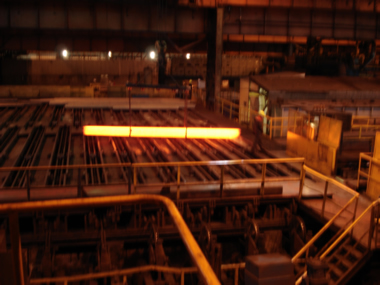
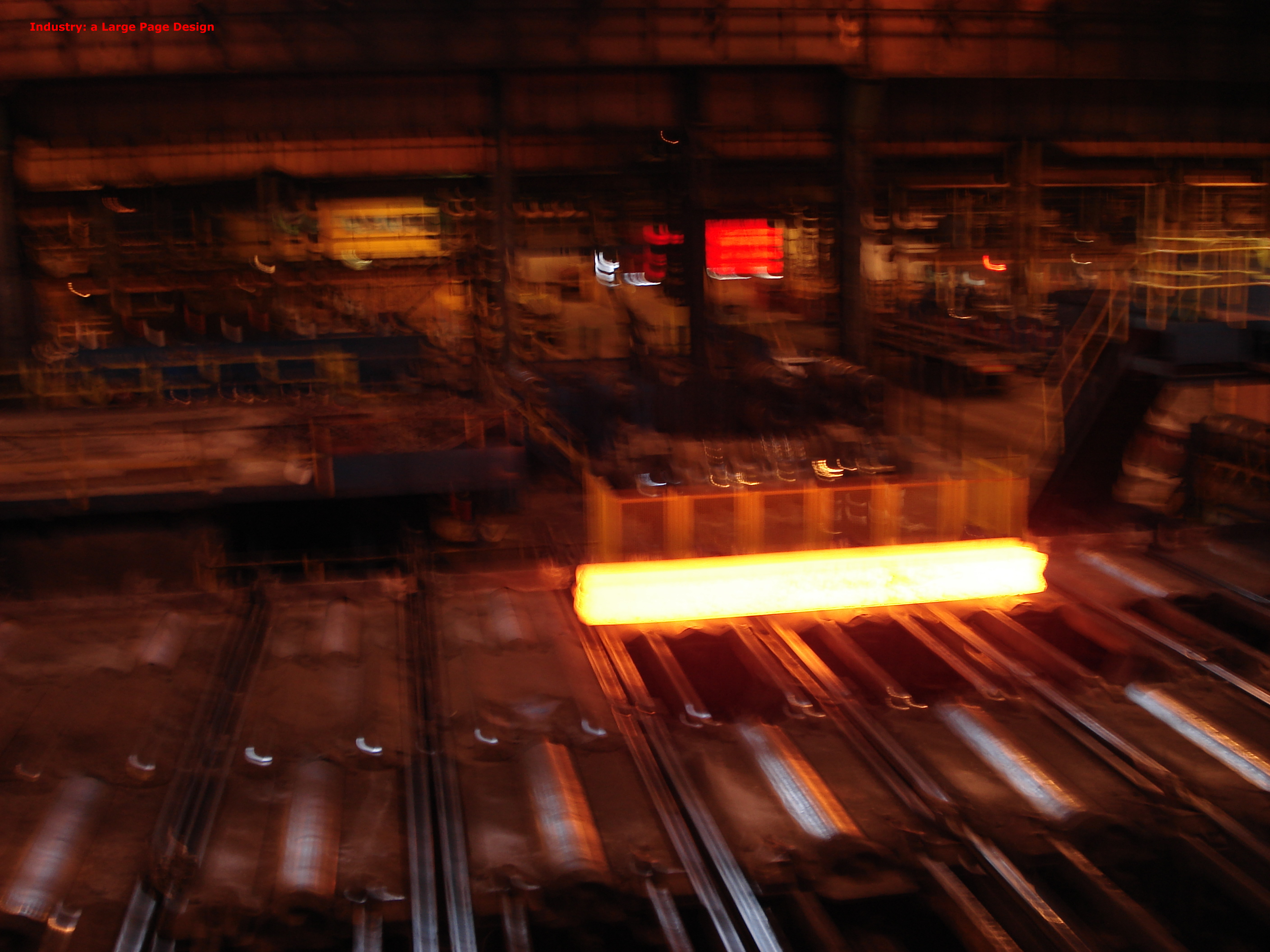
I took the photograph
during a visit to this Sheffield factory organized by South Yorkshire
Industrial History Society. The interior of the
factory is very large, although many factories are much bigger. The very
large image has greater scale and greater adequacy
than the much smaller image below it - it's more likely to produce a
subjective response (as a
matter of fact the larger image, like the smaller image, wasn't subjected to any processing by computer
program.) The inner, subjective response has been emphasized in the history
of expressionism, as when Mallarmé, 'remarked that an artist should
be less concerned with the object to be depicted than with 'the effect it
produces'. (quoted in George Heard Hamilton, 'Painting and Sculpture in
Europe, 1880 - 1940.)
I'd
emphasize inscape, to use Gerard Manley Hopkins' term: the
inner nature of a person or thing, in this case the inner nature of the
steel works, its overwhelmingly impressive but baffling tremendousness.
The scale of the larger image is needed to ensure greater adequacy for inscape
too, as is the nature of the larger image, the distortions which realize
the inner with greater adequacy. The more 'realistic' smaller image gives
an impression of straightforwardness which has far less adequacy in conveying
inscape. It does, though, convey better the rationality of the processes
taking place in the steel works, the high degree of control. This factor
may well be given greater weighting. There are now far
less workers than in the past. At the time the photograph was taken the
works was facing extreme difficulties which were likely to lead to redundancies.
Since then, ownership of the steel works has changed, from Corus to Tata.
Now, Tata is facing extreme difficulties.
Both images are without people but the smaller image seems to show a place
of work which is temporarily unattended, as at night. The larger image shows
a world which seems separate from any human activity, operating under its own
unfathomable laws: technology as apparently unstoppable, irreversible, autonomous.
But technology is subject to all the difficulties of human life, amongst
them very unjust problems. A factory which has required so much human
effort to erect and maintain and operate, including the effort of its
current owners, Tata, is facing severe difficulties.
Cultivating
the soil
There's
an increasing awareness of food and its linkages with the earth, with good
and poor uses of the earth, an awareness which is essential for understanding
the contemporary difficulties and dilemmas of food production. At the same
time, there's surely a limited awareness of the linkages between the articles
we use and the earth - the iron ore and the other metals in the earth, the
minerals in the earth, the oil deep beneath the earth, the earth and all
the other raw materials of industry, which include the air. A limited understanding
of the manufacturing processes themselves, of their difficulty and complexity,
of the ingenuity and resourcefulness which have been needed to devise the
processes. A limited knowledge of manufacturing's past as well as its present.
Coal, a polluting fuel, and steam power - unimportant! How inimportant the
canals, the viaducts which took the canals over valleys, the tunnels which
took them through hills, the locks which took them over hills!
The
tools essential for cultivating the soil, unlike the soil itself, are taken
for granted, yet the manufacture of tools such as scythes using water power
required a vast degree of effort, ingenuity and resourcefulness to make
the massive water wheels, hammers and grindstones - before steam power,
a development of incalculable importance, made it possible to site works
almost anywhere, away from running water.
Sheffield's industrial past and present -
A past which has included these things but so
much more: precision engineering and engineering on a massive scale and
the combination of the two: the extremely fine tolerances for massive parts
which had begun as molten metal poured from massive ladles, the
control over great masses of metal which seems effortless (The one shown in the image above, weighing
many tonnes, was flipped over and compressed with a flick of the operator's
hand on the control lever and slight pressure on foot pedals. This control
is the culmination of very long and very arduous development, development
which was never in the least effortless.) The extreme sophistication and
complexity of the manufacturing processes. Ingots of steel weighing 200
tonnes each. Giant crankshafts for ships and other marine forgings. Special
steels for innumerable different purposes, such as heat resistant steels
for jet engines.
Compassion
A
simple example of compassion, giving water to the thirsty. (See the simple-minded
Gospel according to Saint Matthew, 25: 35, where the righteous who go away
into 'life eternal' are praised: '...I was thirsty, and ye gave me drink.')
Water, although not an element, is elemental, a basic requirement of life,
but providing this basic requirement isn't at all simple. Water illustrates
the complexity of reality. It can carry disease organisms, such as those
that cause cholera. The separation of water for drinking and water for disposal
of faeces poses immense practical problems. If gratitude should be shown
to the compassionate, it should be shown too for those who by their practical
achievements made the compassionate act possible: for the engineers who
designed dams, for those who built the dams and made the bricks and the
other materials for the pipes which led the water from the dams, for the
foundries and other factories which manufactured the taps, the pumps. For
the mathematical and scientific innovators who developed the techniques
in calculus, fluid mechanics and the other techniques needed for supplying
water.
Religious
people are often very fond of simplicities, such as compassionate feelings
and compassionate acts. Compassion, like love, is thought to be in a sphere
beyond complexities. Taking fruit from trees, taking vegetables from the
earth - perhaps to feed the hungry (Matthew 25: 35 again) without the need
to bother about diseases or pests and the best ways of controlling them,
without any thought given to the manufacture of the tools and equipment
needed for cultivation.
Vegans
are an instructive example of mindless compassion. The section on 'vegan
compassion' is here. Since vegans reject leather
and wool (and fur, which I would also reject), for clothing in cold climates
and for many other purposes, they're dependent upon synthetic substitutes.
The processes by which these are made from the raw material, most often
crude oil, are almost unimaginably complex. The lack in vegan writing of
any appreciation for these, any gratitude for these, is striking.
Generally, the compassionate are given a far higher status than any
scientists, engineers or manual workers - giving to fine feeling or the appearance of fine feeling
a much higher status than to human activities which make vast demands on
intellectual achievement, complex planning and effort or vast
demands on strenuous or superhuman effort and stamina.
George
Orwell, in 'Marrakech:' 'All people who work with their hands are partly
invisible, and the more important the work they do, the less visible they
are.'
Unless
the sick are to be looked after in simple shelters or in the open, the work
of roofers and scaffolders and other manual workers in building hospitals
is so important that they deserve heartfelt appreciation - and proper pay
and working conditions - but the work of roofers and scaffolders is almost
invisible, their work taken for granted. The average roofer or scaffolder
probably lacks refinements and many would fail any tests for political correctness,
but few people in possession of those advantages would choose to do physically
demanding work at a height in almost all weathers.
When
transport - and travel - was very slow and often hazardous, then how was
coal to be transported in bulk? To get through a winter without the ability
to heat homes and workplaces effectively, to heat food and heat water -
as an exercise in compassionate and realistic imagination, it's useful for
people who take for granted the simplicity of turning on central heating,
turning on an electric kettle, having a hot shower, to enter into the harshness
of the pre-industrial age. The industrial revolution was as harsh or harsher,
but a necessary prelude to this age of comfort and comfortable assumptions.
The
harshness of the industrial age, like the comfort of this age, wasn't, of
course, shared by everyone. The harshness was experienced by people who
really are all but invisible today, such as the navvies.
'Men
of Iron,' the superb book by Sally Dugan, is mainly concerned with the audacious
work of the engineers Isaambard Kingdom Brunel and Robert Stephenson (she
also does justice to the genius of their fathers, Marc Brunel and George
Stephenson).
Sally
Dugan writes, 'Engineering history tends to be dominated by the men who
put their signatures on the plans. Brunel, in his diaries, writes about
his Chateax d' Espagne - castles in the air. They would have remained
just that if it had not been for the army of individuals who not only made
his dreams possible, but sometimes died for them. This was true of Brunel,
as it was for every other railway engineer in the country.'
She
writes of the navvies' work, 'Maiming or mutilation came with the job, and
navvies were lucky if they escaped with nothing more than the loss of a
limb. They worked using picks and shovels, crowbars and wheelbarrows, and
their bare hands; the only other aid they had was the occasional blast of
gunpowder. Some were blinded by explosions; others were buried in rock falls.
All led a life of hard, grinding physical toil, tramping from one construction
site to another in search of work. Their reputation for violence and drunkenness
made them a frequent focus for missionaries and temperance society members,
as well as turning them into the bogeymen of folk myth.' Elizabeth Garnett
was the secretary of the Navvy Mission Society and might have been expected
to give a harsh verdict on their uncouthness and worse. Far from it. 'Men
of Iron' quotes her words: 'Certainly no men in all the world so improve
their country as Navvies do England. Their work will last for ages, and
if the world remains so long, people will come hundreds of years hence to
look at it and wonder at what they have done.'
There
are many people who like their reality smoothed out, comfortable, free of
unsettling paradoxes and contradictions: in the terminology I use, with
{adjustment} of reality, a sub-theme of {modifiction} of reality. How could
such drunken, violent people (although they were not all drunken and violent)
have done so much to reduce human suffering, and far more, in general, than
the genteel? (The human suffering they reduced was not their own, but the
suffering of the wider population, including the suffering of their critics.)
Aggression
For
those who question the morality of manufacturing bombers, such as the Lancasters
manufactured at Manchester: during the Second World War, it was proposed
that the rail links to the German extermination camps should be bombed.
The proposal was never adopted. It would have been better if it had. If
the bombing had been carried out - with what? This is not to condone the
area offensive on German cities, but bombers were essential for resisting
aggression, in effect for furthering compassion.
The
resistance of Britain against German aggression when it stood alone in the
early part of the war is morally neater, but of course relied just as much
on the ability to kill and destroy with complete reliance upon manufacturing
industry. Sheffield played a prominent part in this as in other aspects
of the war. In the first 18 months of the war the only drop hammer in Britain
capable of forging crankshafts for Spitfires and Hurricanes was the 200
tonne hammer at the Vickers works in Sheffield: a descendant of the hammers
which forged scythe blades for peaceful use by means of water power.
Catherine
Bailey's 'Black Diamonds: the Rise and Fall of an English Dynasty
The
story she has to tell, and tells so very well is so remarkable that it deserves
to be very widely known, and the book and its author too. Simplifying, the
book portrays the Fitzwilliam dynasty and the mining communities who generated
their wealth. The mines have now gone and the aristocratic dynasty is at
an end. The tangible remains are a house, 'Wentworth House,' (or 'Wentworth
Woodhouse'), which is the largest in the country (twice as wide as Buckingham
Palace). It was bought by a recluse and is now derelict, apart, presumably,
from a very few rooms. Even the stable block is huge, with a huge fountain,
glimpsed behind an ornate gate. Even on a summer's day, to see the palace
is a melancholy and eerie experience.
There
are writers who could do justice to the aristocratic world portrayed in
the book, ones who could do justice to the emotional world of the characters,
ones who could do justice to the tragic deaths of some of the upper class
people in the book, in war and in a plane crash, there are writers who could
have done justice to the exotic aspects, such as travel through the Canadian
wilderness, and ones who could do justice to a main strand of the book,
the desperately harsh lives of miners and their families, the tragic deaths
of so many of them. There are writers too who could do justice to the political
background, the financial and the legislative background.
Catherine
Bailey has an understanding of all of these strands -and others - and the
empathy, compassion, knowledge and skill to bring them all to life. Although
I concentrate here on the working class strands, the aristocratic strands
which are necessarily prominent in the book are of the greatest interest
too.
The
miners employed by the Wentworths had, it was said, the most enlightened
employers in the country. The miners who lived at Denaby Dale, not so far
away, had employers who were amongst the least enlightened. Denaby Dale
was 'the worst village in England.' In Chapter 9 of the book, the author
tells us about the 'despotic powers' of the mine owners, the accidents and
the mining disasters, the slums and the evictions in the slums. Of small
evictions (At Denaby, 'it was company policy to evict the dead miner's family
from their house within weeks of bereavement'). And of a mass eviction,
200 policemen putting on to the streets 3,500 miners and their families
in bitterly cold weather in early January.
In the
previous chapter of the book, there are accounts of working conditions in
the previous century. 'Samuel Scriven saw women and girls 'chained, belted,
harnessed like dogs in a go-cart, black, saturated with wet and more than
half-naked, crawling upon their hands and knees and dragging heavy loads
behind them.' After 1842, women and boys under the age of 10 no longer worked
in the mines. The miner David Swallow is quoted: 'The roads are very wet
in some of the pits. The boys are continually wet at their feet...With being
continually wet on their feet and legs they have inflammations in those
parts, on their legs and knees. Boils and rheumatism in all parts of the
body, particularly in their lower parts...Where the road rises very fast,
it is very heavy work indeed.' Catherine Bailey: 'For the majority, there
was no safety net: no unemployment, sickness or injury' benefit.'
This
is the fine closing passage of the book, describing the view from a structure
erected to commemorate the English victory over the Scots at the Battle
of Culloden:
'At
night, the view over the surrounding country stretches for miles. To the
south, the hills above Sheffield are coloured by a livid orange glare; to
the south-west, Rotherham and Rawmarsh blaze, a sodium-lit sprawl; the M1
marches along its western edge. But like totality in a solar eclipse, in
the midst of this, one of England's greatest urban conurbations, there is
a vast expanse of black. Startling in its size and density, it conceals
woodland, fields and parkland. It is the land once encompassed by the nine-mile
perimeter wall that encircled Wentworth House.'
The
industrial past of Sheffield has never lost its hold upon me, and I've a
very great
interest in its industrial present. My interest in these things has steadily
increased, and with it, an interest in the preservation of Sheffield's industrial
past. I'm a member of South Yorkshire Industrial History Society. My
grandfather worked in a very large steel works, a member of the team which
moved the massive machines around the steel works. My step-father was a pattern-maker. The 'patterns' were used
for making the moulds into which the molten steel would be poured. For a
short time, I worked as a labourer at Firth Browns, one of the great names
in Sheffield steel, its factories long gone.