


 Introduction
The upper allotment The
lower allotment Gardening photographs 2
Bed and board
Plant-protection cages with flexible supports
Cloches, cheap and simple to make
Composting, rainwater collecting
Transframe, a system with many uses
Some design principles in gardening
Introduction
The upper allotment The
lower allotment Gardening photographs 2
Bed and board
Plant-protection cages with flexible supports
Cloches, cheap and simple to make
Composting, rainwater collecting
Transframe, a system with many uses
Some design principles in gardeningThe photos on this page were taken in 2010. A more recent page shows photos taken in 2011.
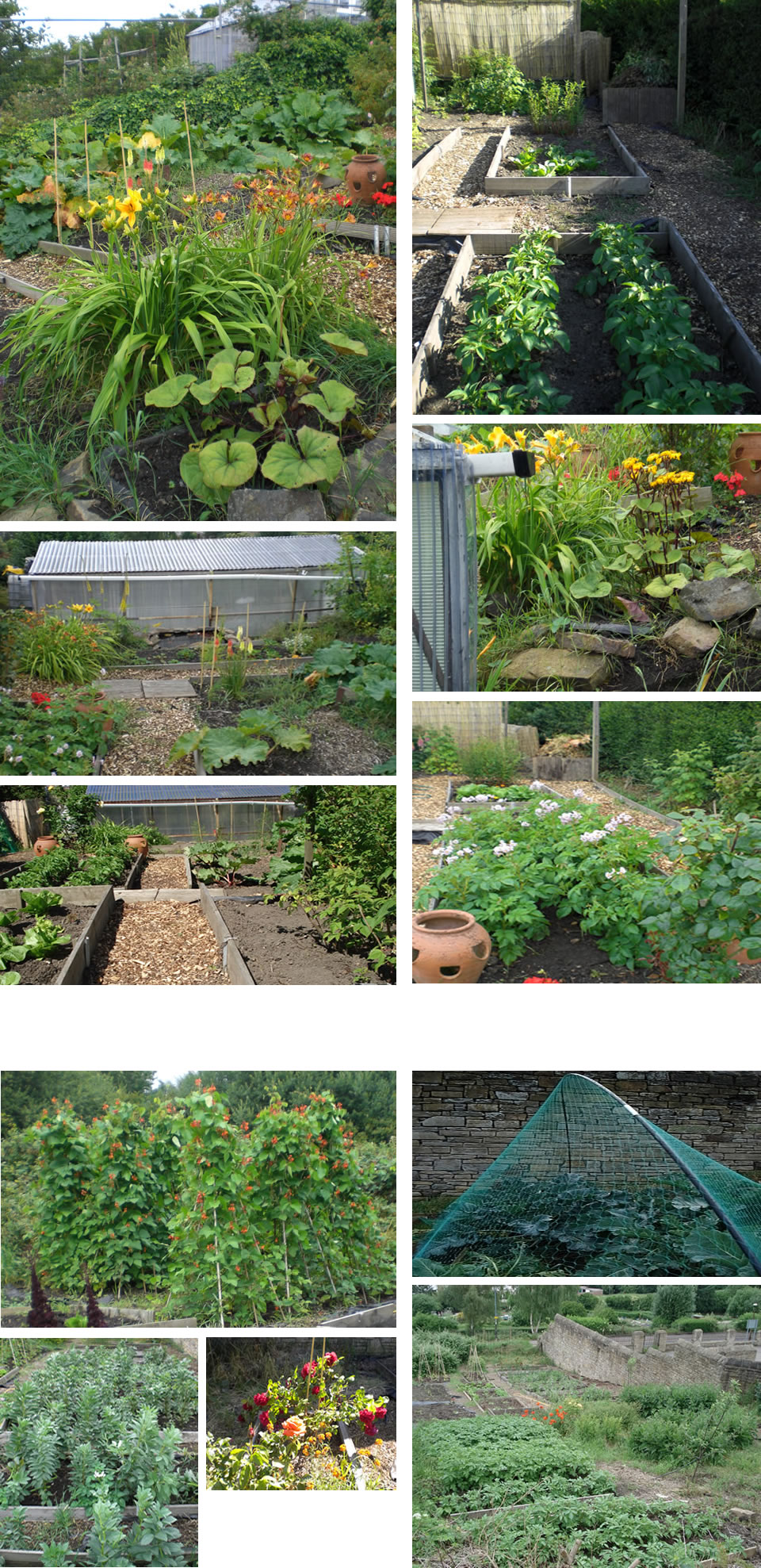
The British allotment system isn't known throughout the world, of course. I stress that these aren't my gardens but land hired from the local council - when I first took on the allotments, derelict land infested with weeds, but at least of no interest to vandals. The damage caused by vandals came later, as I cultivated the land and built structures.
Like the lower allotment, this allotment uses the system of beds and boards which I've devised. Many of the beds contain perennial crops, mostly fruits, but there are non-food plants as well.
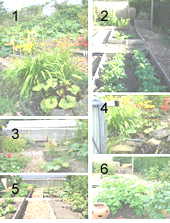
1. In the foreground, the moisture-loving Ligularia dentata 'Gregynog Gold', not in flower. Visible also, and in flower: varieties of Hemerocallis, Kniphofia and Pelargonium. In front of the ivy-covered wall, rhubarb: 'Victoria,' 'Stocksbridge Arrow' and 'Timperley Early.' The greenhouse (and scaffolding) visible are part of another allotment.
2. Bed in the foreground: maincrop potatoes cv. 'Valor.' Beyond, a bed with cos lettuce, 'lobjoits green.' Also visible, Lythrum salicaria (not in flower) and part of a raspberry bed.
3. View of the greenhouse. used mainly for tomatoes. Rainwater is collected from the roof of the greenhouse and stored in a large water tank which holds 1 000 litres (1 tonne) of water, and in a water butt. There's another water butt at the top of the allotment. Water from the storage tank can be supplied to the lower allotment through a pipe. The pond has a value for wildlife. It attracts damselflies but is too small to attract dragonflies. Has varieties of water lily 'Nymphaea.' Visible: a small asparagus bed.
4. A further view of Ligularia, Hemerocallis and the greenhouse.
5. Beds on the left: lettuce and maincrop potatoes. Beds on the right, raspberries and rhubarb.
6. Potatoes 'Valor,' in flower. At right, rose 'Arthur Bell' (not in flower.) Beyond, at right, a raspberry bed.
Not shown in the
pictures: strawberry bed, herb garden (sage, thyme, rosemary, marjoram,
oregano, chives and lovage), bed containing redcurrant bushes and whitecurrant
bush, with cage protection when in bud or fruit, many other non-food plants,
including another Ligularia, Ligularia przewalskii.
The lower
allotment
This is much larger than the upper allotment and more excusively functional, with less space, in proportion to the area, given to non-food plants, although there are five varieties of rose, most prominently 'Graham Thomas.' There are also purple loosestrife (Lythrum salicaria), Hypericum hidcote, Achillea filipendulina and other decorative plants. As in the upper allotment, I use a system of beds and boards, but not for the extensive blackberry bushes, which are wild, or for the comfrey (Symphytum x uplandicum), about 30 plants, which I use as a mulching material and to make liquid fertilizer. I often allow it to flower, for its value to bees. The perennial beds contain asparagus and autumn-fruiting raspberry plants. There are further composters.
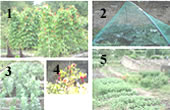
1. Two varieties of runner bean in flower.
2. Protection for purple-sprouting broccoli using a cage I designed.
3. Broad beans, 'Imperial Green Longpod.'
4. Rose bed.
5. In foreground, at left, beds with First Early and Second Early potatoes: cv. 'Duke of York,' 'Kestrel,' 'Anya.' At right, some of area used for growing comfrey. Red flowers of Papaver orientale. Other beds used for salad vegetables, asparagus, courgettes, climbing French beans 'Cobra' and other crops.